Over the next few years, a monument of a giant circular building will emerge, as Silicon Valley has not yet seen. For Steve Jobs it was not only about converting his legacy into glass, steel and concrete and making it visible for future generations. The most important “product” on which he worked during the past few years, was Apple itself. For Freddie Geier, who worked for Apple in California and managed the operations of Apple Germany and Central Europe for almost two years, Steve Jobs was an “infinite source of inspiration, a visionary and a genius.” “He was the God of style who could make things beautiful and simple and provide products with emotion at the same time”
Jony Ive at WWDC 2010
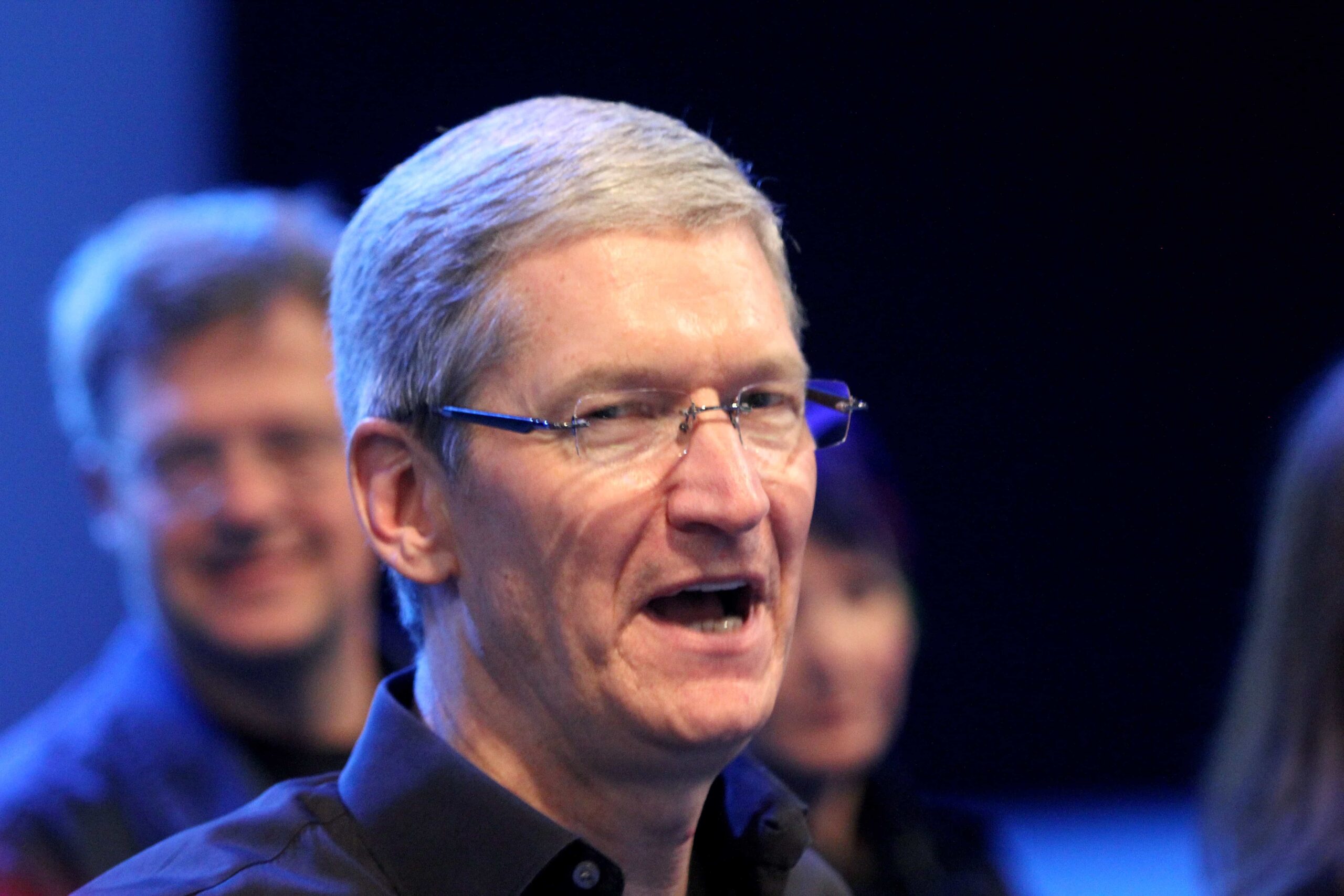
At the end, the products always benefited from Jobs’ perfectionism. Under the motto “think different”, he succeeded in finding new ways and celebrating the presentation of secret developments in a masterly manner. It was clear to Jobs that there was nobody in the company who was able to take over all these challenges alone. During the past years, he therefore set up a management team and distributed the heavy burden on the shoulders of several successors. Apple CEO Tim Cook is responsible for ensuring that the company works logistically and is making money. During the memorial service for Steve Jobs at the Apple campus in Cupertino, Cook radiated sovereignty and authority, which is now expected from him by the Apple employees, customers and shareholders.
Tim Cook said Jobs had told him that Apple employees, should not ask what he would have done. “Just do what’s right.” He had seen Disney going into crisis after the death of founder Walt Disney, where “everyone spent all their time thinking and talking about what Walt would do.” In the future, the soul of Apple will probably be represented by Jony Ive. The chief designer has to guarantee that Apple will continue to bring products to market, which are desirable solely because of their elegant appearance.
Meanwhile, rumors have also vanished that the Briton was homesick for the UK, – among others because he saw his twin sons in better hands there. His poised presence at the funeral service, with which he freed himself from his (superior) father Steve Jobs, has not only moved the people on the campus. Jony Ive is also trusted to preserve the high level of Apple’s designs without yelling and strong criticism of the employees.
Scott Forstall
The software expert Scott Forstall will also take a key role in the management team of Apple. Steve Jobs took him in 1992 from Stanford University to NeXT. In 1997 Forstall followed his boss to Apple. He is now responsible for the iOS platform.
“Scott is a gifted genius like Steve. He is in love with every detail, too,” says a former Apple manager. But like Jobs, Forstall is also often difficult and maintained a catastrophic communication culture. The Bloomberg Business Week called Forstall the ” Sorcerer’s Apprentice at Apple” and quoted former Apple software developer Mike Lee: “I once referred to Scott as Apple’s chief a–hole. And I didn’t mean it as a criticism. I meant it as a compliment. You could say the same thing about Steve Jobs.” In such an area of tension, Tim Cook will have the task of softening Forstall’s emotional outbursts and call his younger fellow board member to reason.
In the fine adjustment of the tasks on the management level, Cook, Ive, Forstall, as well as marketing chiefs Phil Schiller and Eddy Cue, who are responsible for the iCloud line at Apple, can count on help: In the end of 2008, seriously ill Steve Jobs lured away the management professor Joel M. Podolny, Dean of the elite Yale School of Management, to found an in-house university at Apple. “Steve was looking to his legacy. The idea was to take what is unique about Apple and create a forum that can impart that DNA to future generations of Apple employees,” said an employee to the “Los Angeles Times”. “No other company has a university charged with probing so deeply into the roots of what makes the company so successful.”
After all, Podolny had almost three years of direct experience with Steve Jobs. Whether and how he will succeed to transfer Steve Jobs’ success formula to future generations of managers from Apple is yet to be seen. ” While there are many great companies, I cannot think of one that has had as tremendous personal meaning for me as Apple.” Podolny wrote in his goodbye to his Yale students. Steve Jobs advised his successors to rely on their own intuition and not on market research.
Steve Jobs quoted Henry Ford, who reportedly said, “If I had asked people what they wanted, they would have said faster horses.” Jobs said, people don’t know what they want until you show it to them. “That’s why I never rely on market research. Our task is to read things that are not yet on the page.”
Update: Oct. 29, 2012:
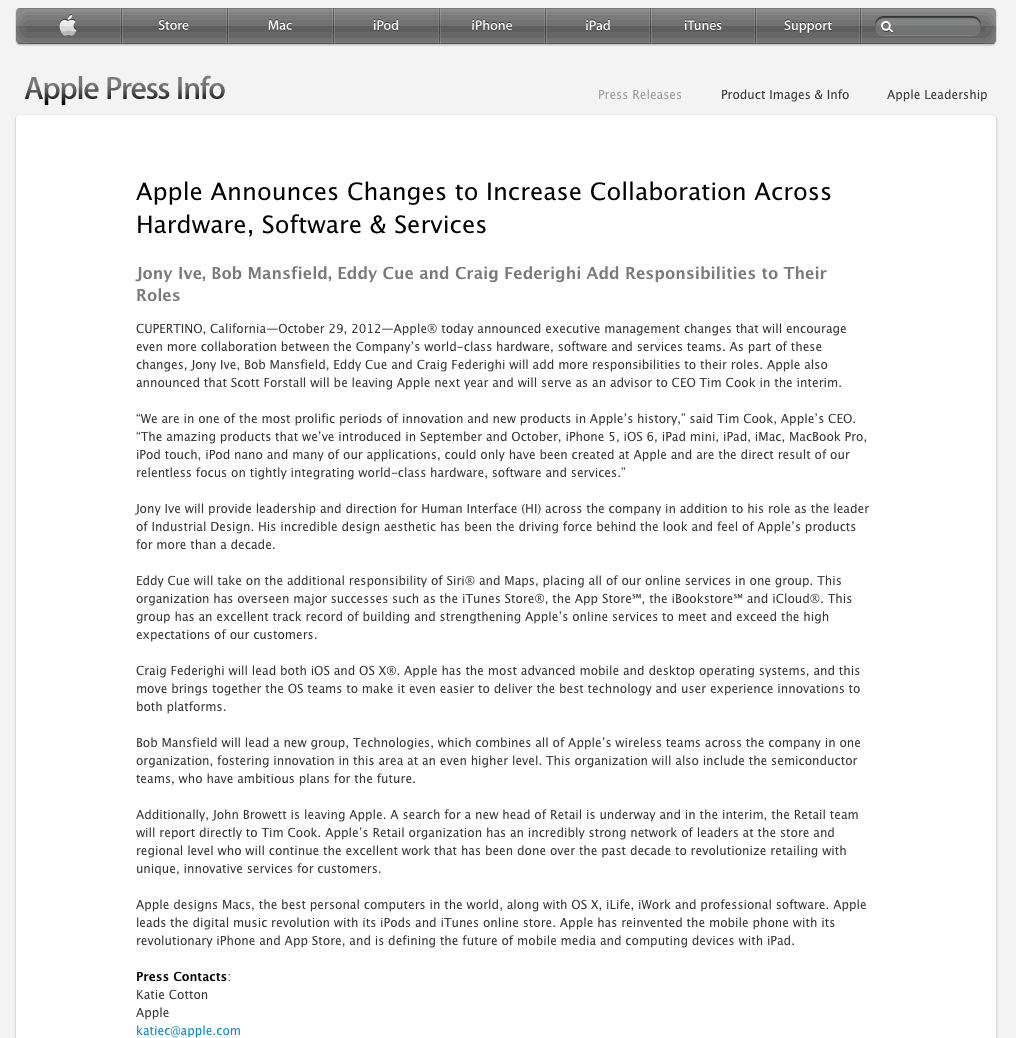
Apple announces that Scott Forstall, vice president of iOS software, and John Browett, head of retail, are out. Memo cites need for more collaborative environment. Bob Mansfield un-retires and returns to company.
The Hammer That Shattered the Monolith: How 60 Seconds Defined the Apple Mythos
It is January 22, 1984. Inside Tampa Stadium, Super Bowl XVIII is in full swing. The Los Angeles Raiders are systematically dismantling the Washington Redskins. But during a break in the third quarter, the game becomes a footnote. For 60 seconds, nearly 100 million Americans are pulled away from the grass and grit into a dystopian nightmare—and then shown a glimpse of a digital revolution.
This wasn’t just a commercial. It was a cinematic manifesto directed by Ridley Scott, a man who had just finished reshaping science fiction with Blade Runner.
The Aesthetic of the Abyss
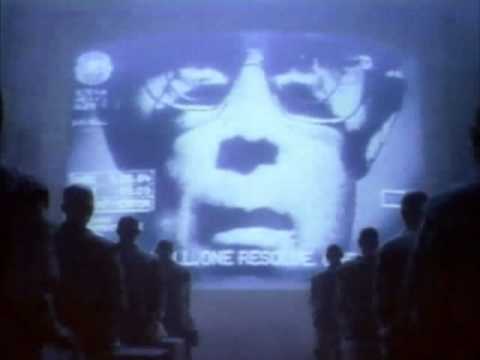
The spot opens on a monochrome, ash-colored world. Rows of hollow-eyed men, their heads shaved and spirits broken, march in lockstep through industrial corridors. They gather in a cold hall before a towering screen where a bespectacled “Big Brother”—a thinly veiled avatar for the then-dominant IBM—drones on about the “unification of thoughts.”
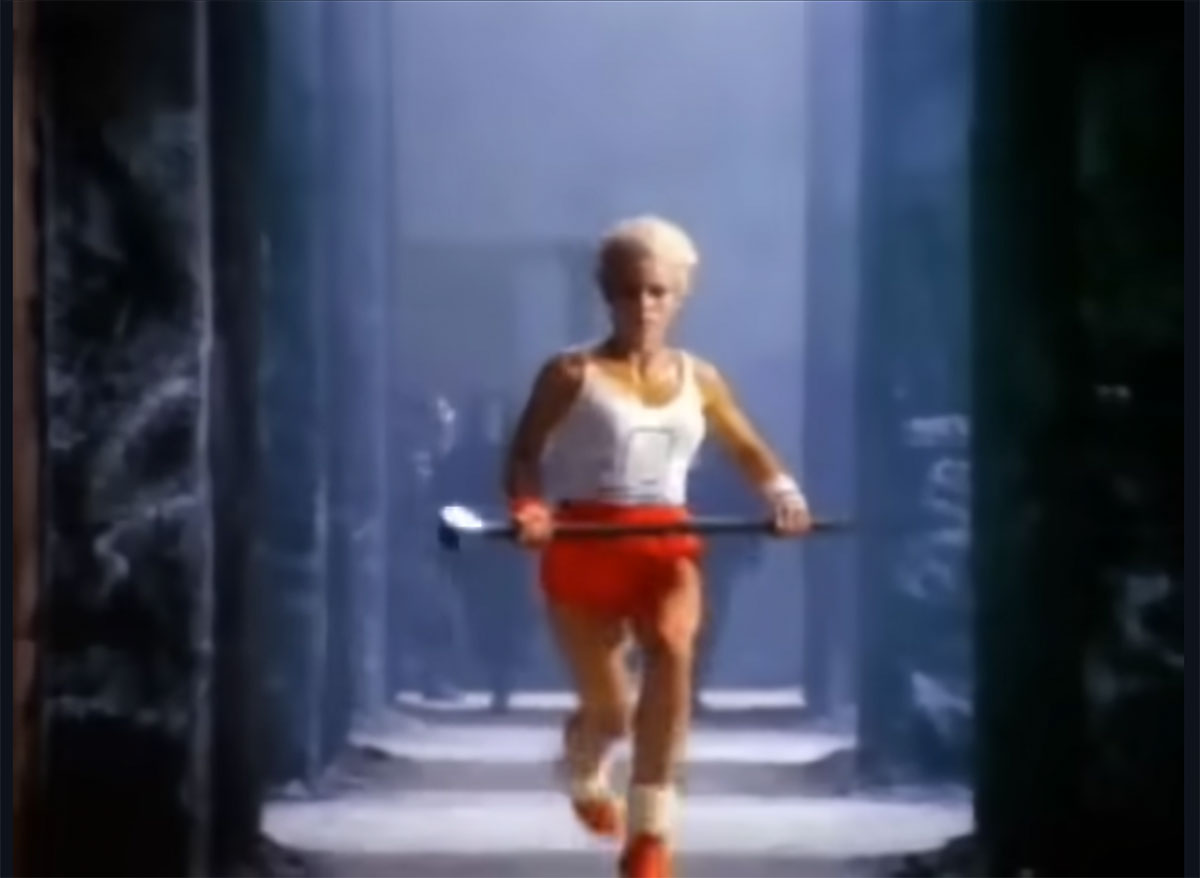
Then, a flash of color breaks the gray. A young woman (played by British athlete Anya Major) sprints toward the screen, pursued by riot police. She wears bright orange shorts and a white tank top emblazoned with a line drawing of a computer. In her hands, she swings a heavy sledgehammer with the grace of an Olympian. As she releases the hammer, it sails through the air and crashes directly into the face of the tyrant.
The screen explodes in a blinding white light. A voiceover—and a simple scroll of text—delivers the finishing blow: “On January 24th, Apple Computer will introduce Macintosh. And you’ll see why 1984 won’t be like ‘1984’.”
Corporate Cold Feet: The Board vs. The Visionaries
Today, the “1984” ad is heralded as the greatest commercial of all time. Yet, it almost never aired.
The backstory is a corporate thriller. The agency Chiat/Day had crafted the concept, and Steve Jobs was immediately electrified by it. He wanted a “thunderclap.” However, when the finished film was screened for Apple’s board of directors in December 1983, the reaction was icy silence.
Mike Markkula, Apple’s chairman and major investor, was horrified. “This is the worst ad I’ve ever seen. Who wants to fire the agency?” he reportedly asked. The board ordered CEO John Sculley to sell back the expensive Super Bowl airtime they had already purchased.
Wozniak’s Act of Rebellion
Steve Jobs, refusing to see his masterpiece buried, showed the spot to co-founder Steve Wozniak. “Woz” was so blown away that he offered to pay for half of the airtime out of his own pocket if the board refused to budge. “If Apple won’t run it, I’ll pay $400,000 and you pay $400,000,” Wozniak told Jobs.
In the end, it was a mix of chutzpah and luck: Chiat/Day claimed they couldn’t find a buyer for the 60-second slot in time. With the slot already paid for and no one to take it, Apple was forced to run the ad.
Skinheads and Discus Throws: The Making of a Legend
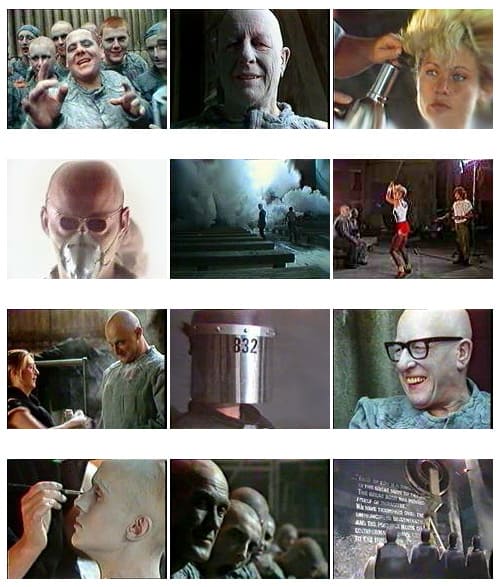
Ridley Scott’s production was grueling and authentic. Filmed at Shepperton Studios in London, Scott didn’t hire standard extras. To achieve the look of a true oppressed proletariat, he hired actual London skinheads for a pittance and the promise of a free lunch. The atmosphere on set was reportedly tense, with the extras’ rowdy behavior adding a layer of genuine grit to the film.
The choice of Anya Major for the lead role was a stroke of casting genius. Many models had auditioned, but most couldn’t even swing the hammer while running. Major was an experienced discus thrower; she had the muscle memory and the athletic form to hurl the sledgehammer with deadly precision.
The Legacy: When Advertising Became Art
The impact the next morning was unprecedented. News stations didn’t just talk about the ad; they replayed it in its entirety during their broadcasts. Apple generated over $5 million in free publicity. Overnight, the Macintosh became more than a piece of hardware; it became a symbol of individuality and freedom.
“1984” marked the moment advertising stopped merely explaining products and started creating myths. It was the birth of Apple as a lifestyle brand and Steve Jobs as the high priest of the digital counter-culture.
There is a modern irony to the story: today, critics often point at Apple’s massive market cap and closed ecosystem, suggesting the company has become the very “Big Brother” it once vowed to destroy. Regardless of the politics, the 60-second storm Ridley Scott and Steve Jobs unleashed remains a masterclass in storytelling—a hammer throw that changed the cultural trajectory of technology forever.
The commercial was rebroadcast in an updated version in 2004 on its 20th anniversary, with the heroine modified to be listening to an iPod. Viewers generally saw the Big Brother target of the Apple advertisement as being Microsoft, with the original villain, IBM, being all but forgotten.
Making of the Apple Ad 1984
Apple commercial “1984”: The Plot
The commercial opens with a dystopic, industrial setting in blue and gray tones, showing a line of people (of ambiguous gender) marching in unison through a long tunnel monitored by a string of telescreens. This is in sharp contrast to the full-color shots of the nameless runner (Anya Major). She looks like an Olympic track and field athlete, as she is carrying a large brass-headed hammer and is wearing an athletic “uniform” (bright orange athletic shorts, running shoes, a white tank top with a cubist picture of Apple’s Macintosh computer, a white sweat band on her left wrist, and a red one on her right).
As she is chased by four police officers (presumably agents of the Thought Police) wearing black uniforms, protected by riot gear, helmets with visors covering their faces, and armed with large night sticks, she races towards a large screen with the image of a Big Brother-like figure (David Graham, also seen on the telescreens earlier) giving a speech:
My friends, each of you is a single cell in the great body of the State. And today, that great body has purged itself of parasites. We have triumphed over the unprincipled dissemination of facts. The thugs and wreckers have been cast out. And the poisonous weeds of disinformation have been consigned to the dustbin of history. Let each and every cell rejoice! For today we celebrate the first, glorious anniversary of the Information Purification Directive! We have created, for the first time in all history, a garden of pure ideology. Where each worker may bloom secure from the pests purveying contradictory truths. Our Unification of Thoughts is more powerful a weapon than any fleet or army on earth. We are one people, with one will, one resolve, one cause. Our enemies shall talk themselves to death and we will bury them with their own confusion. We shall prevail!
The runner, now close to the screen, hurls the hammer towards it, right at the moment Big Brother announces, “we shall prevail!” In a flurry of light and smoke, the screen is destroyed, shocking the people watching the screen. The commercial concludes with a portentous voiceover, accompanied by scrolling black text (in Apple’s early signature “Garamond” font); the hazy, whitish-blue aftermath of the cataclysmic event serves as the background. It reads:
On January 24th, Apple Computer will introduce Macintosh. And you’ll see why 1984 won’t be like “1984.
The screen fades to black as the voiceover ends, and the rainbow Apple logo appears.
Apple commercial “1984”: The Production
Development
The commercial was created by the advertising agency Chiat/Day, Venice, with copy by Steve Hayden, art direction by Brent Thomas and creative direction by Lee Clow. Ridley Scott (whose dystopian sci-fi film, Blade Runner was released two years prior) was hired by agency producer Richard O’Neill to direct it, with a then-“unheard-of production budget of $900,000.” The actors who appeared in the commercial were paid $25 per day.
Steve Jobs and John Sculley were so enthusiastic about the final product that they “…purchased one and a half minutes of ad time for the Super Bowl, annually the most-watched television program in America. In December 1983 they screened the commercial for the Apple Board of Directors. To Jobs’ and Sculley’s surprise, the entire board hated the commercial.” However, Scully himself got “cold feet” and asked Chiat/Day to sell off the two commercial spots.
Despite the board’s dislike of the film, Steve Jobs continued to support it. Steve Wozniak watched it and offered to pay for half of the spot personally if the board refused to air it.
Of the original ninety seconds booked, Chiat/Day managed to resell thirty seconds to another advertiser, leaving the other sixty second slot.
Let’s see – an all-powerful entity blathering on about Unification of Thoughts to an army of soulless drones, only to be brought down by a plucky, Apple-esque underdog. So Big Brother, the villain from Apple’s ‘1984’ Mac ad, represented IBM, right? According to the ad’s creators, that’s not exactly the case. The original concept was to show the fight for the control of computer technology as a struggle of the few against the many, says TBWA/Chiat/Day’s Lee Clow. Apple wanted the Mac to symbolize the idea of empowerment, with the ad showcasing the Mac as a tool for combating conformity and asserting originality. What better way to do that than have a striking blonde athlete take a sledghammer to the face of that ultimate symbol of conformity, Big Brother?
However, in his 1983 Apple keynote address, Steve Jobs made the following comment before showcasing a preview of the commercial to a select audience:
It is now 1984. It appears IBM wants it all. Apple is perceived to be the only hope to offer IBM a run for its money. Dealers initially welcoming IBM with open arms now fear an IBM dominated and controlled future. They are increasing and desperately turning back to Apple as the only force that can ensure their future freedom. IBM wants it all and is aiming its guns on its last obstacle to industry control, Apple. Will Big Blue dominate the entire computer industry? The entire information age? Was George Orwell right about 1984?
Apple commercial “1984”: The Reception
Awards
* 2007: Best Super Bowl Spot (in the game’s 40-year history)
* 1999: TV Guide – Number One Greatest Commercial of All Time
* 1995: Advertising Age – Greatest Commercial
* 1984: 31st Cannes Lions International Advertising Festival – Grand Prix
Social impact
Ted Friedman, in his 2005 text, Electric Dreams: Computers in American Culture, notes the impact of the commercial:
Super Bowl viewers were overwhelmed by the startling ad. The ad garnered millions of dollars worth of free publicity, as news programs rebroadcast it that night. It was quickly hailed by many in the advertising industry as a masterwork. Advertising Age named it the 1980s Commercial of the Decade, and it continues to rank high on lists of the most influential commercials of all time […] 1984 was never broadcast again, adding to its mystique.
1984 became a signature representation of Apple computers. It was scripted as a thematic element in the 1999 docudrama, Pirates of Silicon Valley, which explores the rise of Apple and Microsoft (the film opens and closes with references to the commercial including a re-enactment of the heroine running towards the screen of Big Brother and clips of the original commercial).
“1984” became a signature representation of Apple computers. It was scripted as a thematic element in the 1999 docudrama, Pirates of Silicon Valley, which explores the rise of Apple and Microsoft (the film opens and closes with references to the commercial including a re-enactment of the heroine running towards the screen of Big Brother and clips of the original commercial). The “1984” ad was also prominent in the 20th anniversary celebration of the Macintosh in 2004, as Apple reposted a new version of the ad on its website. In this updated version, an iPod, complete with signature white earbuds, was digitally added to the heroine. Attendees were given a poster showing the heroine with iPod as a commemorative gift.
Influence in media
A commercial for the video game Half-Life 2 was based on this commercial. A parody of the commercial is seen in the Futurama episode Future Stock, promoting Planet Express. Another parody appears in The Simpsons TV show episode Mypods and Boomsticks, featuring Steve Jobs as “Big Brother” and the Comic Book Guy as the runner.
For the 20th anniversary of the Macintosh, Apple re-released the ad with the runner wearing an iPod.
Scott, Linda. “For the Rest of Us”: A Reader-Oriented Interpretation of Apple’s ‘1984’ Commercial.” The Journal of Popular Culture, Volume 25 Issue 1, Summer 1991: 67-81.
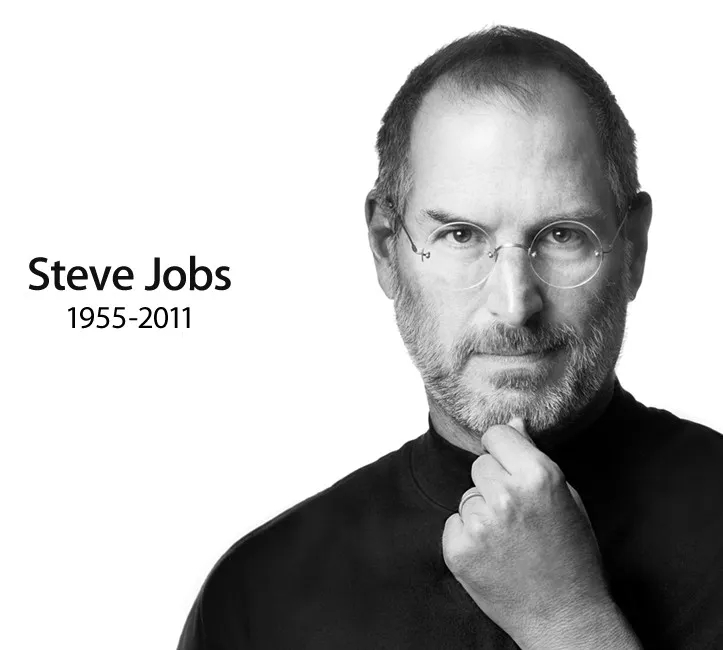
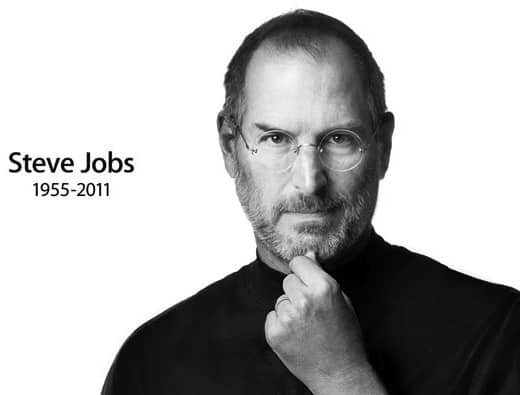
Steve Jobs was a visionary, a genius, a perfectionist, and sometimes a difficult contemporary. When the Apple co-founder died in 2011 at the age of 56, many Apple fans saw a bleak future for the company. However, things turned out differently.
It was unimaginable to think of Apple without Steve Jobs. But on October 5, 2011, the inevitable occurred: the charismatic Apple co-founder lost his long battle with cancer. Six weeks prior, on August 24, 2011, Jobs had appointed his confidant Tim Cook as the company’s new CEO. The decision surprised many observers as Cook had made a name for himself as a logistics and manufacturing expert, but he lacked the charisma that Jobs had regularly used to captivate the masses.
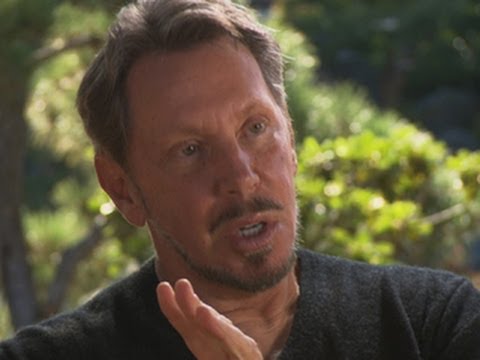
One of the skeptics was Larry Ellison, who had been close friends with the Apple co-founder for years. The head of software giant Oracle believed that Apple was doomed without Steve Jobs. In a TV interview, he drew a parallel to 1985, when Apple’s board of directors forced Steve Jobs out of the company. Over the next 12 years, Apple fell into such disrepair that by 1997 the company was on the verge of bankruptcy, and Jobs was brought back as a savior. “We saw Apple with Steve Jobs, we saw Apple without Steve Jobs. We saw Apple with Steve Jobs. Now we’re going to see Apple without Steve Jobs,” Ellison said. “I like Tim Cook. I think there are a lot of talented people there. But Steve is irreplaceable.”
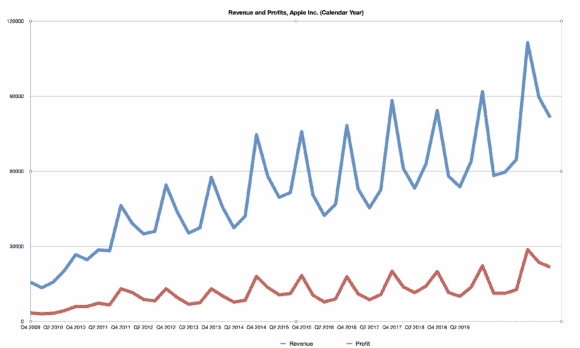
But things have turned out very differently after Jobs’ death than Ellison had feared. Apple is selling more devices and services than ever before. In August 2018, the iPhone maker made financial history as the first U.S. company to reach a trillion-dollar valuation on the stock market. Just two years later, it was two trillion. In addition to the stock market boom, experts say the company’s customer loyalty was a major factor in its rise. “When a new user starts using an Apple smartphone, they tend to stay with an Apple smartphone,” says Jeriel Ong, an equity analyst at Deutsche Bank.
And the rally is not over. Since October 2011, the share price has risen from around $13 to an all-time high of just under $150. Cook is also regularly rewarding shareholders with dividends, something Jobs always refused to do.
With the iPhone, Cook has managed to attract new groups of buyers. He also expanded the range of accessories, such as the Apple Watch computer watch and AirPods earphones, and launched subscription services such as iCloud and Apple TV+. It has also been able to charge higher prices for its products, so much so that a large portion of the industry’s profits now go to Apple.
Revenue and Profit, Apple Inc. (Calendar Year)
Still, Tim Cook is not a great presenter on stage. However, he has now set the tone that sets him apart from his predecessor. One example is the environment. In 2008, Steve Jobs had a heated exchange with Greenpeace when the environmentalists demanded that Apple stop using brominated flame retardants in its products. These can be toxic, difficult to break down in the environment, and accumulate in living organisms.
Under Cook’s leadership, Apple not only eliminated the controversial BFRs, but also all other environmental toxins in its manufacturing. He also switched the company entirely to renewable energy. This ambitious project will now be extended to the entire supply chain.
This change has also been noted by Greenpeace. “Since Tim Cook took the helm at Apple, he has made environmental protection an important part of the company’s identity,” the organization said in 2017, when it published a report on environmental standards at electronics manufacturers. Apple only lost out to smartphone maker Fairphone in the Greener Electronics ranking because the Dutch company’s devices are easier to repair.
In addition to the environmental issue, Apple under Cook is also trying harder to differentiate itself from the competition in the area of privacy. Last April, for example, Apple changed its iPhone software so that providers like Facebook would have to ask users for permission if they wanted to track their activities across different apps and websites. Jobs had announced this privacy principle at the D8 conference in 2010, but left the implementation to his successor.
When it comes to privacy, Cook already made his mark in 2016. At the time, the FBI demanded that Apple manipulate the iPhone’s iOS operating system to allow law enforcement to search the locked iPhone of the shooter in the San Bernardino terrorist attack. Cook rejected the request, saying it would not undermine the security features of the products.
But Cook has also faced setbacks on the issue. For example, Apple shelved plans to introduce a scanning feature on the iPhone that would prevent child abuse images from being uploaded to the cloud. There had been an outcry that Apple was taking the wrong approach in the legitimate fight against child pornography.
The biggest shortcoming of the Cook era, however, is that Jobs’ successor has yet to come up with a revolutionary new product. His predecessor regularly produced “one more thing” that disrupted entire industries: the iMac in 1999, the iPod and iTunes music service in 2001, the revolutionary iPhone in 2007, and the iPad in 2010. Under Cook, there have been rumors of revolutionary new products such as an Apple car or glasses for augmented reality applications, but so far Apple fans are waiting in vain.
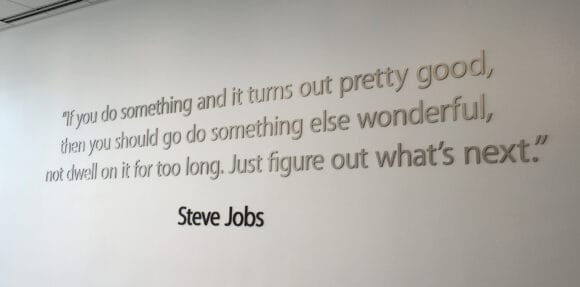
In this context, Cook’s critics point to a quote from Steve Jobs written in large letters on the wall of Apple’s old headquarters: “If you do something and it turns out pretty good, then you should go do something else wonderful, not dwell on it for too long. Just figure out what’s next.”
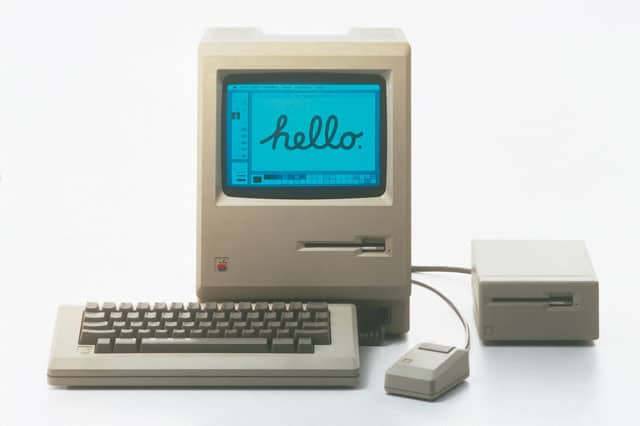
The Apple Macintosh revolutionized the entire computer industry by the year of 1984. Steve Jobs and his ingenious Macintosh team arranged for the computer to be used by the normal “person in the street” – and not only by experts.
“Insanely great” – Steve Jobs could hardly put into words his enthusiasm by the launch of the Macintosh. On the legendary annual general meeting of January 24th, 1984, in the Flint Center not far from the Apple Campus in Cupertino, the Apple co-founder initially quoted Bob Dylan’s “The Times They Are A-Changin’” in order to then polemicize against an imminent predominance of the young computer industry by IBM.
Steve Jobs’ introduction of the Apple Macintosh:
“The early 1980s. 1981 – Apple II has become the world’s most popular computer, and Apple has grown to a 300 million dollar corporation, becoming the fastest growing company in American business history. With over fifty companies vying for a share, IBM enters the personal computer market in November of 1981, with the IBM PC.
1983. Apple and IBM emerge as the industry’s strongest competitors, with each selling approximately one billion dollars worth of personal computers in 1983. The shakeout is in full swing. The first major personal computer firm goes bankrupt, with others teetering on the brink. Total industry losses for 1983 overshadow even the combined profits of Apple and IBM.
It is now 1984. It appears that IBM wants it all. Apple is perceived to be the only hope to offer IBM a run for its money. Dealers, after initially welcoming IBM with open arms, now fear an IBM dominated and controlled future and are turning back to Apple as the only force who can ensure their future freedom.
IBM wants it all, and is aiming its guns at its last obstacle to industry control, Apple. Will Big Blue dominate the entire computer industry? The entire information age? Was George Orwell right?“
The crowd, among them the complete Macintosh developer’s team, shouted back: “Nooooo!”
The introduction of the first Mac on January 24th, 1984; taken from the “Lost 1984 Videos”
There had been only two milestone products so far: the Apple II in 1977 and the IBM PC in 1981, Jobs continued. “Today (…) we are introducing the third industry milestone product, the Macintosh. Many of us have been working on Macintosh for over two years now and it has turned out insanely great.”
Steve Jobs
Taking a look at the history of the personal computer today, Steve Jobs was on the right track with his historical comparison. However, it would not be IBM that became the great dominator of the computer industry over the years, but rather, the alliance of Microsoft and Intel.
Previous to the Macintosh developer team, others had already tried to design a computer with a mouse and a graphical user interface – one year before Apple did, with its own business computer Lisa, which retailed for 10,000 dollars.
Microsoft and Apple have been business partners and tough competitors for many years. Back in the seventies, Steve Jobs and Bill Gates worked close together. In 1997 the Windows-manufacturer helped Steve Jobs saving Apple.
In the early seventies, there was no such thing as a personal computer. It took geniuses and visionaries like Steve Wozniak and Bill Gates to invent this new industry. The early computer geeks were energized by the arrival of the January 1975 issue of Popular Mechanics, which had on its cover the first personal computer kit, the Altair. The Altair wasn’t a real computer —more a $495 pile of parts that had to be soldered to a board that would then do little—but for hobbyists and hackers, it heralded the dawn of a new era. Bill Gates and Paul Allen read the magazine and started working on a version of BASIC, an easy-to-use programming language, for the Altair. It also caught the attention of Jobs and Wozniak.
Later Steve Jobs had to ask for the Microsoft BASIC because his friend Wozniak didn’t finish his own version of BASIC for the Apple II. “He was very childlike,” said Jobs later to the author of his biography, Walter Isaacson, about “Woz”. “He did a great version of BASIC, but then never could buckle down and write the floating-point BASIC we needed, so we ended up later having to make a deal with Microsoft. He was just too unfocused.”
With the rise of the Apple II in the late seventies, Microsoft became more and more successful – even before the IBM PC was invented. When Apple developed the Macintosh Bill Gates and his team was the most important software partner – despite the fact that Microsoft was also the driving force behind the IBM PC and the PC clones. And Steve Jobs even invited Bill Gates for the preview of the Mac: The high point of the October 1983 Apple sales conference in Hawaii was a skit based on a TV show called The Dating Game. Jobs played emcee, and his three contestants, whom he had convinced to fly to Hawaii, were Bill Gates and two other software executives, Mitch Kapor and Fred Gibbons. As the show’s jingly theme song played, the three took their stools.
Gates, looking like a high school sophomore, got wild applause from the 750 Apple salesmen when he said, “During 1984, Microsoft expects to get half of its revenues from software for the Macintosh.” Jobs, clean-shaven and bouncy, gave a toothy smile and asked if he thought that the Macintosh’s new operating system would become one of the industry’s new standards. Gates answered, “To create a new standard takes not just making something that’s a little bit different, it takes something that’s really new and captures people’s imagination. And the Macintosh, of all the machines I’ve ever seen, is the only one that meets that standard.”
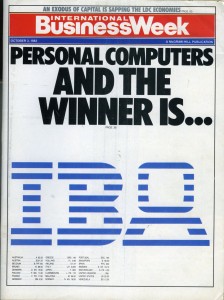
Title of BusinessWeek (October 3rd, 1983)
But even as Gates was speaking, Microsoft was edging away from being primarily a collaborator with Apple to being more of a competitor. It would continue to make application software, like Microsoft Word, for Apple, but a rapidly increasing share of its revenue would come from the operating system it had written for the IBM personal computer. The year before, 279,000 Apple IIs were sold, compared to 240,000 IBM PCs and its clones. But the figures for 1983 were coming in starkly different: 420,000 Apple IIs versus 1.3 million IBMs and its clones. And both the Apple III and the Lisa were dead in the water.
Just when the Apple sales force was arriving in Hawaii, this shift was hammered home on the cover of Business Week. Its headline: “Personal Computers: And the Winner Is . . . IBM.” The story inside detailed the rise of the IBM PC. “The battle for market supremacy is already over,” the magazine declared. “In a stunning blitz, IBM has taken more than 26% of the market in two years, and is expected to account for half the world market by 1985. An additional 25% of the market will be turning out IBM-compatible machines. (Walter Isaacson, p. 159-160)
Apple boss John Sculley’s marketing strategy for the launch of the Macintosh was obvious. The former Pepsi manager, who had been brought to Apple by Steve Jobs, intended to arrange a duel between IBM and Apple, black vs. white, with Apple playing the role of the underdog. Sculley wrote in his book Odyssey:
So we needed a campaign that would focus on a two-horse race to leverage off of Apple’s underdog status. Dozens of other computer companies were coming out with products and I was afraid we were going to get lost in the crowd. If we could create a two-horse race between us and IBM, we might be able to convince people that there are really only two computer companies competing in the marketplace. In any large consumer industry, few people remember the third- or fourth-largest competitor.
In the fight against competitors such as Atari, Commodore, Sinclair and Amstrad, the Apple strategy paid off well. But Sculley, as well as Steve Jobs, had completely underestimated that Microsoft, being an ally from the outset, would, with the aid of Apple, develop into a dominant power of the PC industry and even dwarf IBM.
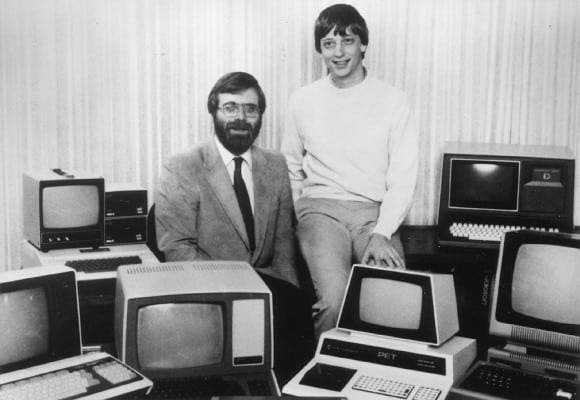
Bill Gates und Paul Allen (1981)
Bill Gates and Paul Allen founded Microsoft as a small software company in Albuquerque (New Mexico) in 1975 and developed the programming language BASIC for the legendary computer MITS Altair in collaboration with other co-workers. Due to fortunate circumstances, Microsoft landed an order from IBM to deliver not only BASIC but also the operating system for the first IBM PC in 1980. In the negotiation phase, the then-leading operating system manufacturer Digital Research (CP/M) did not want to engage in page-filling adhesion contracts from IBM – and thus lost this gigantic deal.
Microsoft did not have any operating system then, but this did not prevent Bill Gates and his companion Steve Ballmer from playing for high stakes while facing IBM. From their neighboring software shack Seattle Computers (in the meantime, Microsoft had moved to the northwest of the USA) they bought all rights for QDOS (Quick and Dirty Operating System) for no less than 50,000 dollars in July 1981 and renamed it as MS-DOS. Gates had been clever enough at that time not to have all rights to the system negotiated away by the IBM crew and was, therefore, able to win clone companies such as Compaq as customers later.
When Microsoft provided their BASIC for the Apple II, Steve Jobs and Bill Gates constantly ran into each other at that time. “Even before we finished our work on the IBM PC, Steve Jobs came and talked about what he wanted to do, what he thought he could do, sort of a Lisa but cheaper. We said boy, we’d love to help out”, Gates remembers. “The Lisa had all its own applications, but of course, they required a lot of memory, ah, and we thought we could do better, and so Steve signed a deal with us to actually provide bundled applications for the first Mac, and so we were big believers in the Mac and what Steve was doing there.”
Apple urgently needed software for the Mac, as there did not yet exist any program for the new system except for their in-house products MacWrite and MacPaint. Gates promised to have the programs Chart and File written for the Mac in addition to the spreadsheet program Excel. Steve Jobs appreciated the risk Microsoft took, but was not content with the first results though. “Most people don’t remember, but until the Mac, Microsoft was not in the applications business… it was dominated by Lotus. And Microsoft took a big gamble to write for the Mac.”
Apple still could have coped well with having given Microsoft’s new application business a leg up. However, Bill Gates tasted blood in the Macintosh project. Jeff Raikes, who was responsible for the Office business at Microsoft until early 2008, reviews: “And so we got started in early 1982 on our Macintosh software effort and I think at that point in time, you know, it really clicked with Bill that, you know, graphic user interface was going to be the way, the way of the future. But while Bill was having his own GUI revelation, Jobs believed that Apple’s true enemy was IBM.”
Raikes joined Apple Computer as the VisiCalc Engineering Manager in 1980. He worked at Apple for fifteen months before being recruited to Microsoft by Steve Ballmer in 1981 as a product manager. He was promoted to director of applications marketing in 1984 and was the chief strategist behind Microsoft’s investments in graphical applications for the Apple Macintosh and the Microsoft Windows operating system. In this role, he drove the product strategy and design of Microsoft Office.
Steve Jobs didn’t see much risk in bringing Microsoft into the Macintosh project. After all, the division of labor between Apple and Microsoft had worked well on the Apple II. The Apple II used some Microsoft software and Jobs reached out to Microsoft this time too. He didn’t want the company to make the Mac’s operating system. Apple was building that on its own. But he did want it to make stuff like spreadsheet software, and word processing.
Andy Hertzfeld, the technical lead for the Macintosh system software, recalls in the podcast “Land of the Giants” with Peter Kafka: “Microsoft was the first Macintosh developer. There was a partnership relationship from the very beginning between both companies. We needed to recruit the right partners that had both the technical skill and the vision to want to write software for the Macintosh. So Microsoft was the very first company we recruited.”
But Hertzfeld thought Microsoft wasn’t just going to be a partner. He thought Bill Gates was going to be a competitor too. “So I picked up on the idea that maybe Microsoft was besides writing applications, they were going to make their own version of the Macintosh. Seemed pretty obvious to me.” One of the guys on Microsoft’s Mac team was asking many questions about the Mac’s guts. He probably didn’t need to know this stuff to make software for the Mac.
Andy Hertzfeld: “I told Steve about it. He kind of laughed it off at first. He thought Microsoft didn’t have the skill to be able to do that.” Steve Jobs was half right. Microsoft didn’t create its own Macintosh. Instead, it created new software that turned other people’s computers into a sort of Macintoshes. And he used that same idea for a graphics-based interface. Gates it turned out had seen what Xerox Park was doing too. He unveiled his plan a few months before the Macintosh debuted.
Andy Hertzfeld: “In November of 1983 they announced their first version of Windows. Steve freaked out. He goes: ‘Get Gates down here right now.’ And I was thinking how are you going to do that? But like in a matter of hours Bill Gates was there. Steve just screamed at him. But Bill’s credit: he just listened to Steve scream and finally responded with a fairly famous response about where Steve said: ‘You’re ripping us off, you’re ripping us off’. And Bill said something like: “Well that’s not how I think about it. It’s more like we both had a rich neighbor named Xerox and you went in to steal the television set and found out it was already stolen.'”
Quote of the movie: “Pirates of Silicon Valley” – Microsoft steals from Apple
In June of 1985, Bill Gates sent a remarkable memo to both the then-CEO of Apple, John Sculley, and then-head of Macintosh development, Jean Louis Gassée, and urged them to spread their wings by licensing their hardware and operating system to other companies.
Apple must make Macintosh a standard. But no personal computer company, not even IBM, can create a standard without independent support. Even though Apple realized this, they have not been able to gain the independent support required to be perceived as a standard.
Apple ignored his advice.
Five months after he sent the memo, Windows 1.0 was released. Microsoft’s decision to do exactly as Gates had recommended to Apple resulted in market domination. If Apple had taken Gates’ advice, things could have been very different.
Apple co-founder Steve Wozniak has since said:
“The computer was never the problem. The company’s strategy was. Apple saw itself as a hardware company; in order to protect our hardware profits, we didn’t license our operating system. We had the most beautiful operating system, but to get it you had to buy our hardware at twice the price. That was a mistake. What we should have done was calculate an appropriate price to license the operating system. We were also naive to think that the best technology would prevail. It often doesn’t.”
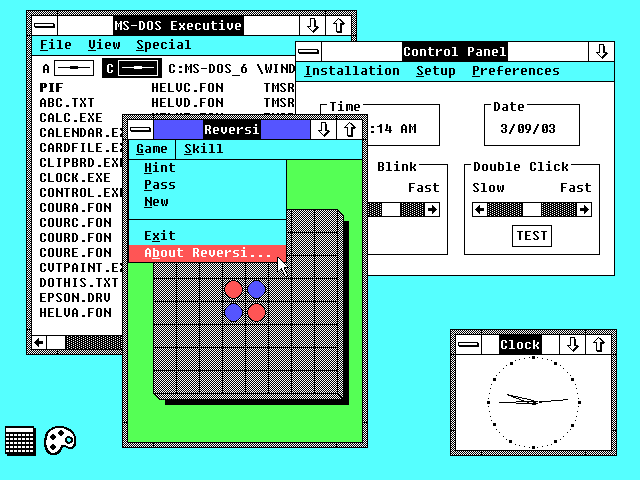
Windows 1.01 was based on DOS and was incredibly slow, but it reminded one of the Macintosh GUI in some features. In order to prevent Apple from taking legal action, Gates put the screws on Apple boss Sculley. His message was: As soon as Apple sends out the lawyers, Microsoft will immediately stop the development of Word and Excel for the Mac. Since Apple was depending on the Microsoft applications, Sculley licensed some of the Mac technologies to Microsoft.
As Microsoft went public with the next large version leap of Windows 2.03 at the beginning of 1988, Sculley tried to pull the ripcord and sued Microsoft and Hewlett-Packard for copyright infringement on March 17, 1988. John Sculley had been in a difficult situation, particularly as he had engaged in vague formulations in the contract with Microsoft in 1985, which gave great leeway to Gates and his lot. Moreover, he knew that his chances to win an action against Microsoft had been, purely from a legal viewpoint, not particularly good: “The look and feel, which is how it looks, the experience of using it, was not patentable, but it was copyrightable, but there was no precedent law. This was going to be a precedent-setting case.”
Parody of an advertising spot for Windows featuring Steve BallmerBill Gates recalls also reluctant this time.: “But it was a period of five years where, Microsoft er, our whole strategy would have been ruined because Windows was very important to us. (…) We assumed that the lawyers, the judges would all come to the right conclusion which eventually they did.” Sculley: “And Apple lost. But in that period of about six years that this case was going on it may have lulled us into a bit of complacency thinking that we were going to be insulated, you know, from the Windows attack.”
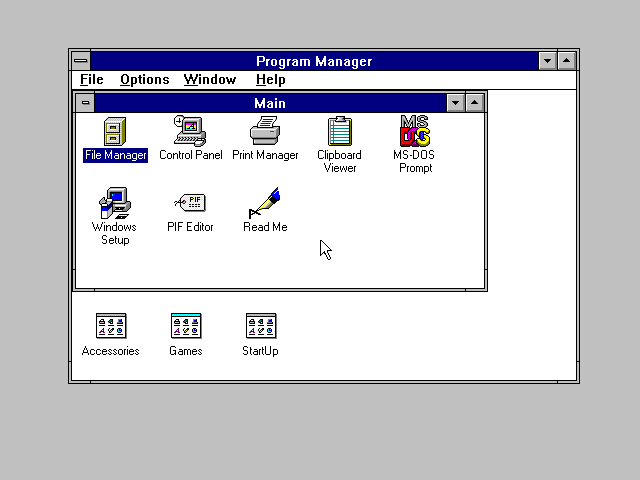
Windows 3.1
The introduction of Windows 3.1 in 1992 brought Microsoft the breakthrough in the “GUI war”. The system lacked the elegance and usability of the Macintosh system 7.0, but Windows appeared good enough to most PC users. With the help of Windows 95, which had been introduced with gigantic effort on August 24, 1995, Microsoft caught up closer to the Mac and in some aspects even appeared more progressive than the Mac OS, which had become dated in the meantime.
Steve Jobs, who, as the head of NeXT, had observed the advance of Windows from a distance, did not have any kind words for Bill Gates at the launch of Windows 95:
The only problem with Microsoft is they just have no taste, they have absolutely no taste, and what that means is – I don’t mean that in a small way, I mean that in a big way. In the sense that they don’t think of original ideas and they don’t bring much culture into their product, and you say why is that important – well you know proportionally spaced fonts come from type setting and beautiful books, that’s where one gets the idea – if it weren’t for the Mac, they would never have that in their products and so I guess I am saddened, not by Microsoft’s success – I have no problem with their success, they’ve earned their success for the most part. I have a problem with the fact that they just make really third rate products.
It is claimed that Jobs has apologized to Bill Gates for this remark later.
Steve Jobs about Microsoft (1995)
The relationship between Apple and Microsoft – and thus also between Steve Jobs and Bill Gates – did not get back to normal before the summer of 1997, when Steve Jobs returned to Apple and engaged in the support of Microsoft to make the troubled company profitable again.
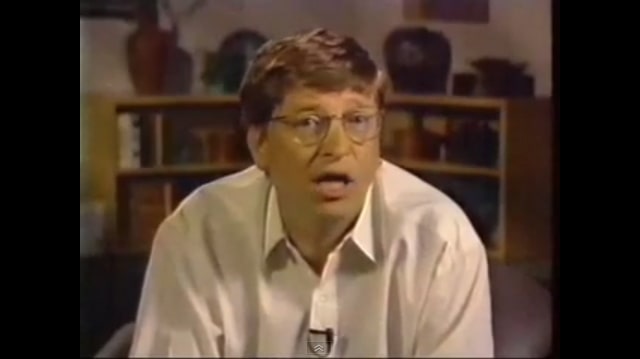
Bill Gates on the video screen at the MacWorld Expo 1997 in Boston
Many faithful Apple fans still remember with horror the moment when Steve Jobs announced the former archrival very pragmatically as the knight in shining armor at the MacWorld Expo 1997 in Boston with Bill Gates appearing on an oversized video screen just like “Big Brother.” Introducing Gates, Jobs said: “We have to let go of the notion that in order to for Apple to win, Microsoft has to lose. Relationships that are destructive don’t help anybody. The era of setting this up as a competition between Apple and Microsoft is over.”
According to certain rumors, Microsoft invested 150 million dollars in 150,000 Apple stocks and paid another 100 million dollars for copyright infringement over the past few years. At the same time, Gates obliged himself to continue the development of the Internet Explorer and Microsoft Office for the Mac for the following five years. Gates drew hisses from the audience of Apple faithful. The crowd also groaned when Steve Jobs said Apple would make Microsoft’s Internet Explorer the default browser for viewing the World Wide Web on Macintosh computers. That development was a blow to Netscape Communications Corp., which made a more popular competing browser and lost later on in the famous “browser war” against Microsoft.
In October 2015 Steve Ballmer appeared on Bloomberg TV where the former executive briefly touched on Microsoft’s monumental 1997 investment in Apple.
At the time, Microsoft’s deal with Apple not only helped rescue the company from the brink of bankruptcy, it gave Apple a much-needed lifeline, affording the company room and time to innovate. And as we all know, the deal ultimately helped set Apple up for the most astounding tech resurgence in history.
In 2010 – after a stunning comeback – Apple Inc. overtook Microsoft Corp. to become the most valuable technology company on optimism it can keep adding customers for its iPhone, Macintosh computer, and iPad. On May 26th by 4 p.m. New York time in Nasdaq Stock Market trading, Apple’s market value was at $222.1 billion, higher than Microsoft’s $219.2 billion. That made Apple the most valuable technology firm in the world.
In an interview with Kara Swisher and Walt Mossberg from the Wall Street Journal, Apple CEO Steve Jobs downplayed the significance of Apple’s passing Microsoft in market value. “For those of us who have been in the industry a long time, it’s surreal,” Jobs said. “But it doesn’t matter very much, it’s not what’s important.
“It’s not why any of our customers buy our products. So I think it’s good for us to keep that in mind.”
“They just don’t get it.” That’s how Steve Jobs described his digital rivals Microsoft and Google in an interview with his biographer Walter Isaacson.
For his biography, “Steve Jobs,” Isaacson conducted more than 40 taped interviews with the Apple co-founder and CEO – all of them done while Apple was on its ascent with one great product after another, but Jobs was on his decline, ill with a form of pancreatic cancer that would end his life at age 56.
Update:
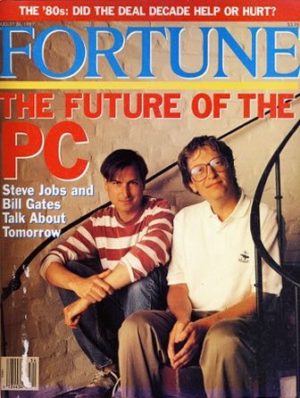
JOBS AND GATES TOGETHER The boy wonders of computing, now thirtysomething, argue over where innovation comes from and where PCs will go.
By Steven P. Jobs, William H. Gates III, Brenton R. Schlender
August 26, 1991
(FORTUNE Magazine) – The two college dropouts most responsible for unleashing the PC revolution rarely see each other anymore, though they say that they’re still friends. At FORTUNE’s invitation, Bill Gates and Steve Jobs met for a Sunday evening in late July to discuss the prospects for the tumultuous industry they shaped. Gates, 35, left Harvard in 1975 to co-found Microsoft. His big break came in 1980, when IBM asked him to provide the operating system — the program that manages a computer’s inner workings — for its now famous PC.
Jobs, 36, who left Reed College to sojourn in India, is best known for co-founding Apple Computer. He led the development of the Macintosh, a computer much easier to use than IBM’s somewhat nerdy PC. Gates has imitated many features of the Mac’s software with a popular PC program called Windows.
Since the mid-1980s the men have taken dramatically different paths. Gates, who owns more than $4 billion of Microsoft stock, remains a workaholic bachelor and an omnivorous reader — he has read several biographies of Napoleon. He has built Microsoft into the world’s largest and most profitable PC software company. It hasn’t all been rosy. Microsoft’s relationship with IBM soured this year, mainly because the two couldn’t agree on an operating- system strategy for future PCs. And the Federal Trade Commission recently began investigating Microsoft’s practices.
Jobs has been less visible but just as busy. In 1985 he started Next, aiming to build the personal computer of the 1990s. Next’s first machine appeared two years ago. Its basic software, NextStep, makes the machine unusually easy to customize; IBM was so impressed it licensed NextStep for its own computers. Despite the dazzling technology, the going has been slow at Next. For one thing, IBM never put NextStep on the market. But lately business has picked up — 10,000 systems rolled out of Next’s automated plant during the second quarter. Jobs has other reasons to smile. He and wife Laurene, who married earlier this year, are expecting their first child in September.
FORTUNE associate editor Brenton R. Schlender put the questions at the meeting. Beneath the conviviality, Jobs and Gates each had a business objective. Jobs lobbied for Gates to develop software for the Next computer. And Gates, whose company is being sued by Apple for allegedly pirating Macintosh software features, was hoping to learn more about the product’s origin.
Schlender: What did you think when the PC appeared ten years ago?
Jobs: When IBM entered the market, we did not take it seriously enough. It was a pretty heady time at Apple. We were shipping tens of thousands of machines a month — more computers than IBM was total. Even so, a lot of people think IBM invented the personal computer, which of course isn’t true.
Gates: A lot of people think Apple did, and that isn’t true either. Our first program was for the Altair ((a mail-order kit sold in 1975)).
Schlender: Does Microsoft’s control of PC operating systems stifle competition in the industry?
Gates: There’s not one element of the industry that’s not competitive. There are people who are cloning Intel’s chips; there are people who are cloning my operating system; there are many, many people who make PCs; and for every software application there are lots of people competing. There is no competitive imperfection.
Jobs: How come nobody has successfully competed with you? I’m not accusing you or Microsoft of anything. I’m not even saying it’s necessarily bad. I’m just saying it’s an interesting contrast. When I zoom back and look at this, there are hundreds of people making PCs, and hundreds of people writing applications programs for them.
Gates: Right.
Jobs: But they all have to travel through this very small orifice called Microsoft to get to one another.
Gates: It’s a very large orifice! ((Laughs.))
Jobs: But it’s only one company.
Gates: Are you saying there’s something wrong with our popularity? My approach to the PC market has been the same from the very beginning. The goal of Microsoft is to create the standard for the industry. Nothing has changed.
Schlender: What does the future hold for IBM and Apple? What do you think of their decision to collaborate on PC software?
Gates: It’s surprising to me.
Jobs: Yes, we are confused about that.
Gates: ((Apple President)) Mike Spindler has said they want to turn Apple into more of a software company. If that’s your goal, you don’t go and give the half of the company that is the future of Apple software to a joint venture. What is Apple getting in return? Here’s the part I don’t understand: What is the contribution from IBM? The IBM name? Did Apple feel so bad about their own work that they had to have that?
Jobs: I truly believe the challenge for IBM is that they can’t survive by selling the same thing you can buy from somebody else for 30% less money. Their cost structure doesn’t allow them to compete with companies that don’t do massive amounts of R&D, that don’t have twice as many employees as they need, et cetera, et cetera. So IBM has to do one of two things: One, suffer continuous erosion of its market share until eventually it goes out of business, which I hope doesn’t happen. Or two, come up with some way to add value. In my opinion the way to make your machines unique is with unique software.
Gates: I said that back in the Seventies! ((Laughs.)) There’s something else I don’t understand. If IBM already held a license to your NextStep software, why did they get all this going with Apple rather than just come to you and expand their license?
Jobs: I really want to answer this que
stion, but I’ve got to be careful what I say. It’s not my purpose to alienate anyone at IBM.
Gates: We share this interest. ((Both laugh.))
Jobs: Somebody at IBM a few years ago saw our NextStep operating system as a potential diamond to solve their biggest and most profound problem, that of adding value to their computers with unique software. Unfortunately, as I learned, IBM is not a monolith. It is a very large place with lots of faces, and they all play musical chairs. Somewhere along the line this diamond got dropped in the mud, and now it’s sitting on somebody’s desk who thinks it’s a dirt clod. Inside that dirt clod is still a diamond, but they don’t see it.
Schlender: Is the PC industry, which until now has been dominated by American companies, liable to get overrun by the Japanese?
Jobs: Computer companies fall on a spectrum of enthusiasm for manufacturing. On the left end are companies that look at manufacturing as a necessary evil, who wish they didn’t have to do it. And at the far right you have people who look at manufacturing as a competitive advantage. Clearly a lot of the Japanese companies look at themselves that way. Unfortunately a lot of American companies look at manufacturing as a necessary evil. You can say the same thing about the way they see software. My opinion is that the only two computer companies that are software-driven are Apple and Next, and I wonder about Apple. Most computer companies would rather that software didn’t even exist.
Gates: Good!
Jobs: It’s good for Microsoft today. But unfortunately all those companies could give way to Japanese companies a few years down the road.
Gates: I think you give up too easily on Americans. You pick one dimension . . .
Jobs: I focus on manufacturing because I care about it. I’ve seen IBM’s. I built Apple’s and Next’s, and I know what Sun does. Ultimately, I believe that most of the PCs will come from offshore. We’re just not good enough at manufacturing.Where will the key innovations come from? Established giants like Microsoft or upstarts like Next?
Gates: I contend technology breakthroughs can happen by extending what we already have. Let’s take handwriting computers. The hardware is coming from PC-compatible makers like Dell Computer ((of Austin, Texas)) and NCR and some Japanese companies. The software will come either from Microsoft or from a U.S. competitor named Go Corp. ((of Foster City, California)). That’s going to be a major breakthrough, and who do you give credit to?
Jobs: I think everybody gives credit to Go, but Go will be crushed.
Gates: That’s one of the nastiest comments I’ve ever heard. I’ve been working on handwriting since long before there ever was a Go Corp.
Jobs: Really? I didn’t know that. Most people would say that Go is the company that first tried to commercialize that technology.,
Gates: Well, Go hasn’t shipped anything yet, and I’ll ship my stuff before they ship theirs.
Jobs: My experience has been that creating a compelling new technology is so much harder than you think it will be that you’re almost dead when you get to the other shore. That’s why, when you take big leaps, like the Mac, or object- oriented programming, or handwriting recognition, you have to leave old technology behind. When Lindbergh was going to fly from New York to Paris, he had to decide what to take with him. There were a lot of demands. They fell into two categories — things that would make his journey safer or more comfortable, and things that would increase his chances of making it to Paris. Weight was a real problem. He could take more gas, which would increase his safety, or he could take a compass, which would increase his chances of getting to Paris. Every time he came down on the side of increasing his chances of getting to Paris at the sacrifice of safety or comfort. That’s why he made it.
Gates: Smart people like Steve ought to try to build things from scratch. That’s a worthy thing. But every time it should be a test. Right now there’s a test in handwriting PCs, in object-oriented operating systems, in multimedia computers. Those are the big questions for personal computing in the 1990s, and I’m the one who has to prove the validity of the evolutionary approach.
Jobs: It’s true, your evolutionary approach with Windows is bringing to PCs great new technologies that Apple and others pioneered. But in the meantime — and it’s been seven years since the Macintosh was introduced — I still think that tens of millions of PC owners needlessly use a computer that is far less good than it should be.
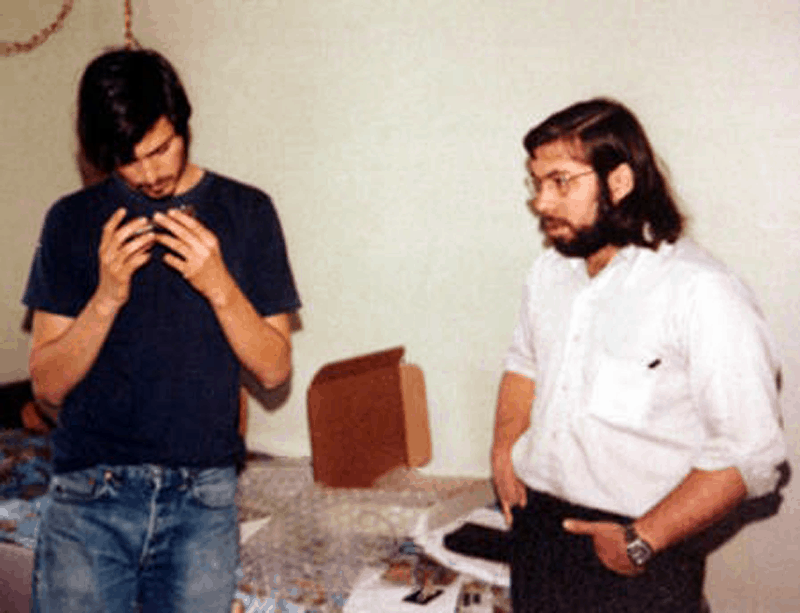
The two main Apple founders – Steve Jobs and Steve Wozniak – both came from humble backgrounds and were not endowed with commercial success. In order to afford the first pieces of the Apple I in 1976, they almost literally sold the shirts off their backs. Jobs invested the proceeds from the sale of his VW bus ($1,500 dollars). “Woz” parted with his beloved programmable calculator Hewlett-Packard 65 and deposited 250 dollars in the company’s treasury.
Ronald Wayne (Photo courtesy of Owen Linzmayer)
Ronald Gerald Wayne, the “third founder” of Apple Computer, was with the company for only a short time. He illustrated the first Apple logo and wrote the Apple I manual. While at Apple, he also wrote their partnership agreement. Wayne worked with Jobs at Atari before co-founding Apple Computer on April 1, 1976. He was given a 10% stake in Apple, but relinquished his stock for 800 dollars only two weeks later because legally, all members of a partnership are personally responsible for any debts incurred by any of the other partners.
After Apple’s IPO, Wayne’s stake could have been worth as much as US$ 1.5 billion. He claimed that he didn’t regret selling the stock as he had made “the best decision available at that time.” According to CNET, as of 1997 Wayne was working as an engineer for a defense contractor in Salinas, California.
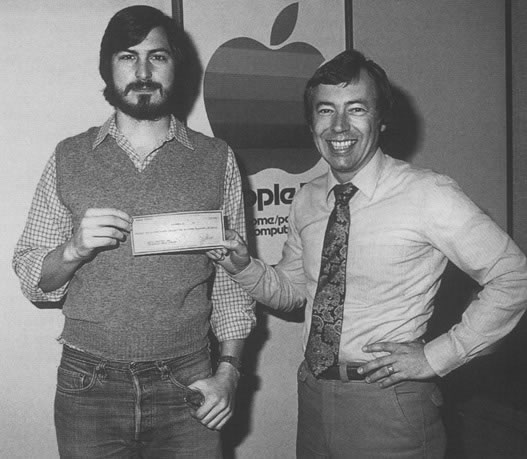
The foundations for the commercial success were laid in 1977 by venture capitalist Arthur Rock as well as by the ex-Intel manager Mike Markkula, who invested 92,000 dollars in Apple and secured a bank loan of 250,000 dollars. Markkula was lured out of retirement by Steve Jobs, who was referred to him by Regis McKenna and venture capitalist Don Valentine.
Valentine—who after meeting the young, unkempt Jobs asked McKenna, “Why did you send me this renegade from the human race?”—was not interested in funding Apple, but mentioned Jobs’ new company to Markkula. Jobs visited him and convinced Markkula of the market for the Apple II and personal computers in general. Later Valentine asked Markkula if he could also invest in Apple.
Mike Markkula at the Apple offices April 1, 1977
In 1977, Markkula brought his business expertise along with US$250,000 ($80,000 as an equity investment in the company and $170,000 as a loan) and became employee number 3. The investment would pay off for Markkula. Before Apple went public in 1980, he owned a third of the company.
Markkula also brought in Apple’s first CEO, Michael Scott, then took the job himself from 1981 to 1983. Markkula served as chairman from 1985 until 1997, when a new board was formed after Jobs returned to the company. Wozniak, who virtually single-handedly created the first two Apple computers, credits Markkula for the success of Apple more than himself. “Steve and I get a lot of credit, but Mike Markkula was probably more responsible for our early success, and you never hear about him,” told Wozniak the Failure Magazine in July 2000.
With the initial public offering on December 12, 1980, Jobs and Wozniak became multimillionaires, as Apple Computer was now valued at 1.8 billion dollars. Jobs possessed 7.5 million stocks (217 million dollars); “Woz” was assigned four million stocks (116 million dollars). Markkula’s share of seven million stocks was worth 203 million.
“I was worth about over a million dollars when I was twenty-three and over ten million dollars when I was twenty-four, and over a hundred million dollars when I was twenty-five,” Jobs said in an interview with Robert Cringley (”Triumph of the Nerds“) in 1996. “And it wasn’t that important because I never did it for the money.”
Read next page: Steve Jobs: It’s not about the money
Steve Jobs at WWDC 2008. Photo: Christoph Dernbach
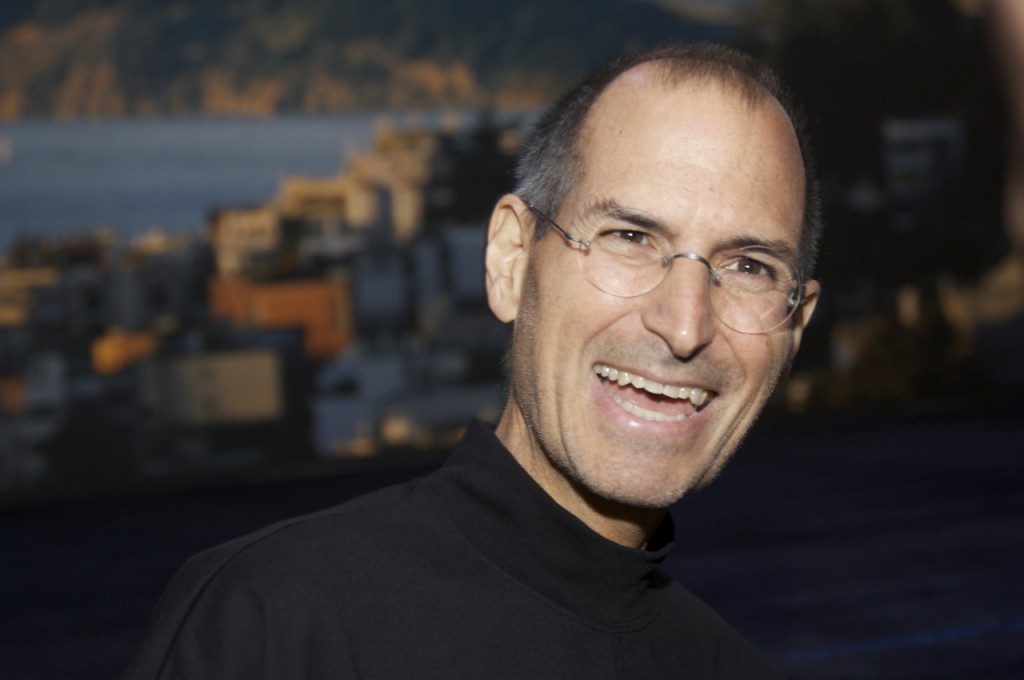
Steve Jobs has been the most influential inventor and manager in the technology industry. On August 24, 2011, he announced his resignation from his role as Apple’s CEO. Time to look back at the most important marks in his life:
1955: Jobs is born on Feb. 24, in San Francisco and was adopted by Paul and Clara Jobs (née Hagopian) of Mountain View, California, who named him Steven Paul.
1972: Jobs graduated from Homestead High School in Cupertino, California, and enrolled in Reed College in Portland, Oregon. Although he dropped out after only one semester, he continued auditing classes at Reed, such as one in calligraphy.
1974: Jobs returned to California and began attending meetings of the Homebrew Computer Club with Steve Wozniak, a high school friend who was a few years older. He works for video game maker Atari.
1976: Building “Blue Boxes”
1976: Apple Computer is formed on April Fools’ Day, shortly after Wozniak and Jobs create a new computer circuit board in a Silicon Valley garage. The third founder, Ronald Wayne, was serving as the venture’s “adult supervision”. He drew the first Apple logo, wrote the three men’s original partnership agreement, and wrote the Apple I manual. He soon gave up his share of the new company for a total of $2,300 becaus he was afraid of the financial risk. The Apple I computer went on sale by the summer for $666.66.
1977: Apple is incorporated January 3, 1977 by its founders and a group of venture capitalists (Mike Markkula et al.). The company unveils Apple II, the first personal computer to generate color graphics. Sales soar to the rate of $1 million a year.
1978: Jobs’ daughter Lisa is born to girlfriend Chrisann Brennan. She briefly raised their daughter on welfare when Jobs denied paternity, claiming that he was sterile; he later acknowledged paternity. In 1983 he named the “Apple Lisa” after his first daughter.
1979: Jobs and several Apple employees including Jef Raskin visited Xerox PARC in December 1979 to see the Xerox Alto. Xerox granted Apple engineers three days of access to the PARC facilities in return for the option to buy 100,000 shares (800,000 split-adjusted shares) of Apple at the pre-IPO price of $10 a share. Jobs was immediately convinced that all future computers would use a graphical user interface (GUI), and development of a GUI began for the Apple Lisa.
John Carmack was the lead programmer of the id video games Commander Keen, Wolfenstein 3D, Doom, Quake, Rage and their sequels. Carmack is best known for his innovations in 3D graphics, such as his Carmack’s Reverse algorithm for shadow volumes. In August 2013, Carmack took the position of CTO at Oculus VR. His first meeting with Steve Jobs was quite interesting.
On October 5th, 2015, Apple CEO Tim Cook sent out an internal email to staff, in remembrance of the fourth anniversary of the passing of the company’s co-founder Steve Jobs. In the text, he encouraged employees to learn about what he was like to work with.
“If you never knew Steve, you probably work with someone who did or who was here when he led Apple,” Cook wrote. “Please stop one of us today and ask what he was really like.”
Cook’s comments come after a report from the Wall Street Journal detailing criticism of an upcoming Aaron Sorkin biopic of Jobs that’s based on a biography penned by Walter Isaacson. Among the film’s critics was Jobs’ wife, Laurene Powell Jobs, who tried to kill the film several times during its development. The film, “Steve Jobs,” is set to release October 9th, 2015.
Remembering Steve for who he was and what he stood for. We honor him by continuing the work he loved so much. pic.twitter.com/6UiXBjYe3l
Today marks four years since Steve passed away. On that day, the world lost a visionary. We at Apple lost a leader, a mentor, and many of us lost a dear friend.
Steve was a brilliant person, and his priorities were very simple. He loved his family above all, he loved Apple, and he loved the people with whom he worked so closely and achieved so much.
Each year since his passing, I have reminded everyone in the Apple community that we share the privilege and responsibility of continuing the work Steve loved so much.
What is his legacy? I see it all around us: An incredible team that embodies his spirit of innovation and creativity. The greatest products on earth, beloved by customers and empowering hundreds of millions of people around the world. Soaring achievements in technology and architecture. Experiences of surprise and delight. A company that only he could have built. A company with an intense determination to change the world for the better. And, of course, the joy he brought his loved ones.
He told me several times in his final years that he hoped to live long enough to see some of the milestones in his children’s lives. I was in his office over the summer with Laurene and their youngest daughter. Messages and drawings from his kids to their father are still there on Steve’s whiteboard.
If you never knew Steve, you probably work with someone who did or who was here when he led Apple. Please stop one of us today and ask what he was really like. Several of us have posted our personal remembrances on AppleWeb, and I encourage you to read them.
Thank you for honoring Steve by continuing the work he started, and for remembering both who he was and what he stood for.
Steve Jobs and John Sculley on the Cover of Business Week (Nov. 1984)
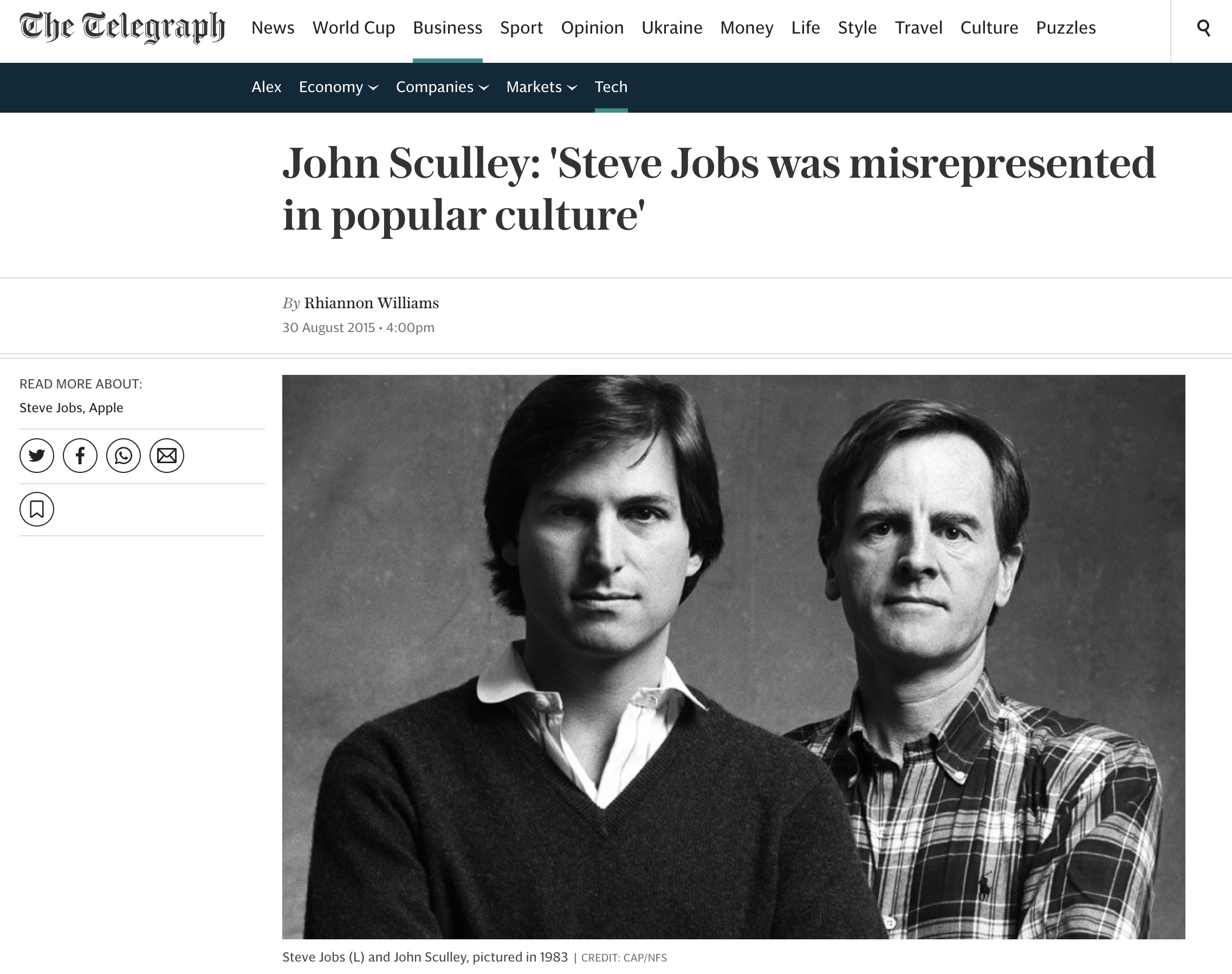
Rhiannon Williams, writing for The Telegraph, had the chance to interview John Sculley, the man who was instrumental in ousting Steve Jobs from Apple back in 1985.
When asked if he ever feels frustrated at how Jobs is presented, or misrepresented, in popular culture, Sculley pauses. “Misrepresented in what way?” he asks, tersely. People tend to draw on the more tyrannical aspects of his personality, I venture.
“I don’t think that’s fair. I think…” He pauses again. “People exaggerate, it’s simple to summarise and exaggerate. I found Steve, remember – at the time we were friends, we were incredibly close friends, and… he was someone who even then, showed compassion, and caring about people. “Didn’t mean he couldn’t be tough in a meeting and make decisions, and sometimes they seemed, y’know, overly harsh. But the reality was, the Steve Jobs I knew was still a very decent person, with very decent values. So I think he was misrepresented in popular culture.”
And:
The pair worked in harmony together on Apple’s 1984 Ridley Scott-directed Super Bowl television advert, but cracks began to appear when Sculley disagreed with Jobs’ plans to drop the price of the Macintosh and direct a large proportion of the marketing budget from Apple II to the Mac in the wake of the poorly-received Macintosh Office network, which later became Desktop Publishing.
“I said ‘Steve, the only cash for the company is coming from the Apple II, and we can’t do that,’” Sculley recalls sadly.
The working relationship between the two descended into a desperate struggle for power. The increasingly-erratic Jobs tried to lead an unsuccessful rebellion against Sculley in May 1985 with the goal of replacing him with Jean-Louis Gassée, then Apple’s director of European Operations. Gassée informed Sculley of the coup, who confronted Jobs at an executive committee meeting and demanded those present choose between the two men as to who they thought best to run the company. They backed Sculley, and Jobs fled the room.