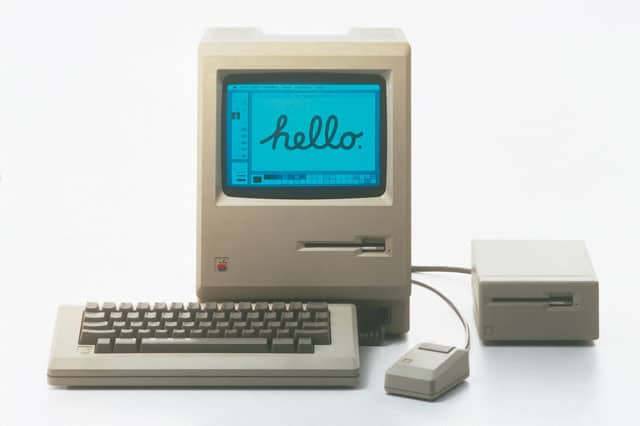
The Apple Macintosh revolutionized the entire computer industry by the year of 1984. Steve Jobs and his ingenious Macintosh team arranged for the computer to be used by the normal “person in the street” – and not only by experts.
“Insanely great” – Steve Jobs could hardly put into words his enthusiasm by the launch of the Macintosh. On the legendary annual general meeting of January 24th, 1984, in the Flint Center not far from the Apple Campus in Cupertino, the Apple co-founder initially quoted Bob Dylan’s “The Times They Are A-Changin’” in order to then polemicize against an imminent predominance of the young computer industry by IBM.
Steve Jobs’ introduction of the Apple Macintosh:
“The early 1980s. 1981 – Apple II has become the world’s most popular computer, and Apple has grown to a 300 million dollar corporation, becoming the fastest growing company in American business history. With over fifty companies vying for a share, IBM enters the personal computer market in November of 1981, with the IBM PC.
1983. Apple and IBM emerge as the industry’s strongest competitors, with each selling approximately one billion dollars worth of personal computers in 1983. The shakeout is in full swing. The first major personal computer firm goes bankrupt, with others teetering on the brink. Total industry losses for 1983 overshadow even the combined profits of Apple and IBM.
It is now 1984. It appears that IBM wants it all. Apple is perceived to be the only hope to offer IBM a run for its money. Dealers, after initially welcoming IBM with open arms, now fear an IBM dominated and controlled future and are turning back to Apple as the only force who can ensure their future freedom.
IBM wants it all, and is aiming its guns at its last obstacle to industry control, Apple. Will Big Blue dominate the entire computer industry? The entire information age? Was George Orwell right?“
The crowd, among them the complete Macintosh developer’s team, shouted back: “Nooooo!”
The introduction of the first Mac on January 24th, 1984; taken from the “Lost 1984 Videos”
There had been only two milestone products so far: the Apple II in 1977 and the IBM PC in 1981, Jobs continued. “Today (…) we are introducing the third industry milestone product, the Macintosh. Many of us have been working on Macintosh for over two years now and it has turned out insanely great.”
Steve Jobs
Taking a look at the history of the personal computer today, Steve Jobs was on the right track with his historical comparison. However, it would not be IBM that became the great dominator of the computer industry over the years, but rather, the alliance of Microsoft and Intel.
Previous to the Macintosh developer team, others had already tried to design a computer with a mouse and a graphical user interface – one year before Apple did, with its own business computer Lisa, which retailed for 10,000 dollars.
Screenshot of the movie “Pirates of Silicon Valley”
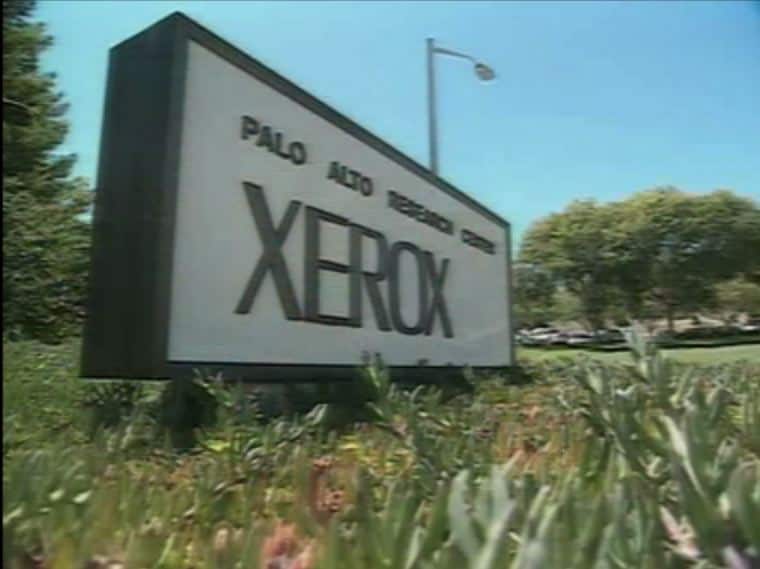
It is claimed again and again that in the course of the Macintosh’s development, Apple just resorted to the ideas the research laboratory Xerox PARC had hatched before. Fact or Fiction?
The myth says, Apple CEO Steve Jobs saw Xerox PARC product, such as the GUI, either on a tour or at a trade show. He then used the PARC GUI implementation without permission, to create the Apple Lisa and the original Mac OS / Macintosh GUI.
The myth entwines about a late 1979 visit to Xerox PARC by a group of Apple engineers and executives led by Steve Jobs. Alex Soojung-Kim Pang, author of “Making the Macintosh”, writes:
According to early reports, it was on this visit that Jobs discovered the mouse, windows, icons, and other technologies that had been developed at PARC. These wonders had been locked away at PARC by a staff that didn’t understand the revolutionary potential of what they had created. Jobs, in contrast, was immediately converted to the religion of the graphical user interface, and ordered them copied by Apple, starting down the track that would eventually yield the Lisa and “insanely great” Macintosh. The Apple engineers– that band of brothers, that bunch of pirates– stole the fire of the gods, and gave it to the people.
It’s a good story. Unfortunately, it’s also wrong in almost every way a story can be wrong. There are problems with chronology and timing. The testimony of a number of key figures at Apple suggests that the visit was not the revelation early accounts made it out to be. But the story also carries deeper assumptions about Apple, Xerox PARC, computer science in the late 1970s, and even the nature of invention and innovation that deserve to be examined and challenged.
Alex Soojung-Kim Pang
Let us take a closer look at what happend at Xerox PARC:
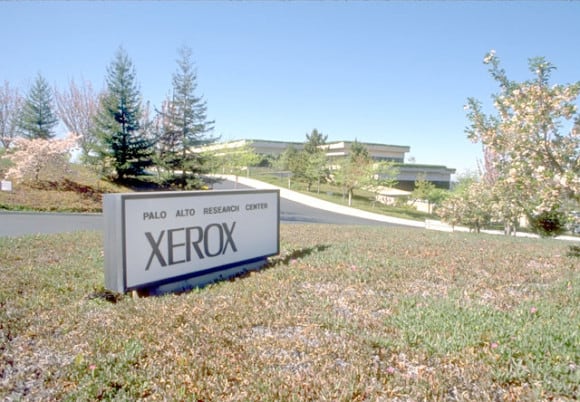
Entrance of Xerox PARC in the eighties
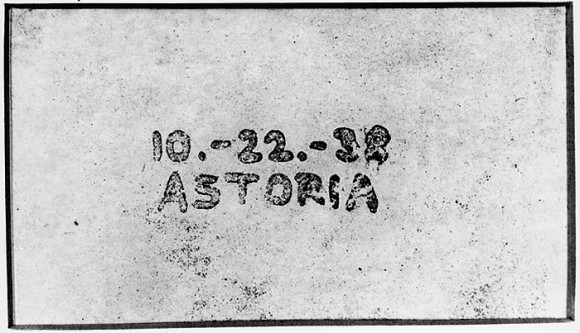
In the Untied States, the brand name “Xerox” denotes photocopying just as “Kleenex” stands for tissues or “Scotch tape” for adhesive film. After all, already in 1950, the Xerox Corp. was the world’s first company to actually transfer the “Xerography” invented by the American law student Chester Carlson into a functional product. Carlson received in 1937 a patent for a process that he called “electrophotography.” On 22 October 1938 followed the premiere in practice: With the help of a metal plate was coated with sulfur and a lamp Chester the lettering “10-22-38 Astoria” on a wax paper.
The first photocopy
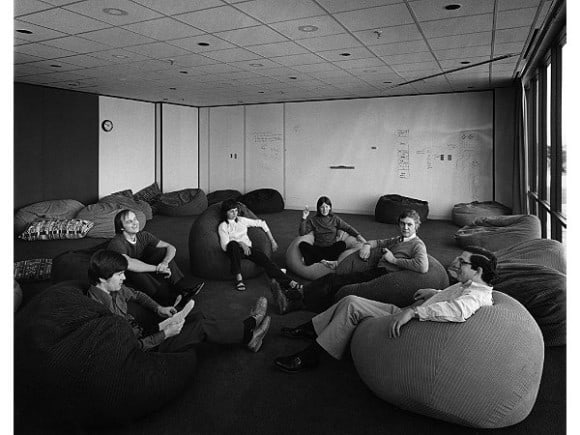
By the end of the sixties, the Xerox management sensed the threat of Japanese companies catching up on Xerox’s technological advantage. Moreover, the Xerox head worried that the “paperless office” might emerge with the following computer generations, in which the Xerox would no longer have a place. Against this background, the Xerox Palo Alto Research Center (PARC) in California was founded in 1970. John Warnock, former researcher in the Xerox PARC and later one of the two founders of Adobe Systems, remembers: “The atmosphere was electric – there was total intellectual freedom. There was no conventional wisdom; almost every idea was up for challenge and got challenged regularly.”
Larry Tessler, who later took part in developing the Macintosh and the Newton PDA at Apple, also enjoyed the liberties the PARC provided in the seventies: “The management said go create the new world. We don’t understand it. Here are people who have a lot of ideas and tremendous talent, [are] young, energetic.” The problem, however, was that the company management at the East Coast of the USA did not [care a straw for] the PARC’s research results unless they were directly involved with photocopiers.
In his TV documentation “Triumph of the Nerds” Robert Cringley is interviewing researchers at the Xerox PARC
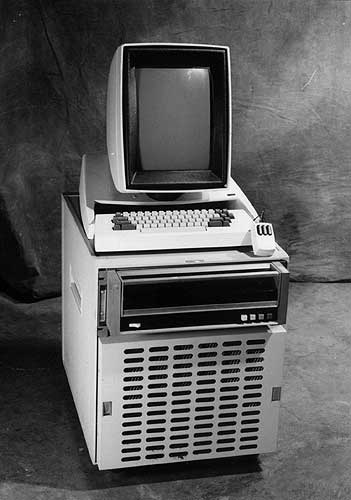
Within two years, the researchers at the PARC had designed the Alto, which was something like the first personal computer. The Alto did not feature character-oriented graphics, as did all the other computers of that time, but a bit-oriented version instead. A high quality printer could print exactly what the screen displayed.
A mouse. Removable data storage. Networking. A visual user interface. Easy-to-use graphics software. “What You See Is What You Get” (WYSIWYG) printing, with printed documents matching what users saw on screen. E-mail. Alto for the first time combined these and other now-familiar elements in one small computer.
Developed by Xerox as a research system, the Alto marked a radical leap in the evolution of how computers interact with people, leading the way to today’s computers.
By making human-computer communications more intuitive and user friendly, Alto and similar systems opened computing to wide use by non-specialists, including children.
People were able to focus on using the computer as a tool to accomplish a task rather than on learning their computer’s technical details.
However, this marvelous machine was not freely available on the market. Only small numbers were built initially, but by the late 1970s, about 1,000 were in use at various Xerox laboratories, and about another 500 in several universities. Total production was about 2,000 systems.
The revolutionary Alto would have been an expensive personal computer if put on sale commercially. Lead engineer Charles Thacker noted that the first one cost Xerox $12,000. As a product, the price tag might have been $40,000.
Commercial for the Xerox Alto (1972).
This commercial for Xerox’s Alto computer released in 1972 introduced the world to the first desktop computer with a graphical user interface. Named after Xerox PARC’s home city of Palo Alto, California, the computer introduced the world to the window-oriented mouse and keyboard interface we use today. The Alto also had a distinctive portrait screen — an idea that was well before its time.
The video showed how the computer could revolutionize your office life, with email, word processing and reminders all controlled by a cursor. It also shows the protagonist expressing his thoughts and actions out loud, as if in conversation with the Alto (which seems to be nicknamed “Fred”).
Some Apple engineers were already familiar with PARC, its work, or technologies like the mouse. Bill Atkinson had read about Smalltalk as an undergraduate. Some had worked at PARC: Jef Raskin spent time there during a sabbatical year at Stanford, and had a number of friends who were researchers there. Finally, there were even some Apple employees whose had learned about the mouse while working for Douglas Engelbart at SRI in the 1960s and early 1970s, or Tymshare in the later 1970s.