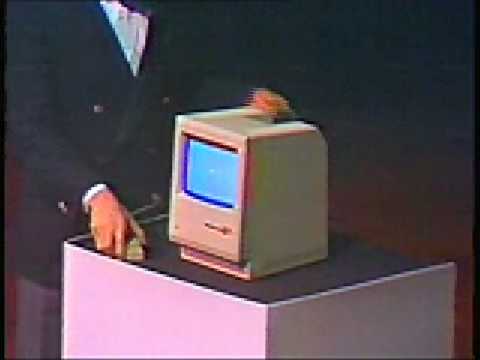
The introduction of the first Mac on January 24th, 1984; taken from the “Lost 1984 Videos”

Rich Neighbor with Open Doors


It is claimed again and again that in the course of the Macintosh’s development, Apple just resorted to the ideas the research laboratory Xerox PARC had hatched before. Fact or Fiction?
The myth says, Apple CEO Steve Jobs saw Xerox PARC product, such as the GUI, either on a tour or at a trade show. He then used the PARC GUI implementation without permission, to create the Apple Lisa and the original Mac OS / Macintosh GUI.
The myth entwines about a late 1979 visit to Xerox PARC by a group of Apple engineers and executives led by Steve Jobs. Alex Soojung-Kim Pang, author of “Making the Macintosh”, writes:
According to early reports, it was on this visit that Jobs discovered the mouse, windows, icons, and other technologies that had been developed at PARC. These wonders had been locked away at PARC by a staff that didn’t understand the revolutionary potential of what they had created. Jobs, in contrast, was immediately converted to the religion of the graphical user interface, and ordered them copied by Apple, starting down the track that would eventually yield the Lisa and “insanely great” Macintosh. The Apple engineers– that band of brothers, that bunch of pirates– stole the fire of the gods, and gave it to the people.
It’s a good story. Unfortunately, it’s also wrong in almost every way a story can be wrong. There are problems with chronology and timing. The testimony of a number of key figures at Apple suggests that the visit was not the revelation early accounts made it out to be. But the story also carries deeper assumptions about Apple, Xerox PARC, computer science in the late 1970s, and even the nature of invention and innovation that deserve to be examined and challenged.
Alex Soojung-Kim Pang
Let us take a closer look at what happend at Xerox PARC:

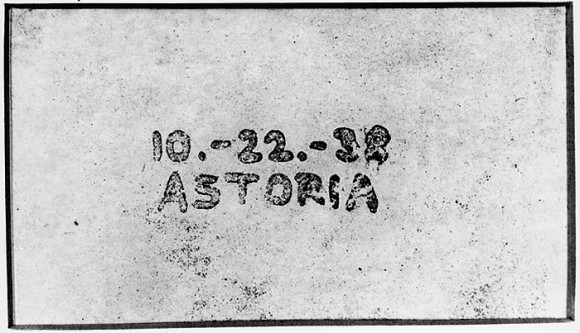
In the Untied States, the brand name “Xerox” denotes photocopying just as “Kleenex” stands for tissues or “Scotch tape” for adhesive film. After all, already in 1950, the Xerox Corp. was the world’s first company to actually transfer the “Xerography” invented by the American law student Chester Carlson into a functional product. Carlson received in 1937 a patent for a process that he called “electrophotography.” On 22 October 1938 followed the premiere in practice: With the help of a metal plate was coated with sulfur and a lamp Chester the lettering “10-22-38 Astoria” on a wax paper.

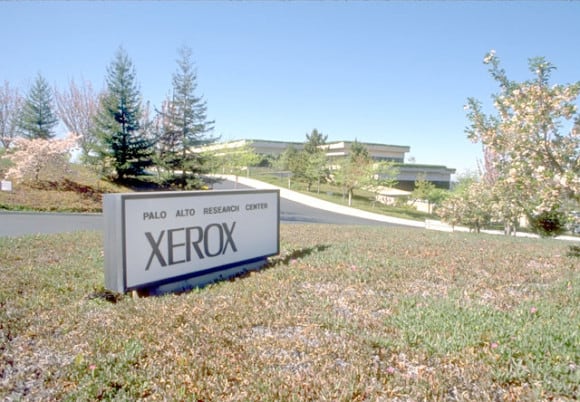
By the end of the sixties, the Xerox management sensed the threat of Japanese companies catching up on Xerox’s technological advantage. Moreover, the Xerox head worried that the “paperless office” might emerge with the following computer generations, in which the Xerox would no longer have a place. Against this background, the Xerox Palo Alto Research Center (PARC) in California was founded in 1970. John Warnock, former researcher in the Xerox PARC and later one of the two founders of Adobe Systems, remembers: “The atmosphere was electric – there was total intellectual freedom. There was no conventional wisdom; almost every idea was up for challenge and got challenged regularly.”

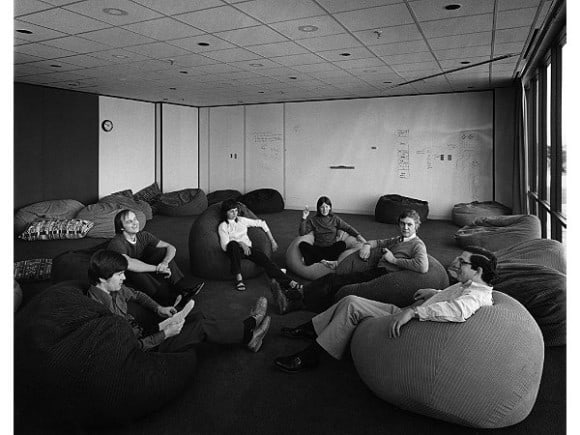
Larry Tessler, who later took part in developing the Macintosh and the Newton PDA at Apple, also enjoyed the liberties the PARC provided in the seventies: “The management said go create the new world. We don’t understand it. Here are people who have a lot of ideas and tremendous talent, [are] young, energetic.” The problem, however, was that the company management at the East Coast of the USA did not [care a straw for] the PARC’s research results unless they were directly involved with photocopiers.

In his TV documentation “Triumph of the Nerds” Robert Cringley is interviewing researchers at the Xerox PARC
Within two years, the researchers at the PARC had designed the Alto, which was something like the first personal computer. The Alto did not feature character-oriented graphics, as did all the other computers of that time, but a bit-oriented version instead. A high quality printer could print exactly what the screen displayed.
A mouse. Removable data storage. Networking. A visual user interface. Easy-to-use graphics software. “What You See Is What You Get” (WYSIWYG) printing, with printed documents matching what users saw on screen. E-mail. Alto for the first time combined these and other now-familiar elements in one small computer.
Developed by Xerox as a research system, the Alto marked a radical leap in the evolution of how computers interact with people, leading the way to today’s computers.
By making human-computer communications more intuitive and user friendly, Alto and similar systems opened computing to wide use by non-specialists, including children.
People were able to focus on using the computer as a tool to accomplish a task rather than on learning their computer’s technical details.
The Computer History Museum about the Xerox Alto

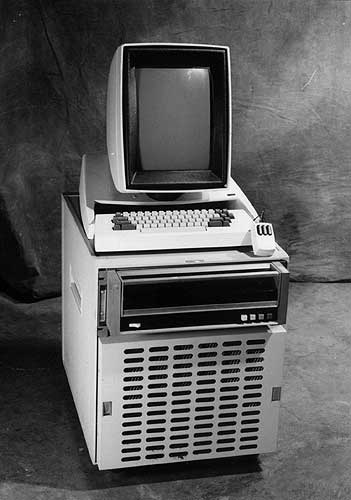
However, this marvelous machine was not freely available on the market. Only small numbers were built initially, but by the late 1970s, about 1,000 were in use at various Xerox laboratories, and about another 500 in several universities. Total production was about 2,000 systems.
The revolutionary Alto would have been an expensive personal computer if put on sale commercially. Lead engineer Charles Thacker noted that the first one cost Xerox $12,000. As a product, the price tag might have been $40,000.

Commercial for the Xerox Alto (1972).
This commercial for Xerox’s Alto computer released in 1972 introduced the world to the first desktop computer with a graphical user interface. Named after Xerox PARC’s home city of Palo Alto, California, the computer introduced the world to the window-oriented mouse and keyboard interface we use today. The Alto also had a distinctive portrait screen — an idea that was well before its time.
The video showed how the computer could revolutionize your office life, with email, word processing and reminders all controlled by a cursor. It also shows the protagonist expressing his thoughts and actions out loud, as if in conversation with the Alto (which seems to be nicknamed “Fred”).
Some Apple engineers were already familiar with PARC, its work, or technologies like the mouse. Bill Atkinson had read about Smalltalk as an undergraduate. Some had worked at PARC: Jef Raskin spent time there during a sabbatical year at Stanford, and had a number of friends who were researchers there. Finally, there were even some Apple employees whose had learned about the mouse while working for Douglas Engelbart at SRI in the 1960s and early 1970s, or Tymshare in the later 1970s.
Read next page: How Apple discovered Xerox PARC
With the initial public offering of Apple Computers in December 1980, Steve Jobs became a multimillionaire – however, he possessed neither enough stock to lead Apple Computers alone nor to determine his own position within Apple. By the beginning of 1981, he actually found himself to be without management responsibility over any specific project. To Jef Raskin’s discomfort, he threw himself into the Macintosh project, which had not been taken really seriously by the Apple board of management at that time.
However, Steve Jobs knew what he wanted. He had seen the graphical user interface of the Xerox Alto at Xerox PARC. Instead of green letters on a dark background, white document windows with black text appeared – just like a sheet of paper. Several different fonts could be selected. The graphics board controlled individual pixels on the screen freely. By means of a mouse, a pointer could be moved on the screen in order to mark texts or issue commands. Files were represented by icons on a virtual desktop.
The Alto was not available on the market. For this experimental computer, the main memory alone would have cost about 7,000 dollars at the time. Jobs wanted a computer even better than the Alto – and also better than Apple’s Lisa. However, the new marvelous machine should cost only a fraction of the Lisa’s price, which was about 12,000 dollars, inclusive of external hard disk.


Pirate flag above the Mac
developers’ building “Bandley III”
Within Apple, Jobs gathered a small, conniving team – and he did not care for other projects in the company. Andy Hertzfeld, one of the most important software designers in the Macintosh developers team, remembers:
Steve Jobs kind of came bopping by my cubicle saying OK you’re working on the Mac now. And I said well I have to finish up this Apple 2 stuff I’m doing here. No you don’t that stinks that’s not going to amount to anything you gotta start now. And I said well just give me a few days to finish and he said no and what he did was he pulled the plug on my Apple 2 that I was programming just losing, losing the code I’m working on and start taking my computer and walking away with it and what could I do but follow him out to his car cause he had my machine he plopped it down in the trunk and drove me over to this remote building, took the computer out, walked upstairs, plopped it down on a desk, well you’re working on the Mac now. While Jobs pursued his MacMission he needed a more orthodox chief executive to run the company. A respectable face who could sell to corporate America. He chose Pepsi-Cola executive John Sculley. Sculley refused – leave Pepsi for a 4 year old company that had been set up in a garage! Are you serious?! But it was hard saying no to Steve Jobs.
The Macintosh Pirates
Above the roof of “Bandley III”, a pirate flag with the Apple symbol as eye patch was waving – and on deck of the virtual pirate ship, Steve Jobs was standing as a man who wanted to prove it to them all. Jobs’ first victim was Jef Raskin, who had fought against the application of a mouse and instead preferred a pen or a joystick. After Jobs had relieved his opponent of the responsibility for the software, Raskin gave in exasperatedly and left Apple Computers in March 1982. In retrospect, Raskin can claim that he was the first at Apple to have presented the vision of an inexpensive, easy to handle computer for the masses. Yet in order to keep “his” Macintosh below the price limit of 1,500 dollars, Raskin also wanted to make technical compromises which would have put at risk the Mac’s success. Thus, for instance, he insisted on limiting the main memory to a tiny 64 kilobytes. Jobs accomplished 128 kilobytes – and afterwards, even this space was actually far too tight for the system programmers.
Raskin did not particularly support the innovations the Lisa team had picked up in the Xerox PARC and therefore disapproved of the change to the more capable 68000 processor, which was included in the Lisa as well. It is hardly imaginable what would have become of the Mac if Raskin had asserted his extreme parsimony and his resistance to the mouse. After the internal disputes had been settled, the Mac team now fully concentrated on the in-house competition against the far larger Lisa developing team. Beforehand, Jobs had enticed away from the Lisa team ingenious programmers such as Bill Atkinson and Steve Capps.
Love and Hate
As a project manager, Steve Jobs had been highly controversial not only within Apple. “He’s also obnoxious and this comes from his high standards. He has extremely high standards and he has no patience with people who don’t either share those standards or perform to them,“ Bob Metcalfe remembers. He is the inventor of the networking standard Ethernet, who had worked as a researcher in the neighboring research institute Xerox PARC at that time. “He’s also obnoxious and this comes from his high standards. He has extremely high standards and he has no patience with people who don’t either share those standards or perform to them.” However, Metcalfe still thinks a lot of Jobs as he had made the vision created in the Xerox PARC become reality. “Steve Jobs is on my eternal heroes list, there’s nothing he can ever do to get off it.”
Larry Tessler and Bob Metcalfe about Steve Jobs (quoted from: Triumph of the Nerds)The respect for Jobs is also shared by Andy Hertzfeld, who had written the Mac’s kernel in the Macintosh ROM, although he was sometimes afflicted with his boss’s tantrums: – quotation – Kenyon set to work again and shortened the booting process by further three seconds.
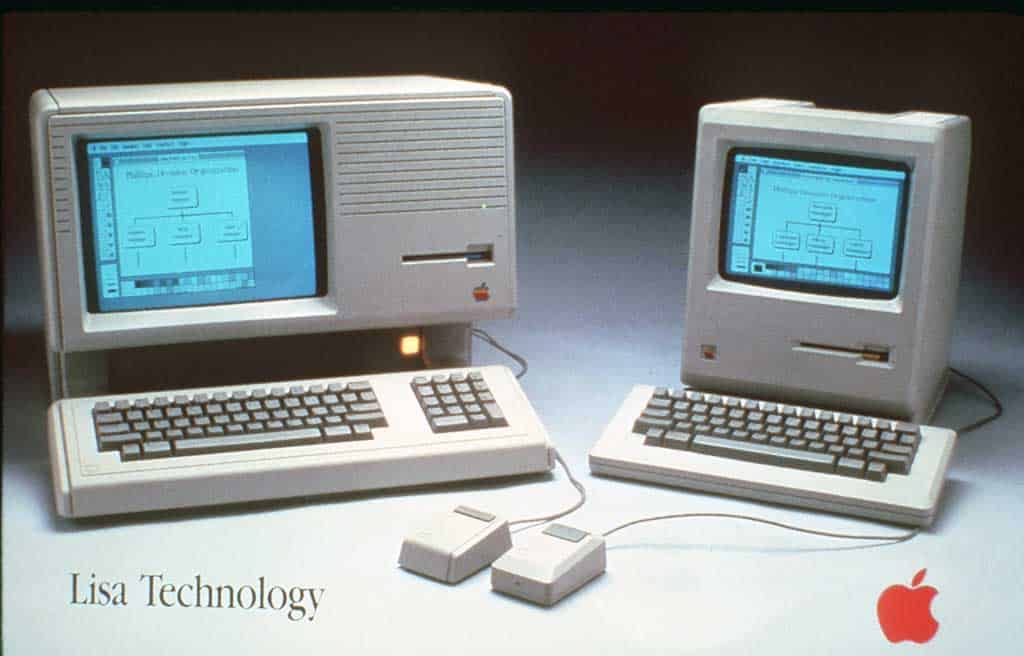
In the internal competition at Apple over whether the Lisa or the Macintosh would be finished first, Jobs got the short end of the stick. He lost a personal 5,000 dollar bet against the Lisa team leader John Couch when the Apple business computer was launched in January 1983 – at least one year previous to the Macintosh. However, the Lisa computer soon proved to be a huge flop. With a price of 10,000 dollars (exclusive of hard disk), it was far too expensive;the graphical user interface devoured Lisa’s power such that the computer did not work particularly briskly; and it lacked the necessary programs to induce the business world to buy the Lisa in large numbers. Moreover, the newly established distribution team could hardly resort to any experience in handling Corporate America.
Exceptionally detailed account of all of Job’s successes and failures
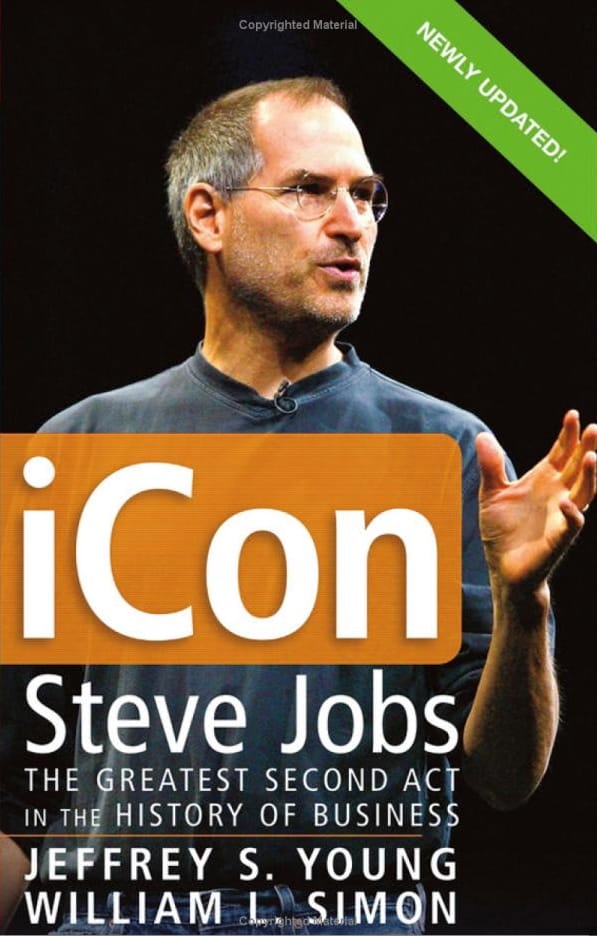
Cover iCon Steve Jobs
iCon Steve Jobs: The Greatest Second Act in the History of Business, retraces the dizzying path of successes and failures of entrepreneur and life long ambassador of technology Steve Jobs. Authors Jeffrey S. Young and William L. Simon produce a detailed account of Jobs’ life and work which begins with Jobs’ adoption and early childhood and ends with his (and Apple’s) success with the iPod and iTunes.
Young and Simon provide an in depth and seemingly unbiased thrashing and congratulatory depiction of what Steve Jobs has accomplished. There is a lot about Jobs covered in this book, and those with an interest in the man behind Apple, the I-pod, and Pixar will find this book fascinating.
Among Steve Jobs accomplishments:
Among his failures:
I had written a summary after I read the book that provides a full overview of the entire account. For those already interested in the book, I suggest reading the book instead of finishing my review. For those seeking a summarization of the content of the book, the rest of my review is for you.
—–
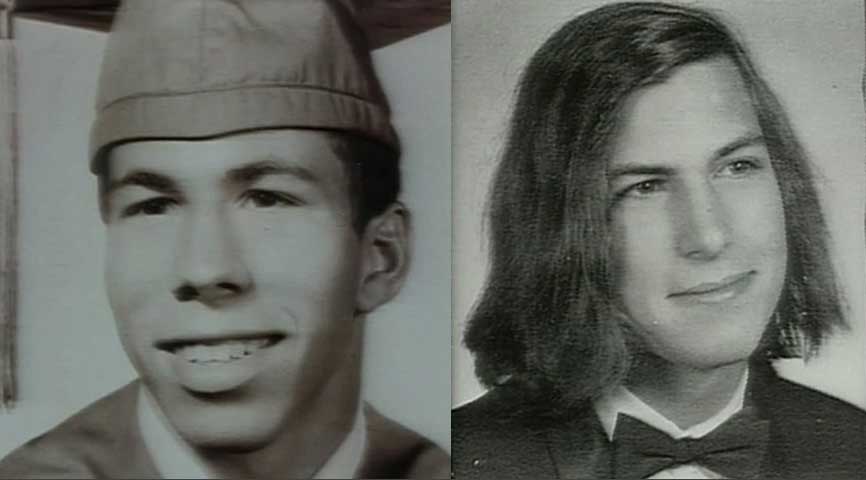
Apple Founders Steve Wozniak and Steve Jobs
Steve was essentially the muscle early on behind his startup, where the other Steve (Steve “Woz” Wozniak) was the schematic genius. Jobs really couldn’t build a schematic with the complexity that Woz could, but Woz could not convince, sell, market, raise money, or operate a business the way Jobs could. It was a perfect combination of skills. Early on they sold illegal boxes that permitted people to make free long distance calls. At that point, they realized there was money in developing their chips which up to that point had only been a hobby. They set out with no money to develop a computer, with Woz doing the designing and Jobs doing the business and sales. Jobs eventually sold 100 computers to a retail store, which when delivered would make them $25,000. They didn’t get paid until they delivered, so Jobs negotiated to get all the supplies on credit using the agreement he had with the store as collateral. This was the start of Apple, and quite smart money management considering Jobs was still a teenager with long hippie hair and wore only jeans and t-shirts.
Apple was selling a lot of basic kits, but nothing of any great magnitude. With Woz being the brains behind the design of the actual computers, Jobs then took it up a notch. He would go to computer fairs all the time and he began to recognize what people were becoming impressed with. Most of the buyers of computers were what he considered computer geeks who had tech knowledge, so they designed the Apple I to suit them. Jobs recognized that these guys liked to get into the circuitry and see what was going on, so he had Woz design all the wiring in very organized straight lines, as opposed to soldering wires haphazardly, which was common at the time. It was the right call, and they sold enough circuit boards to get the Apple name out there. Next they designed the Apple II, based on Jobs view of what it would take to get into homes. For the early 80’s, the Apple II was such a hit that the company went public and Jobs was worth $300 million by age 24.
At this point, Jobs could do no wrong. Things would change however. He was a visionary in one major way; he focused all his energy on what consumers wanted. This led to his products being known for their quality and design…something Apple is still known for to this day. The problem was that this often times took the focus away from budgeting, producing some fairly unrealistic costs. Apple eventually would put out products that were much better than anything out there but were not priced for the market they aimed at, thus becoming failures. This was evident in the next two huge leaps Apple made at Job’s direction. He was so shrewd that he made a deal with Xerox to view what they were doing behind closed doors in exchange for some big discounts on services Apple was working on for Xerox (Xerox was also an investor/owner). What they discovered was a user interface that inspired Jobs to come up with what we now know today as windows and a mouse. This was revolutionary.
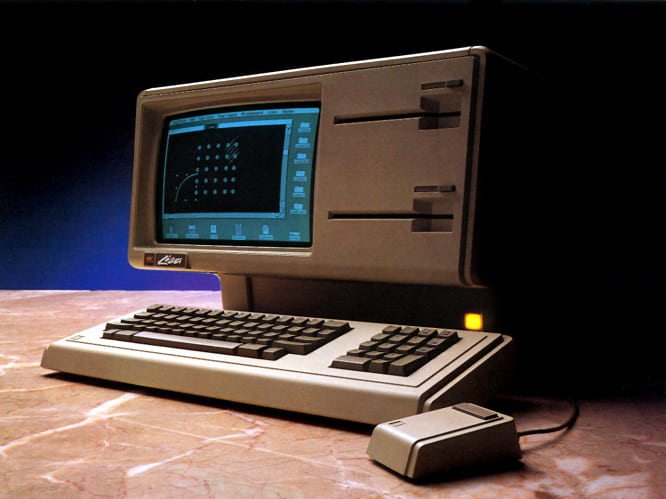
Apple Lisa
Apple went ahead with a windows style computer…two of them. The first, the Lisa, was the beginning of problems with Jobs. He was a visionary, but he also was at times a complete disaster when dealing with people. He was so convinced that what he was working on was the future of computers (which in hindsight is interesting) and thus refused to accept anyone else’s opinion about anything. This resulted in two revolutionary computers being developed, and two total flops. The Lisa had a sales price of $10,000 and never sold. The Macintosh, the computer that is still revered as the most revolutionary breakthrough in computers, although a big seller, never sold what it needed to live up to its reputation as a smashing success. Essentially, the computer was viewed by the public as the best thing since sliced bread, but the cost prevented it from outselling more than IBM PC’s.

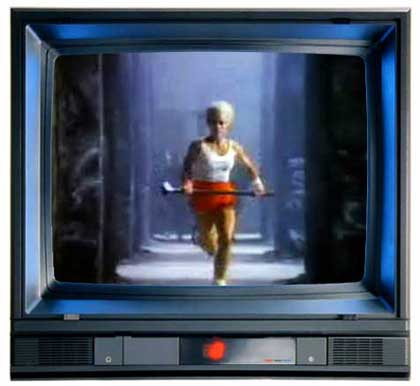
Job’s had been spot on about what the computer meant to Apple and the computer industry, but as a result had totally blew the cost analysis of what it would take to become profitable. At this point, people in Apple disagreed so vehemently with him that the board was split about what to do to, and he was eventually voted out. This was the same board of course that was 100% against his view on using the Superbowl commercial Jobs liked to much to present the Mac, which is still the most famous SB commercial ever. Again, Jobs was right, but his total inability to give any focus to cost analysis or people skills got him ousted.
Jobs then went on to start Next. At this point, his net worth was about $90 million (because Apple stock had dropped). He cashed out and used it to fund Next and eventually to buy Pixar, a failing computer company trying to sell computers for artistic design. Both companies were trying to create new computers, something Jobs did at Apple. For years he poured money into both companies, with neither ever developing any notable profit. Early on at Next, IBM approached him about using their operating system to run on IBM computers. They had been negotiating and were coming to an agreement, but Jobs was so difficult to deal with that it caused significant delays. Eventually, the exec at IBM that was interested in Next’s system left the company, and IBM chose to look elsewhere. They went with Microsoft, and the rest of that story is history. This was an eye opener for Jobs, a lesson he would not easily forget.
Jobs eventually was finally willing to admit temporary defeat, and that neither company was producing a computer that was going to challenge on the market. Although Next sold hundreds of millions of dollars in revenue, this was nothing compared to what Apple and leading PC retailers were doing, so while considered a success to most, this was a failure for Jobs who was known as a revolutionary. Thus, Jobs stopped all computer sales in both companies and focused on software. This changed everything.
With Next, the company was in the brink of bankruptcy when Jobs decided he would make an effort to sell the software to Apple (the software what Mac OS X today is based on). When he went to Apple, he found them surprising receptive because the software was very good, and one of Job’s biggest strengths was presentation. Jobs identified that Apple was interested and took the negotiation up a notch. He said that if Apple was interested in the software, they would best be served by gaining all the technology and staff of the whole company, essentially they should buy Next. They did, and paid nearly $1 billion which put half a billion in profit right into Job’s pocket. This was remarkable considering the company didn’t have enough revenue to support itself. In terms of sales, this was among the greatest of all time. But it worked out for Apple as well, because that software was the future of the industry.
With Pixar, Jobs was putting up to a million a month into the company to keep it afloat. He was making so many cuts that the only thing left in the company was its division on animation with 3D graphics. Jobs eventually pressed Disney to do a movie for them, at Disney’s cost. This was the beginning of what became the most profitable venture in Job’s life. After creating Toy Story, they went on to develop seven blockbusters in a row, bringing the company public, and making Job’s far richer than Apple or Next ever did. He was finally a billionaire.
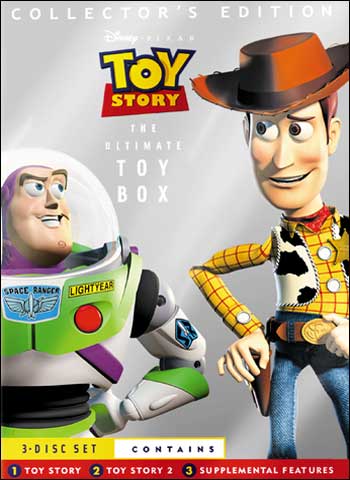
Pixar Blockbuster: Toy Story
In addition, the seven straight blockbusters gained Pixar so much revenue that they became the biggest studio (based on revenue) in Hollywood history, bigger than Paramount, bigger than Lucasfilm, bigger than them all. The bigger they got, the harder Job’s negotiated, and eventually they were more powerful than Disney in the animation department. Disney had no other choice left except to buy Pixar, making Jobs the current largest shareholder in all of Disney, Pixar, and ABC all at once. With that purchase, he became more powerful in the media industry than Ted Turner.
Back at Apple, they were facing serious issues ever since the failure of the Mac. Nothing had worked out, and they decided to try giving Jobs another shot. They never looked back. He cut so many Apple projects that he made the company profitable in six months. However, they were no longer a dominant in the market, taking a huge backseat to other major players. Job’s sold the Next software to Microsoft to get some profits back and Microsoft went on to use it to design Windows 95. Steve was so focused on quality though, that eventually Apple would regain its reputation. He focused on giving to schools, and got all the kids in the current generation using Macs…what would be a brilliant move for the future. Every school in California was given countless Macs and thus all the kids these days using are Macs…as are the teachers.
The hand held market was taking off in the early 2000’s and Job’s had to decide what direction to go. He made an unprecedented move by totally discontinuing all Apple’s interest in the hand help market. He said he just didn’t see a future in it and decided he wanted to go in the direction of music applications. At this point, there were many companies in music that were announcing failures. The invention of Napster had upset the music community so badly that it was near impossible to create anything profitable. Jobs had a different idea. He assessed what the music industry wanted and decided it was a good point to begin negotiations. The music industry feared losing its ability to make residuals because of theft and duplication. They were proposing some of the most ridiculous software which had chased out weaker negotiators, but not Jobs. The music industry wanted features such as monthly subscriptions but no downloads, or, downloads but only onto a single computer, or, downloads that would expire meaning music you bought disappeared after a while. Essentially, the concept of a music store with this type of guidelines would be a ridiculous venture. Steve took the initiative and went to all the top producers and many major labels and bands and presented his case for being able to offer the store with downloads that would have protection, meaning they could not be copied on to other computers or shared, but could be downloaded onto a single music player. In addition, if there was an attempt to transfer the music, it would automatically delete all music on that computer (a feature long gone). This was what Jobs had to doin order for the music industry to agree, and the only way he could offer this was to develop his own software with all these protections. Counter to what is believed to be manipulative marketing strategy to sell his I-pods, this was the reason I-tunes was designed in the limiting manner.
What would happen next changed the industry. Selling music for 99 cents each created billions for the industry, and the music industry eased up considerably as they saw internet sales as a viable way to sell their music and still make a lot of money on residuals. Essentially, Job’s had negotiated so hard with so many restrictions that initially the success of I-tunes meant that the music industry would lessen their desire to have so many restrictions, setting the table for many other music stores with FAR less restrictions.
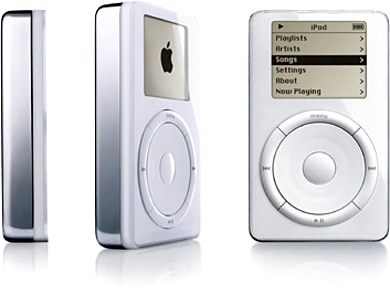
The first iPod (2001)
The iPod sold on its own merit. Jobs had a goal to make a player that was the easiest to use on the market. If you had to hit more than three buttons to reach any song, it would not be acceptable. He designed the pinwheel approach and the iPod sold on its own accord, and became the bedrock of digital music. Job’s was also brilliant in negotiating music legends to do their advertisements for free. He convinced them that the advertisements were just as much an endorsement for them as it was for Apple, so they agreed. .
At this point, he has been spot on for many projects in a row. Surprisingly, it was Pixar that made Job’s the most money, but his comeback at Apple making it one of the major players and viable competition for Microsoft’s dominance may end up being the ultimate story.
Text by Todd Arone (Thanks for the kind permission)
iCon Steve Jobs: The Greatest Second Act in the History of Business (Paperback)
by Jeffrey S. Young (Author), William L. Simon (Author)
Paperback: 368 pages
Publisher: Wiley; 1 edition (April 14, 2006)
Language: English
ISBN-10: 0471787841
ISBN-13: 978-0471787846
A sidebar to the Apple Macintosh review published in Byte, issue 8/1984, pp. 241-242.
At a glance

Apple Macintosh Review Byte
Manufacturer
Apple Computer Inc.
20525 Mariani Ave.
Cupertino, CA 95014
(408) 996-1010
Components
Size: 13.5 by 9.7 by 10.9 inches (main unit)
2.6 by 13.2 by 5.8 inches (keyboard)
Weight: 19.5 pounds
Processor: Motorola 68000 (7,8336 MHz)
Memory: 128K bytes of RAM; 64K bytes of ROM
Display: 9-inch built-in monitor; high-resolution bit-mapped display (512 by 342 pixels); adjustable
Keyboard: 58 keys, detached, standard layout, no function keys, software-mapped
Mouse: single button, mechanical tracking, optical shaft encoding
Mass storage: built-in single-sided 3½-inch Sony drive (400K bytes)
Sound generator: four-voice sound
Interfaces: two RS-422A serial ports (230.4K bps transfer rate); external-disk interface for second (optional) disk drive; mouse interface; synchronous serial keyboard bus
Operating System
Proprietary unnamed
Optional Hardware
Imagewriter dot-matrix printer: $595
Numeric keypad: $99
Carrying case: $99
Modem (300 bps): $225
(300/1200 bps): $495
Security Accessory Kit: $49
Second floppy-disk drive: $495
Optional Software
See text box
Documentation
160-page user’s manual
Price
$2495 ($2990 with Imagewriter)

Apple Macintosh Review Byte - Benchmark 1

Apple Macintosh Review Byte - Benchmark 2
* The Sieve benchmark couldn’t be run on the Mac (see text for details).
** The new Disk Copy program was not available at press time.
A sidebar to the Apple Macintosh review published in Byte, issue 8/1984, pp. 248.
A Second Opinion
The Macintosh is advertised as a 128K-byte machine. In reality, the Finder (Macintosh’s operating system) and other systems software take about 40K bytes. Subtract from this another 40K to 70K bytes for any applications programs that may be in memory and the 128K-byte Macintosh becomes an 18K- to 38K-byte machine. For example, when Mac’s Microsoft BASIC package is loaded on top of the resident software, there is only 13K bytes of space for programs and data left. Similarly, MacWrite, Macintosh’s word-processing program, only allows documents with a maximum size of about 24K bytes. This problem seems to be an inherent limitation in the current design of the Macintosh because there is no way to expand the memory capacity of the machine. When 256K-bit memory chips become available the Macintosh will be upgraded to a 512K-byte machine, enough space for the most ambitious application programs. However, at the time of this writing these chips are only in the development stage. This means that they will not be commercially available before 1985.
Continue reading →
httpv://www.youtube.com/watch?v=lSiQA6KKyJo
Steve Jobs:
It is now 1984. It appears IBM wants it all. Apple is perceived to be the only hope to offer IBM a run for its money. Dealers initially welcoming IBM with open arms now fear an IBM dominated and controlled future. They are increasing and desperately turning back to Apple as the only force that can ensure their future freedom. IBM wants it all and is aiming its guns on its last obstacle to industry control, Apple. Will Big Blue dominate the entire computer industry? The entire information age? Was George Orwell right about 1984?
Steve Jobs
The only problem with Microsoft is they just have no taste, they have absolutely no taste, and what that means is – I don’t mean that in a small way I mean that in a big way. In the sense that they they don’t think of original ideas and they don’t bring much culture into their product ehm and you say why is that important – well you know proportionally spaced fonts come from type setting and beautiful books, that’s where one gets the idea – if it weren’t for the Mac they would never have that in their products and ehm so I guess I am saddened, not by Microsoft’s success – I have no problem with their success, they’ve earned their success for the most part. I have a problem with the fact that they just make really third rate products.
Steve Ballmer
I will admit quite frankly that I think Windows today is probably four years behind, three years behind where it would have been had we not danced with IBM for so long. Because the amount of split energy, split works, split IQ in the company really cost our end customer real innovation in our product line and so whenever I hear these criticisms which I gotta to say sting eh sometimes, I say to myself just you watch, just you watch Windows 95, Windows 9…there’s no lack of focus there hasn’t been here for the last three or four years since we didn’t have this big spot with IBM. Even in the operating systems here now, you’ll start to see clear, clear…and people will recognise clear leadership.
The importance of Apple’s early days is often forgotten by the Mac community in our focus on a product that was released 7 years into Apple’s life. It is certainly long-forgotten by most of the rest of the world. The Apple I and, to a far larger extent, the Apple II were the first truly useful computers that you could *own* and have in your home or office. Certainly other products came online shortly thereafter, but it was Apple that really lit the way.
The History Channel Pays Homage To Apple, Steve Jobs, & Steve Wozniak: