Category Archives: Apple History TV

Apple Super Bowl Commercial 1984

“1984″ – Apple’s famous Super Bowl Spot

The most famous Super Bowl ad

The Hammer That Shattered the Monolith: How 60 Seconds Defined the Apple Mythos

It is January 22, 1984. Inside Tampa Stadium, Super Bowl XVIII is in full swing. The Los Angeles Raiders are systematically dismantling the Washington Redskins. But during a break in the third quarter, the game becomes a footnote. For 60 seconds, nearly 100 million Americans are pulled away from the grass and grit into a dystopian nightmare—and then shown a glimpse of a digital revolution.

This wasn’t just a commercial. It was a cinematic manifesto directed by Ridley Scott, a man who had just finished reshaping science fiction with Blade Runner.

The Aesthetic of the Abyss

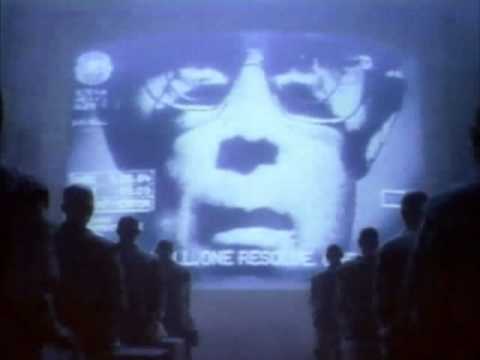
The spot opens on a monochrome, ash-colored world. Rows of hollow-eyed men, their heads shaved and spirits broken, march in lockstep through industrial corridors. They gather in a cold hall before a towering screen where a bespectacled “Big Brother”—a thinly veiled avatar for the then-dominant IBM—drones on about the “unification of thoughts.”

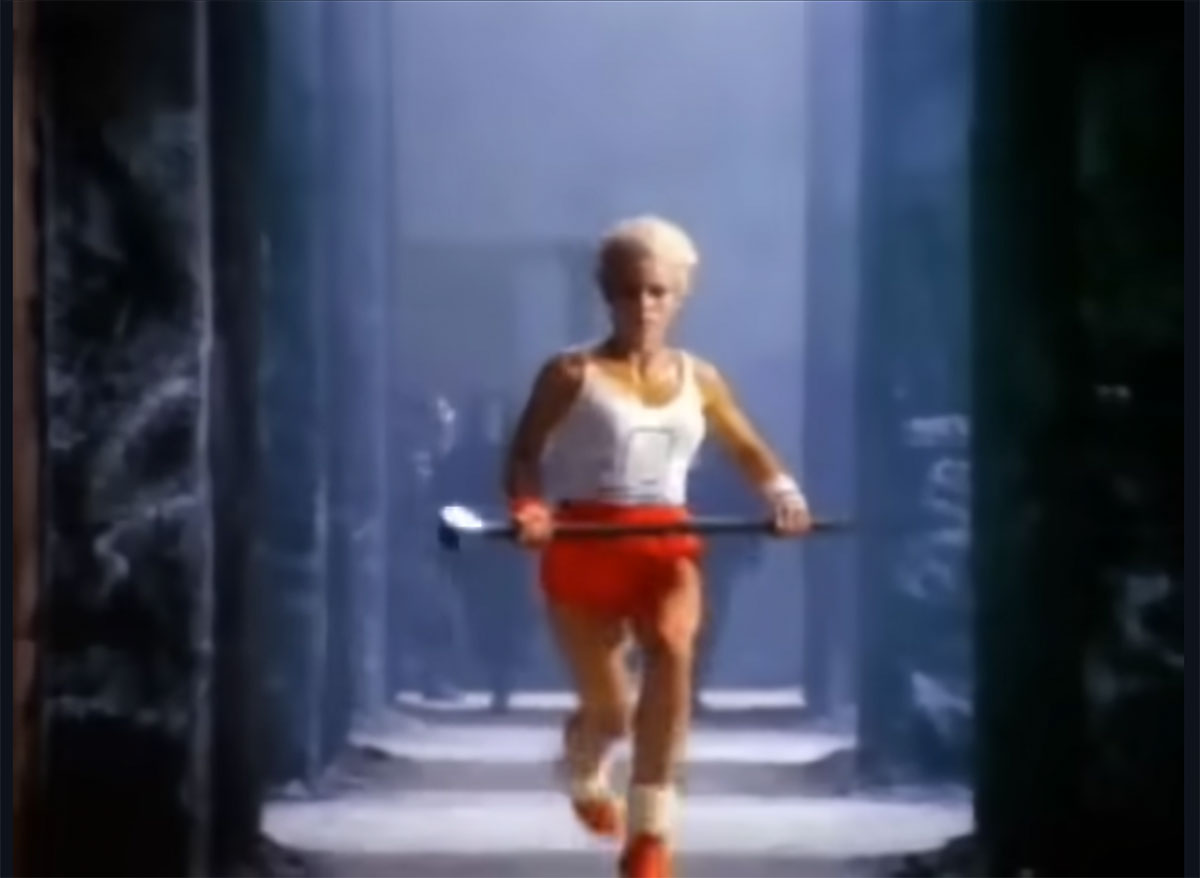
Then, a flash of color breaks the gray. A young woman (played by British athlete Anya Major) sprints toward the screen, pursued by riot police. She wears bright orange shorts and a white tank top emblazoned with a line drawing of a computer. In her hands, she swings a heavy sledgehammer with the grace of an Olympian. As she releases the hammer, it sails through the air and crashes directly into the face of the tyrant.

The screen explodes in a blinding white light. A voiceover—and a simple scroll of text—delivers the finishing blow: “On January 24th, Apple Computer will introduce Macintosh. And you’ll see why 1984 won’t be like ‘1984’.”

Corporate Cold Feet: The Board vs. The Visionaries

Today, the “1984” ad is heralded as the greatest commercial of all time. Yet, it almost never aired.

The backstory is a corporate thriller. The agency Chiat/Day had crafted the concept, and Steve Jobs was immediately electrified by it. He wanted a “thunderclap.” However, when the finished film was screened for Apple’s board of directors in December 1983, the reaction was icy silence.

Mike Markkula, Apple’s chairman and major investor, was horrified. “This is the worst ad I’ve ever seen. Who wants to fire the agency?” he reportedly asked. The board ordered CEO John Sculley to sell back the expensive Super Bowl airtime they had already purchased.

Wozniak’s Act of Rebellion

Steve Jobs, refusing to see his masterpiece buried, showed the spot to co-founder Steve Wozniak. “Woz” was so blown away that he offered to pay for half of the airtime out of his own pocket if the board refused to budge. “If Apple won’t run it, I’ll pay $400,000 and you pay $400,000,” Wozniak told Jobs.

In the end, it was a mix of chutzpah and luck: Chiat/Day claimed they couldn’t find a buyer for the 60-second slot in time. With the slot already paid for and no one to take it, Apple was forced to run the ad.

Skinheads and Discus Throws: The Making of a Legend

Ridley Scott’s production was grueling and authentic. Filmed at Shepperton Studios in London, Scott didn’t hire standard extras. To achieve the look of a true oppressed proletariat, he hired actual London skinheads for a pittance and the promise of a free lunch. The atmosphere on set was reportedly tense, with the extras’ rowdy behavior adding a layer of genuine grit to the film.

The choice of Anya Major for the lead role was a stroke of casting genius. Many models had auditioned, but most couldn’t even swing the hammer while running. Major was an experienced discus thrower; she had the muscle memory and the athletic form to hurl the sledgehammer with deadly precision.

The Legacy: When Advertising Became Art

The impact the next morning was unprecedented. News stations didn’t just talk about the ad; they replayed it in its entirety during their broadcasts. Apple generated over $5 million in free publicity. Overnight, the Macintosh became more than a piece of hardware; it became a symbol of individuality and freedom.

“1984” marked the moment advertising stopped merely explaining products and started creating myths. It was the birth of Apple as a lifestyle brand and Steve Jobs as the high priest of the digital counter-culture.

There is a modern irony to the story: today, critics often point at Apple’s massive market cap and closed ecosystem, suggesting the company has become the very “Big Brother” it once vowed to destroy. Regardless of the politics, the 60-second storm Ridley Scott and Steve Jobs unleashed remains a masterclass in storytelling—a hammer throw that changed the cultural trajectory of technology forever.

The commercial was rebroadcast in an updated version in 2004 on its 20th anniversary, with the heroine modified to be listening to an iPod. Viewers generally saw the Big Brother target of the Apple advertisement as being Microsoft, with the original villain, IBM, being all but forgotten.
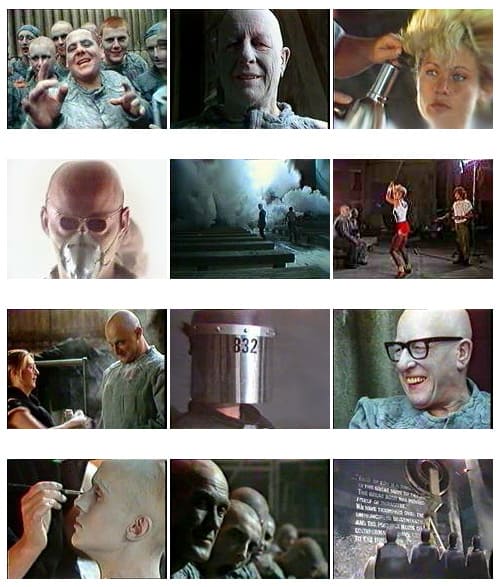
Making of the Apple Ad 1984

Apple commercial “1984”: The Plot

The commercial opens with a dystopic, industrial setting in blue and gray tones, showing a line of people (of ambiguous gender) marching in unison through a long tunnel monitored by a string of telescreens. This is in sharp contrast to the full-color shots of the nameless runner (Anya Major). She looks like an Olympic track and field athlete, as she is carrying a large brass-headed hammer and is wearing an athletic “uniform” (bright orange athletic shorts, running shoes, a white tank top with a cubist picture of Apple’s Macintosh computer, a white sweat band on her left wrist, and a red one on her right).

As she is chased by four police officers (presumably agents of the Thought Police) wearing black uniforms, protected by riot gear, helmets with visors covering their faces, and armed with large night sticks, she races towards a large screen with the image of a Big Brother-like figure (David Graham, also seen on the telescreens earlier) giving a speech:

My friends, each of you is a single cell in the great body of the State. And today, that great body has purged itself of parasites. We have triumphed over the unprincipled dissemination of facts. The thugs and wreckers have been cast out. And the poisonous weeds of disinformation have been consigned to the dustbin of history. Let each and every cell rejoice! For today we celebrate the first, glorious anniversary of the Information Purification Directive! We have created, for the first time in all history, a garden of pure ideology. Where each worker may bloom secure from the pests purveying contradictory truths. Our Unification of Thoughts is more powerful a weapon than any fleet or army on earth. We are one people, with one will, one resolve, one cause. Our enemies shall talk themselves to death and we will bury them with their own confusion. We shall prevail!

The runner, now close to the screen, hurls the hammer towards it, right at the moment Big Brother announces, “we shall prevail!” In a flurry of light and smoke, the screen is destroyed, shocking the people watching the screen.
The commercial concludes with a portentous voiceover, accompanied by scrolling black text (in Apple’s early signature “Garamond” font); the hazy, whitish-blue aftermath of the cataclysmic event serves as the background. It reads:

On January 24th, Apple Computer will introduce Macintosh. And you’ll see why 1984 won’t be like “1984.

The screen fades to black as the voiceover ends, and the rainbow Apple logo appears.

Apple commercial “1984”: The Production

Development

The commercial was created by the advertising agency Chiat/Day, Venice, with copy by Steve Hayden, art direction by Brent Thomas and creative direction by Lee Clow. Ridley Scott (whose dystopian sci-fi film, Blade Runner was released two years prior) was hired by agency producer Richard O’Neill to direct it, with a then-“unheard-of production budget of $900,000.” The actors who appeared in the commercial were paid $25 per day.

Steve Jobs and John Sculley were so enthusiastic about the final product that they “…purchased one and a half minutes of ad time for the Super Bowl, annually the most-watched television program in America. In December 1983 they screened the commercial for the Apple Board of Directors. To Jobs’ and Sculley’s surprise, the entire board hated the commercial.” However, Scully himself got “cold feet” and asked Chiat/Day to sell off the two commercial spots.

Despite the board’s dislike of the film, Steve Jobs continued to support it. Steve Wozniak watched it and offered to pay for half of the spot personally if the board refused to air it.

Of the original ninety seconds booked, Chiat/Day managed to resell thirty seconds to another advertiser, leaving the other sixty second slot.

Intended message

Adelia Cellini states in a 2004 article for MacWorld, “The Story Behind Apple’s ‘1984’ TV Commercial“:

Let’s see – an all-powerful entity blathering on about Unification of Thoughts to an army of soulless drones, only to be brought down by a plucky, Apple-esque underdog. So Big Brother, the villain from Apple’s ‘1984’ Mac ad, represented IBM, right? According to the ad’s creators, that’s not exactly the case. The original concept was to show the fight for the control of computer technology as a struggle of the few against the many, says TBWA/Chiat/Day’s Lee Clow. Apple wanted the Mac to symbolize the idea of empowerment, with the ad showcasing the Mac as a tool for combating conformity and asserting originality. What better way to do that than have a striking blonde athlete take a sledghammer to the face of that ultimate symbol of conformity, Big Brother?

However, in his 1983 Apple keynote address, Steve Jobs made the following comment before showcasing a preview of the commercial to a select audience:

It is now 1984. It appears IBM wants it all. Apple is perceived to be the only hope to offer IBM a run for its money. Dealers initially welcoming IBM with open arms now fear an IBM dominated and controlled future. They are increasing and desperately turning back to Apple as the only force that can ensure their future freedom. IBM wants it all and is aiming its guns on its last obstacle to industry control, Apple. Will Big Blue dominate the entire computer industry? The entire information age? Was George Orwell right about 1984?

Apple commercial “1984”: The Reception

Awards

* 2007: Best Super Bowl Spot (in the game’s 40-year history)

* 1999: TV Guide – Number One Greatest Commercial of All Time

* 1995: Advertising Age – Greatest Commercial

* 1984: 31st Cannes Lions International Advertising Festival – Grand Prix

Social impact

Ted Friedman, in his 2005 text, Electric Dreams: Computers in American Culture, notes the impact of the commercial:

Super Bowl viewers were overwhelmed by the startling ad. The ad garnered millions of dollars worth of free publicity, as news programs rebroadcast it that night. It was quickly hailed by many in the advertising industry as a masterwork. Advertising Age named it the 1980s Commercial of the Decade, and it continues to rank high on lists of the most influential commercials of all time […] 1984 was never broadcast again, adding to its mystique.

1984 became a signature representation of Apple computers. It was scripted as a thematic element in the 1999 docudrama, Pirates of Silicon Valley, which explores the rise of Apple and Microsoft (the film opens and closes with references to the commercial including a re-enactment of the heroine running towards the screen of Big Brother and clips of the original commercial).

“1984” became a signature representation of Apple computers. It was scripted as a thematic element in the 1999 docudrama, Pirates of Silicon Valley, which explores the rise of Apple and Microsoft (the film opens and closes with references to the commercial including a re-enactment of the heroine running towards the screen of Big Brother and clips of the original commercial). The “1984” ad was also prominent in the 20th anniversary celebration of the Macintosh in 2004, as Apple reposted a new version of the ad on its website. In this updated version, an iPod, complete with signature white earbuds, was digitally added to the heroine. Attendees were given a poster showing the heroine with iPod as a commemorative gift.

Influence in media

A commercial for the video game Half-Life 2 was based on this commercial. A parody of the commercial is seen in the Futurama episode Future Stock, promoting Planet Express. Another parody appears in The Simpsons TV show episode Mypods and Boomsticks, featuring Steve Jobs as “Big Brother” and the Comic Book Guy as the runner.

For the 20th anniversary of the Macintosh, Apple re-released the ad with the runner wearing an iPod.

Further reading

Source:

1984 (advertisement). (2012, May 13). In Wikipedia, The Free Encyclopedia. Retrieved 12:12, June 2, 2012, from http://en.wikipedia.org/w/index.php?title=1984_(advertisement)&oldid=492407781

A Look Back at Apple’s Super Ad : NPR.

This article is licenced under the GNU Free Documentation License
Tim Cook about his first year as Apple CEO

NBC News “Rock Center with Brian Williams,” December 6, 2012

Nobody remembers the guy who came after Thomas Edison. And nobody seems to recognize Tim Cook as we walk together across the teeming floor of Grand Central Station.

Tim Cook:

I’m a very private person, I like my being anonymous

As we walk: we’re surrounded by examples of what Apple has done to our society — both good and bad.

People now live their lives while listening to the soundtrack of their lives. Communicating with members of their own community while ignoring the actual community around them.

And in this marble monument to another time, where trains lumber to a halt, two stories beneath our feet — we go up the stairs into what we were told the future would look like. The red shirts greet us. And Tim Cook is home now — in the Apple Store — where the successor to Jobs is suddenly treated more like Jagger.

Tim Cook:

It’s pretty spectacular … who else would put a store like this in Grand Central Station?

And who else would have us believe they intend to be the one company that reverses hundreds of years of business history — by becoming the one company that never fades away into irrelevance.

Brian Williams:
You realize if you’re a company that can keep amazing us, consumers, if you’re a company that can stay fresh without an expiration date, you’ll be the first company ever to do that. There is a cycle, a circle of life, a life and death. And you’re trying to buck that trend.

Tim Cook:

Don’t bet against us, Brian. Don’t bet against us.

We started our day with Tim Cook in lower Manhattan, at another of his 250 austere Apple stores where we began the questioning with: what’s different about him.

Brian Williams:
How are you not Steve Jobs?

Tim Cook:

In many ways. One of the things he did for me — that removed a gigantic burden that would have normally existed is he told me, on a couple of occasions — before he passed away, to never question what he would have done. Never ask the question “What Steve would — do,” to just do what’s right.

Doing right has done well for Tim Cook so far. He’s had a good first year on the job – the company’s stock is up about 45% during his tenure, and think about this: he’s already presided over the rollout of 3 iPads, 2 iPhones and 3 Macs.

Brian Williams:
It’s beautiful.

Tim Cook:

Absolutely stunning. Every detail has been focused on.

Brian Williams:
So, you’ve got guys whose job it is to get this mesh right to get this curve right …

Tim Cook:

To get it precisely right.

In fairness, however — this past year, they haven’t gotten everything precisely right.

Starting with Siri … the small woman who lives in your iPhone. The service amazed all of us at first — but then came under criticism for not being … perfect … or as consistently amazing as Steve Jobs wanted it to be.

And then there are the maps … iPhones used to come with Google maps until they set out on their own — but Apple’s version wasn’t quite ready for launch. It lacked some critical street smarts. And in those early days — God help you if you went anywhere near the Brooklyn Bridge or the Hoover Dam. It was a rare and public embarrassment and Cook fired two top executives in charge.

Brian Williams:
How big of a setback was Maps?

Tim Cook:

It didn’t meet our customers’ expectation, and our expectations of ourselves are even higher than our customers’. However, I can tell ya — so we screwed up.

Brian Williams:
And you said goodbye to some executives.

Tim Cook:

Well, we screwed up. And we are putting the weight of the company behind correcting it.

As for the iPhone 5 itself … they have flown off those perfect Apple store shelves. Apple sold 5-million of them in the first weekend alone, breaking all previous sales records. But buyers of the iPhone 5 soon discovered they had to buy something else – none of the old power cords work on the new equipment.

Brian Williams:
Why did we have to buy new cords for this?

Tim Cook:

As it turns out, we had a connector, a 30-pin connector that we used for a decade or more-

Brian Williams:
I’ve got 500 of ‘em at home-

Tim Cook:

You have a few of those –

Brian Williams:
If you need any. Yeah.

Tim Cook:

On iPod. But, Brian, it was one of those things where we couldn’t make this product with that connector — but let me tell you; the product is so worth it.

And that’s the thing about Apple. Sleek isn’t cheap. Those white ear buds announce to the worldyou’ve got a of couple hundred dollars to spend. Your investment will buy you a staggeringly beautiful product that works unlike any other … and in a lot of workplaces, including our own, the Apple products you’ll see are the ones people bring in from home … they’re usually right there on the desk, next to the computers we have to use for work.

Apple prides itself on being equal parts computer-company and religion. Apple fans get whipped up into a stampeding froth with every new product release … customers famously camp outdoors and then emerge triumphant, emotionally spent. Journalists flock to those dramatic product rollouts — as if the CEO is going to reveal stone tablets instead of the kind with scratch-proof glass. And the legendary Apple culture of secrecy is designed to keep it that way.

Brian Williams:
Why are you institutionally so secretive? How is it that you know how many times I’ve listened to Bob Dylan or Kendrick Lamar or “Have Yourself a Merry Little Christmas” and yet we never get to know anything about you guys?

Tim Cook:

We think that holding our product plans secret is very important because people love surprises.

This was one surprise Apple may not have loved. The new Samsung ad campaign — its blistering, bold, damaging. It portrays Apple products and the people who love them … as somehow passé and uncool and even desperate. It’s a blunt instrument disguised as satire, and it’s a frontal attack on a giant that would have been unthinkable not too long ago.

(Samsung ad:)

Woman: Hey what’d you just do?
Man: I just sent him a playlist
Man: By touching phones?
Man: Yep, simple as that
Woman: It’s the Galaxy S3
Man: I’ll see you at the studio later
Woman: When do you think we’re going to be able to do that thing?
Mom: Hey
Son: Hey mom dad
Mom: Thanks for holding our spot
Son: You guys have fun — home by midnight you two
Announce: The next big thing is already here Samsung Galaxy S3
Mom: But honey this is the line for apps, I stand

The unmistakable message right there? Apple products are for your parents. Samsung makes the really cool stuff and they’re much more casual about it.

Brian Williams:
They came along and tried to paint those with white earbuds, Apple users, as losers. They’re trying to paint their product as cool and yours as not cool. Is this thermonuclear war?

Tim Cook:

We love our customers. And we’ll fight to defend them with anyone. Is it thermonuclear war? The reality is, is that we love competition, at Apple. We think it makes us all better. But we want people to invent their own stuff.

He’s talking about the legal fight between Apple and Samsung — they have sued each other in courts around the world over patent infringements. Apple won the last round in the U.S. when a jury ruled Samsung owed them a billion dollars for stealing ideas. Samsung was back in court just today appealing the judgment. Sometimes the business of making pretty things … can get ugly.

Brian Williams:
How tough is your business, how surprised would we civilians be at how rough it gets? Spying, skullduggery?

Tim Cook:

It’s tough. It’s very tough. You have people tryin’ to hack into systems on a constant basis. You have people trying to elicit confidential information — about future product plans. All of these things are things that we constantly fight.

And then there’s Tim Cook’s larger challenge: the man who rhapsodizes about the perfectly rounded edges of his products … vows to always keep Apple cutting edge.

Brian Williams:
It sounded to me that you and I grew up the same American life, kind of grindingly simple and normal American middle class household — when you and I as kids would go to a neighbor’s house and see, under their new TV, Sony Trinitron, that would tell us something instantly. And you’re smiling. And that brand lasted up until — Walkman, Discman. But then, fast-forward to today, it’s less meaningful. How do you not become Sony, with all apologies to Sony?

Tim Cook:

We’re very simple people at Apple. We focus on making the world’s best products and enriching people’s lives. I think some companies — maybe even the one that you mention, maybe they decided that they could do everything. We have to make sure, at Apple, that we stay true to focus, laser focus — we know we can only do great things a few times, only on a few products.

But will the next great thing be Apple’s long-rumored move … into the television business?

Tim Cook:

It’s a market that we have intense interest in, and it’s a market that we see that has been left behind.

Tim Cook has more to say about Apple’s entry into television … in part two of our interview, when we come right back.

Visit NBCNews.com for breaking news, world news, and news about the economy

In August 2011, Tim Cook was made CEO of Apple. Steve Jobs reduced his own role to Chairman of the Board, then less than two months later he was gone … after a long fight with pancreatic cancer.

It was Tim Cook who was chosen to preside over the private memorial service for Apple employees — thousands of people gathered as the face of the founder gazed down upon them from the side of the building.

Tim Cook:

It was — it was the saddest time in my life.

Brian Williams:
Did you know how sick he was?

Tim Cook:

I always thought that he would bounce back. Because he always did. And it wasn’t until extremely close to the end that I reached a — sort of an intellectual point that — that he couldn’t bounce this time.

It’s his company to run now, and after a peaceful transition of power, he was quickly forced into crisis footing because of the situation in China … where so many Apple products are assembled by skilled workers. There’s been trouble, and Cook travelled there after harsh criticism of poor working conditions and low wages dissolved into violence. The situation was later parodied on “SNL” — by cast members who actually make up the heart of Apple’s demographic.

“SNL’S” FRED ARMISEN:

Ohhhhh, no. Talk about Apple Map. It won’t work, right? It take you to wrong place? You want Starbuck, it take you to Dunkin’ Donut? That must be… so hard for you!

China remains a major issue for Apple, and Tim Cook seems to have a ready answer for it.

Brian Williams:
Why can’t you be a made-in-America company?

Tim Cook:

You know, this iPhone, as a matter of fact, the engine in here is made in America. And not only are the engines in here made in America, but engines are made in America and are exported. The glass on this phone is made in Kentucky. And so we’ve been working for years on doing more and more in the United States. Next year, we will do one of our existing Mac lines in the United States.

Brian Williams:
Let’s say our Constitution was a little different and Barack Obama called you in tomorrow and said, “Get everybody outta China, and do whatever you have to do. Make these, make everything you make in the United States.” What would that do to the price of this device?

Tim Cook:

Honestly, it’s not so much about price it’s about the skills, et cetera. Over time, there are skills that are associated with manufacturing that have left the U.S. Not necessarily people, but the education system stopped producing them.

Cook says Apple has already created more than 600,000 jobs here in the US. That includes everything from research and development, to retail to a solar power farm. He also points to the APP industry — another one of those that didn’t exist before Apple came along … all those icons and all those downloads employ a lot of people.

It was such a different world just six years ago when we sat down with Steve Jobs for one of his last television interviews. He showed us around Apple’s flagship store on 5th Avenue in New York, which six years later is still the big glass granddaddy of them all. Back then he was, as usual, all about the future.

{SOT STEVE JOBS Interview}:

We’ve got some really great ideas of the products we’re going to build next year and the year after that we’re working real hard on. So I think that’s- our focal length is always forward.

Brian Williams:
You’re so different. He was all black turtleneck and the glass frames and mystical and mysterious, and — you know, forgive me, you and I could work at a Best Buy. We’re, you know, plain-looking people. You’re a much more conventional-seeming guy. But there’s obviously brain power he saw in you that you brought to bear on this job.

Tim Cook:

I’m not sure a conventional person would’ve come to Apple at that point in time. Almost everyone I know thought I was crazy.

That’s because Apple was on the ropes back in 1998, Steve Jobs had just come back and was trying to steal Cook away from Compaq Computer … a now-faded name that was actually vibrant back then.

Tim Cook:

I just got to Compaq, I’d just gotten to Houston. I agreed to come out and talk — five minutes into my conversation with him, I was willing to throw caution to the wind and come to Apple. And the rest is history.

Tim Cook’s personal history starts in Robertsdale, Alabama — the son of a Gulf Coast shipyard worker and a mom that stayed at home. After working in an aluminum factory as a teenager he went off to Auburn and then to Duke for an MBA. Among what little else we know about him: he’s got a lot of Bob Dylan on his iPod, and Bobby Kennedy was his hero. He still has his accent from the South. These days he finds solitude in the West.

Brian Williams:
For all the folks trying to get to know you and figure you out — where do you go when you need to go someplace?

Tim Cook:

I work out to keep stress away. I’m in the gym by 5a.m. every morning. If I have some free time, I go to a National Park. I love getting in nature and so this – these are the things that calm my mind and allow me to think clearly so that’s what I do.

Brian Williams:
This is kind of your television-coming-out, and I’m glad you did this. Does this mean you have reached a cruising altitude?

Tim Cook:

There’s no – maybe for other CEOs. There’s no cruising altitude at Apple.

Tim Cook is a manager with a vision — who is following in the footsteps of a visionary turned manager. While he has to worry about global issues like the counterfeiters who instantly turn fake copies of every new Apple product: Cook has to keep one eye on the stock price, constantly, and the other on the future and that sure sounds like it means TV.

Brian Williams:
What can Apple do for television watching? What do you know that is gonna change the game, that we don’t know yet?

Tim Cook:

It’s a market that we see, that has been left behind. You know, I used to watch “The Jetsons” as a kid.

Brian Williams:
Absolutely.

Tim Cook:

I love “The Jetsons.”

Brian Williams:
I was right there with Elroy.

Tim Cook:

We’re living “The Jetsons” with this.

{SOT “The Jetsons:” George you’ll never guess what happened}

Brian Williams:
Facetime is “The Jetsons” but television is still television.

Tim Cook:

It’s an area of intense interest. I can’t say more than that. But …

Brian Williams:
I’m not shocked. All right, complete this sentence “Ten years from now, Americans are going to be amazed that they ever ___” What’s the — give us broad generalities. What’s the new thing?

Tim Cook:

(LAUGH)

Brian Williams:
It’s okay to tell me.

Tim Cook:

Love it. I love it.

Brian Williams:
Let this stuff out. Whatever you’re thinking of for the future … it’s all right.

Tim Cook:

Our whole role in life is to give you something you didn’t know you wanted. And then once you get it, you can’t imagine your life without it.

Brian Williams:
Starting with?

Tim Cook:

And you can count on Apple doing that.

Brian Williams:
Oh man, that’s frustrating.

Apple remembers Steve Jobs on anniversary of his passing

Tim Cook remembers Steve Jobs

Apple’s CEO Tim Cook remembered the company’s late cofounder, Steve Jobs on the one-year anniversary of Jobs’ passing. The letter with a video montage appeared on Apple’s website to remember his life and death. The nearly two-minute video presents a slideshow of Jobs throughout his career and it softly ends with “Remembering Steve”.

Jobs died on Oct. 4, 2011. After he passed, at just 56 years old, news of his death flooded the Internet, TV, newspapers, and homes. Millions of people immediately emailed Apple, and the company subsequently created a “Remembering Steve” page to display a massive compilation of condolences that poured in from around the world.

The tribute letter from Apple’s current CEO appears upon completion of the “Remembering Steve” video. In the message, Cook describes Jobs’ death as a “sad and difficult time”. The executive hopes, however, that everyone will “reflect on [Jobs’] extraordinary life and the many ways he made the world a better place.”

A Message from Tim Cook, Apple’s CEO.

Steve’s passing one year ago today was a sad and difficult time for all of us. I hope that today everyone will reflect on his extraordinary life and the many ways he made the world a better place.

One of the greatest gifts Steve gave to the world is Apple. No company has ever inspired such creativity or set such high standards for itself. Our values originated from Steve and his spirit will forever be the foundation of Apple. We share the great privilege and responsibility of carrying his legacy into the future.

I’m incredibly proud of the work we are doing, delivering products that our customers love and dreaming up new ones that will delight them down the road. It’s a wonderful tribute to Steve’s memory and everything he stood for.
– Tim

PBS: Steve Jobs: One Last Thing

Few men have changed our everyday world of work, leisure, and human communication in the way that Apple founder, Steve Jobs, has done. This PBS documentary looks not only at how his talent, his style and his imagination have shaped all of our lives, but also at the influences that shaped and moulded the man himself. Since his untimely death, tributes from around the world have secured Steve’s place in the pantheon of great Americans.

PBS talked to the people who changed the man, who changed our world. Through interviews with the people who worked closely with him or chronicled his life, PBS gaines unique insight into what made him tick. In a never before broadcast, exclusive interview, Steve Jobs expounds his own philosophy of life, and offers advice to us all on changing our own lives to achieve our ambitions, our desires, and our dreams. “Life can be much broader once you discover one simple fact; that everything around you that you call life was made up by people no smarter than you…the minute you understand that, you can poke life; you can change it, you can mould it, embrace it, make you mark upon it. Once you learn that…. you’ll never be the same again.”

Apple’s 1984 spoof of ‘Ghostbusters’ goes after IBM

This is a 4-minute, uncut version of “Blue Busters”, a 1984 takeoff on ‘Ghostbusters’ that Apple produced to show at the opening of its worldwide sales staff meeting in Hawaii in October 1984. The video includes a cameo appearance by Steve Wozniak. Craig Elliott, former Apple employee now CEO and co-founder of cloud-computing startup Pertino Networks, gave access to this video.

Also shown at that meeting was another film in which Steve Jobs impersonates FDR. That film can be seen here:
https://www.mac-history.net/steve-jobs/2012-05-05/steve-jobs-acts-as-franklin-d-roosevelt-bizarre-internal-apple-promo-1984

Dieter Rams talks about design at Apple

Dieter Rams talks about being bum-rushed at a party by Philippe Starck, who exclaimed, “Apple is stealing from you!” But when it comes to Ive and Apple, Rams subscribes to the adage “Imitation is the sincerest form of flattery.”

via Our Interview With Dieter Rams, The Greatest Designer Alive [Video] | Co.Design: business + innovation + design.

https://web.archive.org/web/20210624214810/https://www.fastcompany.com/1663906/our-interview-with-dieter-rams-the-greatest-designer-alive-video

—————

And another interesting interview with Dieter Rams at Fastcodesign.com:

If you were to design a computer now, what would it look like?

It would look like one of Apple’s products. In many magazines, or on the Internet, people compare Apple products to things which I designed, with this or that transistor radio from 1965 or 1955. In terms of aesthetics, I think their designs are brilliant. I don’t consider it an imitation. I take it as a compliment.

Steve Jobs acts as Franklin D. Roosevelt – Bizarre internal Apple promo (1984)

Apple’s marketing history may seem like a continual streak of genius advertising, but even the mighty gadget company has suffered a few stumbles. Take this rarely seen sequel to Apple’s epic “1984” ad spot that features Steve Jobs showing off his acting chops as Franklin Roosevelt in 1944.

Steve Jobs acts as Franklin D. Roosevelt

The full clip, clocking in at a lengthy 9 minutes, was created for a sales associates meeting held in Hawaii in 1984. Jobs’ role as FDR leading the charge against enemy forces was meant as a rallying call to defeat IBM’s dominance.

My reader Ned Truslow wrote two years in a comment on mac-history.net about this video:

I was a props master on it and also am featured in the video. It was a black and white film that had Steve and his guys acting like generals in World War II and they had Mac soldiers who were being airdropped behind “enemy” lines and taking backpacks filled with Mactosh’s to zombie-fied office workers whose lives were stuck in limbo with old office hardware. Once the Mactosh’s are placed on all the office workers’ desks and switched on, the office workers come more alive and are happy. We shot the plane sequence at an airstrip in Mojave, California, and did most of the stuff with Steve and his guys, along with me taking time off from doing props on the video to act as a zombie office worker, all on a studio soundstage in Los Angeles sometime around July of 1984. Anyway, I’ve never seen this 20-minute video online anywhere. Just would love to know if you have an idea of where it might be located, if anywhere.

Ned Truslow

Okay, here we are.