Tag Archives: Steve Wozniak

How the Founders of Apple Got Rich

The two main Apple founders – Steve Jobs and Steve Wozniak – both came from humble backgrounds and were not endowed with commercial success. In order to afford the first pieces of the Apple I in 1976, they almost literally sold the shirts off their backs. Jobs invested the proceeds from the sale of his VW bus ($1,500 dollars). “Woz” parted with his beloved programmable calculator Hewlett-Packard 65 and deposited 250 dollars in the company’s treasury.

Ronald Wayne (Photo courtesy of Owen Linzmayer)

Ronald Gerald Wayne, the “third founder” of Apple Computer, was with the company for only a short time. He illustrated the first Apple logo and wrote the Apple I manual. While at Apple, he also wrote their partnership agreement. Wayne worked with Jobs at Atari before co-founding Apple Computer on April 1, 1976. He was given a 10% stake in Apple, but relinquished his stock for 800 dollars only two weeks later because legally, all members of a partnership are personally responsible for any debts incurred by any of the other partners.

After Apple’s IPO, Wayne’s stake could have been worth as much as US$ 1.5 billion. He claimed that he didn’t regret selling the stock as he had made “the best decision available at that time.” According to CNET, as of 1997 Wayne was working as an engineer for a defense contractor in Salinas, California.

See also: Two days in the desert with Apple’s lost founder, Ron Wayne @ engadget.com
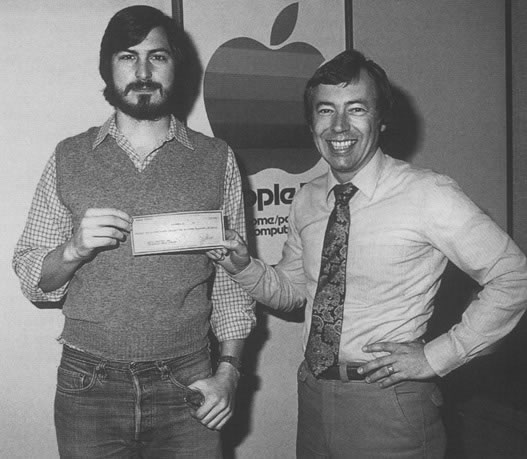
Steve Jobs and Mike Markkula

The foundations for the commercial success were laid in 1977 by venture capitalist Arthur Rock as well as by the ex-Intel manager Mike Markkula, who invested 92,000 dollars in Apple and secured a bank loan of 250,000 dollars. Markkula was lured out of retirement by Steve Jobs, who was referred to him by Regis McKenna and venture capitalist Don Valentine.

Valentine—who after meeting the young, unkempt Jobs asked McKenna, “Why did you send me this renegade from the human race?”—was not interested in funding Apple, but mentioned Jobs’ new company to Markkula. Jobs visited him and convinced Markkula of the market for the Apple II and personal computers in general. Later Valentine asked Markkula if he could also invest in Apple.
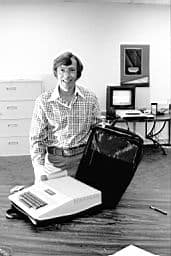
Mike Markkula at the Apple offices April 1, 1977

In 1977, Markkula brought his business expertise along with US$250,000 ($80,000 as an equity investment in the company and $170,000 as a loan) and became employee number 3. The investment would pay off for Markkula. Before Apple went public in 1980, he owned a third of the company.

Markkula also brought in Apple’s first CEO, Michael Scott, then took the job himself from 1981 to 1983. Markkula served as chairman from 1985 until 1997, when a new board was formed after Jobs returned to the company. Wozniak, who virtually single-handedly created the first two Apple computers, credits Markkula for the success of Apple more than himself. “Steve and I get a lot of credit, but Mike Markkula was probably more responsible for our early success, and you never hear about him,” told Wozniak the Failure Magazine in July 2000.

Excerpt of the TV documentary “Triumph of the Nerds” (PBS)


With the initial public offering on December 12, 1980, Jobs and Wozniak became multimillionaires, as Apple Computer was now valued at 1.8 billion dollars. Jobs possessed 7.5 million stocks (217 million dollars); “Woz” was assigned four million stocks (116 million dollars). Markkula’s share of seven million stocks was worth 203 million.

“I was worth about over a million dollars when I was twenty-three and over ten million dollars when I was twenty-four, and over a hundred million dollars when I was twenty-five,” Jobs said in an interview with Robert Cringley (”Triumph of the Nerds“) in 1996. “And it wasn’t that important because I never did it for the money.”

Read next page: Steve Jobs: It’s not about the money

Steve Jobs and Steve Wozniak talk about the company’s beginnings (Video)

In this vintage nine-minute video, cofounders Steve Jobs and Steve Wozniak looked back at some of it, dating all the way back to 1976’s Apple I.


The speaker at the start of the video is Paul Terrell, who founded one of the world’s first computer stores, the Byte Shop, in Mountain View, California, in 1975. The next year, he played a significant role in Apple history by placing an order for 50 of Wozniak and Jobs’s Apple I computers—on the contingency that they supply them fully assembled, rather than as a solder-it-yourself kit.


Source: Fast Company

Steve Wozniak Debunks One of Apple’s Biggest Myths

In 1976, The Apple 1 computer went on sale for a retail price of $666.66. Steve Wozniak, who co-founded Apple with Steve Jobs and designed that product, remembers the early days.

1976The Apple I computer goes on sale for a retail price of $666.66.

You said you saw a revolution coming. Do you think Steve Jobs did?
He had always spoken about wanting to be a person that moves the world forward, but he couldn’t really create things and design them like I could. Steve wanted a company real badly. His thinking was not necessarily about what computers would do for the average Joe in the average home. Steve found the words that explained what these computers would do for people and how important it was a little later in life.

You mentioned you didn’t like conflict. Did Steve like conflict?
Steve was going to make sure that his position was strong and forceful and heard by others. Thankfully he had the best brain. He usually had a little, tiny suggestion, but almost always he was right.

How many computers did you sell?
We only sold about a hundred Apple I’s. Of the Apple II’s, we probably sold a few thousand through the first year. And then [we designed] a spreadsheet program that let small businessmen do more work in one hour than they could do in 10 years with pencil and paper. Sales shot up. It was maybe five years before we sold a million—the first computer ever to sell a million.

Did you think Apple would become a behemoth?
When we started the company, I knew that the computer was so far ahead of anything the rest of the world had ever seen. We knew we had a revolution. Everyone who joined Apple, this was the greatest thing in their life.

Read more:
Bloomberg BusinessWeek: Steve Wozniak on Apple, the Computer Revolution, and Working With Steve Jobs

Blue Box – Why Steve Jobs and Steve Wozniak hacked the phone network

Before Steve Wozniak and Steve Jobs built Apple in the 1970s, they were phone phreaks.

YouTube-Link

In his famous interview with Bob Cringley for PBS TV series “Thriumpf of the nerds”, Steve Jobs said:
We read about (…) the story Esquire magazine about this guy named “Captain Crunch”, who could supposedly make free telephone calls. You heard about this, I’m sure. And we – again – were captivated: How could anybody do this? And we thought, it must be a hoax. And we started looking through libraries, looking for the secret tones that would allow you to do this. And it turned out we were at Stanford Linear Accelerator Centre one night, and way in the bowels of their technical library way down at the last bookshelf in the corner bottom rack we found an AT&T technical journal that laid out the whole thing. And that’s another moment I’ll never forget – we saw this journal we though – “My God, it’s all real” – (laughs) and so we set out to build a device to make these tones.

And the way it worked was: You know, you make a long-distance call, you used to hear “tüdülüdülü” right in the background. They were tones that sounded like the touch tone you can make on your phone. But they were different frequencies, so you could make them. It turned out, that was the signal from one telephone computer to another – controlling the computers on the network. And AT&T made a fatal flaw when they designed the original telephone network, digital telephone network. They put the signaling from computer to computer in the same band as your voice, which meant, that if you could make those same signals you could put it right in through the handset. And literally the entire AT&T international phone network would think, you were an AT&T computer.

So after three weeks we finally built a box like this that worked. And I remember the first call we made was down to L.A. to one of Woz’s relatives down in Pasadena. We dialed the wrong number, but we woke some guy up in the middle of the night – yelling at him like “Don’t you understand? We made this call for free!”. And this person didn’t appreciate that. But it was miraculous. And we built these boxes to do “blue boxing”, as it was called. An we put a little note in the bottom of them. Our logo was: “He’s got the whole world in his hand”. (laughs) And they worked.

>We built the best blue box in world. It was all digital, no adjustments. And you could go to a pay phone, and you could take a trunk over White Plaines, then take a satellite over Europe and go to Turkey, take a cable back to Atlanta, you could go around the world, around the world five or six times. Because we learned all the codes for how to get on the satellite and stuff. And then you could call a pay phone next door, and you could shout in the phone and after about a minute would come out the other phone. It was miraculous.

And you might ask: “What so interesting about that?” What’s so interesting is that we were young and what we learned was, that we could build something ourselves that could control billions of dollars’ worth of infrastructure in the world. That was what we learned. That it was us two – you know, we didn’t know much – we could build a little thing, that could control a giant thing. And that was incredible lesson. I don’t think there would have ever been an Apple Computer had there not been blue boxing.

Bob Cringely: Woz said, you called the Pope.

Steve Jobs: Yes, we did call Pope. He pretended to be Henry Kissinger. We got the number of the Vatican. And we called the Pope. They started waking people up in the hierarchy, you know. I don’t know, cardinals and this and that. And they actually sent someone to wake up the Pope. When finally we just burst out laughing they realized that we weren’t Henry Kissinger. And so we never got to talk to the Pope. But it was very funny, so.

———————————-

Woz remembers blue boxing:

So we’re sitting in the payphone trying to make a blue box call. And the operator comes back on the line. And we’re all scared and we’d try it again. … And she comes back on the line; we’re all scared so we put in money. And then a cop car pulls up. And Steve was shaking, you know, and he got the blue box back into my pocket. I got it– he got it to me because the cop turned to look in the bushes for drugs or something, you know? So I put the box in my pocket. The cop pats me down and says, “What’s this?” I said, “It’s an electronic music synthesizer.” Wasn’t too musical. Second cop says, “What’s the orange button for?” “It’s for calibration,” says Steve.

— Steve Wozniak,
lecture at Computer History Museum, 2002

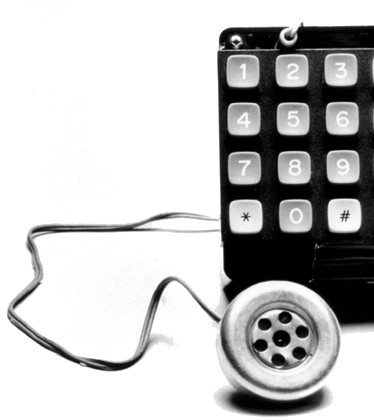
Wozniak and Jobs Blue Box, ca. 1972. The Blue Box allowed electronics hobbyists to make free telephone calls.

The “Blue Box” was a simple electronic gizmo that bypassed telephone company billing computers, allowing anyone to make free telephone calls anywhere in the world.

The “two Steves” had a great deal of fun building and using them for “ethical hacking,” with Wozniak building the kits and Jobs selling them—a pattern which would emerge again and again in the lives of these two innovators. (Wozniak once telephoned the Vatican, pretended to be Henry Kissinger and asked to speak to the Pope—just to see if he could. When someone answered, Woz got scared and hung up.)

These early playful roots are what Wozniak remembers most fondly of Jobs. As columnist Mike Cassidy recalled in a San Jose Mercury News interview, what these two friends most remembered was “not bringing computers to the masses … or the many ‘aha’ moments designing computers. Instead, it’s the time the two tried to unfurl a banner depicting a middle finger salute from the roof of Homestead High School…” or their many Blue Box exploits. Walter Isaacson, Jobs’s official biographer, cites Jobs reflecting on the Blue Box:

If it hadn’t been for the Blue Boxes, there would have been no Apple. I’m 100% sure of that. Woz and I learned how to work together, and we gained the confidence that we could solve technical problems and actually put something into production.

(Isaacson, p. 30)

So far with the story told by Steve Jobs building ‘blue boxes’ about making free phone calls around the world. Now hear it directly from the man who gave Steve Job the idea. Steve Wozniak found a “fiction” article with too much detail to be false. They helped themselves to the library at the Stanford Linear Accelerator and discovered the article was, in fact, real.
But he emphasizes they called around the world to explore not to rip off Ma Bell. All his legit calls were made from home and he had a high phone bill as a result.

(This is an Oct. 4, 1984 speech the Apple co-founder gave to the Denver Apple Pi club at the Colorado School of mines. NOTE: This is assembled from two dubs to fix playback errors. Every word is included, but video quality worsens in the second half.) Kudos to Vince Patton who discovered this video.

——————————–

Source: Computer History Museum

Silicon Valley Historical Association

Apple I

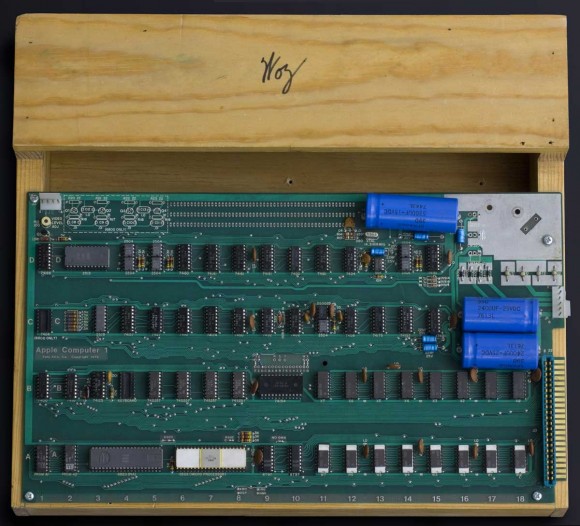
Apple I at the Computer History Museum

Apple I

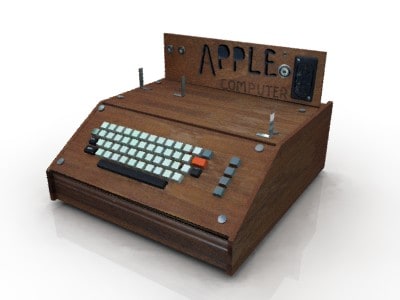
The original Apple Computer, also known retroactively as the Apple I, or Apple-1, is a personal computer released by the Apple Computer Company (now Apple Inc.) in 1976. They were designed and hand-built by Steve Wozniak. Wozniak’s friend Steve Jobs had the idea of selling the computer. The Apple I was Apple’s first product, and to finance its creation, Jobs sold his only means of transportation, a VW van and Wozniak sold his HP-65 calculator for $500. It was demonstrated in July 1976 at the Homebrew Computer Club in Palo Alto, California.

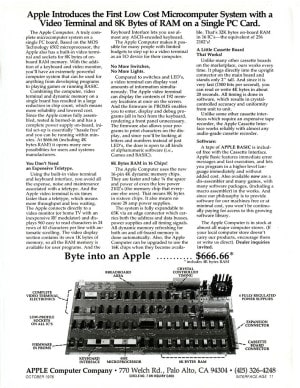
The Apple I went on sale in July 1976 at a price of US$666.66, because Wozniak “liked repeating digits” and because they originally sold it to a local shop for $500 plus a one-third markup. About 200 units were produced. Unlike other hobbyist computers of its day, which were sold as kits, the Apple I was a fully assembled circuit board containing about 60+ chips. However, to make a working computer, users still had to add a case, power supply transformers, power switch, ASCII keyboard, and composite video display. An optional board providing a cassette interface for storage was later released at a cost of $75.

Introductory advertisement for the Apple I Computer

The Apple I’s built-in computer terminal circuitry was distinctive. All one needed was a keyboard and an inexpensive television set. Competing machines such as the Altair 8800 generally were programmed with front-mounted toggle switches and used indicator lights (red LEDs, most commonly) for output, and had to be extended with separate hardware to allow connection to a computer terminal or a teletypewriter machine. This made the Apple I an innovative machine for its day. In April 1977 the price was dropped to $475. It continued to be sold through August 1977, despite the introduction of the Apple II in April 1977, which began shipping in June of that year. Apple dropped the Apple I from its price list by October 1977, officially discontinuing it.

As Wozniak was the only person who could answer most customer support questions about the computer, the company offered Apple I owners discounts and trade-ins for Apple IIs to persuade them to return their computers, contributing to their scarcity. In 1976, Concord High School Junior Wai Lee assembled one of the first 12 Apple Is (no serial number), the first Apple Computer in an aluminum housing.

[portfolio_slideshow include=”2429,2428,2427,2426,2425,2424,2422″]

————————————————————-

Apple I – Collector’s item

As of 2012, less than 50 Apple I computers (with only six in working order) are believed to exist, making it a very rare collector’s item.

  • An Apple I reportedly sold for $50,000 USD at auction in 1999.
  • A unit was sold in September 2009 for $17,000 on eBay.
  • A unit was sold on March 23, 2010 for $42,766 on eBay.
  • In November 2010, an Apple I with serial number 82 sold for £133,250 ($210,000) at Christie’s auction house in London. The high price was likely due to the rare documents and packaging offered in the sale in addition to the computer, including the original packaging (with the return label showing Steve Jobs’ parents’ address, the original Apple Computer Inc ‘headquarters’ being their garage), a personally typed and signed letter from Jobs (answering technical questions about the computer), and the original invoice showing ‘Steven’ as the salesman. The computer was brought to Polytechnic University of Turin where it was fixed and used to run the BASIC programming language.
  • On June 15 2012, a working Apple I was sold at auction by Sotheby’s for a record $374,500, more than double the expected price.
  • In October 2012, another (very early – Serial number 22) Apple I in a Christie´s auction found no bidder who was willing to pay the starting price of 80.000 GBP.
  • On November 24, 2012, a working Apple I was sold at auction by Auction Team Breker for € 400,000


Auction Team Breker Original »Apple 1 Computer«, 1976
Source:

Apple I. (2012, June 26). In Wikipedia, The Free Encyclopedia. Retrieved 02:21, July 9, 2012, from http://en.wikipedia.org/w/index.php?title=Apple_I&oldid=499416018

This article is published under the GNU General Public License

Ron Wayne: “Why I Left Apple Computer After Only 12 Days”

Ronald G. Wayne

Ron Wayne, Apple, Inc.’s sometimes forgotten third co-founder, has posted a short essay entitled “Why I Left Apple Computer After Only 12 Days, In My Own Words”. The piece notes that though he sold his share of Apple for pennies on the dollar, he has no regrets. Instead, he was looking to change the world in his own way:

Source: Facebook-Wall of Ronald G Wayne

An Essay by Ronald G. Wayne

I didn’t separate myself from Apple because of any lack of enthusiasm for the concept of computer products. Aside from any immediate apprehension in regard to financial risks, I left because I didn’t feel that this new enterprise would be the working environment that I saw for myself, essentially for the rest of my days. I had every belief would be successful but I didn’t know when, what I’d have to give up or sacrifice to get there, or how long it would take to achieve that success.

In addition to my rather mundane daily activities during my time as an Apple Co-founder—a full time job at Atari working for Al Acorn and directly answerable to Nolan Bushnell as Atari’s International Field Service engineer—I was writing my treatise on the true nature of money, Insolence of Office.

At the time I was earning $22,000 a year—$88,000 a year in today’s money—we’ve had at least 400% inflation since that time. The Dow Jones had just broken a thousand points. Something Steve Jobs and I had discussed many times—Jobs had asked me if I had thought the Dow Jones would ever break a thousand points. I told him that it would break 1,000, then 5,000 thousand, and at some point in the future, 10,000 points. These types of conversations were typical of those Jobs and I would have over lunch at some of the local diners surrounding Los Gatos, during our time together at Atari.

To counter much that has been written in the press about me as of late, I didn’t lose out on billions of dollars. That’s a long stretch between 1976 and 2012. Apple went through a lot of hard times and many thought Apple would simply go out of business at various times in its maturity. I perhaps lost tens of millions of dollars. And quite honestly, between just you and me, it was character building.

If I had known it would make 300 people millionaires in only four years, I would have stayed those four years. And then I still would have walked away. Steve and Steve had their project. They wanted to change the world in their way. I wanted to change the world in my own.

My book Insolence of Office is the result of 40 years of research.

We’ve had a 2500% increase in inflation since the end of World War II. The $2,300—$800 and then later, another $1500—I received from Apple Inc. in 1976 would be roughly the same as $9,200 today. I’m sure you would agree with me that’s not bad pay for only 12 days worth of work. However, that increase of inflation is something I predicted decades ago and the driving factors behind that inflation is something I discuss in great detail in my book.

I’m sure I’ve mentioned this to you before, as a belief that I truly hold (and I know this sounds arrogant as hell), but the writing and publication of Insolence is, in itself, enough to justify my existence on this planet.

Get the book on iTunes: http://bit.ly/yuXdcj
Get the eBook for the Kindle: http://amzn.to/ziQ7cS
Get the Paperback from Amazon: http://amzn.to/wBIXbf