Tag Archives: Spalte

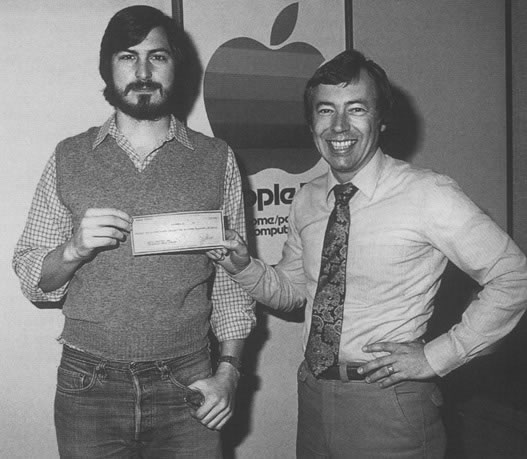
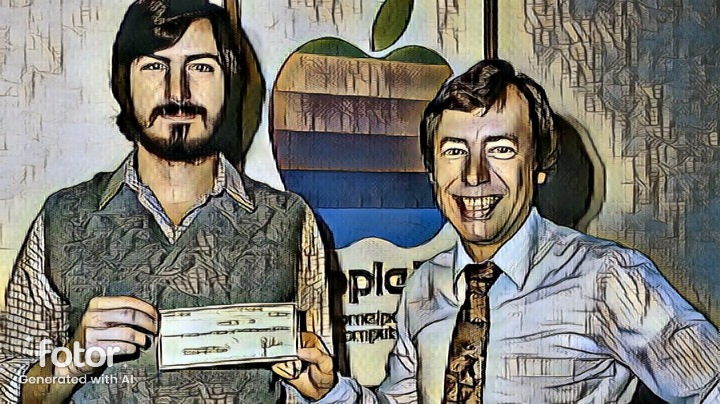
Steve Jobs und Mike Markkula mit einem Scheck

The Silent Architect: How Mike Markkula Turned a Garage Hobby into a Corporate Empire

As we commemorate the history of Apple Computer, books, articles and blog posts often prioritize the mercurial genius of Steve Jobs and the engineering brilliance of Steve Wozniak. However, any serious technical historian knows that without the “adult in the room,” Apple might have remained a footnote in a 1970s hobbyist magazine. That adult was A.C. “Mike” Markkula Jr. While the two Steves provided the spark and the fuel, Markkula provided the engine, the steering, and—most importantly—the map.

The Millionaire Who Came Out of Retirement

In 1976, Mike Markkula was already a success story. Having made a fortune from stock options at Fairchild Semiconductor and Intel, he had retired at the age of 32. His plan was simple: spend his days tinkering and consulting. That changed when a mutual contact (the venture capitalist Don Valentine) pointed a young, scruffy Steve Jobs in his direction.

Unlike the traditional bankers who saw two college dropouts in a garage, Markkula saw a nascent industry. He didn’t just give Apple advice; he brought a $250,000 investment ($92,000 as equity and $157,000 as a loan). In exchange, he became a one-third owner of the company. It was the moment Apple transitioned from a partnership of friends into a legitimate corporation.

The “Apple Marketing Philosophy”: A Legacy of Three Words

Markkula’s most enduring contribution wasn’t just the capital—it was the culture. He authored a one-page document titled “The Apple Marketing Philosophy,” which outlined three core principles that still dictate Apple’s DNA today:

  1. Empathy: A deep, almost obsessive understanding of the customer’s feelings and needs.
  2. Focus: To do a few things well, one must eliminate all unimportant opportunities.
  3. Impute: The belief that people judge a book by its cover. This led to Apple’s legendary obsession with high-quality packaging and industrial design. Markkula understood that if a computer was presented in a sloppy way, the user would perceive the technology inside as sloppy.

The Professional CEO and the “Steves”

Markkula served as Apple’s second CEO from 1981 to 1983, bridging the gap between the chaotic early days of Mike Scott and the corporate era of John Sculley. He was a mentor to Jobs, teaching him the nuances of business, and a protector of Wozniak, ensuring the engineering side had the resources it needed.

However, his tenure was not without friction. Markkula was a proponent of the Apple III and the Lisa, projects that struggled commercially. Perhaps his most controversial historical moment was his support for the board’s decision to side with John Sculley in 1985, leading to Steve Jobs’ famous departure. Markkula believed in the institution over the individual—a pragmatic view that was necessary for Apple to survive its turbulent adolescence.

The End of an Era

Markkula remained on Apple’s board for two decades, serving until Steve Jobs returned in 1997. As Jobs “cleaned house” to start the “Think Different” era, the old guard—including Markkula—stepped aside.

While he rarely seeks the spotlight today, his influence is visible in every minimalist Apple Store and every “designed in California” box. He was the venture capitalist who actually understood the product, the marketer who understood the human psyche, and the strategist who knew that for a computer to change the world, it first had to look like it belonged in the world.


Historical Assessment: The Essential Third Pillar

In the history of technology, we often romanticize the lone inventor. But the Apple I and II would likely have been overtaken by Commodore or IBM if Markkula hadn’t professionalized the operation. He transformed Apple into a “real” company that could secure credit lines, manage supply chains, and build a brand. If Jobs was the heart and Woz was the brain, Mike Markkula was the backbone of Apple.


Year Milestone Impact on Apple
1976 The Meeting Retired at 32, Markkula is introduced to Jobs and Wozniak. He sees the potential they couldn’t yet articulate.
1977 The Investment He invests $250,000, writes the business plan, and officially incorporates Apple Computer Co.
1977 The Manifesto Writes “The Apple Marketing Philosophy,” establishing the brand’s psychological foundation.
1981 The CEO Seat Takes over as CEO following Mike Scott’s departure, guiding the company through its IPO and early growth.
1983 The Sculley Era Steps down as CEO to make room for John Sculley but remains a powerful Chairman of the Board.
1985 The Schism Sides with John Sculley during the power struggle with Steve Jobs, leading to Jobs’ 12-year exile.
1997 The Departure Resigns from the Board of Directors as Steve Jobs returns, marking the end of the “original” Apple leadership.

Source: Historical Records of Apple Computer Leadership (1976-1997).

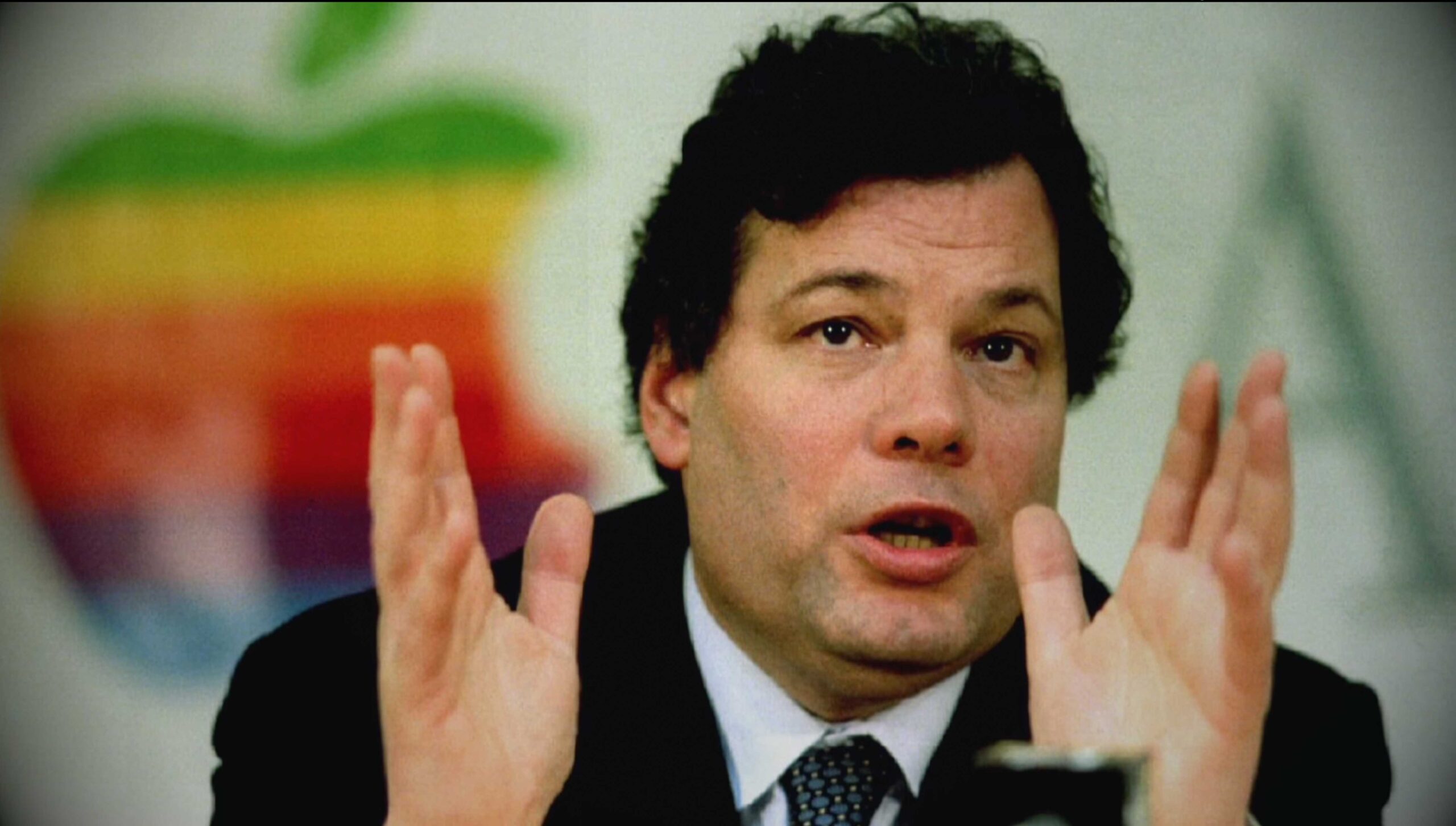
Michael Spindler

Michael Spindler was the CEO of Apple Computer from 1990 to 1993. During his tenure at the company, Spindler oversaw a number of significant changes at Apple, including the introduction of new products and a shift in the company’s focus towards enterprise customers.

Born in Berlin in 1942, he lived through all the transformations of the computer world, from the birth of mainframes to the advent of personal computers, and even the development of the first mobile devices. Hired by Mike Markkula in 1980, he climbed all the ranks of Apple’s organization chart, until he succeeded John Sculley as CEO.

Michael Spindler began his career at Siemens in 1966 after graduating from the prestigious Rheinische Fachhochschule in Cologne as an electrical engineer. Tired of working on such technical aspects as tape controllers for mainframes, he wanted to get closer to the customers and joined Schlumberger’s British telemetry subsidiary.

He returned to Munich in 1970 to take on the role of salesman at DEC, which was then competing with IBM in the minicomputer market. The story goes that he earned the nickname “Diesel” at the time because he was big and strong, grunted more than he spoke, and worked tirelessly from dawn to dusk. But this is just a story, probably invented in the 1980s, and repeated ad nauseam despite the denials of the person concerned.

After seven years at DEC, he knows how to manage teams and set up long-term strategies, but he also knows that the microcomputer will dethrone the minicomputer. Spindler left Munich for Brussels, where he became head of European marketing for Intel. There he met Mike Markkula, who had been advising Steve Jobs and Steve Wozniak for a long time, and was about to take over Apple himself.

It was 1980, and Spindler took over as head of marketing for Apple’s small European office. Legend has it that he went without a salary for a good six months while the company opened a European account. Apple Europe moved to Paris the following year, and Spindler distinguished himself with original and aggressive campaigns that got him noticed in Cupertino.

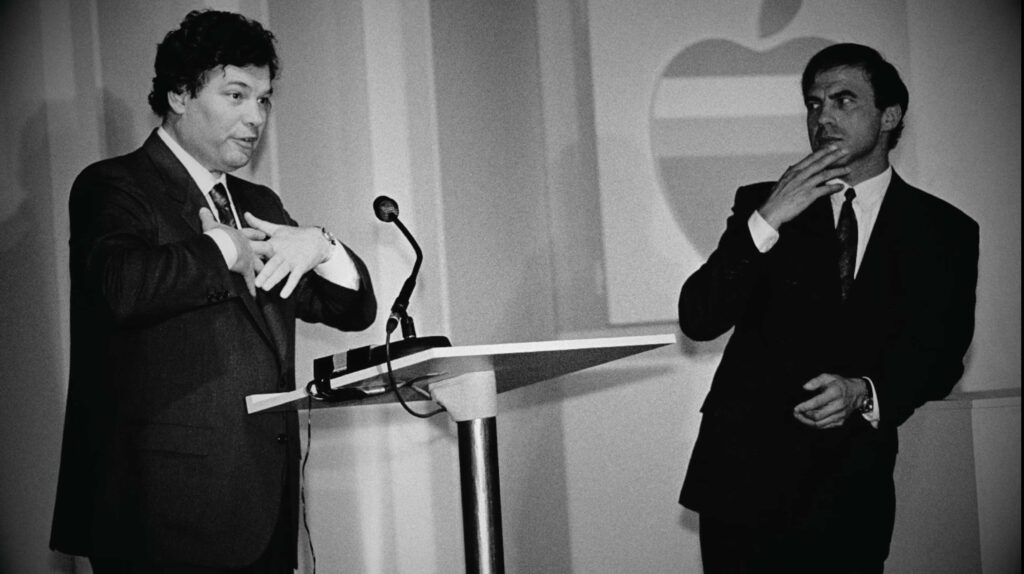
Michel Spindler with Steve Jobs

Mike Markkula wanted to return to his golden retirement, financed by the stock options he had received at Fairchild and Intel but did not intend to hand over the reins to the young and capricious Steve Jobs. Apple recruited John Sculley, the CEO of Pepsi, whom Jobs finally convinced with a formula that went down in history.

A talented strategist who had put Pepsi back on the map, Sculley appreciated Spindler’s talent, and even more so what he perceived as a lack of ambition. In 1983, Sculley promoted Spindler to executive vice president of marketing, reporting to Del Yocam, who had just taken over as head of the Apple II group. Spindler then showed the best, but also the worst, of himself.

The best first: with one heart in Cupertino and the other in Louveciennes, to paraphrase his famous aphorism, he encourages the internationalization of the company. Local subsidiaries operate as independent companies, which can create their own campaigns and even design their own products, like KanjiTalk, which made the Mac popular in Japan.

Then the worst: beset by panic attacks, Spindler struggles to express himself clearly, when he doesn’t run away from his responsibilities. The anecdote is famous: newly appointed director of Apple USA, Allan Loren wanted to introduce himself to Spindler, but couldn’t find him at his desk. A few minutes later, Spindler comes out of his office and shakes hands with Loren – had he been hiding in his closet?

The complexities of Spindler’s career are then confused with the complexities of Apple’s procrastination. The contenders to succeed John Sculley were disqualified one after the other: Del Yocam because he was an authoritarian and brittle COO, Jean-Louis Gassée. He spent tens of millions of dollars looking for technological dead ends, Allan Loren because he was unable to turn Apple USA around.

Spindler was appointed head of Apple Europe. He implements his “global-local” strategy, harmonizing the offer and the prices while letting each country adapt its message, and triples the turnover in two years. His fortune was strengthened by the disgrace of his competitors: he became COO in 1990, pushed Jean-Louis Gassée out of the company, and finally reached the highest level of responsibility when Sculley was fired in 1993, due to strategic errors.

One of Spindler’s major merits was his efforts to expand Apple’s product line and increase its market share. During his time as CEO, Apple introduced several new products including the Macintosh LC, Macintosh Quadra, and the Macintosh Performa. These products were designed to appeal to a wider range of customers and helped to broaden Apple’s customer base.

Another of Spindler’s merit was his attention to the enterprise market. He acknowledge the enterprise market was an important area of growth for Apple and he focused on expanding Apple’s presence in this market. He attempted to build stronger relationships with business customers and to develop new software and services that would appeal to enterprise users.

However, Spindler also faced a number of challenges during his tenure as CEO. One of the major weaknesses was that he faced criticism for his lack of focus on the consumer market. The competition was stronger in consumer market and Apple was facing tough competition from companies such as Dell, Compaq and IBM in the personal computer market.

Additionally, during his tenure, the company faced financial struggles, causing profits to decline. This led to a series of cost-cutting measures and layoffs at the company, which further damaged morale among employees and customers.

Ultimately, Spindler was replaced as CEO by Gil Amelio in 1993, who was tasked with turning around the company’s fortunes. While Spindler’s tenure as CEO was marked by both successes and challenges, his efforts helped to set the stage for Apple’s resurgence in the years that followed.

Father of three children, Michael Spindler lived between San Francisco and Paris with his wife. He died on September 5, 2016 after a short illness.

Ron Wayne – The third Apple founder

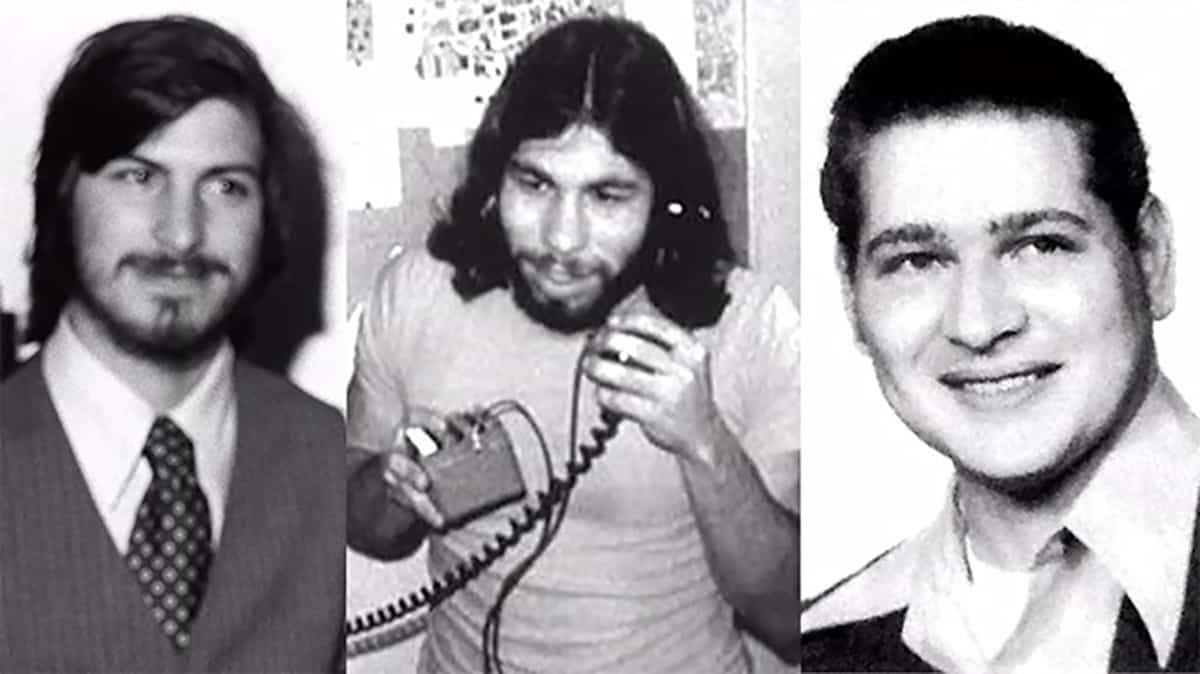
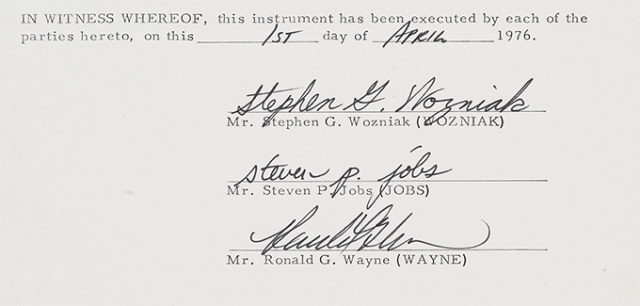
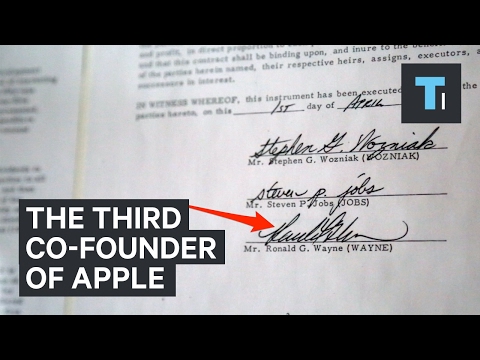
When you talk about the founders of Apple, you first think of Steve Jobs and Steve Wozniak. Jobs, the far-sighted business strategist – and “Woz”, the brilliant inventor. In fact, the Apple Computer Company was founded by three men: “Mr. Stephen G. Wozinak, Mr. Steven P. Jobs and Mr. Ronald G. Wayne”, as it is also stated in the company’s founding contract of April 1, 1976.

Three men founded Apple Computer on April 1st, 1976

Ron Wayne worked at Atari before founding Apple Computer, where he met Steve Jobs, who was involved in new game development. Through Jobs, Wayne became aware of Steve Wozniak, a brilliant hardware designer and engineer who had created the first usable personal computer that would go down in technological history as the Apple I.

But it soon became clear that the two Steves were pursuing very different goals: Steve Wozniak wanted to impress his pal’s guys at the Homebrew Computer Club with his brilliant development steps. Woz had no serious interest in making a big business out of it. Steve Jobs, on the other hand, quickly recognized the business potential. With a computer like Apple, I could break the dominance of the mainframes of companies like IBM and turn the personal computer into a mass product.

However, Jobs was not able to match his interests with Woz. Therefore he relied on Ron Wayne. So he and against this background offered him a minority share in the foundation of Apple Computer on April 1, 1976. Wayne had a 10 percent stake in the company, and Jobs and Wozniak each held 45 percent. Ron Wayne was to tip the scales when the two main players were at loggerheads with each other. “We both trusted him so much that he would resolve any conflicts we had,” said Steve Jobs.

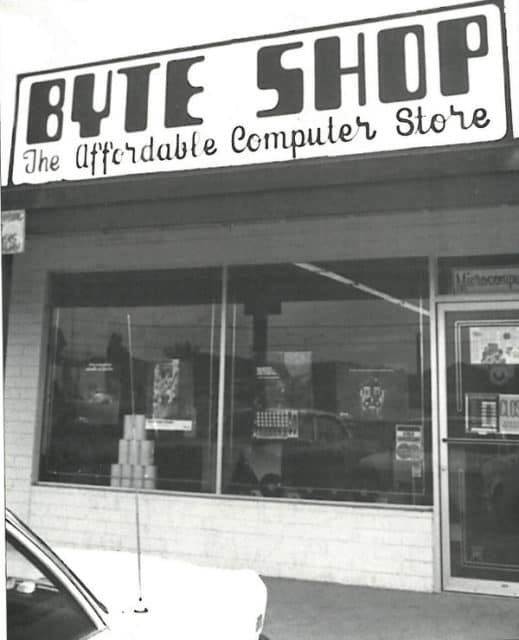
The first larger order came from the Byte Shop

r Wayne got cold feet: “I was practically the adult in the room. I was in my 40s, those kids were around 20. Then about a week and a half later, when I had time to think, I did what most people thought was absolutely crazy. I had my name taken off the contract.”

Wayne was particularly worried about the financial obligations associated with the first major contract for Apple computers. Jobs was in the process of signing supply contracts for the Apple I with first customers like “The Byte Shop”. He was getting the components for it on tick.

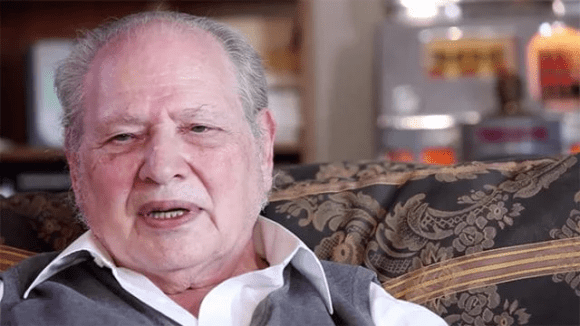
“I had very good reasons to remove my name from the contract,” Wayne said in a 2016 TV interview looking back. “The main reason was that we had started a company. And if we failed, Jobs and Woz would not have had two nickels in their pockets. Who would be left to stick? Well, I had a house and a car, and a bank account, too. I was handy. So I was financially vulnerable. But I also wanted to be my own man. I also realized I was in the shadow of two grand. I was never gonna get my own project. I didn’t like the idea of spending the next 20 years behind piles of paper in an office. That was another reason to get out.”

Ron Wayne talks to Jules Pochy und Jérôme Schmidt (2016)

His co-founder Steve Wozniak could not understand this step. “I don’t know why Ron gave up. “He sold his shares and got out. He may have had good reasons. He got out and he was happy with it. He couldn’t see the big picture. But you couldn’t see the big picture at the time. There was only the Apple I.”

Wayne could not count on Steve Jobs’ understanding. Jobs described the process as follows: “He decided that he really wanted a VCR or something. So he sold us back 10 percent for eight hundred dollars.”

But there were also reservations in the opposite direction: “I didn’t know whether jobs were the kind of personality I wanted to work for either,” Wayne said in the ARTE interview (2016). “He was just the way he was. He knew exactly what he wanted to do. And it was better not to get in his way. You would end up with a footprint on your forehead. Jobs had a very aggressive character. And if you had to choose between Steve Jobs and an ice cube to warm them up, you’d snuggle up to the ice cube. But it was the only way he could achieve what he had achieved with Apple. Apple was Steve Jobs.”

So Wayne has no regrets about getting out of Apple so early: “Those kids were wild hotshots, like whether you have to hold a tiger by the tail. If I’d stayed with Apple, I’d have been caught in a hurry. I’d just be the richest man in the cemetery.”

One thing in life Wayne does regret, though. In the mid-nineties, he saw an ad in a magazine for a company that dealt with autographs and signatures. He remembered the old Apple contract that was lying around in a closet collecting dust. Finally, he sold the historical document for 500 dollars to the autograph dealer.

Years later, Wayne then saw on television how his old contract came under the hammer for almost 1.6 million dollars at the Sotheby’s auction house.

“I’m sorry for this incident. But what can I say? It’s the story of my life, right? A day late and a dollar short in my pocket.”

Ron Wayne has left his mark on Apple’s history even after he left as a shareholder. The first trace should be removed quickly because Steve Jobs did not like the first logo of the young company, which Wayne had designed. “In this logo, which they had me design, I captured Wozniak’s bizarreness. The logo with Newton in this Gothic frame with the ribbon and the inscription ‘Apple Computer Company’ was of course a 19th-century design, not a 20th-century design. I knew that already.”

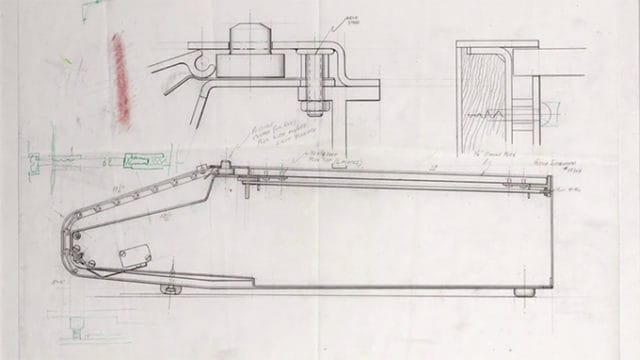
The second mark was deeper: Jobs asked Wayne if he could design a case for the Apple II. Although his design was never used. But Apple adopted the basic design principle.

Design for a housing for the Apple II by Ron Wayne.

To this day, Wayne is amused by the thought that he may have influenced all his later work. “A typical computer today consists of a tower and a circuit board mounted vertically. The keyboard and screen are separate. In my design for the Apple II, I had a horizontal design with a horizontally mounted board. The keyboard was integrated into the housing. The monitor stood on top, as one unit. They used this design for all future models, the Macintosh and Lisa, and so on. All were built this way. This form was unique among modern computers.”

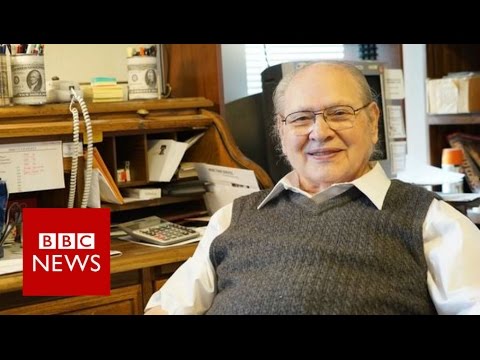
BBC feature about Ron Wayne

How the Founders of Apple Got Rich

The two main Apple founders – Steve Jobs and Steve Wozniak – both came from humble backgrounds and were not endowed with commercial success. In order to afford the first pieces of the Apple I in 1976, they almost literally sold the shirts off their backs. Jobs invested the proceeds from the sale of his VW bus ($1,500 dollars). “Woz” parted with his beloved programmable calculator Hewlett-Packard 65 and deposited 250 dollars in the company’s treasury.

Ronald Wayne (Photo courtesy of Owen Linzmayer)

Ronald Gerald Wayne, the “third founder” of Apple Computer, was with the company for only a short time. He illustrated the first Apple logo and wrote the Apple I manual. While at Apple, he also wrote their partnership agreement. Wayne worked with Jobs at Atari before co-founding Apple Computer on April 1, 1976. He was given a 10% stake in Apple, but relinquished his stock for 800 dollars only two weeks later because legally, all members of a partnership are personally responsible for any debts incurred by any of the other partners.

After Apple’s IPO, Wayne’s stake could have been worth as much as US$ 1.5 billion. He claimed that he didn’t regret selling the stock as he had made “the best decision available at that time.” According to CNET, as of 1997 Wayne was working as an engineer for a defense contractor in Salinas, California.

See also: Two days in the desert with Apple’s lost founder, Ron Wayne @ engadget.com

Steve Jobs and Mike Markkula

The foundations for the commercial success were laid in 1977 by venture capitalist Arthur Rock as well as by the ex-Intel manager Mike Markkula, who invested 92,000 dollars in Apple and secured a bank loan of 250,000 dollars. Markkula was lured out of retirement by Steve Jobs, who was referred to him by Regis McKenna and venture capitalist Don Valentine.

Valentine—who after meeting the young, unkempt Jobs asked McKenna, “Why did you send me this renegade from the human race?”—was not interested in funding Apple, but mentioned Jobs’ new company to Markkula. Jobs visited him and convinced Markkula of the market for the Apple II and personal computers in general. Later Valentine asked Markkula if he could also invest in Apple.

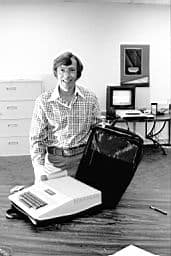
Mike Markkula at the Apple offices April 1, 1977

In 1977, Markkula brought his business expertise along with US$250,000 ($80,000 as an equity investment in the company and $170,000 as a loan) and became employee number 3. The investment would pay off for Markkula. Before Apple went public in 1980, he owned a third of the company.

Markkula also brought in Apple’s first CEO, Michael Scott, then took the job himself from 1981 to 1983. Markkula served as chairman from 1985 until 1997, when a new board was formed after Jobs returned to the company. Wozniak, who virtually single-handedly created the first two Apple computers, credits Markkula for the success of Apple more than himself. “Steve and I get a lot of credit, but Mike Markkula was probably more responsible for our early success, and you never hear about him,” told Wozniak the Failure Magazine in July 2000.

Excerpt of the TV documentary “Triumph of the Nerds” (PBS)


With the initial public offering on December 12, 1980, Jobs and Wozniak became multimillionaires, as Apple Computer was now valued at 1.8 billion dollars. Jobs possessed 7.5 million stocks (217 million dollars); “Woz” was assigned four million stocks (116 million dollars). Markkula’s share of seven million stocks was worth 203 million.

“I was worth about over a million dollars when I was twenty-three and over ten million dollars when I was twenty-four, and over a hundred million dollars when I was twenty-five,” Jobs said in an interview with Robert Cringley (”Triumph of the Nerds“) in 1996. “And it wasn’t that important because I never did it for the money.”

Read next page: Steve Jobs: It’s not about the money

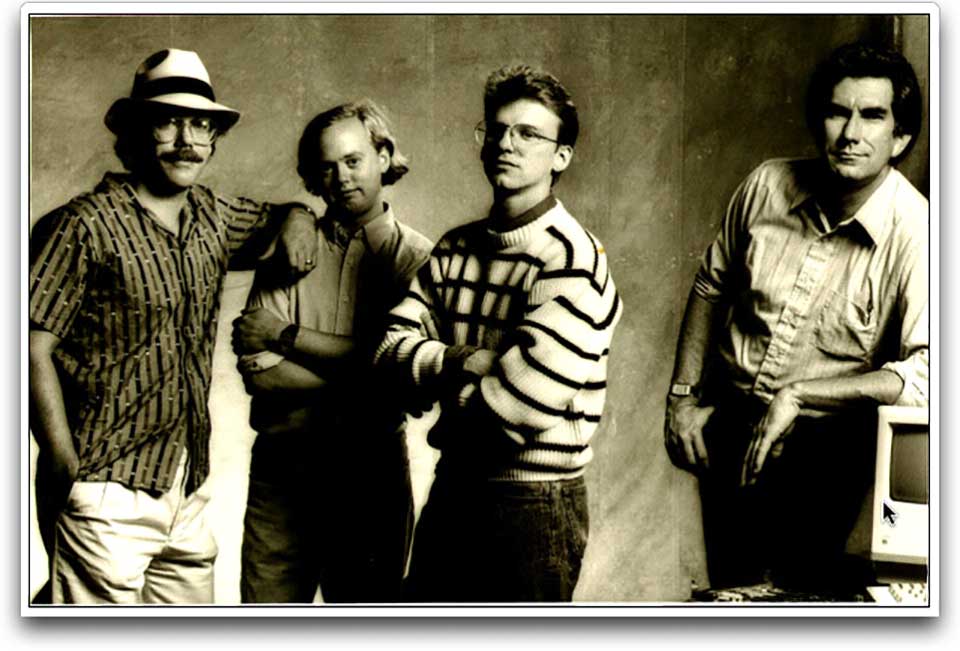
The Wizards behind the Macintosh

The making of Macintosh – An Interview with The Macintosh Design Team (Byte – Feb, 1984)

Bill Atkinson

Bill Atkinson nearly had his Ph.D. in neurochemistry before he admitted to himself that his real love was computers. He “got a quick E.E.” and started his own company. He was happily minding his own business when his friend ]eff Raskin asked him to come see what was happening at Apple, which was then six months old. Bill wasn’t really interested, but airplane tickets showed up in the mail, so he took a look. What he saw was “several years reaching into the future” of anything he could do where he was. He stayed to write Apple’s Pascal and later became Mr. User Interface for Lisa before he moved over to the Mac team.

Andy Hertzfeld

Andy Hertzfeld says, “The Apple II changed my life.” The computer people at Berkeley were a little narrow-minded about letting a grad student really get into the computer as Andy wanted to. So he spent nearly all the money he had in the world on an Apple II and had a computer he could control completely. He decided the Apple was more interesting than his classes and began writing programs for magazines. When Apple bought one of Andy’s programs, Steve Jobs offered him a job, which he took when he finished school. He worked on silent-type printers and Apple III demos until a shake-up in his part of the company shook him loose. He looked around and decided to go with Mac.

Larry Kenyon

Larry Kenyon arrived at Apple from Amdahl with a double degree in psychology and computer science. He was working on Apple III products when the same shake-up that shook Andy loose freed him, too. Andy asked Larry to join the Mac crew because he was one of the few people who understood the arcane art of making the Apple II work with printer peripherals, and anybody who can do that has to be good. No one in the company really believed that Mac was a product when Larry joined the Mac team. It was just a research effort, and there was some risk involved: would you still have your job in a few months?

Joanna Hoffman

Joanna Hoffman is still on leave from her Ph.D. program in archaeology at the University of Chicago. She has a background in anthropology, physics, and linguistics. She came to Apple because of Mac. After using her computer skills in the field of archaeology for so long, she was tired of looking at the past and turned to the future. She was Mac’s entire marketing department for more than a year. She wants to make Mac a tool that feels natural for international users by making it speak their languages.

Burrell Carver Smith

Burrell Carver Smith encountered the Homebrew Computer Club in 1975, got hooked on microprocessors, and moved to the Bay Area. Just riding around in a borrowed truck one day, he saw Apple and decided to drop in. The only job Apple had available was in the service department, repairing Apple IIs. He took the job and fixed at least a thousand Apple II boards and got involved in other projects before Jeff Raskin and Bill Atkinson recruited him for Mac. He talked the Lisa engineers out of some chips and stuff and got a prototype running over Christmas 1979. He was the first full-time Mac person after Jeff Raskin.

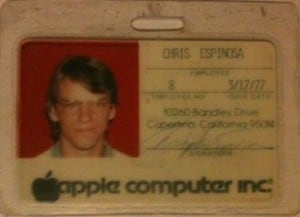
Chris Espinosa says, “There was no life before Apple.” At 13 years old he could be found cruising up and down the bus line in his home town, spending a few hours at each Byte Shop on the line until the owner threw him out. He discovered the way to keep from getting thrown out was to write demo programs for the machines, so he wrote for whatever was lying around: ”Altairs, IMSAIs, or this weird new machine called Apple I. His mom worried when he was offered a ride to the Homebrew Computer Club meeting with two scruffy characters named Jobs and Wozniak, but she gave in, and the rest is history. Chris spent a Christmas vacation debugging Apple’s BASIC in exchange for a whole row of 4K-byte RAM chips, which he thought was a pretty good deal. He worked part-time during college writing BASIC programs and reference manuals and signed on full-time when he graduated. He likes being in on the design process: ”If the machine is designed right in the first place, you don’t have to write a lot about it.”

Jerry Manock

Jerrold C. Manock was a freelance product-design consultant with a Stanford education who finally joined Apple when he saw that three-quarters of his billing was to Apple anyway. He worked on the Apple II, the Disk II, the III, and Lisa before designing Mac. In Macintosh, he says, “The outside matches the inside in elegant simplicity.”

Susan Kare best known for her interface elements and typeface contributions to the first Apple Macintosh from 1983 to 1986. She was employee #10 and Creative Director at NeXT, the company formed by Steve Jobs after he left Apple in 1985. She was a design consultant for Microsoft, IBM, Sony Pictures, and Facebook, Pinterest and she is now an employee of Niantic Labs. As an early pioneer of pixel art and of the graphical computer interface, she has been celebrated as one of the most significant technologists of the modern world.

And 30 years later, Susan talks about the Apple icons.

Susan Kare, Iconographer (EG8) from eg on Vimeo.

Bruce Horn grew up at Xerox PARC, much the same way Chris grew up at Apple, and later attended Stanford. Bruce started working at Xerox when he was 14 years old: he was one of the kids Xerox brought in to test Smalltalk. Turns out he was brighter than most and became a systems wizard who actually implemented Smalltalk on a variety of different processors. Bruce is all of 23 years old now, but he spent seven years at Xerox PARC and brought Apple that perspective.

George Crowe and David Egner designed the analog board in the Macintosh.

Steve Capps assisted Andy Hertzfeld with the systems software.