Steve Jobs combined his visions with art and technology in order to bring products to the market that have changed the lives of millions of people. He founded Apple and the computer industry, was fired, and twelve years later saved the company from bankruptcy. Afterwards, he pushed through a series of innovations that were really enough for seven lives. After his early death, not only his fans are wondering how Apple will deal with Steve Jobs’ legacy.
By Christoph Dernbach
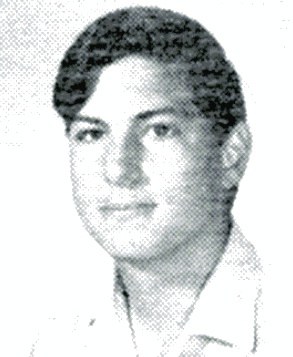
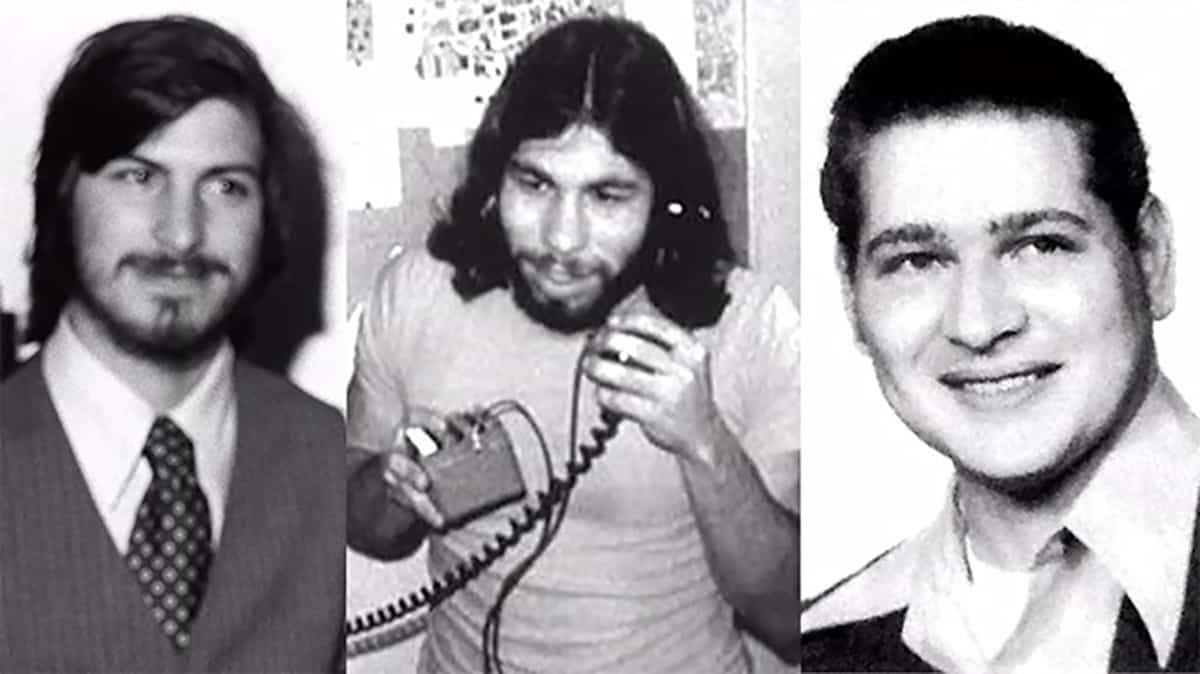
Steve Jobs’ highschool photo
Steve Jobs must already have been charismatic as a twelve year old school boy. Or was it just cockiness with which he would later take his business partners by surprise time and again? As an eighth grade student, he wanted to build a frequency counter for his school project and needed some parts. He contacted non other than Bill Hewlett, who was the legendary co-founder of computer group Hewlett-Packard (HP).
In the 60s, the Silicon-Valley pioneer’s contact information could still be found in the phone book. The lanky boy did not just coax the needed parts free of charge from the group boss. “He answered and chatted with me for twenty minutes. He got me the parts, but he also got me a job in the plant where they made frequency counters,” Jobs told book author Walter Isaacson for his biography.
Steve Jobs worked there the summer after his freshman year at Homestead High. obs worked there the summer after his freshman year at Homestead High. “My dad would drive me in the morning and pick me up in the evening.” He found himself at the right place at the right time. Still, Steve Jobs’ fate as the most successful entrepreneur of America was not handed to him at birth.
“He was a boy who had no money,” recalls his friend and Apple co-founder Steve Wozniak. “He had nothing except his intellect. But he brought us things that became a challenge for all of us.” Paul Otellini, CEO of chip giant Intel, said: “True genius is measured by the ability to touch every person on the planet. Steve did that, not just once, but many, many times over his amazing life.” In contrast to industry titans like Bill Gates, Steve Jobs came not from a wealthy home, but from a lower-class background.
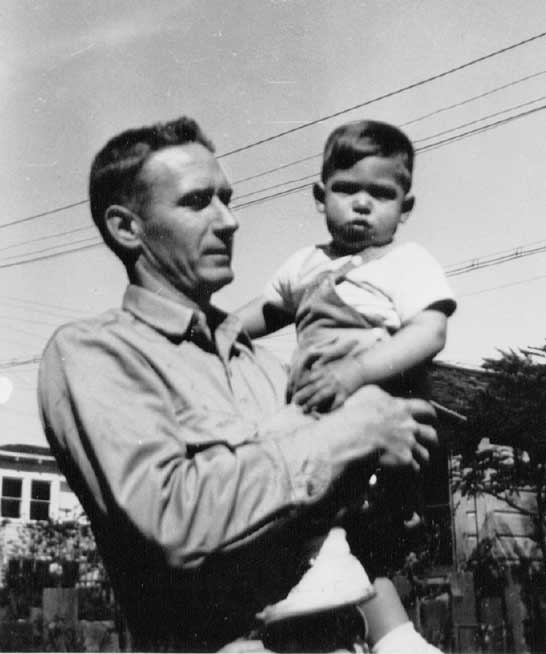
Steve Jobs with his father Paul Jobs (1958)
His biological parents, the Syrian student Abdulfattah John Jandali and his American girlfriend Joanne Simpson, gave him up for adoption after his birth. In 1955, the still unmarried couple, both 23, was studying at the University of Wisconsin and found themselves unable to care for the child without a proper income. Actually, his parents insisted on giving him away to an academic family, which could guarantee that he could one day attend university. But the desired family got cold feet and cancelled the adoption in the last minute.
Finally, the child ended up in the house of Paul and Clara Jobs. Steve’s adoptive parents were simple people. His father worked as a car mechanic and his mother as an office employee. When Steve was five years old, his parents moved with him from San Francisco to Mountain View, in the middle of booming Silicon Valley. Author Walter Isaacson relates in his biography of Steve Jobs that in the new neighborhood Jobs told a girl that he was an adopted child. “So does that mean your real parents didn’t want you?” the girl asked. “Lightning bolts went off in my head,” according to Jobs. “I remember running into the house, crying. And my parents said, ‘No, you have to understand. We specifically picked you out.” This key scene described the tension between the terms “abandoned”, “chosen”, and “special” at a very early age for Steve Jobs.
Steve gets it
Who knows where Steve Jobs’ journey through life would have brought him if he had not met electronics enthusiast Steve Wozniak, who was four classes above him in school. Despite the age difference, the two Steves got along very well. “It seemed as if we had a lot in common,” recalled Woz later in his autobiography. “Typically, it was really hard for me to explain to people the kind of design stuff worked on, but Steve got it right away. And I liked him. He was kind of skinny and wiry and full of energy.”
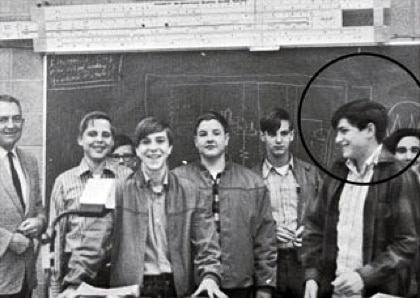
Steve Jobs (circled) at Homestead High School Electronics Club (1969)
Jobs, like Wozniak before him, attended Homestead High School in Cupertino, California, a solidly middle-class school in the suburbs of Silicon Valley. Homestead was progressive, with an innovative electronics program that shaped Wozniak’s life. Jobs and Wozniak had been friends for some time. They met in 1971 when their mutual friend, Bill Fernandez, introduced then 21-year-old Wozniak to 16-year-old Jobs. After hours, the two Steves would often meet at Hewlett-Packard lectures in Palo Alto.
Read next episode: Steve Jobs and Steve Wozniak hack the phone system
It’s a story of corporate courtship, a brief period of “magical” synergy, and a cold-blooded boardroom coup that fundamentally reshaped the trajectory of personal computing. At the heart of this drama stood two men: the visionary co-founder Steve Jobs and the seasoned marketing executive John Sculley.
The Seduction: From Sugar Water to Silicon
By 1983, Apple was no longer a hobbyist’s garage project; it was a public company facing fierce competition from IBM. Steve Jobs, while brilliant, was perceived by the board as too young and volatile to lead a multinational corporation. They wanted “adult supervision.”
Jobs set his sights on John Sculley, the then-president of PepsiCo. Sculley was a marketing prodigy responsible for the “Pepsi Challenge.” The recruitment process was a months-long pursuit that culminated in one of the most famous lines in business history. When Sculley initially hesitated, Jobs challenged him:
“Do you want to sell sugar water for the rest of your life, or do you want to come with me and change the world?” Steve Jobs challenges John Sculles
Jobs wanted Sculley to share his excitement about the Macintosh and showed him a prototype. “This product means more to me than anything I’ve done,” Jobs said. “I want you to be the first person outside of Apple to see it.” He dramatically pulled the prototype out of a vinyl bag and gave a demonstration. Sculley found Jobs as memorable as his machine. “He seemed more a showman than a businessman. Every move seemed calculated, as if it was rehearsed, to create an occasion of the moment.”
Jobs had asked Software Developer Andy Hertzfeld and the gang to prepare a special screen display for Sculley’s amusement. “He’s really smart,” Jobs said. “You wouldn’t believe how smart he is.” The explanation that Sculley might buy a lot of Macintoshes for Pepsi “sounded a little bit fishy to me,” Hertzfeld recalled, but he and Susan Kare created a screen of Pepsi caps and cans that danced around with the Apple logo. Hertzfeld was so excited he began waving his arms around during the demo, but Sculley seemed underwhelmed. “He asked a few questions, but he didn’t seem all that interested,” Hertzfeld recalled. He never ended up warming to Sculley. “He was incredibly phony, a complete poseur,” he later said. “He pretended to be interested in technology, but he wasn’t. He was a marketing guy, and that is what marketing guys are: paid poseurs.”
Steve Jobs was not very impressed by the concerns of his team and decided to hire the marketing specialist: Sculley joined Apple as CEO in April 1983, bringing the corporate discipline and marketing prowess Apple’s board craved.
John Sculley and Steve Jobs: The “Dynamic Duo” Phase
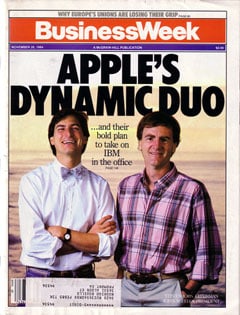
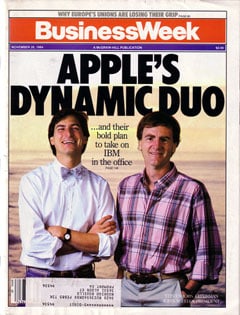
Apple’s Dynamic Duo
Initially, the partnership was remarkably harmonious. The media dubbed them the “The Dynamic Duo.”. Jobs was the product visionary, dreaming up the Macintosh; Sculley was the operational expert who knew how to scale a brand.
The Bond: They were nearly inseparable, often finishing each other’s sentences in interviews. Sculley gave Jobs the professional validation he sought, and Jobs gave Sculley a sense of higher purpose beyond consumer goods.
During this honeymoon period, they successfully launched the Macintosh in 1984, backed by the iconic Super Bowl commercial. It seemed, for a moment, that the marriage of counter-culture innovation and Madison Avenue marketing was invincible.
The Apple Macintosh had not been a success from the outset. The hardware was not designed particularly generously for the requirements of a graphical user interface. Especially the main memory had been calculated rather tightly. Moreover, there was no hard disk for the Mac at that time.
“The original 128K Mac had too many problems to list,” wrote Jack Schofield from the Guardian 20 years later in an article about the 20th anniversary of the apple Macintosh. “It had too little software, you couldn’t expand it (no hard drive, no SCSI port, no ADB port, no expansion slots), it was horribly underpowered and absurdly overpriced. The way MacWrite and MacPaint worked together was brilliant, but producing anything more than a short essay was a huge struggle. Just copying a floppy was a nightmare.” In addition, there was a lack of appropriate business software.
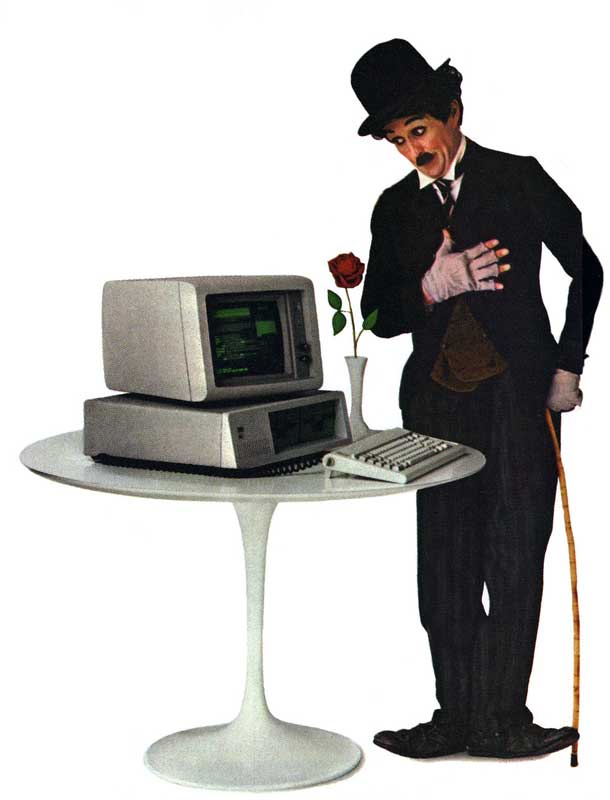
The Mac lacked the applications that dragged the Charlie Chaplin figure across the screen box by box in the IBM’s advertising spot for the PC. Therefore, Guy Kawasaki and other “Software Evangelists” of Apple made an effort to convince the developers of other software companies to write programs for the Mac. The Mac’s ROM, which had been calculated far too narrowly at 128 kilobytes, did not make this a simple task. Not until the “Fat Mac” with 512 kilobytes was launched one year after the first Macintosh had this narrow bottleneck been removed.
The problem came to a head when by the beginning of 1985, the Macs that had not found purchasers during the Christmas sales of 1984 were piling up in storage. Apple had to publish the first quarterly loss in the company’s history and release a fifth of the staff. During a marathon meeting on April 10 and 11, 1985, Apple’s CEO John Sculley demanded to have Steve Jobs relieved of his position as an Apple vice president and general manager of the Macintosh department.
According to Sculley’s wishes, Steve Jobs was to represent the company externally as a new Apple chairman without influencing the core business. As Jobs got wind of these plans to deprive him of his power, he tried to arrange a coup against Sculley on the Apple board. Sculley told the board: “I’m asking Steve to step down and you can back me on it and then I take responsibility for running the company, or we can do nothing and you’re going to find yourselves a new CEO.” The majority of the board backed the ex-Pepsi man and turned away from Steve Jobs.
On May 31, 1985, Jobs lost his responsibilities and was shuffled off to the chairman position. In September, the Apple co-founder left the company with a few people in order to found NeXT Computer. “I feel like somebody just punched me in the stomach and knocked all my wind out. I’m only 30 years old and I want to have a chance to continue creating things. I know I’ve got at least one more great computer in me. And Apple is not going to give me a chance to do that,” Jobs wrote to Mike Markkula on parting. Ten years later, Steve Jobs also commented on his disempowerment with bitterness in the TV documentary “Triumph of the Nerds” (1996):
Excerpt from the TV documentary “Triumph of the Nerds” with Robert Cringley
Jobs: What can I say? I hired the wrong guy. – Question: That was Sculley? Jobs: Yeah and he destroyed everything I spent ten years working for. Starting with me but that wasn’t the saddest part. I would have gladly left Apple if Apple would have turned out like I wanted it to.
Apple’s Heart and Soul
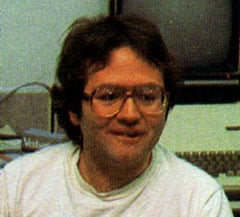
Andy Hertzfeld, one of the Macintosh’s fathers, later recalled the events:
Andy Hertzfeld
The conflict came to a head at the April 10th board meeting. The board thought they could convince Steve to transition back to a product visionary role, but instead he went on the attack and lobbied for Sculley’s removal. After long wrenching discussions with both of them, and extending the meeting to the following day, the board decided in favor of John, instructing him to reorganize the Macintosh division, stripping Steve of all authority. Steve would remain the chairman of Apple, but for the time being, no operating role was defined for him. John didn’t want to implement the reorganization immediately, because he still thought that he could reconcile with Steve, and get him to buy into the changes, achieving a smooth transition with his blessing. But after a brief period of depressed cooperation, Steve started attacking John again, behind the scenes in a variety of ways. I won’t go into the details here, but eventually John had to remove Steve from his management role in the Macintosh division involuntarily. Apple announced Steve’s removal, along with the first quarterly loss in their history as well as significant layoffs, on Friday, May 31, 1985, Fridays being the traditional time for companies to announce bad news. It was surely one of the lowest points of Apple history.
Hertzfeld mourned for Steve Jobs openly: “Apple never recovered from losing Steve. Steve was the heart and soul and driving force. It would be quite a different place today. They lost their soul.” In contrast, Larry Tessler, who had come to Apple from Xerox, refers to mixed reactions of the Apple staff: “People in the company had very mixed feelings about it. Everyone had been terrorized by Steve Jobs at some point or another and so there was a certain relief that the terrorist had gone but on the other hand I think there was an incredible respect for Steve Jobs by the very same people and we were all very worried – what would happen to this company without the visionary, without the founder without the charisma…”
The Sculley Era: From Visionary Disruption to Corporate Precision
The departure of Steve Jobs in 1985 marked a fundamental shift in Apple’s DNA. While the “Jobsian” approach was rooted in creating “insanely great” products regardless of immediate market demand, John Sculley’s leadership transitioned the company toward a market-driven, high-margin business model.
Embracing the “Open” Mac
One of the most significant shifts was the reversal of Jobs’s “closed box” philosophy. Jobs famously insisted that the Macintosh should be a sealed appliance, devoid of expansion slots, to maintain total control over the user experience. Sculley, listening to corporate customers, greenlit the Macintosh II (1987). It featured color graphics and expansion slots. This move was a massive commercial success, as it allowed the Mac to compete with IBM in the high-end workstation market.
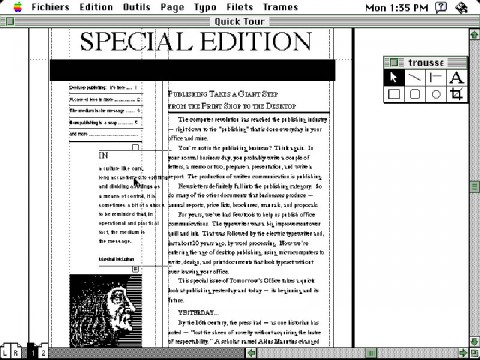
Screenshot of PageMaker 1.0 (french version)
The Desktop Publishing Revolution
Under Sculley, Apple stopped trying to sell the Mac as a general-purpose “appliance for the rest of us” and found its “killer app”: Desktop Publishing (DTP).
By pairing the Macintosh with the LaserWriter printer and Aldus PageMaker software, Sculley targeted a specific niche—graphic designers and publishers. This strategy saved the company, creating a loyal, high-paying user base that allowed Apple to charge premium prices during the late 80s.
Milking the Apple II “Cash Cow”
While Jobs had viewed the Apple II as an obsolete distraction, Sculley recognized it was the company’s financial lifeblood. He continued to iterate on the line (notably the Apple IIGS), using the profits from the aging platform to fund the expensive research and development of future Macintosh models. This pragmatism provided the stability Apple needed to survive the mid-80s tech slump.
The PowerBook Triumph
In 1991, Apple released the PowerBook, arguably the most successful product of the Sculley years. While Jobs’s earlier attempt at a portable (the 1989 Macintosh Portable) was a 16-pound failure, the PowerBook was a masterpiece of industrial design. It introduced the ergonomic layout we still see in laptops today—the keyboard pushed back to provide palm rests and a centered pointing device (the trackball). It captured 40% of the laptop market at its peak.
Strategy by Proliferation (The Downfall)
However, the post-Jobs era also saw the beginning of “product sprawl.” Without Jobs’s obsessive focus, the product line became bloated. Apple began releasing dozens of confusingly named models—Performa, Centris, Quadra—often with nearly identical specs. This led to:
Customer Confusion: It was impossible for a buyer to know which Mac was right for them.-
Inventory Bloat: Managing so many different hardware configurations became a logistical nightmare.
Brand Dilution: Apple started to look like just another PC manufacturer, losing its “special” status.
The Newton: A Visionary Leap Too Soon
Sculley’s final major push was the Apple Newton (MessagePad). He coined the term “Personal Digital Assistant” (PDA) and envisioned a world of handheld computing. However, without Jobs’s perfectionism, the product was launched prematurely. The handwriting recognition—its core feature—was unreliable, turning the device into a punchline in popular culture.
The immediate post-Jobs era was characterized by professionalization. Sculley turned Apple into a highly profitable, organized, and respected corporate entity. However, the cost was the loss of a singular, coherent vision. By the early 1990s, Apple was a company that made great hardware but had lost its way. Even before Microsoft introduced Windows 95, Apple sales were under heavy pressure. In 1993 Sculley had to step down.
Searching for a Strategy of Survival
Michael Spindler, known as “The Diesel” for his work ethic, took the helm after Sculley. His tenure was marked by a desperate attempt to keep Apple relevant in a world increasingly dominated by Microsoft’s Windows. Spindler successfully oversaw the architectural shift from Motorola 68k processors to the PowerPC. While technically impressive, it was an expensive and exhausting transition for developers and users alike. But Spindler made ohne bis mistake: In a move that Steve Jobs would later describe as “selling the soul of the company,” Spindler licensed the Macintosh Operating System to third-party manufacturers (cloners). The goal was to increase market share, but instead, it cannibalized Apple’s own high-margin hardware sales. Michael Spindler resigned as CEO of Apple on January 31, 1996. His departure followed a period of severe financial struggle for the company, including a massive quarterly loss and a failed attempt to sell Apple to Sun Microsystems.
The Amelio Era: 500 Days of Crisis
When Gil Amelio took over in 1996, Apple was hemorrhaging cash. The company was suffering from massive quarterly losses and a bloated product line that lacked any clear direction. Apple’s greatest asset, the Mac OS, was aging rapidly. It lacked modern features like protected memory and multitasking. Amelio realized that Apple could not build a new operating system in-house fast enough (the internal “Copland” project had failed).
Amelio began looking for an external operating system to buy. It is an irony of computer history that Jobs later saved the struggling Apple Computer company. NeXT’s subsequent 1997 buyout by Apple brought Jobs back to the company he co-founded, and he has served as its CEO since then. Jobs did not only save Apple, but revolutionized the world with the iMac, the iPod, the iPhone and the iPad.
Steve Jobs and John Sculley: Not on good terms
In an Interview (June 2010) Sculley credits Jobs for everything Apple has accomplished and still laments the way things turned out. “I haven’t spoken to Steve in 20-odd years,” Sculley told The Daily Beast. “Even though he still doesn’t speak to me, and I expect he never will, I have tremendous admiration for him.”
Sculley said in the interview he accepts responsibility for his role but also believes that Apple’s board should have understood that Jobs needed to be in charge. “My sense is that it probably would never have broken down between Steve and me if we had figured out different roles,” Sculley said. “Maybe he should have been the CEO and I should have been the president. It should have been worked out ahead of time, and that’s one of those things you look to a really good board to do.”
As a teenager, Steve Jobs and his older friend Steve “Woz” Wozniak cavorted in the “phone-phreaking” scene. Hackers such as “Captain Crunch” found out how one could manipulate the systems of telecommunications giant AT&T in order to make free calls with the help of a plastic whistle from a cornflakes package. Both Steves were electrified.
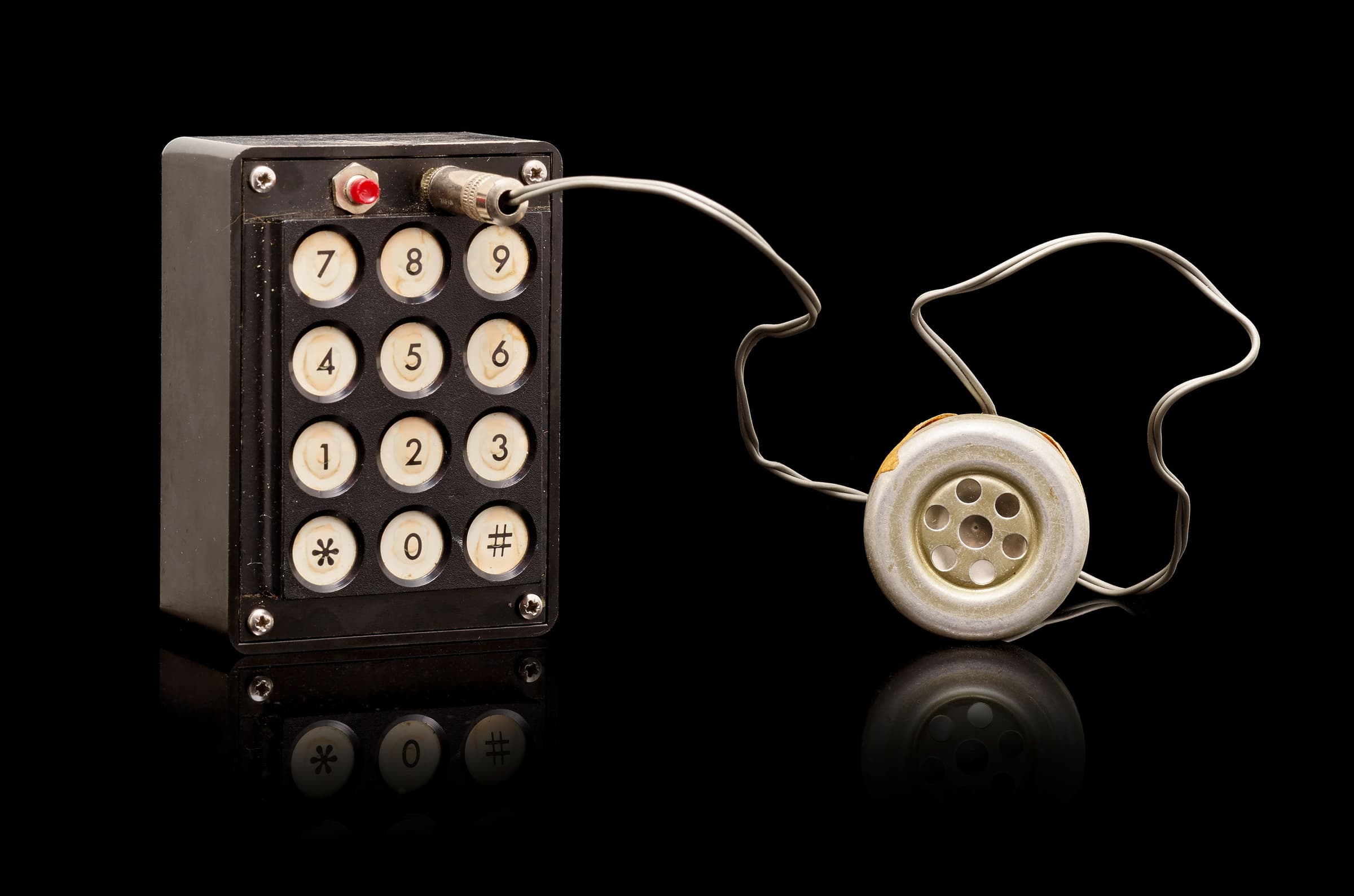
Wozniak and Jobs Blue Box (1972)
Woz constructed a crammed box from inexpensive electronic parts and a small speaker, which enabled them to produce tone sequences in a more precise and delicate way than with the toy whistle. “There used to be a way to fool the entire telephone system – they were thinking you were a telephone-computer,” recalled Steve Jobs later. “You could call anyone in the world for free. In matter of fact, you could call from a pay phone, go to White Plains, New York, take a satellite to Europe, take a cable to Turkey, come back to Los Angeles. You could go around the world – three, four times and call the pay phone next door. If you shouted into the phone, about 30 seconds later it came out the other end of the other phone.”
The manipulation of the telephone system was of course illegal. That did not stop Woz and Jobs from building and selling blue boxes within their circle of friends. “It was the magic of the fact, that two teenagers could build this box for a hundred dollars worth of parts and control hundred of billions of dollars of infrastructure in the entire telephone network of the whole world from Los Altos and Cupertino, California. That was magical,” said Jobs.
His friend “Woz” had even mor fun:
So we’re sitting in the payphone trying to make a blue box call. And the operator comes back on the line. And we’re all scared and we’d try it again. … And she comes back on the line; we’re all scared so we put in money. And then a cop car pulls up. And Steve was shaking, you know, and he got the blue box back into my pocket. I got it– he got it to me because the cop turned to look in the bushes for drugs or something, you know? So I put the box in my pocket. The cop pats me down and says, “What’s this?” I said, “It’s an electronic music synthesizer.” Wasn’t too musical. Second cop says, “What’s the orange button for?” “It’s for calibration,” says Steve. — Steve Wozniak, lecture at Computer History Museum, 2002
“Experiences like that taught us the power of ideas, the power of understanding that you could build this box, you could control hundreds of millions dollars worth of telephone infrastructure around the world. This is a powerful thing,” Jobs told many years later to Santa Clara Valley Historical Association.
If it hadn’t been for the Blue Boxes, there would have been no Apple. I’m 100% sure of that. Woz and I learned how to work together, and we gained the confidence that we could solve technical problems and actually put something into production.
In 1972 Jobs wanted to study at Reed College in the neighboring state of Oregon, although it was clear that his parents could not afford the university fees. “All savings of my working-class parents went for my college fees,” recalled Steve Jobs in June 2005 during his legendary commencement address at Stanford University.” After six months, I couldn’t see the value in it. I had no idea what I wanted to do with my life and no idea how college was going to help me figure it out.”
Search for the meaning of life
Jobs broke off his studies and made his way as a person making the best of things. Now and then he would get a hot meal at the local Hare Krishna temple. He sneaked into the calligraphy course, which was offered at Reed College. ” I learned about serif and I learned about serif and sans serif typefaces, about varying the amount of space between different letter combinations, about what makes great typography great. It was beautiful, historical, artistically subtle in a way that science can’t capture, and I found it fascinating.” This episode as well would later influence computer history:
Ten years later, when we were designing the first Macintosh computer, it all came back to me. And we designed it all into the Mac. It was the first computer with beautiful typography. If I had never dropped in on that single course in college, the Mac would have never had multiple typefaces or proportionally spaced fonts. And since Windows just copied the Mac, it’s likely that no personal computer would have them.
Steve Jobs was looking for the meaning of life. He experimented with mind-expanding drugs. At the time when he worked for Atari in 1975, he profited from a business trip to Europe to go to India on his own. At that time, Jobs was studying extensively the teachings of the Harvard professor Richard Alpert, who had converted to Hinduism and taught in India as Guru Ram Dass (“servant of God”). In India, however, Jobs found no enlightenment but ended up with a scammer who was just playing the role of a guru. Disillusioned, he returned to California.
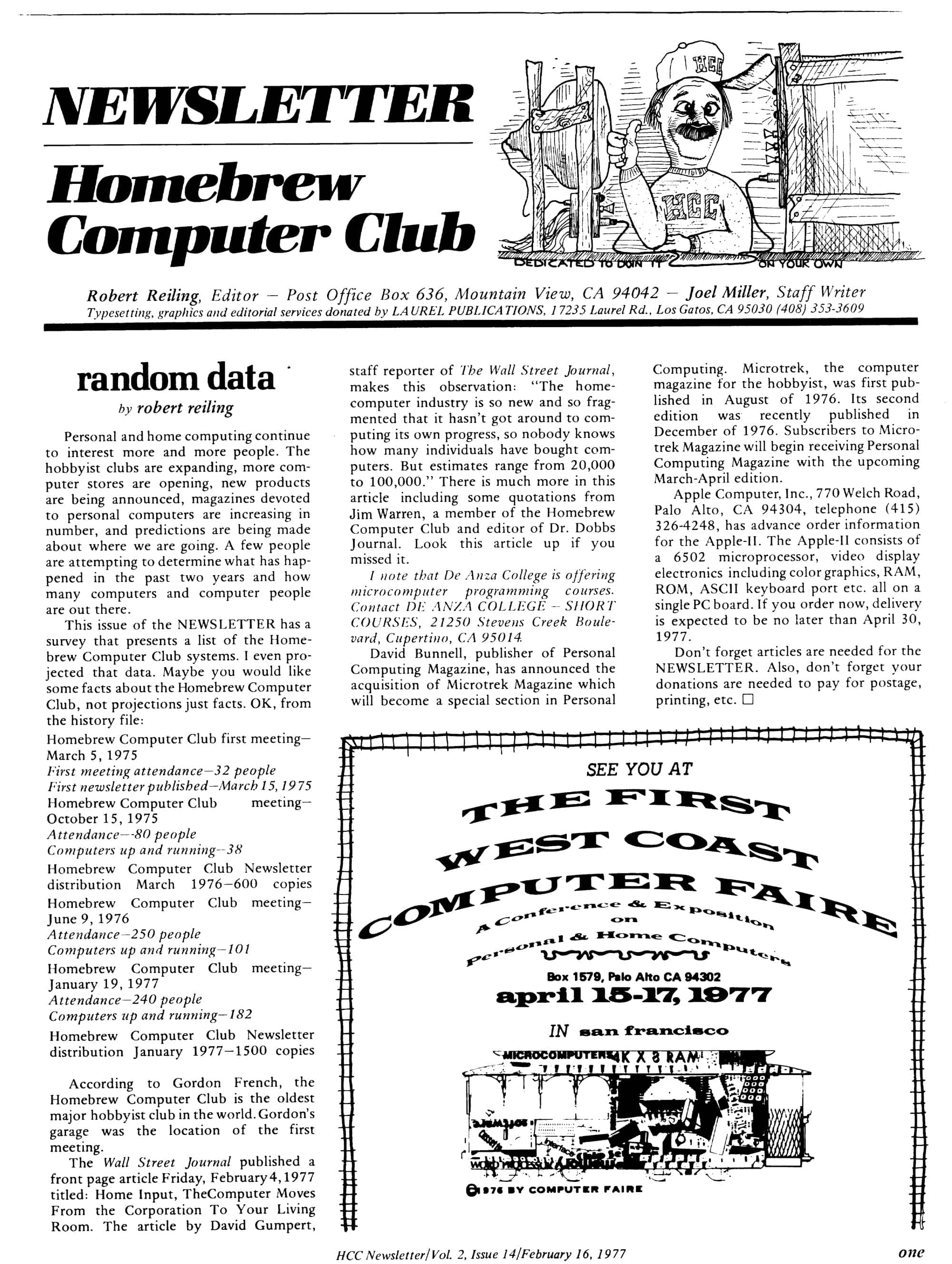
The Homebrew Computer Club newsletter
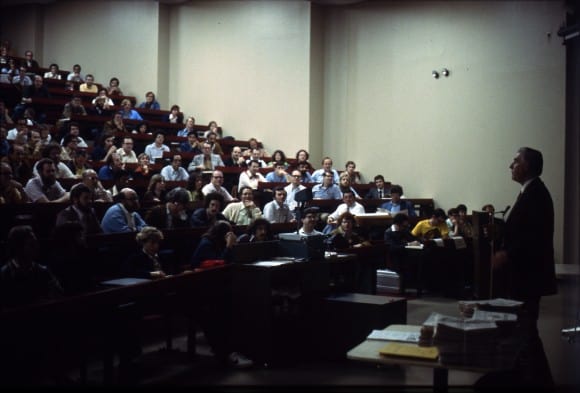
Meanwhile, his friend Steve Wozniak tried to impress a “strange, geeky group of people” who called themselves “Homebrew Computer Club.” “This was a group fascinated with technology and the things it could do. Most of these people were young, a few were old, we all looked like engineers; no on was actually good looking. Ha. Well, we’re talking about engineers, remember?”, Wozniak wrote in his book “iWoz”. Steve Wozniak developed a kit for the geeks from the club that would later be known as the Apple I. At that time, Steve Jobs was forging much bigger plans, as he had observed that very few people from Homebrew had the time or skills to build computers on their own. “Why don’t we build and then sell the printed circuit boards to them?”, he asked Woz. (iWoz, Page 172)
With a sense of humor, Jobs and Wozniak founded Apple Computer on “April Fools Day”, the 1st of April, 1976. For the necessary initial investment of $1,000 Wozniak sold his programmable HP 65 calculator for $500. “The guy who bought it only paid the half, though, and never paid the rest”, wrote Steve Woziak in his book “iWoz”. “I didn’t feel to bad because I knew HP’s next-generation calculator, the HP 67, was coming out in a month and would cost me only $370 with the employee discount. And Steve sold his VW van for another few hundred dollars. He figured he could ride around on his bicycle if he had to. That was it. We were in business.”
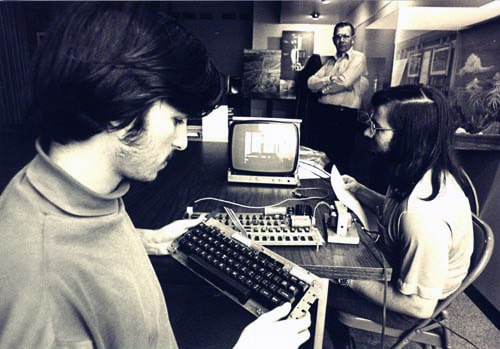
Steve Jobs and Steve Wozniak using Apple 1 computer system, ca. 1976
The third founder, Ron Wayne, who was an adult with experience, was to provide a proper accounting. He received a 10 percent share of the company, while the two Steves had their shares of 45 percent each. But Wayne dropped out after a few weeks because the family man was not comfortable with the unclear liability risk as he had much more to lose than the two Steves.
Later on, the millionaire Mike Markkula took over the role of the adult supervisor. He invested a quarter-million dollars in the start-up to finance the production and marketing of the Apple II.
Steve and I get a lot of credit, but Mike Markkula was probably more responsible for our early success, and you never hear about him.
— Steve Wozniak, Failure Magazine, July 2000
Breakthrough with Apple II
Steve Wozniak was the hardware genius. The driving force of the marketing was Woz’s dynamic companion, Steve Jobs. He was fascinated by Woz’s technical skills, partly because he would never have been able to construct a computer like the Apple II himself. But he viewed his friend also with a critical eye: “Woz is very bright in some areas, but he’s almost like a savant since he was so stunted when it came to dealing with people he didn’t know,” said Jobs and conceded in his biographer Isaacson’s account: “We were a good pair.” Wozniak was however impressed with the business sense of his friend: “I never wanted to deal with people and step on toes, but Steve could call up people he didn’t know and make them do things,” said Wozniak. “He could be rough on people he didn’t think we’re smart, but he never treated me rudely, even in later years when maybe I couldn’t answer a question as well as he wanted.”
Woz would have been happy to market the Apple II as a kit. But Jobs demanded a complete product in a smooth bright plastic body, similar to a Cuisinart food processor. Jobs also asked for an expensive switching power supply, which made a fan unnecessary, He bothered Wozinak by demanding that the lines on the board of the Apple II should run straight. The huge effort paid off: The Apple II developed by Woz was the first personal computer, which found a mass audience.
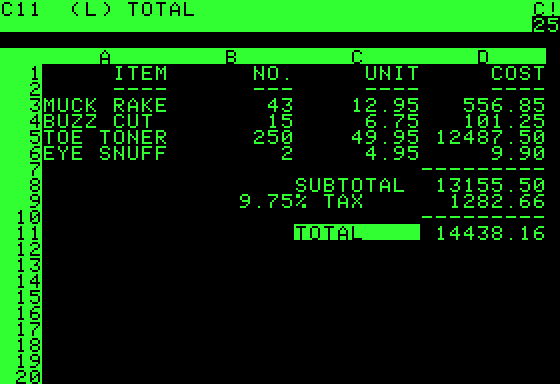
The sales success has been driven by VisiCalc, the first spreadsheet software for a microcomputer. “From 1,000 units a month we went to 10,000 a month,” remembers Woz. “Good god, it happened so. Through 1978 and 1979, we just got more and more successful. In 1980, we were the first company to sell one million computers.” (iWoz, page 220)
A screenshot of Visicalc
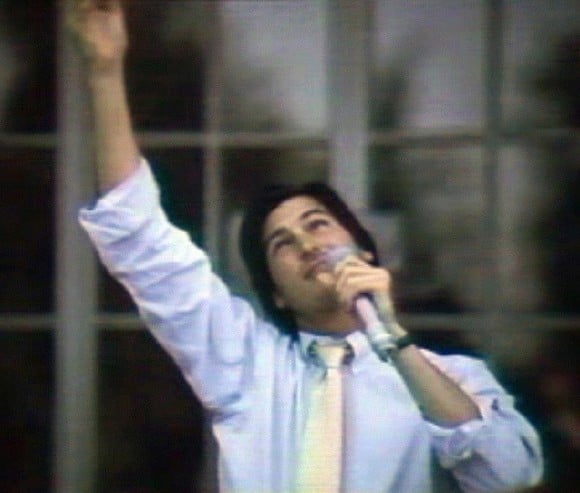
On 12 December 1980, Apple Computer Inc. went public. With Apple going public, Steve Jobs became a multi-millionaire as the company was now valued at $1.8 billion. Forgotten were the difficult times in which Jobs had taken advantage of his friend Woz and denied him the fair share of the royalties for a programming job for Atari.
Jobs now had 7.5 million Apple shares worth 217 million dollars. Woz could also forget all economic problems as he received four million shares (116 million dollars). Markkula’s cut of seven million shares were worth $203 million. “I was worth about over a million dollars when I was twenty-three and over ten million dollars when I was twenty-four, and over a hundred million dollars when I was twenty-five,” Jobs said in an interview in 1995. “It wasn’t that important because I never did it for the money.”
Steve Jobs celebrating Apple’s IPO (1980)
Going public had bitter consequences as well for Steve Jobs. Unlike Microsoft founder Bill Gates, the co-founder of Apple was no longer the leading decision-maker in “his” company. On the one hand, he had an enormous amount of money, but on the other hand he no longer held the majority of company shares. Now Apple was lead by a management defined by investors. At that time, the main character of the top management of Apple was the “angel investor” Mike Markkula, who took over the job of managing director from Mike Scott in the summer of 1981. However, Markkula and Jobs agreed, that the new Apple management director should be a charismatic figure who was familiar with the methods of modern marketing in the field of consumer goods and could apply it to Apple. Jobs and Markkula’s search paid off. On the east coast of the United States, they found someone at the management level of Coca-Cola’s rival PepsiCo.
Read next page: “Dynamic Duo”: Steve Jobs and John Sculley
“Do you want to sell sugared water for the rest of your life or do you want to come with me and change the world?” With this famous sentence, Steve Jobs convinced the Pepsi manager John Sculley in 1983 to enter the computer industry and move to California. But the “Dynamic Duo” did not last long. It quickly became obvious that the Apple co-founder Jobs and the new manager Sculley did not come to an agreement in key issues such as the marketing strategy for the Macintosh. It began in the time before Apple went public: In 1979, Markkula and Scott had hired the talented engineer Jef Raskin to construct a “people’s computer.”
The new model should reduce the company’s dependence on mega-seller Apple II. However, the project progressed very slowly, partly because Steve Wozniak did not play an active role in its development anymore. After a plane crash with his Beechcraft Bonanza in February 1981, Woz had largely withdrawn from Apple. Therefore, it was Steve Jobs who at this stage provided strategic directions in Apple’s technology. He was neither an inventor nor an engineer or programmer. But Jobs was able to estimate the implications of new technology concepts much better than anyone else.
The Enlightenment in Xerox PARC
Steve Jobs’ masterpiece in technology scouting took off during the event of Xerox PARC. As early as 1979 he had visited with a small team of Apple developers the legendary California research center in nearby Palo Alto. He had the chance to look into the future. “They showed me really three things,” Jobs said in 1995 in a TV interview. “But I was so blinded by the first one I didn’t even really see the other two. One of the things they showed me was object orienting programming they showed me that but I didn’t even see that. The other one they showed me was a networked computer system…they had over a hundred Alto computers all networked using email etc., etc., I didn’t even see that. I was so blinded by the first thing they showed me which was the graphical user interface. I thought it was the best thing I’d ever seen in my life, ” Jobs said in a TV interview in 1995.
At Xerox PARC Steve Jobs had seen the light. Now, he also wanted to build an Apple computer that was easy to operate. Apple had bought admission to the Xerox Research Center PARC through a stock deal that appeared to be very lucrative to the narrow-minded Xerox managers on the East Coast. Xerox was allowed to buy 100,000 shares of the Apple start-up company stock before the public offering for a million dollars. In the short term, this deal was worth it: By the time Apple went public a year later, Xerox’s $1 million worth of shares were already worth $17.6 million. But in the long term, Xerox lost the chance to become an industry giant like Microsoft or IBM because the work of their researchers in California had been ignored internally.
Pirates of Macintosh
Steve Jobs was quick to distance himself from the failure of the Apple Lisa, since in 1980 the then managing director Mike Scott denied him the management of the Lisa team. In an internal competition with the Lisa team, Jobs subsequently acquired the fledgling Macintosh project from Jef Raskin and bet $5,000 that he would bring the Mac to the market before Lisa. Initially, Jobs hounded Raskin out of the group. Then he positioned his team within Apple as a rebel troop. They wanted to prove the Lisa team, which enjoyed the confidence of the management, that they could do it.
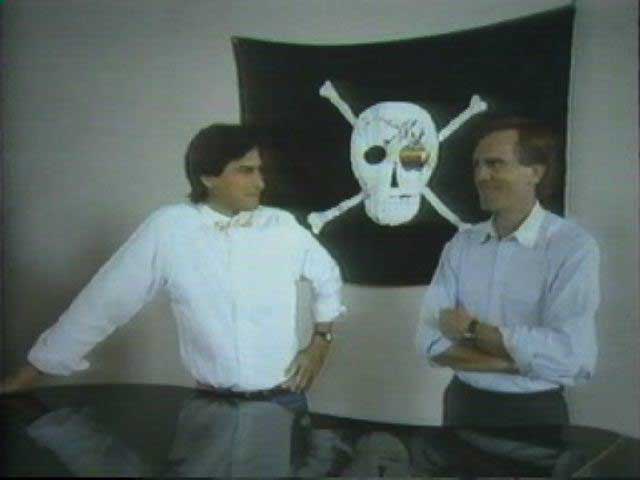
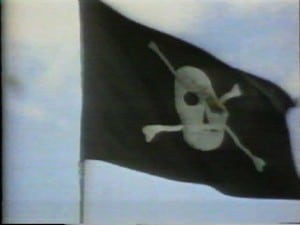
The pirate flog on building Bandley III
Above the building of the Mac developers “Bandley III”, a skull and crossbones flag fluttered. “It is better to be a pirate than to go to the Navy,” Jobs said to his developers. Apple investor Arthur Rock became really agitated by this action, “Flying that flag was really stupid. It was telling the rest of the company they were no good.” But Jobs loved it, and he made sure it waved proudly all the way through to the completion of the Mac project. “We were the renegades, and we wanted people to know it,” he recalled. (Isaacson, page 186)
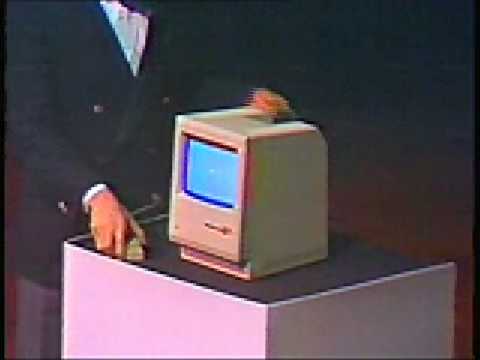
Jobs had assembled a dream team of genius programmers and engineers, whom he urged like a cult leader with flattery and verbal attacks to continually new heights. But the ever-changing demands of Jobs delayed the Mac project so that the Apple co-founder finally lost his bet against the Lisa team. It was not until the 24th of January 1984, that the Mac was finally ready.
At the public presentation of the new computer model, Jobs recited the song “The Times They Are A-Changin” by Bob Dylan:
Come writers and critics
Who prophesize with your pen
And keep your eyes wide
The chance won’t come again
And don’t speak too soon
For the wheel’s still in spin
And there’s no tellin’ who
That it’s namin’
For the loser now
Will be later to win
For the times they are a-changin’
In their most famous television commercials of all time, director Ridley Scott evoked this vision of enslaved IBM users who would be released through the Mac. The Mac would make clear in the clip, why Big Brother IBM would not dominate the world; why “1984 would not be 1984”. Jobs was visibly proud of the achievements they made, and attributes this to his broadly talented employees. “I think part of what made the Macintosh great was that the people working on it were musicians and poets and artists and zoologists and historians who also happened to be the best computer scientists in the world,” Jobs said in a 1995 documentary on the U.S. television network PBS.Difficult start for the Mac
With the Macintosh, Steve Jobs had set a new milestone in computer development. But Apple had to first overcome a long dry spell in order to make a commercial breakthrough. This was also due to the fact that the first Mac model was only equipped with 128 kilobytes of main memory which was far too little. At that time, Apple Fellow Alan Kay described the Mac as a “Honda with a one-gallon gas tank.”
Furthermore, applications such as Aldus Pagemaker or peripheral devices such as laser printers, which could use the advantages of Mac GUI in desktop publishing, did not exist yet.
“The original 128K Mac had too many problems to list,” wrote Jack Schofield from the Guardian 20 years later in an article about the 20th anniversary of the apple Macintosh. “It had too little software, you couldn’t expand it (no hard drive, no SCSI port, no ADB port, no expansion slots), it was horribly underpowered and absurdly overpriced. The way MacWrite and MacPaint worked together was brilliant, but producing anything more than a short essay was a huge struggle. Just copying a floppy was a nightmare.”
In a two-day marathon meeting, Sculley demanded that Jobs should give up his position as Apple vice president and general manager of the Macintosh team. Sculley wanted Steve Jobs to become Apple’s new chairman and represent the company on the outside, without having influence on the core business. When Jobs got wind of Sculley’s plan to disempower him, he attempted to organize a coup in the Apple board. Sculley defended himself and told the board: “I said look, it’s Steve’s company, I was brought in here to help you know, if you want him to run it that’s fine with me but you know we’ve at least got to decide what we’re going to do and everyone has got to get behind it.” The majority of the board stood behind the former Pepsi manager and turned away from Steve Jobs.
In the end of May 1985, Jobs lost his responsibilities and was demoted to the post of the chairman. In September 1985, the Apple co-founder, left with a handful of people in order to found NeXT Computer. “I’m only 30 years old and I want to have the chance to continue creating things.” Steve Jobs wrote in his farewell to Mike Markkula:
Dear Mike,
This morning’s papers carried suggestions that Apple is considering removing me as Chairman. I don’t know the source of these reports, but they are both misleading to the public and unfair to me.
You will recall that at last Thursday’s board meeting I stated that I had decided to start a new venture, and tendered my resignation as Chairman.
The board declined to accept my resignation and asked me to defer it for a week. I agreed to do so in light of the encouragement the Board offered with regard to the proposed new venture and the indications that Apple would invest in it. On Friday, after I told John Sculley who would be joining me, he confirmed Apple’s willingness to discuss areas of possible collaboration between Apple and my new venture.
Subsequently the Company appears to be adopting a hostile posture toward me and the new venture. Accordingly, I must insist upon the immediate acceptance of resignation. I would hope that in any statement it feels it must issue, the Company will make it clear the decision to resign as Chairman was mine.
I find myself both saddened and perplexed by the management’s conduct in this matter which seems to me contrary to Apple’s best interests. Those interests remain a matter of deep concern to me, both because of my past association with Apple and the substantial investment I retain in it.
I continue to hope that calmer voices within the Company may yet be heard. Some Company representatives have said they fear I will use proprietary Apple technology in my new venture. There is no basis for any such concern. If that concern is the real source of Apple’s hostility to the venture, I can allay it. As you know, the company’s recent reorganization left me with no work to do and no access even to regular management reports. I am but 30 and want still to contribute and achieve.
After what we have accomplished together, I would wish our parting to be both amicable and dignified.
Yours sincerely,
Steven P. Jobs
The reactions of the Apple employees on the de facto sacking of Jobs revealed both sides of him. Andy Hertzfeld, one of the founders of Macintosh, mourned Jobs although he as well had been driven by his crude methods. “Apple never recovered from losing Steve. Steve was the heart and soul and driving force. It would be quite a different place today. They lost their soul.,” said the software developer, who left Apple after Job’s departure and recently grabbed the headlines by designing Google+.
Larry Tesler, who came to Apple from Xerox also openly brought up the dark side of the co-founder: “People in the company had very mixed feelings about it. Everyone had been terrorized by Steve Jobs at some point or another and so there was a certain relief that the terrorist had gone but on the other hand I think there was an incredible respect for Steve Jobs by the very same people and we were all very worried – what would happen to this company without the visionary, without the founder without the charisma… “
In 1985 Jobs sold all but one of his Apple shares, and had around 70 million dollars on his account. By chance he became aware of the sale of the animation department of George Lucas. The Star Wars director had divorced his wife in 1983 and was broke. At least Lucas could no longer afford to put millions of dollars into the innovative but economically not very successful “Graphics Group” of Lucasfilm year after year.
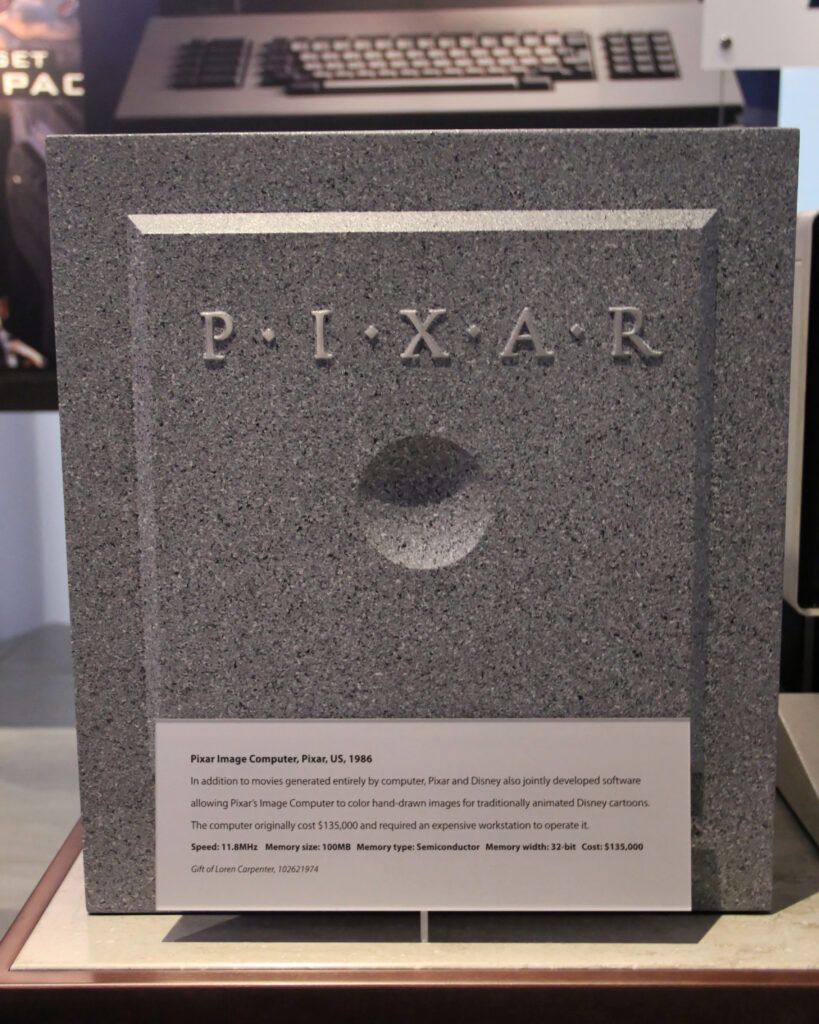
Pixar Image Computer (1986)
Jobs bought the department from Lucas for five million dollars and invested another five million more into the company, which was now named Pixar. While developing the Macintosh, Jobs had taken care of even the smallest detail, and his unwillingness to compromise had repeatedly gotten on the nerves of his employees. At Pixar, however, he gave much freedom to his management department. But initially, this freedom did not pay off. Sales of the core product, the Pixar Image Computer used for the animation of film sequences, were slow. But the short films of genius Pixar employee, John Lasseter, received one award after the other, even though the film strips were only meant to demonstrate the performance of Pixar’s hardware. For that reason, in the early nineties Pixar focused on the movies themselves and no longer on the hardware.
Becoming a billionaire with ”Toy Story”
The breakthrough was made by Lasseter’s team with the computer-animated cartoon “Toy Story”, which Pixar got produced for Disney. With a production budget of $30 million, the cartoon brought over 360 million dollars at the box office and in the secondary market. On 29th of November 1995, shortly after the release of “Toy Story”, Pixar went public.
Jobs’ new computer company NeXT had a very different structure than Pixar, as it was fully focused on the boss. Here Jobs wanted to create a computer he was not allowed to build at Apple. When the cash reserves ran low and still no product was in sight, he coaxed 20 million dollars out of multi-millionaire Ross Perot to build a modern factory for the production of NeXT. He commissioned the legendary designer Paul Rand, who had previously designed the IBM logo, to design a NeXT logo, and the German designer Hartmut Esslinger created the legendary black cube housing. Steve Jobs took care of details that could hardly be communicated to his employees.
For example, he demanded that the screws for the computer got an expensive coating and that the matt black paint was applied on the inside of the body as well, although the user would never get to see this. “He was not familiar with compromise,” said Esslinger. Anyone who tried a NeXT cube was usually enthusiastic about it. But the price of $6,500 for the NeXT cube was still too much for most of the potential clients. There was also at that time very little software available for this powerful workstation so that a total of only about 50,000 systems were sold. Therefore, similar to the first Macintosh, Jobs found only few buyers for his expensive hardware. Nevertheless, among the European users of NeXT was the British scientist Tim Berners-Lee, who developed the concept of the World Wide Web and the first browser on a black NeXT cube at the CERN Research Center in Geneva.
During this time, Archibald Horlitz, head of Germany’s largest Apple retailer Gravis, met Steve Jobs. Horlitz had heard about the new project and during a trip to California spontaneously knocked on the door of NeXT, in order to have the system demonstrated by the head of the company himself. “Steve Jobs had several facets. If he wanted something, he could be one of the most charming people in the world,” recalls Horlitz. “I’ve heard from a colleague at NeXT, how typical interviews were carried out. He took the people literally into his arms and went with them for one or two hours around the Stanford campus.
“When they came back, they were enlightened and could imagine nothing better than to work for him.” In this way Jobs could retain a great number of big talents such as Avie Tevanian or Scott Forstall. But there was no sign of NeXT’s economic recovery. The company burned through an alarming amount of money and Jobs financial reserves (before Pixar’s initial public offering) were slowly running out. In 1993 he put on the emergency brake at NeXT, fired many employees, and stopped the hardware production. From that moment on, NeXT focused solely on the software development. And, it sounds like a staircase wit of history: Through this strategic decision, Steve Jobs came back into the game at his first company Apple.
In the mid-nineties, Apple was in the worst possible condition. In the late eighties and early nineties, John Sculley had indeed been successful in the publishing industry. Products such as the PowerBook family boosted sales for some time, but with the Macintosh, Apple never managed to approach the sales figures of Microsoft, the manufacturer of IBM-compatible PCs with the DOS operating system. When the Mac was launched in 1984, Bill Gates had publicly praised Apple computers as an innovative PC platform.
But behind the back of Steve Jobs, the founder of Microsoft went about stealing the ideas of Macintosh for his Windows system. Jobs got wind of it and put Gates angrily to task: “You’re ripping us off!” he shouted. “I trusted you, and now you’re stealing from us!” The Microsoft boss just sat there coolly, looking Steve in the eye, before hurling back, in his squeaky voice. “Well, Steve, I think there’s more than one way of looking at it. I think it’s more like we both had this rich neighbor named Xerox and I broke into his house to steal the TV set and found out that you had already stolen it.”
After the departure of Jobs, even Sculley was not able to prevent Microsoft from constantly developing the Windows system and step by step adopting details from the Mac’s graphical user interface in to their software. Apple was vulnerable to blackmail, as Microsoft made important applications for the Mac. After Bill Gates had threatened to discontinue the development of Microsoft Office for Mac if Apple acted against Windows, Apple’s CEO licensed certain elements of the Mac GUI to the competitor from Redmond in 1986. Sculley had to look on helplessly as the Microsoft Company shamelessly shifted agreement limits in their favor with each new version of Windows.
Even Apple’s lawsuit in 1988 could not stop the software giant. In 1992, the court ruled that Apple could not claim any copyright on the graphical user interface or protect the idea of the virtual desktop as a patent. Apple ultimately failed in stopping Windows from copying at the US Supreme Court in 1994. Declining revenues and increased difficulties in the development department of aggravated the sense of crisis at Apple. In June 1993, the management board of Apple lost patience.
Around this time Steve Jobs was asked in an oral history interview about the shape of Apple. Jobs didn’t blame Microsoft for the crisis but only John Sculley and his team:
When I left Apple it was a two billion dollar company. We were Fortune 300 and something. We were 350. When the Mac was introduced we were a billion dollar corporation; so Apple grew from nothing to two billion dollars while I was there. That’s a pretty high growth rate. It grew five times since I left basically on the back of the Macintosh. I think what’s happened since I left in terms of growth rate has been trivial compared with what it was like when I was there. What ruined Apple wasn’t growth. What ruined Apple was values. John Sculley ruined Apple and he ruined it by bringing a set of values to the top of Apple which were corrupt and corrupted some of the top people who were there, drove out some of the ones who were not corruptible, and brought in more corrupt ones and paid themselves collectively tens of millions of dollars and cared more about their own glory and wealth than they did about what built Apple in the first place–which was making great computers for people to use. They didn’t care about that anymore. They didn’t have a clue about how to do it and they didn’t take any time to find out because that’s not what they cared about. They cared about making a lot of money so they had this wonderful thing that a lot of brilliant people made called the Macintosh and they got very greedy and instead of following the original trajectory of the original vision–which was to make this thing an appliance, to get this out there to as many people as possible–they went for profits and they made outlandish profits for about four years. Apple was one of the most profitable companies in America for about four years.
What that cost them was the future. What they should have been doing was making reasonable profits and going for market share, which was what we always tried to do. Macintosh would have had a thirty- three percent market share right now, maybe even higher, maybe it would have even been Microsoft but we’ll never know. Now its got a single digit market share and falling. There’s no way to ever get that moment in time back. The Macintosh will die in another few years and its really sad. The problem is this: no one at Apple has a clue as to how to create the next Macintosh because no one running any part of Apple was there when the Macintosh was made–or any other product at Apple. They’ve just been living off that one thing now for over a decade and the last attempt was the Newton and you know what happened to that. It’s kind of tragic, but as unemotionally as I can be, that’s what’s happening. Unless somebody pulls a rabbit out of a hat, companies tend to have long glide slopes because of the installed bases. But Apple is just gliding down this slope and they’re loosing market share every year. Things start to spiral down once you get under a certain threshold. And when developers no longer write applications for your computer, that’s when it really starts to fall apart.
“The Diesel” – Michael Spindler
The Apple board at this point really had no clue how to save the company. They replaced Sculley by the German-born manager Michael Spindler, who was very experienced in sales and distribution for Europe. “The diesel” was an effective manager, but he lacked any inspiration. Neither could he get Apple out of the current crisis nor even succeed in selling the company to interested parties such as IBM, Sun Microsystems, or Philips. After a year and half, Spindler was replaced by the restructuring expert Gil Amelio. In 1996, a year after the successful launch of Windows 95, Amelio, above all, had to deal with the question about the future of the operating system, since Apple’s internal Copland project had failed spectacularly. There was a choice between BeOS of the former Apple manager Jean-Louis Gassée, and Steve Jobs’ system NeXTStep. Many myths surround the decision made in favor of Jobs which are still difficult to unravel today.
BeOS finally lost the race. In February 1997, Apple paid just under 430 million dollars for NeXT and the know-how of the company. Bill Gates only had to spare scorn and ridicule for the change in direction at Apple. “Do you really think Steve Jobs has anything there?” Gates asked the still reigning Apple CEO Amelio. “I know his technology, it’s nothing but a warmed-over UNIX, and you’ll never be able to make it work on your machines.” (…) “What the hell are you buying that garbage for?” Gates did not take NextStep for a serious rival. He suspected already that it was not just about a new operating system, but a coup that would bring Steve Jobs back in charge at Apple. Five months later, Amelio was actually fired from the board of directors. And in September 1997, Jobs took over the post of an interim CEO. At that time, Apple was about 90 days away from bankruptcy.
By the summer of 1997, Apple Computer was not just a company in trouble; it was a corporate casualty in waiting. The “Bleeding in Colors” era was nearly over, and the red ink was flowing much faster than the rainbow-colored logos could mask. When Steve Jobs returned to the company he co-founded, he didn’t just bring a new strategy—he brought a surgical saw and a surprising olive branch extended toward Redmond.
The Boston Massacre: A Giant Screen and a Chorus of Boos
The scene at the 1997 MacWorld Expo in Boston remains one of the most surreal moments in technological history. Steve Jobs, standing on stage in his trademark casual attire, addressed a crowd of Apple faithful who lived and breathed a singular doctrine: Microsoft is the enemy. Then, the unthinkable happened. Bill Gates’ face appeared on a colossal video screen, looming over Jobs like a digital Big Brother. The announcement was a bombshell: Microsoft would invest $150 million in non-voting Apple stock and, more importantly, commit to developing Microsoft Office for the Mac for at least five years.
The reaction was visceral. Boos echoed through the hall, a mixture of betrayal and shock. But Jobs, ever the pragmatist disguised as a visionary, silenced the crowd with a cold dose of reality. “If we want to move forward and see Apple healthy again, we have to let go of a few things here,” he famously stated. “We have to let go of this notion that for Apple to win, Microsoft has to lose.” It was a masterclass in ego-management. Jobs knew that without the industry standard—Office—the Macintosh was a creative island with no bridge to the business world. He wasn’t just taking Gates’ money; he was buying Apple the time it needed to breathe.
The Great Purge: Killing the Clones and the Newton
Once the financial lifeline was secured, Jobs turned his attention inward with a ferocity that stunned the remaining executive suite. He wasn’t interested in consensus; he was interested in survival. He ruthlessly “cleaned up” the management tiers, firing those he deemed “losers” or “rip-off artists” who had allowed the company to drift into a sea of mediocrity.
His first victims were the projects and agreements that he felt diluted the Apple brand. He famously “killed” the Newton, John Sculley’s ambitious handheld PDA, despite its cult following. To Jobs, the Newton—with its clunky stylus and struggling handwriting recognition—was a distraction from the core mission. Next, he tore up the agreements with manufacturers of Macintosh clones. While previous CEOs thought licensing the MacOS would increase market share, Jobs saw only one thing: cheap, ugly hardware cannibalizing Apple’s high-end sales. By killing the clones, he reclaimed total control over the user experience.
90 Days from Death: The “Miraculous” Remnant
The gravity of the situation was even worse than the public realized. Years later, at the 2010 D8 conference, Jobs admitted that upon his return, Apple was roughly 90 days away from total bankruptcy. The coffers were empty, and the product line was a convoluted mess of numbered Performa and Quadra models that even the sales staff couldn’t explain.
Yet, amidst the wreckage, Jobs found a spark of hope. He expected the “good people” to have fled the sinking ship long ago. Instead, he discovered a core group of engineers and designers who stayed not for the stock options—which were underwater—but for the mission. When he asked them why they remained, they gave him a phrase that would become part of Apple lore: “Because I bleed in colors.” They were the true believers in the original six-colored Apple ethos, waiting for a leader who cared about the “insanely great” rather than just the quarterly balance sheet.
The Discovery of Jony Ive: From Frustration to Future
Among those frustrated geniuses was a 30-year-old Briton named Jony Ive. Having joined Apple in 1992, Ive had spent years being ignored by a succession of CEOs—Sculley, Spindler, and Amelio—who viewed design as an afterthought, a “veneer” to be slapped onto a beige box at the end of production. Ive was so disillusioned by the company’s focus on profit maximization that he reportedly had his resignation letter in his pocket when Jobs visited the design studio.
The meeting changed history. Jobs didn’t see design as a department; he saw it as the soul of the product. When Jobs announced that the goal was no longer “just to make money, but to make great products,” Ive realized he had finally found his kindred spirit. Jobs recognized Ive’s undiscovered brilliance, and together they began a partnership that would eventually produce the iMac, the iPod, and the iPhone.
By stabilizing the ship with Microsoft’s capital and refocusing the culture on design excellence, Jobs didn’t just save Apple—he set the stage for the most remarkable corporate turnaround in history. The “archenemy” had provided the ladder, but it was Jobs and his “miraculous” team who climbed it to reach the stars.
he Antitrust Insurance: Why Gates Needed Apple to Live
While the Apple community viewed the $150 million investment as an act of mercy, Bill Gates was playing a much larger game of chess. In 1997, Microsoft was the undisputed titan of the tech world, but it was also a company under heavy fire. The U.S. Department of Justice was circling Redmond with a massive antitrust investigation, accusing Microsoft of maintaining an illegal monopoly in the PC operating system market.
For Gates, the death of Apple would have been a PR and legal disaster. If his only viable competitor vanished, the calls to break Microsoft into smaller pieces would have become deafening. By propping up Apple, Gates bought himself “antitrust insurance.” He could point to a healthy, revitalized rival in Cupertino as proof that the market was still competitive. Furthermore, the deal included a crucial provision: Apple agreed to make Internet Explorer the default browser on the Mac, effectively giving Microsoft a decisive edge in the “Browser Wars” against Netscape. It was a win-win; Jobs got his capital, and Gates got a shield against the regulators and a foothold in the emerging web market.
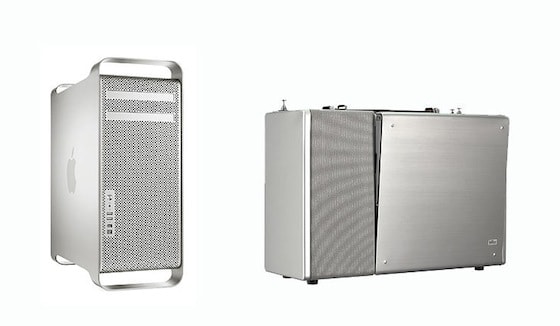
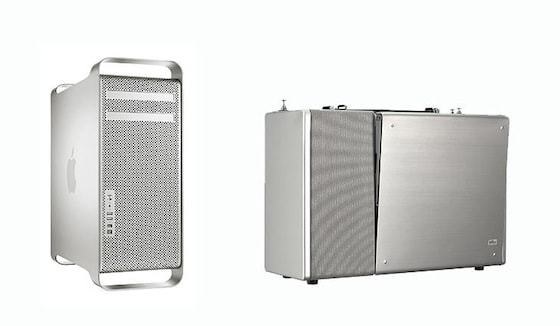
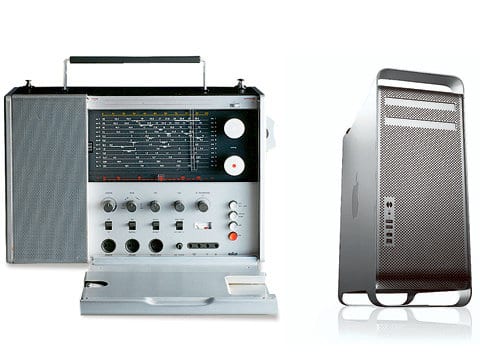
Apple designer Jony Ive brought to Apple the ideas of the German industrial designer Dieter Rams, who had developed key stylistic elements while working for the electric equipment manufacturer Braun. “Less is more” – Rams’ policy became then the design credo of Jony Ive and Steve Jobs. With the first iMac G3, Ive converted the typical beige PC box into a semitransparent, candy-like design statement. With the PowerBook made of Titanium and Aluminum and the PowerMac G5, Ive paid homage to his role model Dieter Rams, who had designed a similar-looking aluminum case for the legendary World Receiver T1000 as early as in 1963.
The design of the PowerMac G5 was inspired by the famous Braun radio T1000Braun Radio T1000 (1967) – Apple PowerMac G5 / Mac Pro (2003)
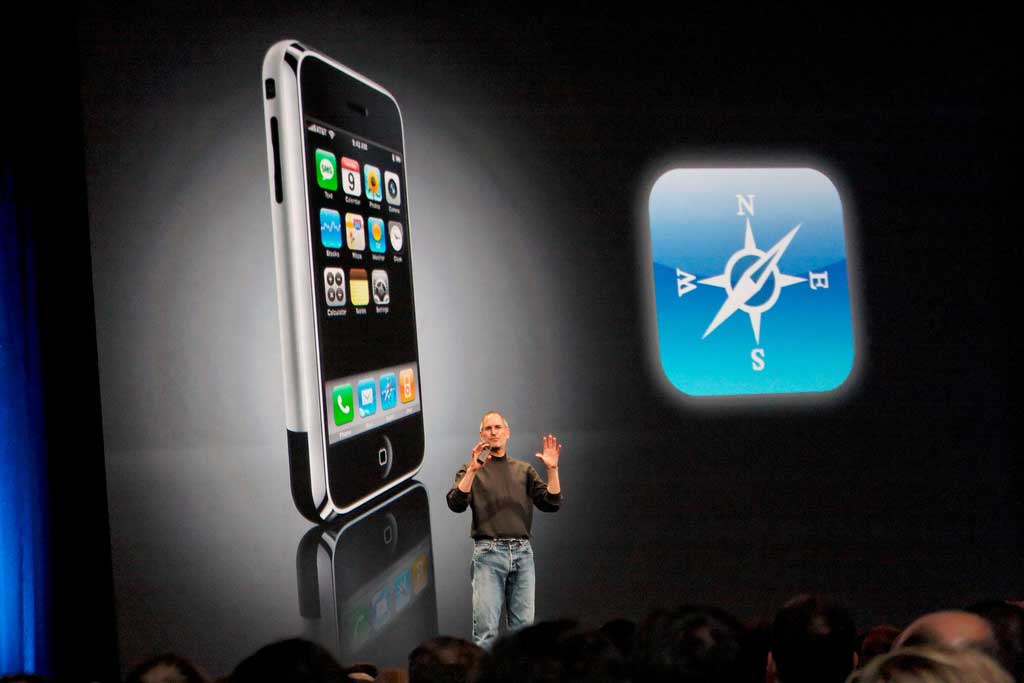
In 2007, the first iPhone was created, and the calculator app on the first iPhone was nothing else than a copy of the ET44 calculator body, which Rams had designed for Braun 20 years ago.
Even more serious consequences for Apple and the industry came with the next major project, which was developed under the code name “Purple 2”. Shortly after the presentation of the first iPod, the Apple leadership dealt with the question of whether Apple should launch a (mobile) phone. In a secret operation, a development group was founded, which remained largely unknown within the company. As part of secret work on a predecessor of the iPad, the engineers in Cupertino had built up a considerable knowledge of touch-screen technology that could be transferred to a smaller screen.
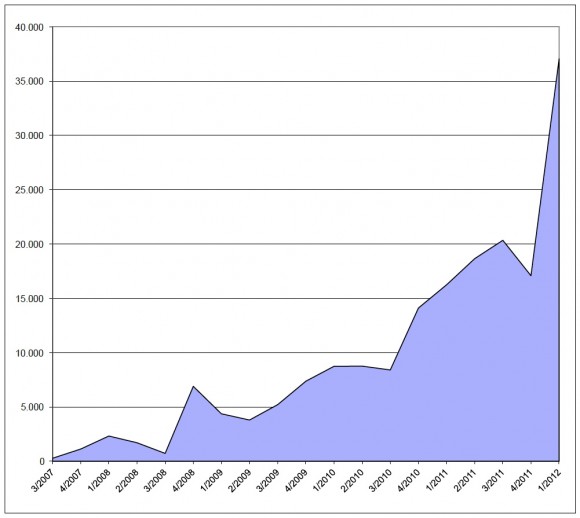
Moreover, a microprocessor ARM11 chip, which could provide sufficient power for complex smart phone applications, finally came on the market. As of 2005, the Apple smartphone designed by Jony Ive gradually materialized. At the MacWorld Expo in January 2007, Steve Jobs boasted, “Today, we’re introducing three revolutionary products of this class. The first one is a widescreen iPod with touch controls. The second is a revolutionary mobile phone. And the third is a breakthrough Internet communications device.” Jobs repeated this list many times until it began to dawn on even the last visitor at the Moscone Center what he meant: “These are not three separate devices – this is one device… and we are calling it iPhone!” The old archrivals from Microsoft attempted to ridicule Apple’s advance. “It’s the most expensive mobile phone in the world,” barked Microsoft CEO Steve Ballmer in a TV interview. “The business customer will reject it because it has no keyboard.” Ballmer was very much mistaken. By the end of the first fiscal quarter 2012 (end of December 2011), Apple had sold 183 million iPhones.
Sales figures Apple iPhone
Only Google could keep up with the iPhone, thanks to its Google Android mobile operating system. Until his death Steve Jobs was convinced that the success of Android was only possible because of a betrayal of the long-standing Google boss Eric Schmidt. Between 2006 and 2009, Schmidt was on the Apple Board, where he had seen the development of the iPad and iPhone. His obligations to Apple did not prevent him from pushing Google to develop a competing system. Only when his conflict of interest became very obvious, Schmidt resigned from the Apple board. In January 2010, when the Taiwanese company HTC introduced a new Android-powered smartphone, which dominated many of iPhone’s features, Jobs became furious. “Our lawsuit is saying, “Google, you fucking ripped off the iPhone, wholesale ripped us off. Grand theft. I will spend my last dying breath if I need to, and I will spend every penny of Apple’s $40 billion in the bank, to right this wrong,” said Jobs to book author Isaacson. “I’m going to destroy Android, because it’s a stolen product. I’m willing to go to thermonuclear war on this. They are scared to death, because they know they are guilty.” Apple and many Android OEMs like Samsung and HTC have been fighting for months in court. Despite victories in some points, Apple was not able to stop the winning run of Android. Jobs could take comfort in the fact that two-thirds of the profits of the entire smartphone industry are noted in the books of Apple, and other manufacturers excluding Samsung, are financially getting nowhere.
Steve Jobs had put the first stages of his personal suffering already behind him when he presented the first iPhone in January 2007. In October 2003 he was diagnosed with cancer, which for months he initially wanted to combat without methods of conventional medicine. Finally end of July 2004, he underwent an operation to have a tumor removed from his pancreas. While in the summer of 2007, at the sales launch of the first iPhone, Jobs again seemed quite well, one year later he appeared at the developer conference WWDC 2008, looking decidedly thinner. In early 2009 he retired from public life and underwent a liver transplant.
He returned to the stage two more times, to present both the first and second iPad. It must have been a big victory for Jobs that under his leadership Apple brought a digital tablet to the market, which at the same time established a new device category. His old adversary Bill Gates had presented tablet PCs on shows such as CES over the past ten years, but the devices were too complicated to use, too expensive and flawed, so nobody bought them. At his last public appearance, Steve Jobs fought for a building permit before Cupertino City council for the futuristic new Apple Campus 2, which was designed by British architect Norman Foster.