The Hammer That Shattered the Monolith: How 60 Seconds Defined the Apple Mythos
It is January 22, 1984. Inside Tampa Stadium, Super Bowl XVIII is in full swing. The Los Angeles Raiders are systematically dismantling the Washington Redskins. But during a break in the third quarter, the game becomes a footnote. For 60 seconds, nearly 100 million Americans are pulled away from the grass and grit into a dystopian nightmare—and then shown a glimpse of a digital revolution.
This wasn’t just a commercial. It was a cinematic manifesto directed by Ridley Scott, a man who had just finished reshaping science fiction with Blade Runner.
The Aesthetic of the Abyss
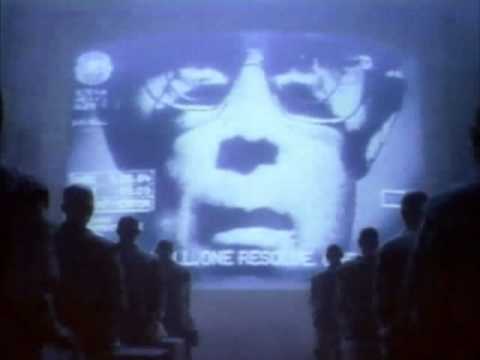
The spot opens on a monochrome, ash-colored world. Rows of hollow-eyed men, their heads shaved and spirits broken, march in lockstep through industrial corridors. They gather in a cold hall before a towering screen where a bespectacled “Big Brother”—a thinly veiled avatar for the then-dominant IBM—drones on about the “unification of thoughts.”
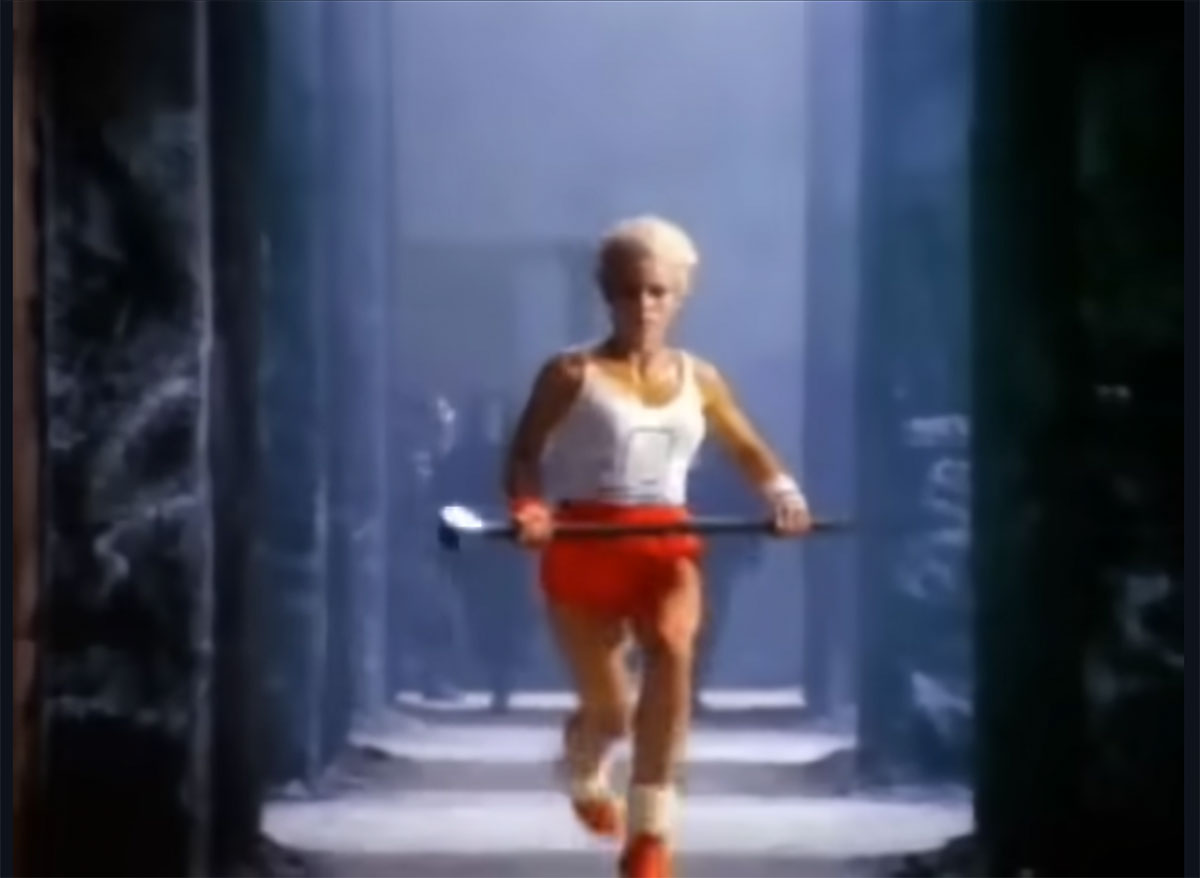
Then, a flash of color breaks the gray. A young woman (played by British athlete Anya Major) sprints toward the screen, pursued by riot police. She wears bright orange shorts and a white tank top emblazoned with a line drawing of a computer. In her hands, she swings a heavy sledgehammer with the grace of an Olympian. As she releases the hammer, it sails through the air and crashes directly into the face of the tyrant.
The screen explodes in a blinding white light. A voiceover—and a simple scroll of text—delivers the finishing blow: “On January 24th, Apple Computer will introduce Macintosh. And you’ll see why 1984 won’t be like ‘1984’.”
Corporate Cold Feet: The Board vs. The Visionaries
Today, the “1984” ad is heralded as the greatest commercial of all time. Yet, it almost never aired.
The backstory is a corporate thriller. The agency Chiat/Day had crafted the concept, and Steve Jobs was immediately electrified by it. He wanted a “thunderclap.” However, when the finished film was screened for Apple’s board of directors in December 1983, the reaction was icy silence.
Mike Markkula, Apple’s chairman and major investor, was horrified. “This is the worst ad I’ve ever seen. Who wants to fire the agency?” he reportedly asked. The board ordered CEO John Sculley to sell back the expensive Super Bowl airtime they had already purchased.
Wozniak’s Act of Rebellion
Steve Jobs, refusing to see his masterpiece buried, showed the spot to co-founder Steve Wozniak. “Woz” was so blown away that he offered to pay for half of the airtime out of his own pocket if the board refused to budge. “If Apple won’t run it, I’ll pay $400,000 and you pay $400,000,” Wozniak told Jobs.
In the end, it was a mix of chutzpah and luck: Chiat/Day claimed they couldn’t find a buyer for the 60-second slot in time. With the slot already paid for and no one to take it, Apple was forced to run the ad.
Skinheads and Discus Throws: The Making of a Legend
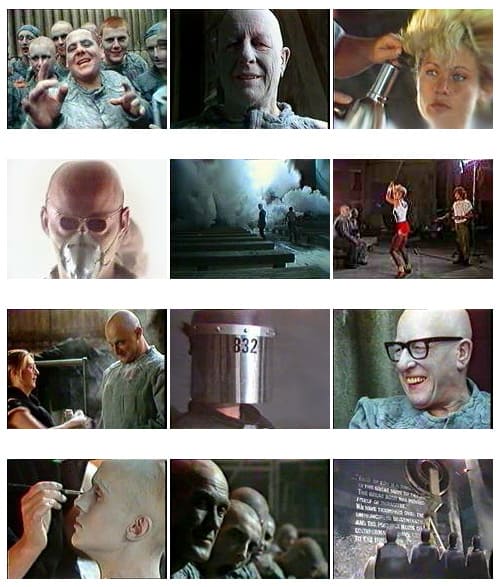
Ridley Scott’s production was grueling and authentic. Filmed at Shepperton Studios in London, Scott didn’t hire standard extras. To achieve the look of a true oppressed proletariat, he hired actual London skinheads for a pittance and the promise of a free lunch. The atmosphere on set was reportedly tense, with the extras’ rowdy behavior adding a layer of genuine grit to the film.
The choice of Anya Major for the lead role was a stroke of casting genius. Many models had auditioned, but most couldn’t even swing the hammer while running. Major was an experienced discus thrower; she had the muscle memory and the athletic form to hurl the sledgehammer with deadly precision.
The Legacy: When Advertising Became Art
The impact the next morning was unprecedented. News stations didn’t just talk about the ad; they replayed it in its entirety during their broadcasts. Apple generated over $5 million in free publicity. Overnight, the Macintosh became more than a piece of hardware; it became a symbol of individuality and freedom.
“1984” marked the moment advertising stopped merely explaining products and started creating myths. It was the birth of Apple as a lifestyle brand and Steve Jobs as the high priest of the digital counter-culture.
There is a modern irony to the story: today, critics often point at Apple’s massive market cap and closed ecosystem, suggesting the company has become the very “Big Brother” it once vowed to destroy. Regardless of the politics, the 60-second storm Ridley Scott and Steve Jobs unleashed remains a masterclass in storytelling—a hammer throw that changed the cultural trajectory of technology forever.
The commercial was rebroadcast in an updated version in 2004 on its 20th anniversary, with the heroine modified to be listening to an iPod. Viewers generally saw the Big Brother target of the Apple advertisement as being Microsoft, with the original villain, IBM, being all but forgotten.
Making of the Apple Ad 1984
Apple commercial “1984”: The Plot
The commercial opens with a dystopic, industrial setting in blue and gray tones, showing a line of people (of ambiguous gender) marching in unison through a long tunnel monitored by a string of telescreens. This is in sharp contrast to the full-color shots of the nameless runner (Anya Major). She looks like an Olympic track and field athlete, as she is carrying a large brass-headed hammer and is wearing an athletic “uniform” (bright orange athletic shorts, running shoes, a white tank top with a cubist picture of Apple’s Macintosh computer, a white sweat band on her left wrist, and a red one on her right).
As she is chased by four police officers (presumably agents of the Thought Police) wearing black uniforms, protected by riot gear, helmets with visors covering their faces, and armed with large night sticks, she races towards a large screen with the image of a Big Brother-like figure (David Graham, also seen on the telescreens earlier) giving a speech:
My friends, each of you is a single cell in the great body of the State. And today, that great body has purged itself of parasites. We have triumphed over the unprincipled dissemination of facts. The thugs and wreckers have been cast out. And the poisonous weeds of disinformation have been consigned to the dustbin of history. Let each and every cell rejoice! For today we celebrate the first, glorious anniversary of the Information Purification Directive! We have created, for the first time in all history, a garden of pure ideology. Where each worker may bloom secure from the pests purveying contradictory truths. Our Unification of Thoughts is more powerful a weapon than any fleet or army on earth. We are one people, with one will, one resolve, one cause. Our enemies shall talk themselves to death and we will bury them with their own confusion. We shall prevail!
The runner, now close to the screen, hurls the hammer towards it, right at the moment Big Brother announces, “we shall prevail!” In a flurry of light and smoke, the screen is destroyed, shocking the people watching the screen. The commercial concludes with a portentous voiceover, accompanied by scrolling black text (in Apple’s early signature “Garamond” font); the hazy, whitish-blue aftermath of the cataclysmic event serves as the background. It reads:
On January 24th, Apple Computer will introduce Macintosh. And you’ll see why 1984 won’t be like “1984.
The screen fades to black as the voiceover ends, and the rainbow Apple logo appears.
Apple commercial “1984”: The Production
Development
The commercial was created by the advertising agency Chiat/Day, Venice, with copy by Steve Hayden, art direction by Brent Thomas and creative direction by Lee Clow. Ridley Scott (whose dystopian sci-fi film, Blade Runner was released two years prior) was hired by agency producer Richard O’Neill to direct it, with a then-“unheard-of production budget of $900,000.” The actors who appeared in the commercial were paid $25 per day.
Steve Jobs and John Sculley were so enthusiastic about the final product that they “…purchased one and a half minutes of ad time for the Super Bowl, annually the most-watched television program in America. In December 1983 they screened the commercial for the Apple Board of Directors. To Jobs’ and Sculley’s surprise, the entire board hated the commercial.” However, Scully himself got “cold feet” and asked Chiat/Day to sell off the two commercial spots.
Despite the board’s dislike of the film, Steve Jobs continued to support it. Steve Wozniak watched it and offered to pay for half of the spot personally if the board refused to air it.
Of the original ninety seconds booked, Chiat/Day managed to resell thirty seconds to another advertiser, leaving the other sixty second slot.
Let’s see – an all-powerful entity blathering on about Unification of Thoughts to an army of soulless drones, only to be brought down by a plucky, Apple-esque underdog. So Big Brother, the villain from Apple’s ‘1984’ Mac ad, represented IBM, right? According to the ad’s creators, that’s not exactly the case. The original concept was to show the fight for the control of computer technology as a struggle of the few against the many, says TBWA/Chiat/Day’s Lee Clow. Apple wanted the Mac to symbolize the idea of empowerment, with the ad showcasing the Mac as a tool for combating conformity and asserting originality. What better way to do that than have a striking blonde athlete take a sledghammer to the face of that ultimate symbol of conformity, Big Brother?
However, in his 1983 Apple keynote address, Steve Jobs made the following comment before showcasing a preview of the commercial to a select audience:
It is now 1984. It appears IBM wants it all. Apple is perceived to be the only hope to offer IBM a run for its money. Dealers initially welcoming IBM with open arms now fear an IBM dominated and controlled future. They are increasing and desperately turning back to Apple as the only force that can ensure their future freedom. IBM wants it all and is aiming its guns on its last obstacle to industry control, Apple. Will Big Blue dominate the entire computer industry? The entire information age? Was George Orwell right about 1984?
Apple commercial “1984”: The Reception
Awards
* 2007: Best Super Bowl Spot (in the game’s 40-year history)
* 1999: TV Guide – Number One Greatest Commercial of All Time
* 1995: Advertising Age – Greatest Commercial
* 1984: 31st Cannes Lions International Advertising Festival – Grand Prix
Social impact
Ted Friedman, in his 2005 text, Electric Dreams: Computers in American Culture, notes the impact of the commercial:
Super Bowl viewers were overwhelmed by the startling ad. The ad garnered millions of dollars worth of free publicity, as news programs rebroadcast it that night. It was quickly hailed by many in the advertising industry as a masterwork. Advertising Age named it the 1980s Commercial of the Decade, and it continues to rank high on lists of the most influential commercials of all time […] 1984 was never broadcast again, adding to its mystique.
1984 became a signature representation of Apple computers. It was scripted as a thematic element in the 1999 docudrama, Pirates of Silicon Valley, which explores the rise of Apple and Microsoft (the film opens and closes with references to the commercial including a re-enactment of the heroine running towards the screen of Big Brother and clips of the original commercial).
“1984” became a signature representation of Apple computers. It was scripted as a thematic element in the 1999 docudrama, Pirates of Silicon Valley, which explores the rise of Apple and Microsoft (the film opens and closes with references to the commercial including a re-enactment of the heroine running towards the screen of Big Brother and clips of the original commercial). The “1984” ad was also prominent in the 20th anniversary celebration of the Macintosh in 2004, as Apple reposted a new version of the ad on its website. In this updated version, an iPod, complete with signature white earbuds, was digitally added to the heroine. Attendees were given a poster showing the heroine with iPod as a commemorative gift.
Influence in media
A commercial for the video game Half-Life 2 was based on this commercial. A parody of the commercial is seen in the Futurama episode Future Stock, promoting Planet Express. Another parody appears in The Simpsons TV show episode Mypods and Boomsticks, featuring Steve Jobs as “Big Brother” and the Comic Book Guy as the runner.
For the 20th anniversary of the Macintosh, Apple re-released the ad with the runner wearing an iPod.
Scott, Linda. “For the Rest of Us”: A Reader-Oriented Interpretation of Apple’s ‘1984’ Commercial.” The Journal of Popular Culture, Volume 25 Issue 1, Summer 1991: 67-81.
This timeline details Apple’s history – from the company’s founding on April 1, 1976, to Steve Jobs’ departure in 1985, his return in 1997, his triumphant product presentations, his death in October 2011, and his continuation at Apple under his successor, Tim Cook.
1976
April 1, 1976
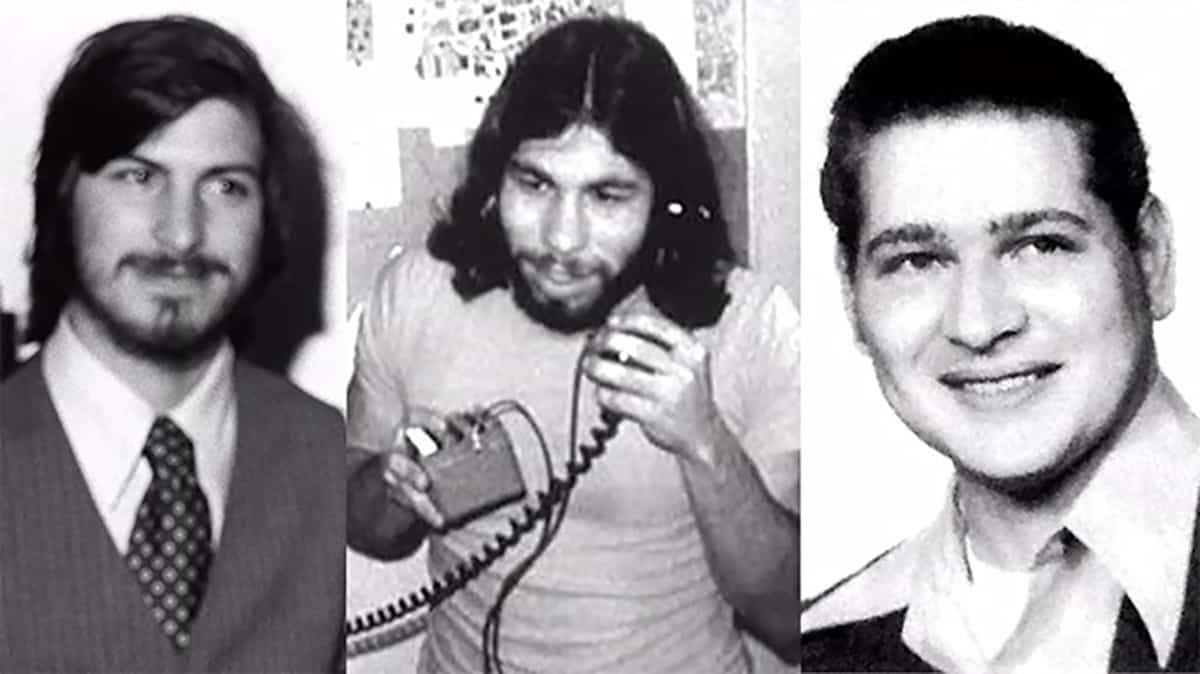
Steve Jobs, Steve Wozniak and Ronald Wayne, with the help of venture capitalist Armas Clifford “Mike” Markkula found Apple Computer to market the Apple I. Wayne drops out after a few weeks because he doesn’t want to take the risk as a family man.
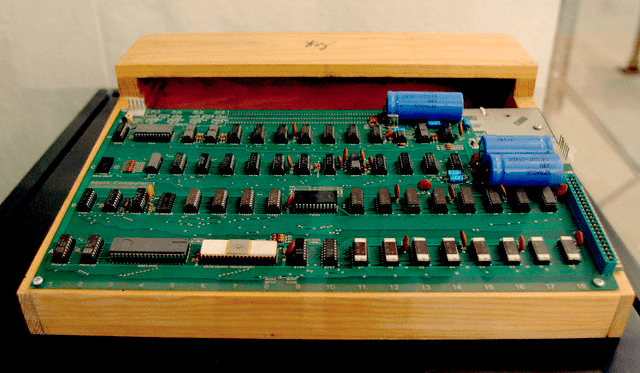
1976: Apple I in the Smithsonian Museum, Photo: Ed Uthman (Creative Commons-Lizenz via Wikipedia)
In May 1976 “Woz” presents the Apple I at the meeting of the Homebrew Computer Club. The computer costs later $666.66. Paul Terell, head of the chain Byte Shop places 50 orders alone. In total, about 200 devices are sold.
Apple Video Recalling the Early Days
1977
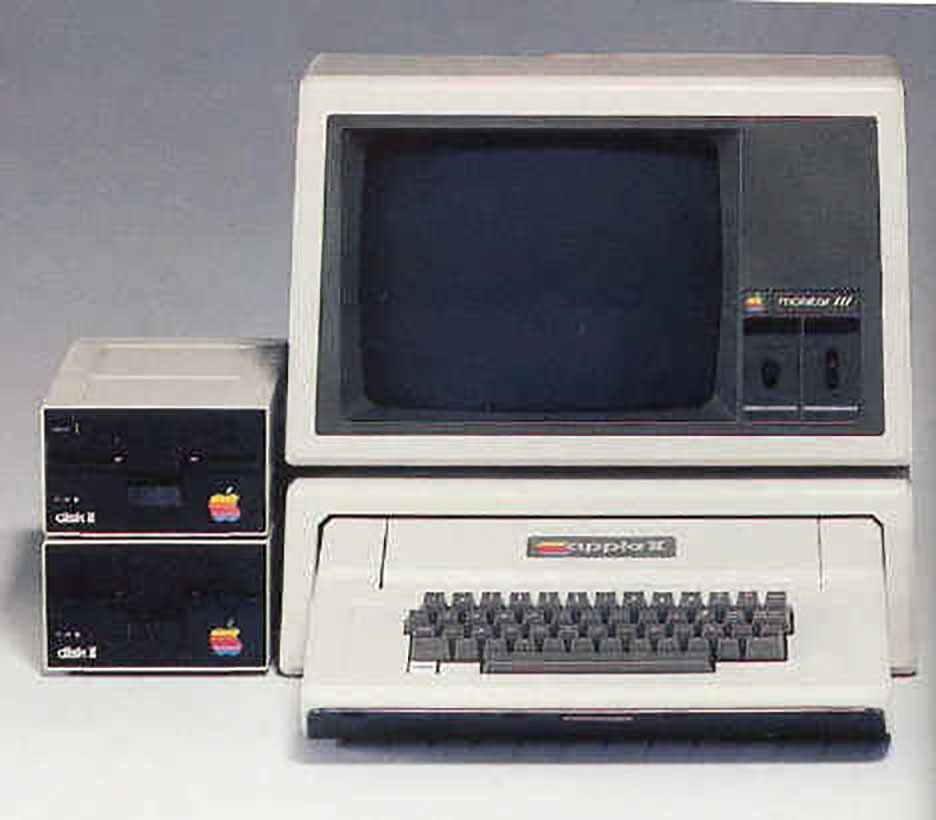
Apple II (1977)
In April 1977, Apple launches the Apple II. The Apple II series was an open system, which means that all essential construction details were published. This construction principle was later copied by IBM and marketed as the IBM PC. The Apple II became the first microcomputer to be widely distributed. It cost $1,295 at launch.
1978
Jef Raskin (34) starts at Apple Computer. Raskin was Apple Computer’s thirty-first employee, its manager of publications, and manager of the Macintosh project from 1979 to 1982.
1979
Jef Raskin (front) and Steve Jobs
A research project for a new low-cost computer is started under the direction of Jef Raskin. This would later become the Macintosh project. Raskin leaves Apple in 1982, even before the Mac was launched, because he would not accept Steve Jobs’ meddling.
In June 1979, the Apple II+ is launched for $1,195.
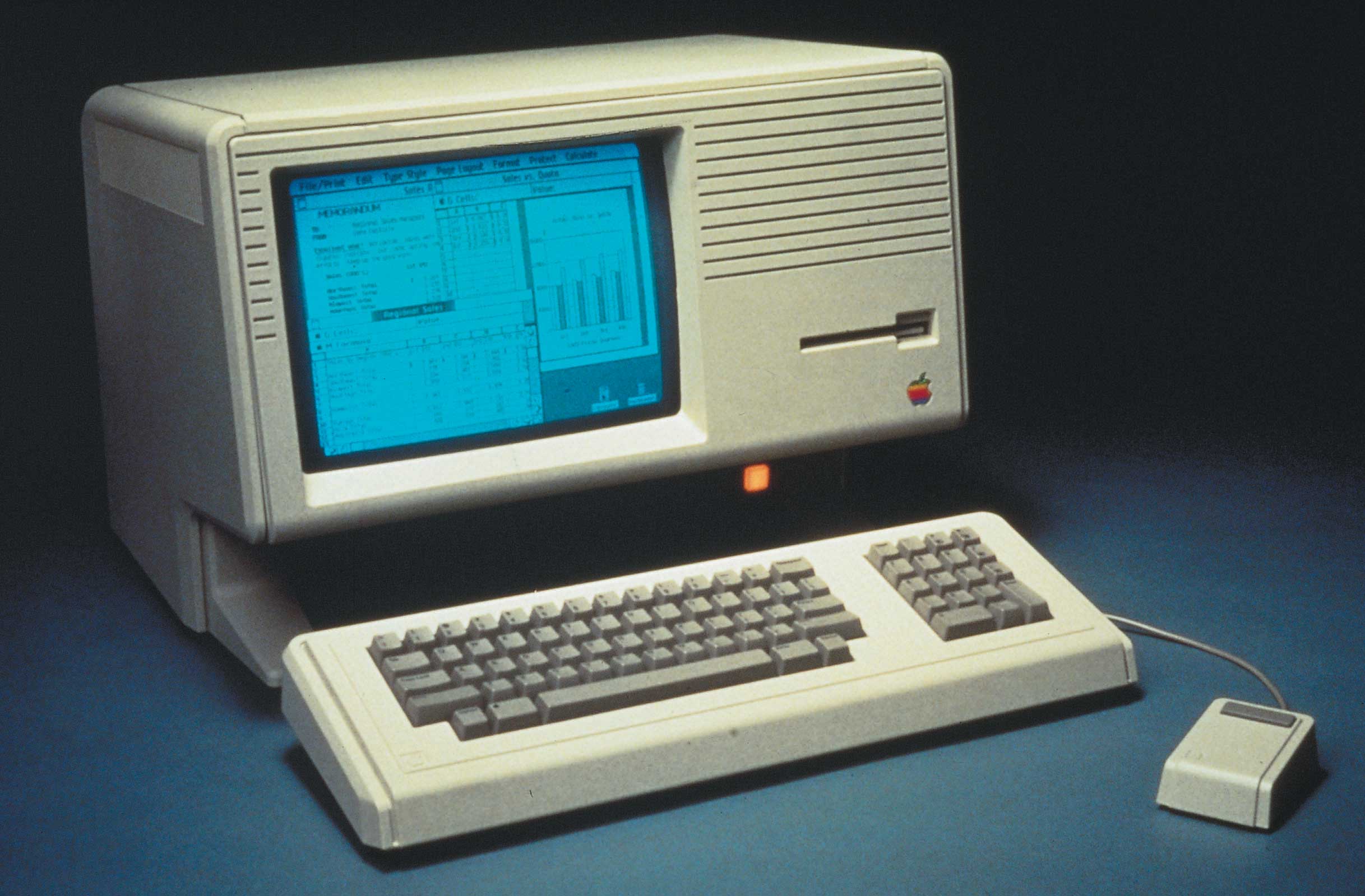
In July 1979, the project for the Apple Lisa is started. The computer was supposed to be ready in March 1981. In fact, it took until January 1983.
Steve Jobs and his team at Apple visit the legendary research institute Xerox PARC, where they see several novel technologies. These include the Xerox Alto, the first personal computer with a graphical user interface, the computer mouse, and object-oriented programming.
1980
Specifications for the Apple Lisa are developed. It includes several features that Apple employees have seen at Xerox PARC.
On December 12, 1980, Apple goes public, floating 4.6 million shares of stock at $22 per share. The Apple IPO makes some rich, others mad.
1981
Steve Jobs takes over the Macintosh project.
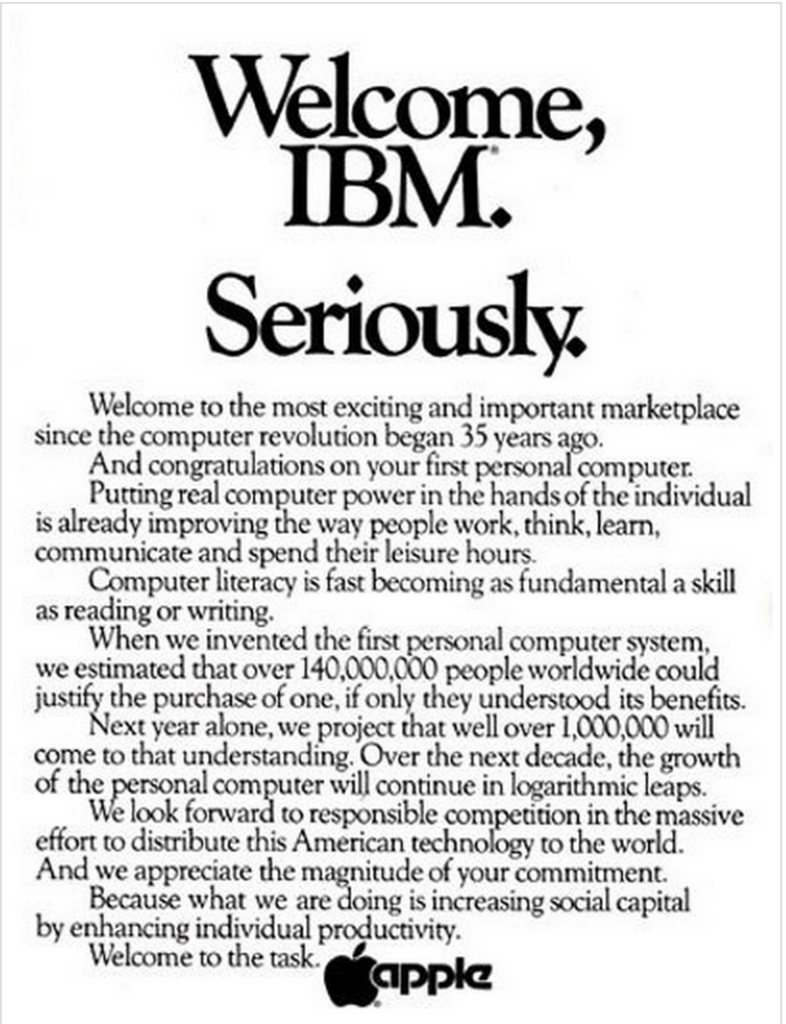
IBM introduces its PC. Apple “welcomes” IBM to the PC market in an ad.
Steve Wozniak crashes a private plane and partially retires from Apple.
1982
Jef Raskin quits after being pushed out of the Macintosh project by Steve Jobs.
1983
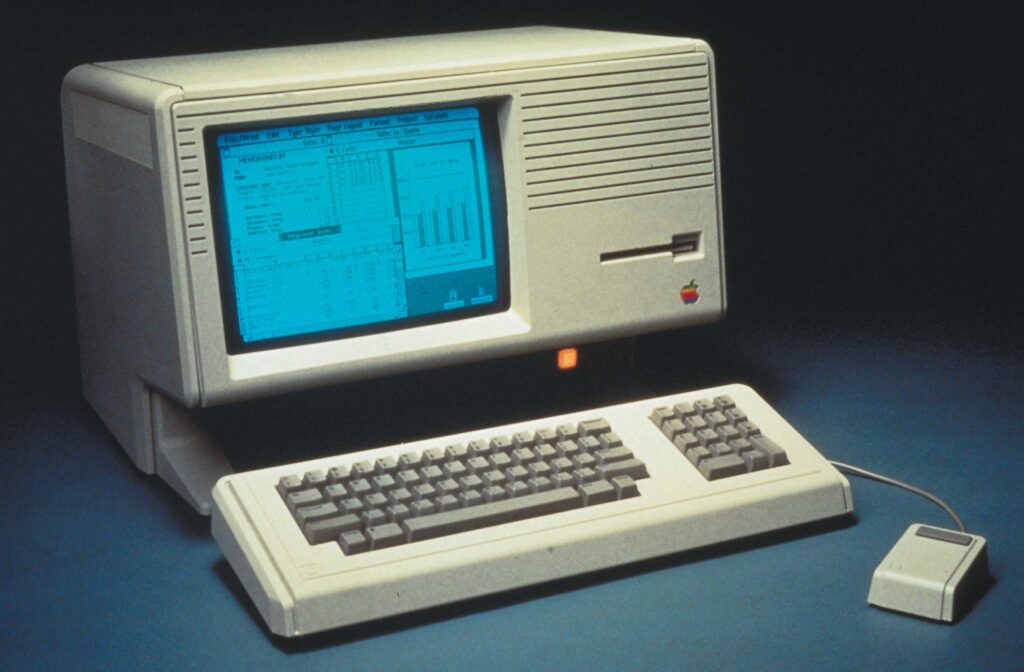
Apple Lisa (1983)
The Apple Lisa hits the market on January 22, 1983 for $9,995. As sales falter, the price drops to $6,995 by the end of the year.
At Apple, the previously competing Lisa and Mac divisions are merged.
In April, Steve Jobs convinced Pepsico president John Sculley to join Apple. “Do you want to sell sugar water for the rest of your life, or do you want to take a chance and change the world?” was Jobs’ legendary question, which ultimately won Sculley over as Apple CEO.
In order to qualify for the Cannes Advertising Film Festival, Apple had the famous Big Brother commercial for the Mac in December 1983 on TV station KMVT in Twin Apple Lisa (1983) Falls (Idaho). On January 22, 1984, six weeks later, the commercial then aired during a commercial break in SuperBowl XVIII. The ad not only cleared Cannes, but was repeatedly aired by TV stations in the news. The Chiat/Day agency calculated that the “1984” spot generated over five million dollars worth of free publicity.
Apple’s Macintosh Commercial
1984
January 24, 1984: The Mac is launched for $2,495. The Apple Lisa 2 retails for $3,495.
Apple launches the “Test a Mac” promotional program. Prospective customers can take a Mac home from a retailer for 24 hours to try it out, free of charge. Although the promotion was unique and innovative up to that point, the program does not show the desired success. For one thing, too few Macs are initially available. And many customers do not bring the computers back to the stores in perfect condition, incurring significant repair costs.
April 24, 1984: The Apple IIc is introduced. With the different Apple II series, Apple does the main part of its business.
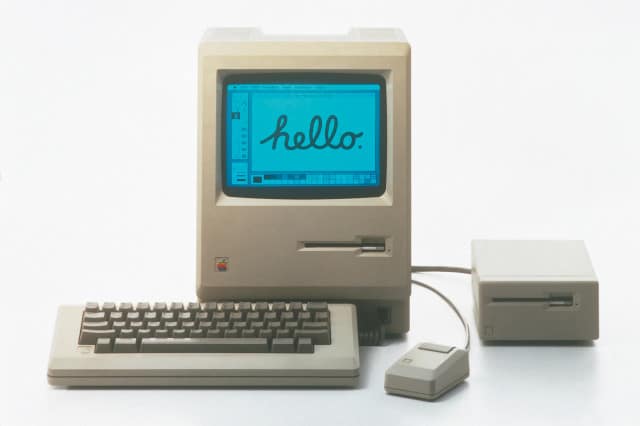
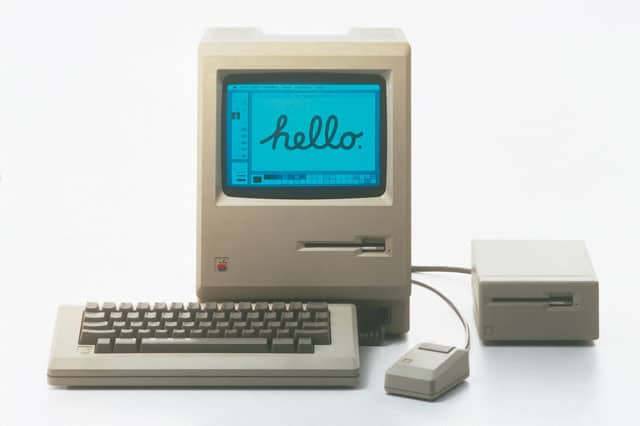
Apple Macintosh (1984)
1985
Sales of the Mac falter because too few applications are available. After a power struggle with then Apple CEO John Sculley, Steve Jobs is relieved of his operational duties. Jobs leaves Apple and founds the computer company NeXT Inc. and uses the proceeds from stock sales to buy Lucas Film’s animation division, creating Pixar.
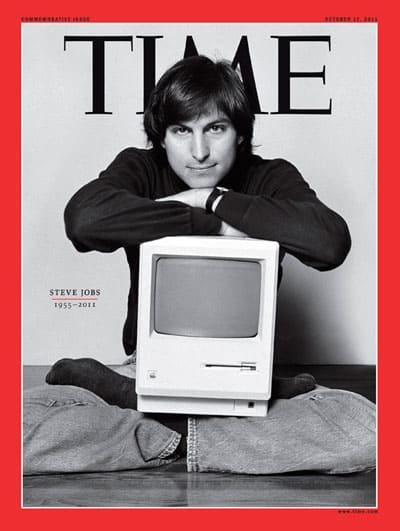
Steve Jobs on the cover of Time Magazine
“AS YOU KNOW, THE COMPANY’S RECENT REORGANIZATION LEFT ME WITH NO WORK TO DO AND NO ACCESS EVEN TO REGULAR MANAGEMENT REPORTS. I AM BUT 30 AND WANT STILL TO CONTRIBUTE AND ACHIEVE.“
The Apple Lisa is discontinued. Some models are converted and sold as the Mac XL.
Microsoft licenses some of the Mac technologies to develop its Office package for the Mac. At the end of 1985 Microsoft publishes its first Windows version 1.01.
1987
Apple builds the Mac II, the first Mac that does not rely on an all-in-one design. The Mac II can also support color displays. At the same time, Apple launches the Mac SE with the classic all-in-one design. Both machines allow expansion slots to be added to Macs for the first time.
The installed base of Mac users grows to 1 million users.
Ross Perot invests $20 million in NeXT, Inc.
In August 1987, Microsoft releases its first version of Windows, but it is virtually unusable.
1988
The greatly improved Windows 2.03 is released.
Apple sues Microsoft over various similarities between Windows and Mac OS. Microsoft counters the counterclaim and refers to the license agreement from the year 1985. A protracted legal battle ensues, with Apple unable to stop the further development of Windows. Apple is unable to stop the further development of Windows.
Microsoft prevails in court in 1992 and also wins the appeal two years later. In 1995, the US Supreme Court confirms the rejection of the appeal.
1989
Xerox sues Apple over the user interface of the Mac and the Apple Lisa. The suit is dismissed a year later.
Apple Computer is also sued by Apple Corps Ltd, the Beatles’ record label, for trademark infringement. In 2006, the Beatles initially lose. In 2010, the adversaries come to an agreement. The agreement stipulates that in the future, California-based Apple Inc. (formerly Apple Computer Inc.) will own all rights to the “Apple” trademark and the apple logo and will license some usage rights from the Beatles’ record company Apple Corps Ltd. in return.
Apple disposes of unsold models of the Lisa in a landfill in Logan, Utah.
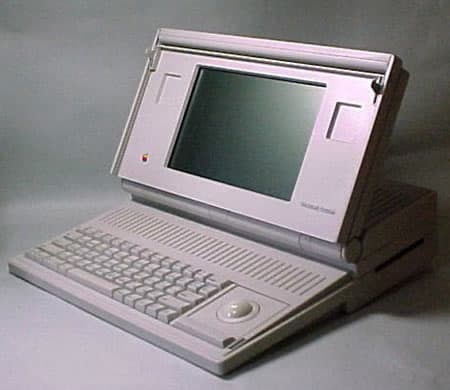
Apple introduces the Macintosh Portable. The device weighs about seven kilograms and was initially shipped without a backlight on the screen. As a result, the Portable barely lived up to its name and did not sell well.
Macintosh Portable (1989)
1990
Steve Jobs launches the NeXTstation for 4,995, a year after introducing the NeXTstep OS operating system
1991
Apple draws conclusions from the portable debacle and launches the much lighter and more compact PowerBook 100, the first true Mac notebook.
1992
Apple sets new standards with the subnote family PowerBook Duo. A docking station ensures that several interfaces do not have to be present in the PowerBook Duo itself in order to save weight and space.
Apple and Novell launch the “Star Trek” project, which aims to get the Macintosh operating system running on Intel hardware. A first proof of concept is created. However, the project is abandoned in 1993.
Microsoft launches Windows 3.1 and increasingly competes with Apple.
1993
Michael Spindler
Apple delivers the first Power Macintosh models. These computers no longer contain a 680×0 processor from Motorola, but the more modern PowerPC chips produced by Motorola and IBM.
Apple launches the Apple Newton PDA at the Macworld Expo in Boston in August 1983. The futuristic device proves to be little success in business because important features such as handwriting recognition work only moderately. The Newton flop also undermined Apple CEO John Sculley’s position of power.
Michael Spindler, who is called “The Diesel” at Apple, replaces Sculley as Apple’s chief executive. Sculley remains chairman for now.
1994
The first “DOS-compatible” Mac, the Quadra 610, is introduced. It contains a second motherboard and other components to run DOS and early Windows versions in parallel to the Mac OS. This is followed by a handful of Macs that are also “DOS compatible”.
Apple licenses its operating system Mac OS to selected Mac clone manufacturers like Power Computing or Umax, with Apple retaining control over key components of the hardware design used by the licensees.
Code-named “Copland”, this is Apple’s first attempt to replace its aging operating system.
Mac OS Copland
In the operating system version, Mac OS 7.5 Apple introduces the tools Mac Easy Open and PC Exchange. They allow the exchange of floppy disks and files with PCs running DOS or Windows.
1995
Power Computing ships the first Mac clones: Power, PowerWave and PowerCurve.
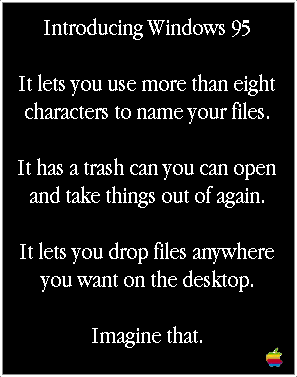
August 24th, 1995: Microsoft launches Windows 95 with a huge publicity show.
Apple jabs at Microsoft
1996
The PowerBook 1400 becomes the first Mac notebook to ship with an internal optical drive.
Apple freezes development of Copland and begins searching for companies that can provide a technological foundation for the next generation of an operating system. The company Be Inc., which had been founded by former Apple manager Jean-Louis Gassée, is shortlisted. The company had developed the BeOS.
Apple CEO Michael Spindler is replaced by Gil Amelio.
1997
Apple introduces the Power Mac G3. It is the first Mac with the PowerPC G3 processor.
To mark the twentieth anniversary of Apple’s founding, the Twentieth Anniversary Mac is released. In an all-in-one design, Apple installs an LCD flat-panel display for desktop Macs for the first time. The anniversary Mac costs a whopping $7,500. For that, customers get a setup through a concierge service. Later, the price of the “Spartacus” drops significantly.
Apple surprisingly decides against BeOS and takes over NeXT in order to use the NeXT operating system OpenStep as a basis for its own new operating system. This deal also brings Steve Jobs back to Apple, initially as a consultant.
Steve Job’s return to Apple
Apple announces Rhapsody, the code name for the new Mac OS based on NeXT OpenStep, for developers.
Apple releases Mac OS 8, the name it originally intended to use for the Copland system. Since the clone license agreements are tied to Mac OS 7.x, this move marks the beginning of the end of the Mac clone era.
Gil Amelio resigns as Apple CEO and makes room for Steve Jobs at the top of the company.
1998
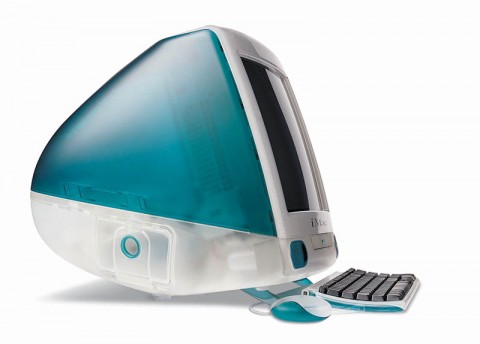
Steve Jobs transforms Apple’s offerings, saying goodbye to products like the Apple Newton and introducing the iMac as the cornerstone of Apple’s product line. It is the first Mac with a USB and SCSI port. Umax discontinues the last Mac clone, the SuperMac.
1999
The first iMac (1997)
The Power Mac G3 Blue & White is introduced. The clever tower design with an easy-open latch, the Mac as easy as upgrade or repair.
The first iBook picks up the colorful design of the iMac and is designed to strengthen Apple’s position in the market.
The first iMac (1997) in the education market again.
The Macintosh hardware comes with a multimedia software package: iMovie was first introduced in October 1999, which made it convenient to edit home videos. Later came iDVD for semi-professional DVD productions. With iPhoto, Garage Band and iWeb, the iLife package was then put together: The Mac thus evolved into the “hub” of the digital life.
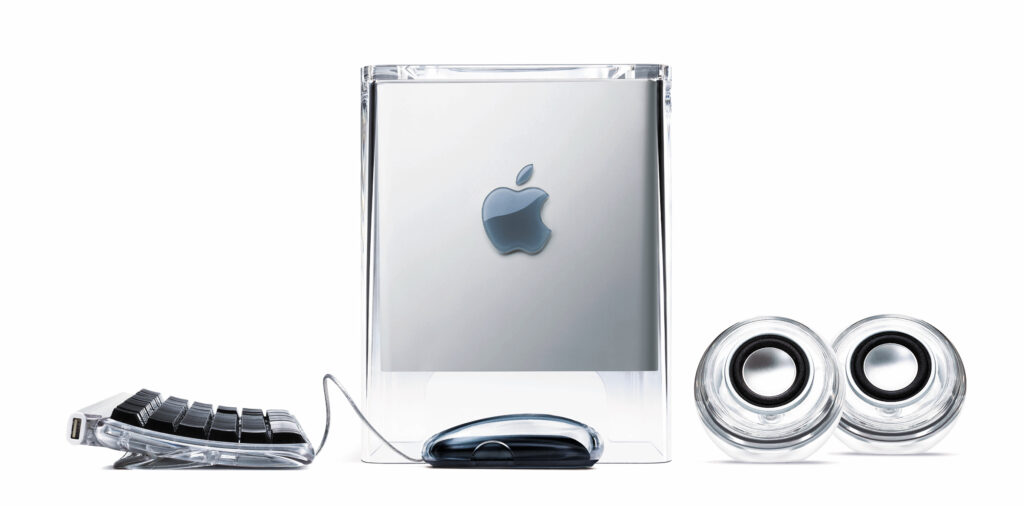
The Power Mac G4 Cube is introduced. It surprises with an unusual cube design and manages as a desktop computer completely without a fan. However, the high price and poor expansion options deter many buyers.
Power Mac G4 Cube (2000)
Apple releases the first beta version of Mac OS X. It’s the first time that Apple makes such a pre-release product available to the public. This step allows Apple to respond to public criticism and, for example, to reverse the removal of the Apple menu in the final version of Mac OS X.
2001
Apple opens its first retail store. With the Apple Store, the company addresses consumers directly.
With the PowerBook G4, Apple introduces metal cases for its high-end notebooks. Initially, Apple uses titanium, later aluminum from 2003.
The second generation of iBooks says goodbye to the colorful design of the first series. From now on, the consumer notebooks have monochrome cases (white, later also black). Only with the unicase of the MacBook in fall 2008 do the low-end models also get an aluminum case.
Mac OS X 10.0 Cheetah
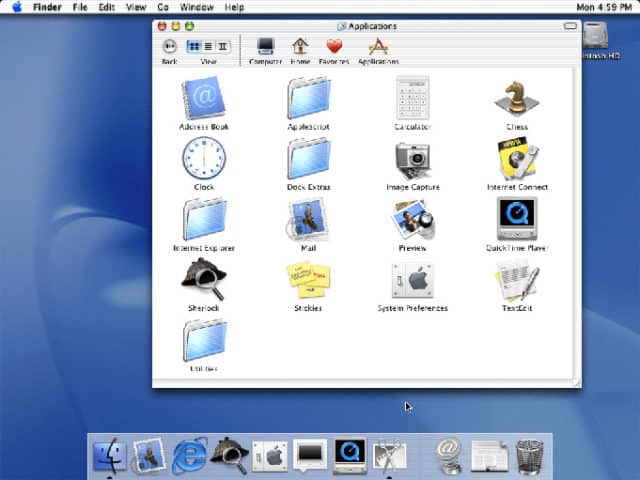
Mac OS X is released. Later in the year, the Mac OS X 10.1 update is released.
The Apple operating system competes with Windows XP, which was also launched by Microsoft in 2001.
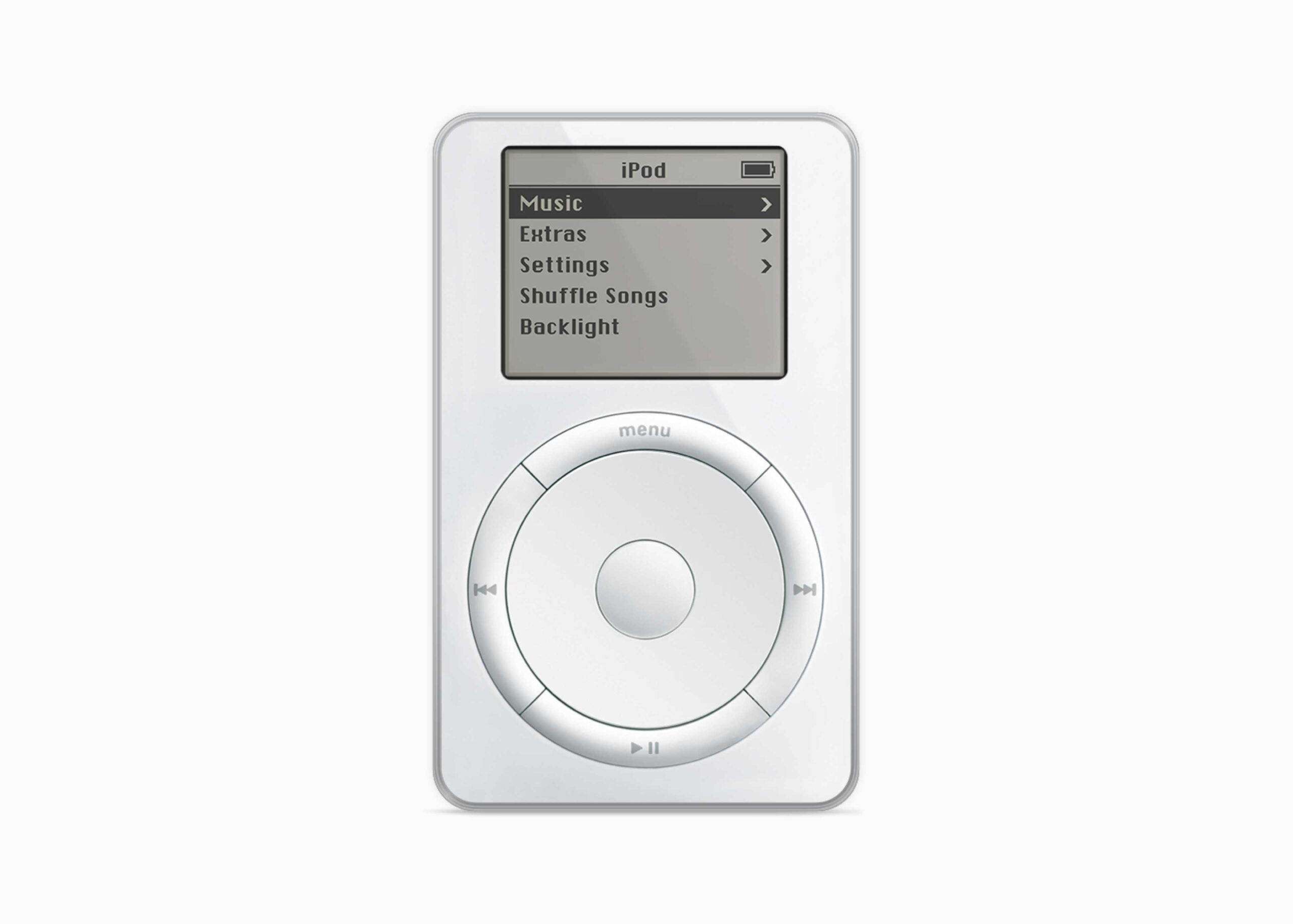
Steve Jobs introduces the first iPod, initially as a Mac-only media player, on October 23, 2001, just weeks after the devastating attacks in New York and Washington.
Apple launches the first flat-panel iMac with a swing-arm design. This computer reminds many people of a desk lamp. OS X wird freigegeben.
2002
Mac OS X 10.2 is released. This release marks the breakthrough of the new Mac system in the Macintosh scene.
2003
Apple introduces Xserve, its first server for a 19-inch rack.
Mac OS X 10.3 Panther is introduced. The system adds native support for Windows file and print sharing access.The eMac is introduced. Originally designed for the education market, this all-in-one Mac is later offered in other markets and is the last Mac to be sold with a CRT display.
With the 17-inch PowerBook G4, Apple becomes the first manufacturer to offer a notebook with such a large screen.
2004
In the summer, Steve Jobs announces to his employees that he had been diagnosed with a dangerous pancreatic cancer and could be treated successfully by surgery. During the convalescence phase, COO Tim Cook takes the helm at Apple for four weeks. Jobs makes a public appearance again at the WWDC developer conference in August 2004.
Apple WWDC 2004
Apple launches the Mac mini, an extremely compact desktop computer. It is similar in concept to the G4 Cube, even smaller but much less expensive.
OS X 10.4 wird Tiger freigegeben.
Steve Jobs’ 2005 Stanford Commencement Address
On June 12, 2005, Apple founder Steve Jobs gave a speech to graduates of Stanford University. He had just survived successful cancer treatment. Never again did Jobs speak so openly about his life.
2006
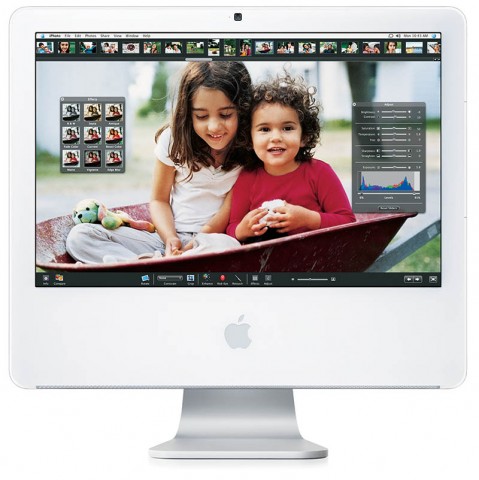
Apple introduces the first Macs with Intel processors at Macworld Expo in January. The first Intel Macs available are the iMac and MacBook Pro. Apple completes the transition to Intel’s new processor platform in all product lines by the end of the year.
iMac with an Intel-CPU (2006)
Also new are Apple Boot Camp (beta) and virtualization tools from Parallels and VMware that allow Windows to run on Apple hardware.
2007
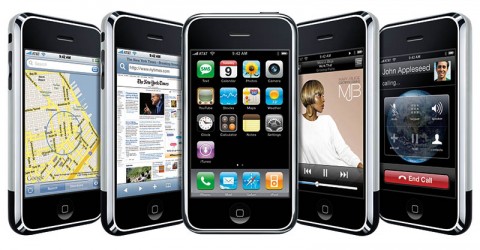
Apple launches the iPhone and Apple TV, both running variants of Mac OS X.
The first iPhone from Apple (2007)
The iPhone changes Apple and the phone market forever.
Steve Jobs introduces iPhone in 2007
The Apple TV set-top box initially remains a “hobby” for company CEO Steve Jobs – without much response from customers.
Mac OS X 10.5 Leopard is delivered and sold two million times on the first weekend.
2008
The MacBook Air is the lightest and thinnest Mac notebook Apple has ever produced.
The new iPhone 3G supports UMTS and is equipped with a GPS receiver.
Apple launches a new generation of MacBooks with a case machined from a block of aluminum.
2009
Apple cancels further participation in the Macworld Expo. Instead of Steve Jobs, who is ill, marketing boss Phil Schiller only shows new versions of the software packages iLife and iWork as well as a new 17-inch MacBook in a new case design at the last trade fair appearance.
Apple offers almost entirely music without copy protection in the iTunes Store after the four major music labels agree to online delivery without DRM.
Steve Jobs introduces the iPad in San Francisco on January 27, 2010. Apple was not the first company to launch a tablet computer. But unlike the flops that Microsoft CEO Bill Gates, for example, experienced with his attempts in the 1990s, the iPad scored a great success right off the bat when it was launched on April 3, 2010.
Then, on June 7, 2010, the iPhone 4 makes its debut (market launch June 24). Even though the new design of the antenna caused reception problems with a certain grip position, this device also became a box office hit.
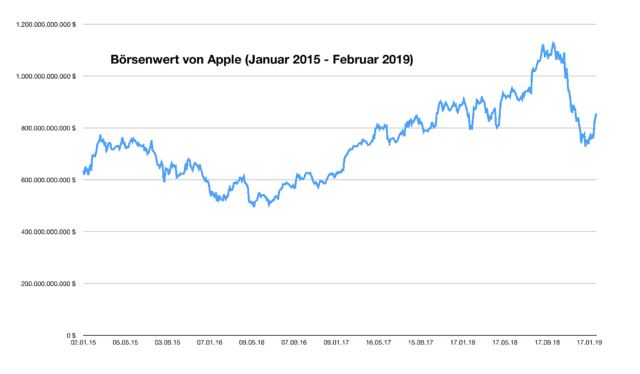
In October 2010, Apple’s stock broke through the $300 threshold for the first time.
2011
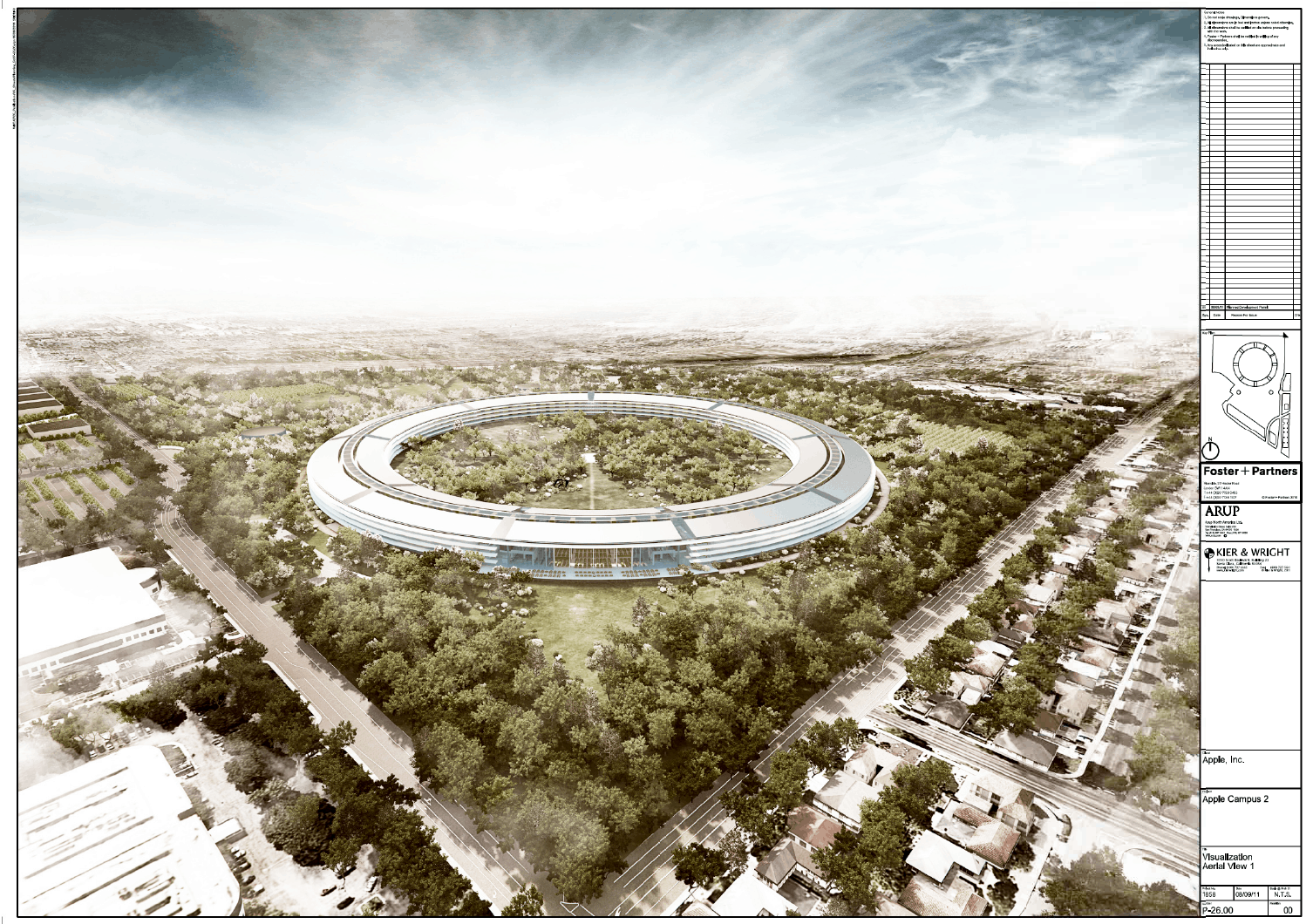
Steve Jobs again announces time off for medical reasons in an e-mail to his team on January 17, 2011. Tim Cook takes over the day-to-day business. However, Jobs interrupts his time off three times: On March 2, he presents the iPad 2, with which Apple continues its triumphal march in the tablet computer segment. At WWDC 2011, he presents the concept of iCloud to developers in June 2010 and, one evening later, presents the plans for a new headquarters, Apple Campus 2, to the Cupertino Council.
October 4: Tim Cook and Phil Schiller present the iPhone 4S at the “Let’s Talk iPhone” event, but not the iPhone 5 with a new design that many fans had been expecting. The new iPhone is significantly faster than the iPhone 4 and includes the novel voice recognition and voice control software Siri. Externally, however, it resembles the design of the iPhone 4.
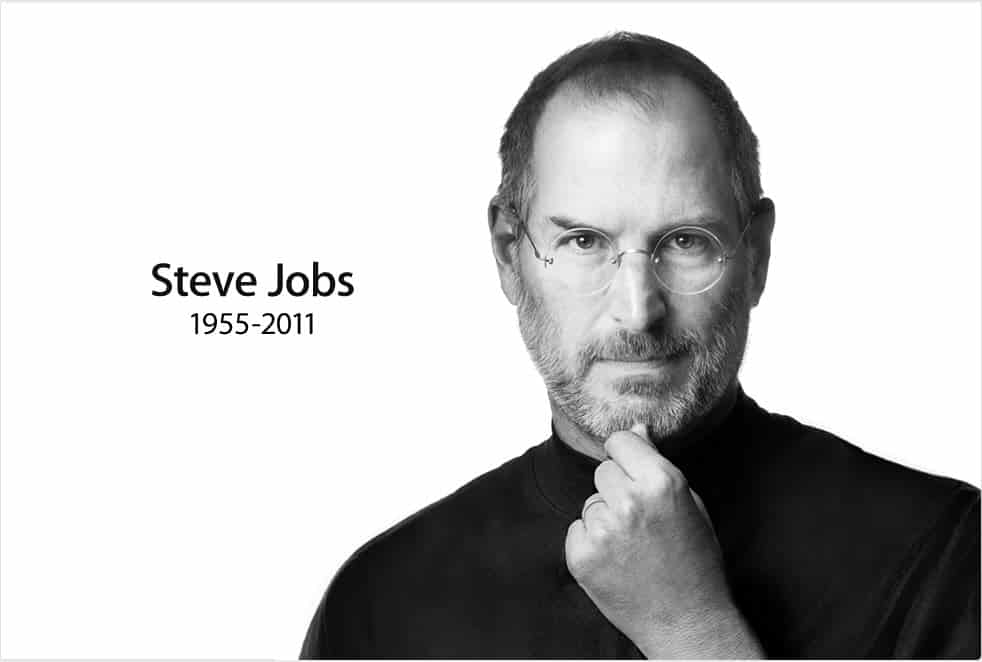
October 5, 2011: Apple co-founder Steve Jobs dies at the age of 56.
Five days after Jobs’ death, Apple overtakes oil multinational Exxon Mobil as the world’s most valuable publicly traded company.
2012
January 19, 2012: Apple wants to turn around the education market in the U.S. with a broad-based campaign. Digital textbooks on the iPad are to replace traditional books in schools and universities
March 7, 2012: Tim Cook, as Apple’s new CEO, unveils the third-generation iPad in San Francisco. The new iPad, according to Apple’s marketing parlance, differs from the iPad 2 primarily in its higher-resolution display (2048 × 1536 pixels), more computing power and LTE data transmission technology. However, the LTE technology cannot be used in Germany because the frequency bands used for LTE in this country are not supported. However, the also newly installed UMTS extension HSPA+ is also available in Germany.
July 25, 2012: Apple unveils the new Mac operating system OS X Mountain Lion (10.8) at the WWDC developer trade show.
September 12, 2012: Phil Schiller and Tim Cook present the new iPhone 5, which runs iOS 6. On September 21, 2012, the new iPhone generation is launched in Germany and on September 28, 2012, in Liechtenstein, Austria and Switzerland.
October 23, 2012: Apple introduces the fourth iPad generation (“iPad with Retina display”). In addition to the high-resolution Retina display, the new iPad will be equipped with an A6X chip from Apple. The classic iPad connector will be replaced by a Lightning connector. The devices will be launched on November 2 in 35 countries, including the US, Germany and the UK.
October 26, 2012: Apple was able to increase its revenue to $36 billion in the fourth quarter of its fiscal year, which ended at the end of September, from $28.3 billion a year earlier. Net income grew to a handsome $8.2 billion ($8.67 per share) from $6.6 billion a year earlier. Nevertheless, the stock market is not satisfied, because investors had expected even more sales and profits. The share price is hovering around 600 dollars.
2013
January 25, 2013: Apple terminates supplier in China because of too young workers. Apple CEO Tim Cook thus fulfills his promise to pay more attention to working conditions at suppliers. In 2012, there were more inspections. In the process, more than 70 workers under the age of 16 were also discovered in a factory in China.
January 25, 2013: Apple stock slips: oil major ExxonMobil is again most valuable company.
February 11, 2013: First hints in the U.S. press (NYT and WSJ) of a computer watch from Apple.
March 20, 2013: Apple hires away the former chief technology officer of software specialist Adobe, Kevin Lynch. It is later revealed that he will be in charge of the Apple Watch program.
April 2, 2013: after a campaign in state media in China for “arrogance,” Apple CEO Tim Cook must publicly apologize to Chinese customers. The kowtowing later pays off. On December 23, 2013, it is reported that the iPhone is coming to the world’s largest mobile group, China Mobile.
April 17, 2013: Stockbrokers’ worries about weak iPhone and iPad sales send Apple’s stock plunging to its lowest level in more than a year. The paper is trading down 6 percent at $398.11 in New York. The last time the paper had previously been below the prominent $400 threshold was in December 2011.
April 23, 2013: Apple posts its first profit decline in nearly a decade after an unprecedented run of success. The iPhone company still posted the fourth-highest quarterly profit in its history at $9.5 billion (7.3 billion euros). In a year-on-year comparison, however, that meant a drop of a good 18 percent.
May 1, 2013: A veritable rain of money is descending on Apple. Through the sale of bonds, the iPhone and iPad manufacturer has raised a total of 17 billion dollars (13 billion euros), more than any other U.S. company before in one fell swoop. The money is to be used to buy back the company’s own shares and to pay dividends. Thus Apple wants to boost its weakening share price.
Apple fans and customers wait for the opening of the Apple Store on Ku’damm in Berlin. Photo: Britta Pedersen/dpa
May 3, 2013: After two years of construction, Apple opens the first Berlin Apple Store and the largest customer support center in Europe on Kurfürstendamm. The listed building had been built in October 1913 as one of the first cinemas in Berlin. The renovated cinema hall of the former Union-Palast not only hosts customer events, but also concerts and cultural events.
May 21, 2013: Apple avoided billions of dollars in tax payments in the U.S. and other countries through a complex network of foreign companies, according to a U.S. Senate investigation. A Senate committee concludes that Apple’s clever system meant it had no tax liability anywhere on much of its revenue. The corporation insists it always acts within the law.
June 3, 2013: Apple faces charges of illegal price fixing on e-books in a New York court. According to the U.S. Department of Justice, Apple and five U.S. publishers artificially pushed through higher prices for digital books at the launch of the iPad tablet, to the detriment of consumers. The publishers have since entered into multi-million dollar settlements with the U.S. government, with only Apple continuing to defend itself against the allegations.
Apple WWDC 2013
June 10, 2013: At its WWDC 2013 developer conference, Apple is declaring war on its rivals in the smartphone market with radically revamped iPhone software. The new version iOS 7 is the biggest change since the launch of the iPhone in 2007, said Apple CEO Tim Cook. With iOS 7 comes numerous new features and a significantly changed look. Among the other WWDC announcements are a complete redesign of the Mac Pro professional computer, a new version of the Mac OS X system and an Internet radio for listening to music over the Internet. Some innovations seem like a counter to Google’s world-leading smartphone system, Android.
September 10, 2013: Apple launches a slightly cheaper new iPhone for the first time in addition to a top-of-the-line model. The company unveiled the iPhone 5C at its annual smartphone event, featuring a plastic body in bright colors. Together with a new top model, it replaces the year-old iPhone 5 on September 20. The top version, called iPhone 5S, can now recognize users by their fingerprint. For this purpose, a scanner is hidden in the typical round button under the screen.
October 15, 2013: From British elegance to iPhones and iPads: Angela Ahrendts, the head of the fashion brand Burberry will in future lead the more than 400 Apple stores. Angela Ahrendts is moving to Apple in the spring. She will report directly to company CEO Tim Cook and also oversee the online stores. The head job at Apple’s retail division had been vacant for about a year after Ahrendts’ predecessor John Browett was fired after just a few months. Ahrendts announced in February 2019 that she would be leaving Apple again.
October 22, 2013: Apple defends its top position in the tablet market with a new iPad generation. The large model was made much thinner, lighter and more powerful. That’s why it got the new nickname iPad Air. Externally, the large model has been adapted to the design of the smaller iPad mini with narrow side edges. It is now only 7.5 millimeters thick instead of 9.4 millimeters before. The weight has been reduced from 700 to 500 grams. The price starts at $499, as before. Market launch is on November 1. As expected, the iPad mini has been upgraded with a higher resolution display. It now has as many pixels in the screen as the large model. Both versions got the same fast chip that Apple puts in its flagship iPhone 5s smartphone. The price of the most basic model of the iPad mini rose from $329 to $399 with the upgrades.
October 28, 2013: The new iPhone models are boosting Apple’s business again. In the fourth fiscal quarter from July to September 2013, revenue rose 4 percent to $37.5 billion. However, profits fell for the third time in a row, also due to higher development and marketing costs. Compared to the same period last year, Apple lost 9 percent here to a bottom line of $7.5 billion.
November 21, 2013: In the permanent patent case against Samsung in California, Apple gets a large part of the high damages payment confirmed. The original sum of just over one billion dollars decreased after a second trial by about 100 million. Samsung had demanded a drastic reduction. However, an appeal is still pending. If the verdict becomes final, Samsung would have to transfer a total of just under $930 million to Apple. In the second trial, which concluded Thursday, jurors awarded Apple about $290 million – significantly less than its original demand for billions in damages.
December 12, 2013: the Seoul Central District Court dismisses a damages lawsuit filed by the world’s largest smartphone maker, Samsung, against Apple. In the case, Samsung had accused the iPhone company of infringing three patents on technologies for mobile short messaging applications.
2014
January 24, 2014: At Wall Street Journal, the first rumors emerge that Apple plans to build a larger iPhone.
February 10, 2014: The showdown between Apple CEO Tim Cook and major shareholder Carl Icahn for Apple’s annual shareholder meeting is called off. Icahn drops his demand that Apple increase its ongoing share buyback to $50 billion this fiscal year. He had previously faced headwinds from an influential shareholder advisory group.
February 28, 2014: In the long-running dispute over patents in the mobile phone industry, the Mannheim Regional Court dismisses a billion-dollar lawsuit against Apple. Another chamber of the court came to the same conclusion in a similar case against cell phone manufacturer HTC, in which no damages had yet been claimed, only a finding of patent infringement. The losing patent exploiter IPCom immediately announced its appeal against these rulings.
March 31, 2014: Apple and Samsung’s second major patent trial in the U.S. begins in San Jose, California. Apple accuses Samsung of infringing five patents in the case. Among the ten devices affected by the South Korean smartphone market leader is the Galaxy S3 smartphone. Samsung, in turn, is taking aim at nine Apple models with two patents, including the iPhone 5 and iPad 4.
April 23, 2014:The iPhone is holding its own against growing competitive pressure, giving Apple renewed gains in revenue and profit. The company sold 43.7 million of its smartphones in the second fiscal quarter of 2014 (January-March). That was more than most analysts had expected. As a result, revenue in the second fiscal quarter ended March rose 4.7 percent year over year to $45.6 billion. Net income for the quarter was $10.2 billion. That was seven percent higher than in the year-ago quarter.
May 3, 2014: Apple also scores a win in its second patent trial against Samsung in California, but gets much less money than it asked for. Jurors award the iPhone company just under $120 million. Apple wanted a good 2.2 billion dollars in damages. The jury found two of five Apple patents in the trial not infringed. The first California patent trial had ended much better for Apple. In it, jurors had awarded Apple around $1 billion in damages in August 2012. The sum was later reduced to $930 million. All of Samsung’s accusations were dismissed. However, the appeal is still pending.
May 28, 2014: Apple buys headphone maker Beats for a total of three billion dollars. Beats’ founders, hip-hop star Dr. Dre and influential music producer Jimmy Iovine, will join Apple’s top management team. Beats is known for its headphones with the distinctive red “b” and also recently launched a streaming service for music.
July 16, 2014: Apple agrees to partner with IBM to make a stronger push into the enterprise business. More than 100 new apps for iPhone and iPad will map various business processes, the erstwhile rivals announced. IBM will also offer cloud services specifically adapted to Apple devices, as well as sell iPhones and iPads to its customers.
August 6, 2014: Apple and Samsung end their patent dispute outside the United States. Mutual lawsuits are dropped in all countries except the iPhone company’s home market. This includes the proceedings in German courts. The decision comes as a surprise, although tempers had already calmed down considerably recently.
August 19, 2014: Shortly before the launch of the new iPhones, investors are tearing around Apple shares: for the first time in two years, a share certificate of the group cost more than 100 dollars again on Tuesday. In New York trading, the price climbed to 100.49 dollars. The all-time high was marked in September 2012 at more than 700 dollars. However, that was before the company split its share certificates to make them more attractive to small investors. Taking into account the stock splits, the record is $100.72.
Sept. 7, 2014: Apple hires Marc Newson, a world-renowned industrial designer. Newson will join the team of Apple’s chief designer Jony Ive, Vanity Fair magazine reported, citing Apple. Newson designed items as diverse as watches, jewelry, furniture, flashlights, kitchen utensils, aircraft interiors and fashion over the course of his career. Among his clients were sporting goods manufacturer Nike and automaker Ford, and some of his work is on display at the Museum of Modern Art in New York.
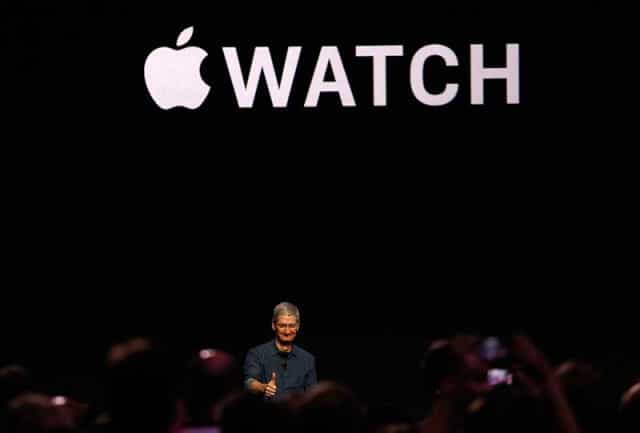
Tim Cook presents the Apple Watch (2014)
September 9, 2014: Apple ignites a fireworks display of new products at its traditional fall smartphone event: the company unveils a computer watch and new larger iPhones. An iPhone payment service is to replace the wallet. Group CEO Tim Cook presented the long-awaited Apple Watch, which is to take over various smartphone functions. The watch is the group’s first foray into a new product category since the iPad tablet more than four years ago. Apple also unveiled two iPhone models with significantly larger screens and a mobile payment system to rival the traditional wallet.
October 16, 2014: Apple introduces an improved iPad generation. The new devices got the fingerprint sensor known from the iPhone and faster chips. The larger Apple Air 2 model was also made 18 percent thinner. It is the thinnest tablet on the market, emphasizes marketing chief Phil Schiller. The company is also introducing a new iMac desktop computer with a dramatically increased screen resolution. The iPhone payment service Apple Pay is initially launching only in the U.S.
October 21, 2014: The iPhone 6 is proving to be a money machine for Apple right from the start. Apple earned just under $8.47 billion in the 4th fiscal quarter of 2014 (July-September). That was 12.7 percent more than in the same quarter last year – the strongest growth in almost two years. The main driver was the record launch of the iPhone 6 just two weeks before the end of the fourth fiscal quarter in September. Apple also sold more Mac computers than ever before in a quarter.
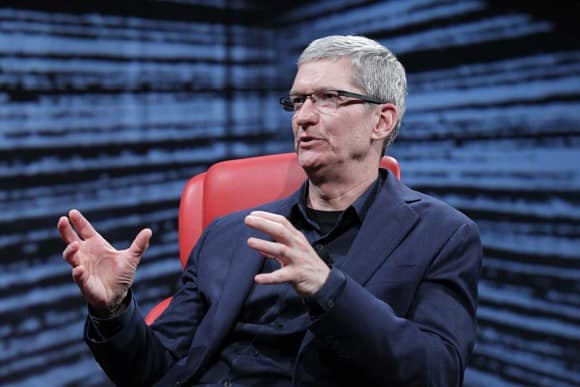
Apple CEO Tim Cook at the AllThingsD conference- D10. Photo: Asa Mathat/All Things Digital
October 30, 2014: Apple CEO Tim Cook comes out as gay. “I am proud to be gay,” the 53-year-old wrote in a contribution to the American business magazine “Businessweek”. Many colleagues at Apple already know that, he said. He said he hopes his move will help or inspire others. Cook had never commented publicly on the matter until now.
2015
January 27, 2015: The success of the iPhone 6 and a huge boom in China give Apple a record profit of $18 billion. Never before has a company worldwide earned so much in one quarter. The group sold 74.5 million iPhones in the Christmas business – almost half more than a year ago. Revenue in the first fiscal quarter ended in late December grew nearly 30 percent to $74.6 billion. Apple profits jumped more than 38 percent year over year on the equivalent of 15.9 billion. The stock climbed to a new all-time high of $120 two days later.
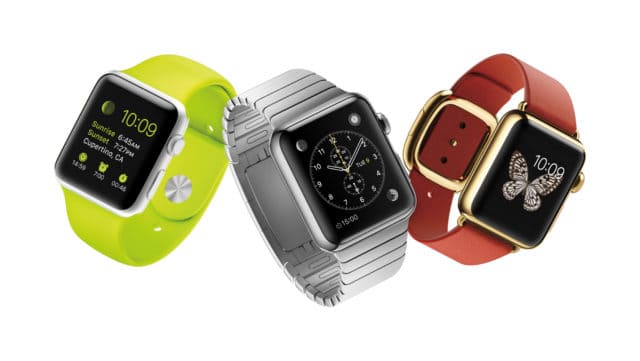
Apple Watch Sport, Apple Watch and Apple Watch Edition with 18-carat gold. Photo: Apple
April 24, 2015: The Apple Watch smartwatch hits the market. Due to high demand and a bottleneck in the supply chain, Apple initially sells the wrist computer only online and to some select fashion boutiques.
June 30, 2015: Apple launches its own music streaming service, Apple Music. Apple also competes with providers such as Spotify and Pandora with an Internet radio service (Beats One) and a social network for music lovers and artists (Apple Connect)
September 9, 2015: At its annual iPhone event, Apple expands the way a touch-sensitive smartphone display is operated for the first time since the launch of the first iPhone in 2007. For example, the strength of the pressure in “3D Touch” can be used to call up additional information or menus. This also offers new possibilities for game developers. Externally, the new iPhone 6S and the larger 6S plus look exactly like the current 6 models. However, the technology has been greatly updated. The chips are faster, the camera now has 12 megapixels and can also record video in particularly high Ultra HD quality. In addition, the housings are made of a new aluminum alloy.
September 9, 2015: Tim Cook also presents at the iPhone event a new edition of the TV box Apple TV, on which apps from the iTunes Store can now be installed. In addition takes a large tablet computer (“iPad Pro”) with a 12.9-inch Retina display in the program.
November 10, 2015: Apple is making its Apple Music streaming music service available to users of Google’s Android operating system just over four months after its launch.
2016
January 26, 2016: Another record-breaking record: Although Apple was barely able to increase iPhone sales in the Christmas business. Sales increased by 0.4 percent to 76.8 million devices. That was enough, however, to achieve just under a new record profit of 18.4 billion (17 billion euros). Apple reached the mark of one billion active customers. The company is now sitting on a mountain of cash of $216 billion.
February 2, 2016: Alphabet’s holding company around search engine giant Google is running away from Apple for a day as the most expensive company in the stock market world. Apple shares have been under pressure for months due to weak forecasts for future iPhone sales and reports of weaker growth in the Chinese economy. However, Apple’s stock is rebounding in the spring of 2016, putting it well ahead of Alphabet again.
February 17, 2016: Apple’s commitment to unbreakable encryption is being put to its toughest test yet: A U.S. court is demanding help from Apple in unlocking the iPhone of one of the San Bernardino attackers. This escalates the current debate about encryption and counterterrorism, and the corporation comes under massive pressure. Apple CEO Tim Cook announced resistance to the demand. It is an “unprecedented step that puts the security of our customers at risk,” he wrote in an open letter.
February 21, 2016: Republican presidential contender Donald Trump calls for a boycott of Apple until the corporation relents. After the FBI, the U.S. Department of Justice is also demanding that Apple help investigators undermine the phone’s password protection. IT groups such as Alphabet/Google, Microsoft, Facebook and Twitter are showing solidarity with Apple.
March 21, 2016: Apple is softening its long-standing high-price strategy in the smartphone business, introducing a new smaller iPhone with up-to-date technology for the first time. The iPhone SE looks like the iPhone 5 on the outside – but incorporates various technologies from the current larger 6-series models, such as the faster processor, a 12-megapixel camera and an NFC chip for, among other things, mobile payment systems like Apple Pay. Apple is also introducing a small iPad Pro with a 9.7-inch display, making it the same dimensions as the iPad Air 2.
March 29, 2016: The sensational dispute between Apple and the U.S. government over unlocking the iPhone of a dead assassin is over for now. Investigators have succeeded in obtaining the data on the phone, assistance from Apple is no longer needed, court documents say. Presumably, the FBI, with the help of a company from Israel, used a zero-day security flaw to crack the iPhone %C
May 13, 2016: Apple is making a $1 billion (880 million euro) investment in Chinese Uber rival Didi Chuxing. The strategic investment is a coup for the Chinese ride-hailing service provider, which is in hot competition with U.S.-based Uber in the fast-growing Chinese market.
August 30, 2016: Apple is facing an unprecedented back tax payment of more than 13 billion euros after a decision by the EU Commission. The iPhone group had received illegal tax benefits in Ireland in this amount, decided the European competition watchdogs. Ireland would have to reclaim the illegal aid for the years 2003 to 2014 now plus interest. Apple and Ireland want to defend themselves against the decision.
September 8,2917: Apple introduces the iPhone 7, a new waterproof model without the familiar earphone jack. In addition, after almost a year and a half, there is the second version of the Apple Watch, which is even more focused on sports and fitness.
October28, 2016: Apple presents a new generation of MacBook Pro. In this notebook, the row of function keys has been replaced by a narrow touchscreen bar. Various buttons and controls are displayed there depending on the current application.
December 19, 2016: As announced, Apple and Ireland are taking legal action against the demand for back taxes of more than €13 billion. The Irish Ministry of Finance stated that the EU Commission had misunderstood the relevant facts and was interfering in national sovereignty in tax matters. Apple CFO Luca Maestri accused EU Competition Commissioner Margrethe Vestager of pursuing a political agenda.
2017
January 22, 2017: Apple is suing chipmaker Qualcomm, which provides wireless connectivity in many smartphones. Qualcomm is accused of charging excessive fees for patent licenses. The lawsuit also alleges that the chip company is withholding $1 billion in commissions as punishment for Apple’s cooperation with authorities in South Korea. Qualcomm denies the allegations.
February 1, 2017: Apple presents a brilliant balance sheet for the 2016 Christmas quarter: The iPhone 7 makes the company the smartphone market leader. Apple sold 78.3 million iPhones in the quarter. That was a new record after around 74.8 million devices in the previous quarter. After months of decline, sales rose by 3.3 percent to $78.4 billion. The good figures also drove up the share price.
April 15, 2017: Apple receives permission to test self-driving cars on public roads in California. However, it remains unclear how deeply the company intends to venture into the mobility business of the future. Apple is the 30th company to be issued such a license in the most populous US state.
May 23, 2017: Nokia and Apple settle their patent dispute and sign a multi-year licensing agreement. Nokia will receive an upfront payment and regular payments throughout the term of the agreement. Further financial details were not disclosed. The companies want to work more closely together in the future, including plans for “summit meetings” between top management. In December, Nokia and Apple had kicked off a new patent dispute with fierce mutual accusations.
September 12, 2017: Apple announces two new iPhone generations at the Steve Jobs Theater on the new Apple Park corporate campus. Apple wants to set a new standard in the smartphone business with a radically redesigned iPhone. On the iPhone X (which stands for 10, not the letter X), the screen fills most of the front of the device and the fingerprint scanner has been replaced by facial recognition. With a US starting price of $999, it is significantly more expensive than previous iPhone models and will be available on November 3. The iPhone 8, which was unveiled at the same time, is an upgrade of the iPhone 7 with the familiar Touch ID fingerprint sensor. Apple is also presenting the third generation of the Apple Watch, which is equipped with an LTE module.
December 12, 2017: Apple buys the music recognition app Shazam. The app can display the name of the song currently playing in the vicinity by accessing the microphones of a smartphone. To do this, the recording is compared with a database of all possible music tracks on the Shazam servers. According to information from the Financial Times, the price is $400 million.
December 29, 2017: Apple responds to fierce criticism of throttling performance in older iPhones with worn-out batteries. Customers with slow older iPhones will be able to get new batteries that could solve the problem at a significantly lower price in 2018. In Europe, a necessary battery replacement outside the warranty period for iPhone 6 and later models will cost €29 instead of the previous €89 until the end of next year. At the same time, the company assured that it would “never” intentionally degrade the user experience in order to sell more new devices. Apple had come under criticism for largely concealing the throttling by the iOS operating system from customers.
2018
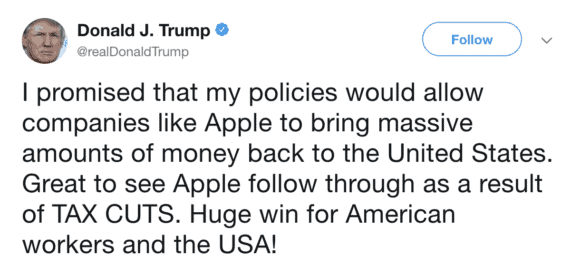
January 18, 2018: Apple announces that, following the US tax reform, it will bring most of its enormous cash reserves of more than $250 billion back to its home country. In addition to an unprecedented tax payment of $38 billion (just under €31 billion), the company announced massive investments in the US and a new large location outside California. At that time, Apple had a mountain of cash worth a good $252 billion stored outside the US. Group CEO Tim Cook told ABC that a “vast majority” of these foreign profits would be brought back to America. The amount of the expected tax payment suggests that the group intends to leave very little of it abroad. The EU Commission emphasized that the move does not change its demand that Apple pay at least €13 billion in back taxes in Ireland. US President Donald Trump was quick to take credit for Apple’s decision.
Screenshot of the Trump tweet
I promised that my policies would allow companies like Apple to bring massive amounts of money back to the United States. Great to see Apple follow through as a result of TAX CUTS. Huge win for American workers and the USA! https://t.co/OwXVUyLOb1
February 9, 2018: Apple is launching its HomePod connected speaker, entering a market previously occupied by Sonos, Amazon and Google. Similar to its competitors, the HomePod can play music and respond to voice commands. However, the HomePod is said to score with users with better sound quality than its rivals.
March 27, 2018: Apple is looking to gain a stronger foothold in schools with an improved model of its iPad tablet. The device now also supports the Apple stylus, which previously only worked with the more expensive Pro models, the company announced at an event in Chicago. The new iPad version will be sold in Germany from 349 euros and is thus 50 euros cheaper than the previously cheapest iPad. For educational institutions set Apple a price of 335.58 euros. In the U.S., the starting price remains at $329 for consumers and $299 for schools. There is also new software that teachers can use to work digitally with their classes.
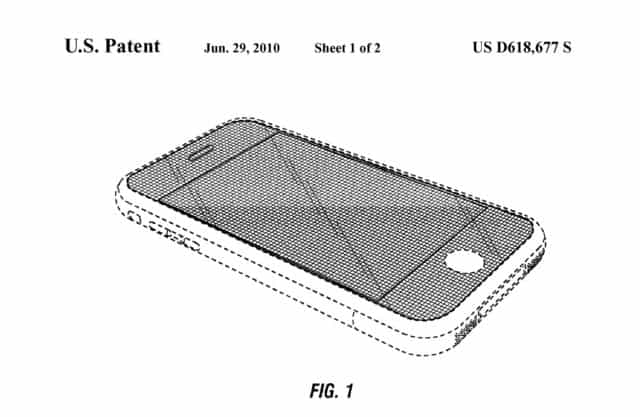
May 25, 2018: Late victory in patent dispute with Samsung: the Koreans must pay Apple some $539 million (about 460 million euros) for copying the iPhone’s design in the two smartphone giants’ years-long patent battle, according to a new court ruling. The jury thus boosted an original amount of $399 million contested by Samsung in 2012. Samsung had taken the case all the way to the U.S. Supreme Court. That found fault with the original decision and sent the case back for a new trial in district court. This time, jurors were asked to decide whether Apple was entitled to all profits from the sale of a device because design patents had been infringed – or just a portion. They put the total in the middle of the possible range. The bulk of it is $533.3 million for infringement of three patents on 16 Samsung devices. Another $5.3 million was added for infringement of two more patents on four smartphones.
Apple had protected the look of the first iPhone with a design patent.
June 28, 2018: Apple and Samsung settle their tough patent dispute in the US after more than seven years. The terms of the out-of-court settlement were not disclosed. The California judge in charge of the case, Lucy Koh, ordered the case to be dismissed. The two companies did not comment on the settlement. Apple only referred to an earlier statement from May 2018, at which time the group had reiterated that Samsung had copied the iPhone design and that the case was about more than just money.
August 1, 2018: Apple announces the launch of Apple Pay in Germany. The service will be launched “by the end of the year,” group CEO Tim Cook said in an analyst conference to present recent quarterly figures. September 12, 2018:
At the traditional presentation of new iPhone models, Apple introduces three devices at once. In addition to the iPhone XS and XS Max, there is also a new iPhone XR. It is not quite as expensive as the two top models, but it also does not have an OLED screen. Also, the main camera has only one lens instead of two on the XS models.
October 3, 2018: Apple’s stock hits an all-time high of $233.47 on the stock market. The weeks and months later, the price sinks again significantly. On the one hand, technology stocks are under pressure. On the other hand, it is becoming apparent that Apple will sell fewer iPhones in the 2018 Christmas quarter than the year before. In addition, business in China is suffering.
January 29, 2019: Apple admits in presenting its official quarterly figures that the iPhone isn’t selling as well as it used to, but the company is still coming up with its usual billions in profits. That’s thanks to other products from the iPad to the Apple Watch, as well as its business providing services to existing customers.
March 15, 2019: Chip company Qualcomm wins a key trial in the U.S. in its global patent dispute with Apple Apple. Jurors in California concluded that Apple infringed three of Qualcomm’s patents, and awarded the chip company about $31.6 million.
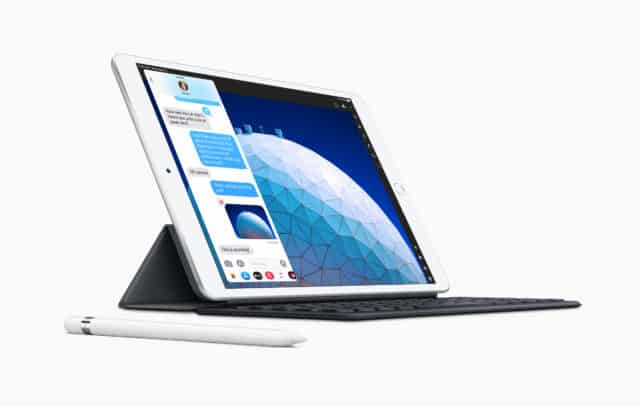
March 18, 2019: Apple is launching the seventh generation of its iPad tablet computer. In addition to a new iPad Air with a 10.5-inch screen size,
The new iPad mini. Photo: Apple
Both devices use the Apple designed A12 Bionic chip, which is said to make the devices significantly faster compared to previous models. The iPad Air is said to achieve a 70 percent increase in performance and double the graphics performance, while the iPad mini Apple even promises a tripling of performance. In the iPad Air, the display has also been enlarged.
April 17, 2019: Apple and chip specialist Qualcomm settle their bitter patent dispute after more than two years. The iPhone company will acquire a patent license and also purchase chips from Qualcomm. In addition, Qualcomm gets a payment from Apple, the amount initially remained unknown.
The settlement was announced in the middle of the pivotal trial in the dispute – while lawyers were still exchanging blows in court. A few hours later, Qualcomm rival Intel announced it was exiting the smartphone modem chip business.
April 30, 2019: Apple s quarterly figures beat stock market expectations. The iPhone company is also distributing another $75 billion to investors via a share buyback. While there were year-over-year revenue declines in the iPhone and Mac computers, the company’s business in iPads, devices such as computer watches and earbuds devices, and online services grew.
June 27, 2019:
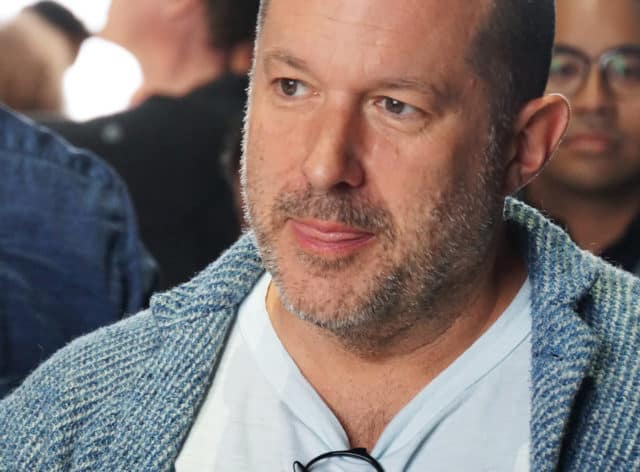
Apple design chief Jony Ive. Photo: Christoph Dernbach
Chief designer Jony Ive announces he will leave Apple. at the end of the year. He will start his own company, announced the iPhone maker. Apple will be among the most important clients of the new company LoveFrom. The 52-year-old Briton joined Apple in the early 1990s and has led the design team there since 1996. He is considered one of the key figures in the group. In the future, his colleagues Evans Hankey and Alan Dye are to report to board member Jeff Williams for the design team.
JONY IS A UNIQUE FIGURE IN THE DESIGN WORLD AND HIS ROLE IN APPLE’S REVIVAL CANNOT BE OVERSTATED.
APPLE CEO TIM COOK ON JONY IVE’S DEPARTURE
AFTER NEARLY 30 YEARS AND COUNTLESS PROJECTS, I AM MOST PROUD THAT AT APPLE WE HAVE CREATED A DESIGN TEAM, PROCESSES AND CULTURE THAT IS SECOND TO NONE.
JONY IVE ON HIS DEPARTURE FROM APPLE
September 10, 2019: Apple s new generation of iPhones is relying heavily on better cameras to boost recently slumping sales of its flagship product. The iPhone 11, which replaces the current iPhone XR as the entry-level model, gets, among other things, a night mode that is supposed to ensure good pictures in dark lighting conditions. And for the first time, even the cheapest iPhone model gets a dual camera setup that allows for wide-angle shooting, a full portrait mode and other improvements.
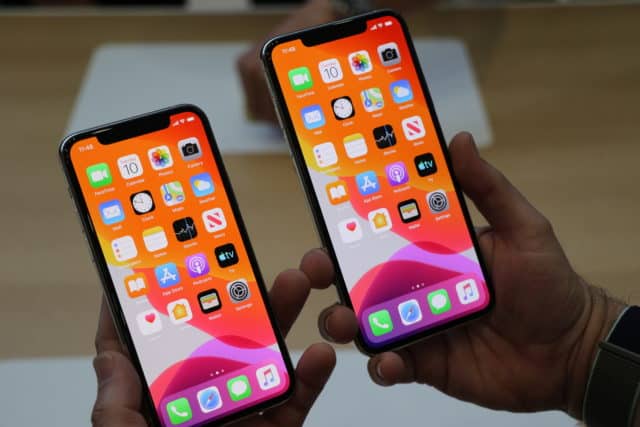
iPhone 11 Pro and 11 Pro Max. Photo: Christoph Dernbach
The successors to the current top iPhone XS and XS Max models are named iPhone 11 Pro and Pro Max. The devices are housed in a new type of stainless steel casing and now feature three cameras on the back – medium focal length, telephoto and ultra-wide angle. The new “Deep Fusion” function in the Pro models is supposed to produce particularly high-quality photos by evaluating multiple images. For this, the cameras take nine photos with different settings and put them together “pixel by pixel” to form an image
September 17, 2019: The legal battle between Apple and the EU Commission over Ireland’s record 13 billion euros in back taxes is coming to a head. The iPhone group reiterates before the EU court in Luxembourg that the income of two Irish subsidiaries had been taxable primarily in the United States. The Commission accuses Apple of only causing confusion. It stressed its view that Ireland had understated taxes. Apple, on the other hand, feels it is being asked to pay twice. “Apple is now paying around 20 billion euros in taxes in the U.S. on the same profits that, according to the Commission, should also be taxed in Ireland,” the U.S. company said. EU Competition Commissioner Margrethe Vestager had asked Apple in August 2016 to pay the billion in back taxes in Ireland because the country had given the group undue special treatment on tax terms.
December 10, 2019: One year after the launch of Apple Pay in Germany, significantly more consumers can use the iPhone company’s mobile payment service than before. Shortly before Christmas 2019, 371 of a total of 379 German savings banks launched the service for their approximately 50 million customers. Commerzbank, Norisbank and LBBW were also added as additional credit institutions in a single sweep. Commerzbank alone has around eleven million private customers. Initially, only credit cards and debit cards issued by the banks can be integrated. A solution for the Girocard, which is very widely used in Germany and which many consumers still know under the old brand name EC card, is still in the works. It will not come until late summer 2020.
2020
January 29, 2020: After a record Christmas 2019 with just over $22 billion in quarterly profits, Apple is having to battle turbulence from the new corona virus. Some supplier factories are located in the particularly affected region around the city of Wuhan, said company CEO Tim Cook. However, he said there were alternative sources for their products. He said it was unclear how things would develop at other suppliers, some of which had extended their usual Chinese New Year shutdown by a week. Compared to many other corporations, Apple is coming through the Corona crisis reasonably unscathed.
March 18, 2020: Two years after its last major product offensive in the tablet computer market, Apple is introducing four new iPad models. The new iPad Pro have been equipped with a faster A12Z Bionic chip. Augmented reality (AR) applications in particular are expected to benefit from the better hardware equipment, which also includes a newly developed ultra-wide-angle camera and a new type of lidar scanner. With AR, virtual content is shown on a display mixed with the real environment. Lidar scanners, for example, are used by self-driving cars to scan their surroundings.
iPad Pro (2020)
April 10, 2020: Apple and Google, as providers of the world’s two leading smartphone platforms, want to make it easier to develop apps that track Corona infections. They are relying on distance detection with Bluetooth wireless technology and encryption. “User privacy and security will be at the heart of this development,” the two groups said. The iOS operating system of Apple’s iPhones and Google’s Android system are expected to get corresponding interfaces.
The concept is to allow smartphones to exchange temporary identification numbers regardless of the operating system used, thus preserving user privacy. Apple and Google, however, want to store the contact information only on users’ smartphones, not on a central server. Only when someone tests positive with Covid-19 would the information be transferred to a server, if the person agrees. The other smartphones periodically retrieve a list of the anonymized IDs of those with the disease from this concept to see if they themselves have had contact with an infected person.
Google and Apple and Google want to ensure, among other things, that the constant exchange of ID numbers does not significantly reduce the battery life of the devices. As a first step, the two companies said they would release an application programming interface (API) in May that would allow Android and iOS devices to work together using apps provided by health authorities. These official apps would be available for users to download through their respective app stores.
April 15, 2020: Apple is introducing a new smartphone amid the Corona crisis. The new entry-level iPhone SE looks exactly like the iPhone 8 on the outside, with its aluminum body and home button fingerprint reader. However, the US company has technically updated the device and installed the modern A13 Bionic processor from the current iPhone 11. In addition, the optics and electronics of the camera have been improved. With the new iPhone SE, Apple is aggressively priced by its standards. Compared to the less powerful hardware of the iPhone 8, the price has been reduced by 50 euros. Thus, the entry-level model is available from 479 euros (64 GB storage). The variant with 128 GB costs 529 euros, the largest with 256 GB strikes at 649 euros.
June 16, 2020 The German Robert Koch Institute (RKI) releases the Corona Warning app for the iPhone and Android smartphones. The app was developed on behalf of the RKI by Deutsche Telekom or the group’s subsidiary T-Systems and the software group SAP. The app is openly viewable as open source and relies on the technical interfaces of Apple and Google. With the decision to use the APIs of the two OS manufacturers, the dispute over the data protection concept also fell in favor of the decentralized storage concept. There is controversy in the public that only iPhone models from iOS 13 can run the Corona warning app. This leaves out popular models like the iPhone 6, 5s, 5 and older.
Die Bundesregierung wirbt für die Corona-Warn-App des RKI.
June 23, 2020: Apple breaks out of the PC industry’s well-worn rut and switches its Mac computers from Intel processors to chips developed in-house. This means that future Apple computers will run on the same technical platform as the iPhones and iPad tablets. The first Macs with the new chip architecture are expected to hit the market at the end of the year, company CEO Tim Cook announced Monday. The company will be able to build better products with it, promised chief developer Johny Srouji. Large software providers such as Microsoft (Office) or Adobe (Photoshop) are already working on adapted versions of their programs, emphasized software boss Craig Federighi. Apple expects the transition to take two years, Cook said. At the same time, Macs with Intel chips will continue to be supported – and new devices with processors from the semiconductor company are also planned.
Apple switches from Intel CPUs to its own processors.
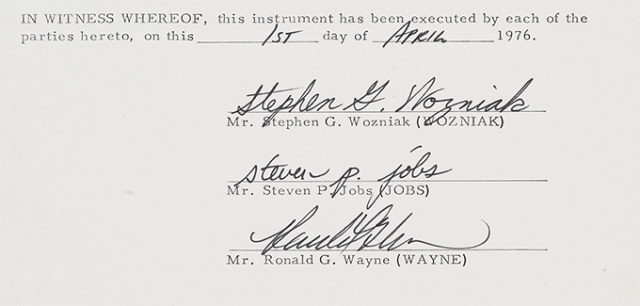
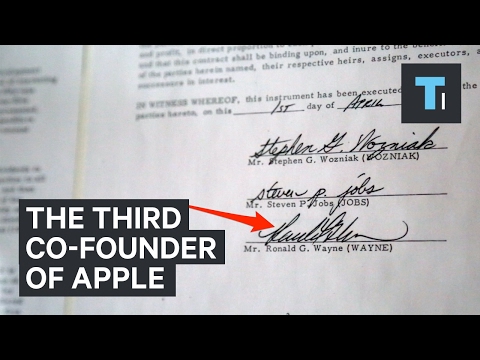
When you talk about the founders of Apple, you first think of Steve Jobs and Steve Wozniak. Jobs, the far-sighted business strategist – and “Woz”, the brilliant inventor. In fact, the Apple Computer Company was founded by three men: “Mr. Stephen G. Wozinak, Mr. Steven P. Jobs and Mr. Ronald G. Wayne”, as it is also stated in the company’s founding contract of April 1, 1976.
Three men founded Apple Computer on April 1st, 1976
Ron Wayne worked at Atari before founding Apple Computer, where he met Steve Jobs, who was involved in new game development. Through Jobs, Wayne became aware of Steve Wozniak, a brilliant hardware designer and engineer who had created the first usable personal computer that would go down in technological history as the Apple I.
But it soon became clear that the two Steves were pursuing very different goals: Steve Wozniak wanted to impress his pal’s guys at the Homebrew Computer Club with his brilliant development steps. Woz had no serious interest in making a big business out of it. Steve Jobs, on the other hand, quickly recognized the business potential. With a computer like Apple, I could break the dominance of the mainframes of companies like IBM and turn the personal computer into a mass product.
However, Jobs was not able to match his interests with Woz. Therefore he relied on Ron Wayne. So he and against this background offered him a minority share in the foundation of Apple Computer on April 1, 1976. Wayne had a 10 percent stake in the company, and Jobs and Wozniak each held 45 percent. Ron Wayne was to tip the scales when the two main players were at loggerheads with each other. “We both trusted him so much that he would resolve any conflicts we had,” said Steve Jobs.
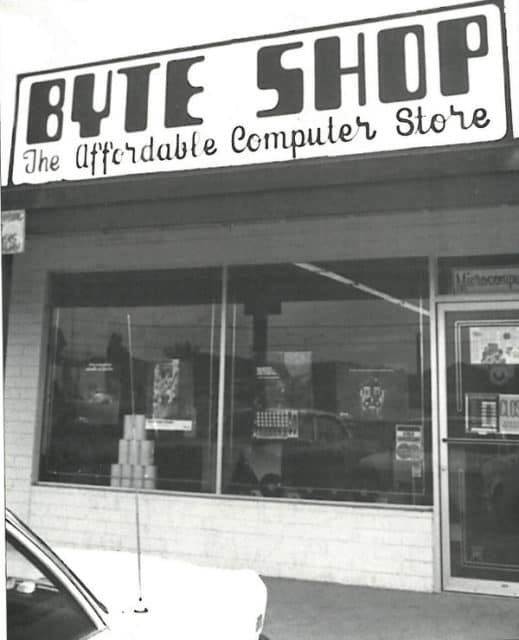
The first larger order came from the Byte Shop
r Wayne got cold feet: “I was practically the adult in the room. I was in my 40s, those kids were around 20. Then about a week and a half later, when I had time to think, I did what most people thought was absolutely crazy. I had my name taken off the contract.”
Wayne was particularly worried about the financial obligations associated with the first major contract for Apple computers. Jobs was in the process of signing supply contracts for the Apple I with first customers like “The Byte Shop”. He was getting the components for it on tick.
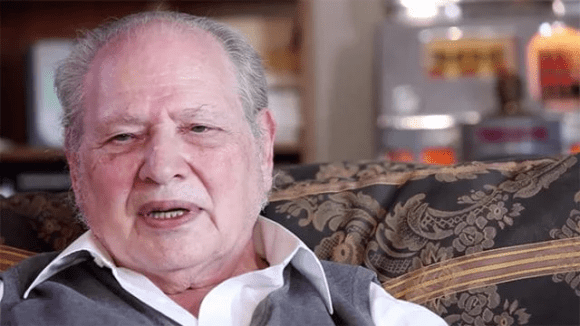
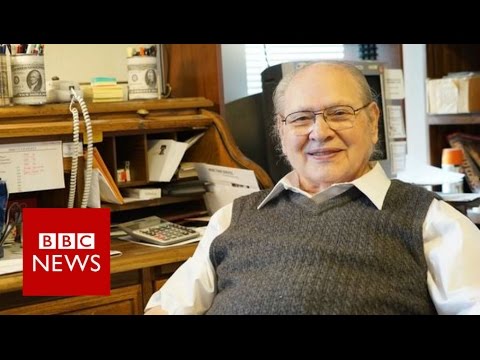
“I had very good reasons to remove my name from the contract,” Wayne said in a 2016 TV interview looking back. “The main reason was that we had started a company. And if we failed, Jobs and Woz would not have had two nickels in their pockets. Who would be left to stick? Well, I had a house and a car, and a bank account, too. I was handy. So I was financially vulnerable. But I also wanted to be my own man. I also realized I was in the shadow of two grand. I was never gonna get my own project. I didn’t like the idea of spending the next 20 years behind piles of paper in an office. That was another reason to get out.”
Ron Wayne talks to Jules Pochy und Jérôme Schmidt (2016)
His co-founder Steve Wozniak could not understand this step. “I don’t know why Ron gave up. “He sold his shares and got out. He may have had good reasons. He got out and he was happy with it. He couldn’t see the big picture. But you couldn’t see the big picture at the time. There was only the Apple I.”
Wayne could
not count on Steve Jobs’ understanding. Jobs described the process as follows:
“He decided that he really wanted a VCR or something. So he sold us back
10 percent for eight hundred dollars.”
But there
were also reservations in the opposite direction: “I didn’t know whether
jobs were the kind of personality I wanted to work for either,” Wayne said
in the ARTE interview (2016). “He was just the way he was. He knew exactly
what he wanted to do. And it was better not to get in his way. You would end up
with a footprint on your forehead. Jobs had a very aggressive character. And if
you had to choose between Steve Jobs and an ice cube to warm them up, you’d
snuggle up to the ice cube. But it was the only way he could achieve what he
had achieved with Apple. Apple was Steve Jobs.”
So Wayne has no regrets about getting out of Apple so early: “Those kids were wild hotshots, like whether you have to hold a tiger by the tail. If I’d stayed with Apple, I’d have been caught in a hurry. I’d just be the richest man in the cemetery.”
One thing in life Wayne does regret, though. In the mid-nineties, he saw an ad in a magazine for a company that dealt with autographs and signatures. He remembered the old Apple contract that was lying around in a closet collecting dust. Finally, he sold the historical document for 500 dollars to the autograph dealer.
Years
later, Wayne then saw on television how his old contract came under the hammer
for almost 1.6 million dollars at the Sotheby’s auction house.
“I’m sorry for this incident. But what can I say? It’s the story of my life, right? A day late and a dollar short in my pocket.”
Ron Wayne has left his mark on Apple’s history even after he left as a shareholder. The first trace should be removed quickly because Steve Jobs did not like the first logo of the young company, which Wayne had designed. “In this logo, which they had me design, I captured Wozniak’s bizarreness. The logo with Newton in this Gothic frame with the ribbon and the inscription ‘Apple Computer Company’ was of course a 19th-century design, not a 20th-century design. I knew that already.”
The second mark was deeper: Jobs asked Wayne if he could design a case for the Apple II. Although his design was never used. But Apple adopted the basic design principle.
Design for a housing for the Apple II by Ron Wayne.
To this day, Wayne is amused by the thought that he may have influenced all his later work. “A typical computer today consists of a tower and a circuit board mounted vertically. The keyboard and screen are separate. In my design for the Apple II, I had a horizontal design with a horizontally mounted board. The keyboard was integrated into the housing. The monitor stood on top, as one unit. They used this design for all future models, the Macintosh and Lisa, and so on. All were built this way. This form was unique among modern computers.”
“The demo was not going well. Again. It was a late morning in the fall of 2006. Almost a year earlier, Steve Jobs had tasked about 200 of Apple’s top engineers with creating the iPhone. Yet here, in Apple’s boardroom, it was clear that the prototype was still a disaster. It wasn’t just buggy, it flat out didn’t work. The phone dropped calls constantly, the battery stopped charging before it was full, data and applications routinely became corrupted and unusable. The list of problems seemed endless. At the end of the demo, Jobs fixed the dozen or so people in the room with a level stare and said, «We don’t have a product yet.»
Cover Wired 02/2008
So starts Fred Vogelstein’s article in the U.S. technology magazine «Wired» (Feb. 2008) about the difficult launch of a product that would later turn the mobile phone industry upside down. Vogelstein is known for his well-researched reports and features. For example, he revealed (also for Wired) that the story of how the social network Facebook came into being was somewhat different than founder Mark Zuckerberg had repeatedly claimed.
For the «Untold Story» in Wired about the creation of the iPhone – a story that no one had told before – Fred Vogelstein interviewed countless actors and observers and was able to report on exciting details on this basis: Apple CEO Steve Jobs, for example, did not attack his employees screaming after the failed demo in the fall of 2006 – as he had done so many times before. This time, he remained completely calm. The silence made the panel even more nervous than a tantrum from Jobs. «That was one of the few times at Apple that a cold shiver went down my spine,» said one meeting attendee.
The iPhone’s back story goes back to 2002. Shortly after the unveiling of the first iPod, Apple executives were specifically looking at whether Apple should develop a (mobile) phone. Jobs realized early on that the boom in Blackberry smartphones in large companies in the USA would sooner or later spread to private customers. It was also foreseeable to him that the cell phones of the future would usually have an MP3 player built-in, so the dominance of the iPod as a mobile music player seemed threatened.
In the short term, however, Apple was not in a position to build a smartphone itself at the time. The iPod’s operating system was not made to handle complicated network operations or elaborate graphics. And no slim version of the Macintosh operating system OS X existed at the time that could have run on the phone chips available at the time.
Palm Treo 600
In particular, the sales success of the Palm Treo 600, which combined the functions of a cell phone, PDA and Blackberry, encouraged Steve Jobs in his intention to become active in the market for so-called convergence devices himself. In 2004, the iPod business already contributed to 16 percent of Apple’s revenue. But new developments such as the growing popularity of 3G cell phones and WiFi phones, as well as falling memory prices, were at least potentially threatening the iPod’s leadership position. In addition, new online music platforms were constantly being established to compete with Apple’s iTunes Store.
Quick action was now necessary, even though Apple itself was not yet ready for the development of an iPhone. In the search for cooperation partners, Steve Jobs chose Motorola. The U.S. mobile phone giant was celebrating great sales successes at the time with its RAZR design cell phone. Jobs also knew Motorola CEO Ed Zander from the time when Zander had worked in the top management of Sun Microsystems. The scenario called for Apple to concentrate fully on developing the music software, while Motorola and cellular provider Cingular would take care of the hardware and complicated network technology.
Jobs expected a worthy successor to the RAZR from Motorola, but was bitterly disappointed: Motorola didn’t present a new design gem, but only slightly modified the existing E398 model. The iTunes-compatible phone could only hold 100 songs. The music tracks could only be transferred to the cell phone via a PC. And on top of that, the ROKR E1 was extremely ugly in Steve Jobs’ eyes.
At the presentation of the Motorola ROKR E1 in September 2005, the Apple CEO made little effort to conceal his lack of enthusiasm for the first iTunes cell phone. Jobs coolly described it at the event as «an iPod shuffle on a cell phone» – and already suspected that the ROKR would be left behind by buyers. At that point, he was already pursuing completely different plans, namely to build his own music phone and to stop compromising with handset manufacturers or network operators.
Motorola ROKR E1
According to Vogelstein’s research, Jobs met with a handful of Cingular executives as early as February 2005 to discuss a partnership without Motorola. The panel included Cingular CEO Stan Sigman, who would be in charge of AT&T’s wireless business after Cingular was acquired by AT&T in December 1996. In the meeting, Steve Jobs made three things clear. Apple has the technology to build a revolutionary device. Apple is willing to enter into an exclusive agreement with a wireless provider. And – in the event that no provider takes up this business model – Apple is also prepared to enter the market itself as a virtual network provider and compete with the established carriers.
Compared to the situation in 2004, Apple had much better starting conditions for building its own smartphone at that time: As part of the secret work on an Apple tablet PC, the engineers in Cupertino had built up considerable knowledge of touchscreen technology that could also be transferred to a small device. In addition, with the ARM-11 chip, a microprocessor was finally on the market that could give a cell phone the necessary power for sophisticated smartphone and iPod applications. Furthermore, companies such as the British Virgin Group had proven that it was possible to earn money as a virtual network operator without having to operate transmission towers.
In the twelve months of negotiations with Cingular, Apple succeeded in doing nothing less than turning the established business model between cell phone producers and network operators on its head. In the era before the iPhone, providers alone determined the conditions under which services were offered in their network. The cell phones played only a minor role in this scenario and were also usually offered to consumers at absurdly low symbol prices. The subsidized cell phones were ultimately refinanced through long contract terms of the cell phone customers. This model worked quite well as long as the one-dollar or one-euro cell phones constantly attracted new customers who had not previously had a mobile communications contract. In cutthroat competition, however, low-cost cell phones were no longer enough to retain customers over the long term.
For ages, Apple’s recipe for success has included an almost paranoid secrecy associated with every new product. And with the iPhone, Steve Jobs personally made sure that the usual security precautions were once again tightened. Internally, the iPhone project was just called Purple 2 or P2. Jobs spread the development teams across the entire Apple campus in Cupertino so that no one could get an idea of the overall strength of the project team.
When Apple employees went to Cingular, they posed as Infineon employees, Wired reporter Vogelstein found out. The German chip company supplies the radio component of the iPhone. Jobs even made sure that hardly anyone within Apple got to see the overall concept of the iPhone. The hardware team had no idea what the user interface would look like until shortly before the iPhone was unveiled at MacWorld Expo in January 2007. Their dummy devices were loaded with fake software that had nothing to do with the eventual iPhone. And the software people were handed clumsy wooden boxes that ran their programs. According to Vogelstein’s research, only about 30 top people in the project were allowed to see the complete iPhone before MacWorld 2007.
The secrecy did not stop after the launch of the iPhone. Until today the details of the revenue sharing between AT&T and Apple are secret. However, analysts such as Gene Munster of Piper Jaffray, after analyzing the balance sheets, assume that Apple receives around 18 US dollars per month from AT&T for each iPhone customer. If this figure is realistic, Apple will take another $432 in commission over the course of the minimum contract period of 24 months, in addition to the hardware price of $399. It’s no wonder that cell phone manufacturers like Nokia and SonyEricsson looked to California with disbelief and envy – and providers like Vodafone now fear that the iPhone example will now set a precedent for other top cell phones.
Later, the head of Deutsche Telekom, René Obermann, found himself in a similar position to Cingular and AT&T in 2006. For Obermann, the sex appeal of the iPhone offered a unique opportunity to distract from the gray reality at T-Mobile and the entire Telekom Group. For this reason, Obermann also accepted conditions that he would otherwise not have accepted from any other cell phone manufacturer.
iPhone on the cover of Time Magazine
AT&T and T-Mobile wanted the iPhone in their product portfolios. Absolutely. They also respected the immense effort Apple had put into developing the iPhone. For example, Apple spent several million dollars on the purchase of equipment for antenna and network tests alone. In total, the development of the iPhone is said to have cost around 150 million dollars. At least in the U.S., the formula for business success with the iPhone worked. In the first 200 days, Apple sold four million iPhones, Apple CEO Steve Jobs announced at the MacWorld Expo. According to a study by Canalys, the iPhone already captured third place in the «smart mobile devices» category in the 4th quarter of 2007 with a market share of 6.5 percent, behind Nokia (53 percent) and Blackberry manufacturer Research In Motion (11.4 %). This means that the iPhone was able to overtake other smartphone manufacturers such as Motorola, SonyEricsson, and Windows Mobile licensees such as HTC and Samsung right from the start. However, smartphones only account for a small fraction of the mobile phone market, which is worth billions.
Market success in Germany was more modest. In the first eleven weeks, T-Mobile sold just 70,000 iPhones, while in the U.S. an average of 20,000 devices crossed the counter every day. However, there are also many iPhone buyers in Germany who do not appear in any T-Mobile statistics because they acquired their dream phone on the gray market on the Internet or on a trip to the USA. Experts believe that one in four iPhones sold in the U.S. was not registered with AT&T.
The Apple Macintosh revolutionized the entire computer industry by the year of 1984. Steve Jobs and his ingenious Macintosh team arranged for the computer to be used by the normal “person in the street” – and not only by experts.
“Insanely great” – Steve Jobs could hardly put into words his enthusiasm by the launch of the Macintosh. On the legendary annual general meeting of January 24th, 1984, in the Flint Center not far from the Apple Campus in Cupertino, the Apple co-founder initially quoted Bob Dylan’s “The Times They Are A-Changin’” in order to then polemicize against an imminent predominance of the young computer industry by IBM.
Steve Jobs’ introduction of the Apple Macintosh:
“The early 1980s. 1981 – Apple II has become the world’s most popular computer, and Apple has grown to a 300 million dollar corporation, becoming the fastest growing company in American business history. With over fifty companies vying for a share, IBM enters the personal computer market in November of 1981, with the IBM PC.
1983. Apple and IBM emerge as the industry’s strongest competitors, with each selling approximately one billion dollars worth of personal computers in 1983. The shakeout is in full swing. The first major personal computer firm goes bankrupt, with others teetering on the brink. Total industry losses for 1983 overshadow even the combined profits of Apple and IBM.
It is now 1984. It appears that IBM wants it all. Apple is perceived to be the only hope to offer IBM a run for its money. Dealers, after initially welcoming IBM with open arms, now fear an IBM dominated and controlled future and are turning back to Apple as the only force who can ensure their future freedom.
IBM wants it all, and is aiming its guns at its last obstacle to industry control, Apple. Will Big Blue dominate the entire computer industry? The entire information age? Was George Orwell right?“
The crowd, among them the complete Macintosh developer’s team, shouted back: “Nooooo!”
The introduction of the first Mac on January 24th, 1984; taken from the “Lost 1984 Videos”
There had been only two milestone products so far: the Apple II in 1977 and the IBM PC in 1981, Jobs continued. “Today (…) we are introducing the third industry milestone product, the Macintosh. Many of us have been working on Macintosh for over two years now and it has turned out insanely great.”
Steve Jobs
Taking a look at the history of the personal computer today, Steve Jobs was on the right track with his historical comparison. However, it would not be IBM that became the great dominator of the computer industry over the years, but rather, the alliance of Microsoft and Intel.
Previous to the Macintosh developer team, others had already tried to design a computer with a mouse and a graphical user interface – one year before Apple did, with its own business computer Lisa, which retailed for 10,000 dollars.
Microsoft and Apple have been business partners and tough competitors for many years. Back in the seventies, Steve Jobs and Bill Gates worked close together. In 1997 the Windows-manufacturer helped Steve Jobs saving Apple.
In the early seventies, there was no such thing as a personal computer. It took geniuses and visionaries like Steve Wozniak and Bill Gates to invent this new industry. The early computer geeks were energized by the arrival of the January 1975 issue of Popular Mechanics, which had on its cover the first personal computer kit, the Altair. The Altair wasn’t a real computer —more a $495 pile of parts that had to be soldered to a board that would then do little—but for hobbyists and hackers, it heralded the dawn of a new era. Bill Gates and Paul Allen read the magazine and started working on a version of BASIC, an easy-to-use programming language, for the Altair. It also caught the attention of Jobs and Wozniak.
Later Steve Jobs had to ask for the Microsoft BASIC because his friend Wozniak didn’t finish his own version of BASIC for the Apple II. “He was very childlike,” said Jobs later to the author of his biography, Walter Isaacson, about “Woz”. “He did a great version of BASIC, but then never could buckle down and write the floating-point BASIC we needed, so we ended up later having to make a deal with Microsoft. He was just too unfocused.”
With the rise of the Apple II in the late seventies, Microsoft became more and more successful – even before the IBM PC was invented. When Apple developed the Macintosh Bill Gates and his team was the most important software partner – despite the fact that Microsoft was also the driving force behind the IBM PC and the PC clones. And Steve Jobs even invited Bill Gates for the preview of the Mac: The high point of the October 1983 Apple sales conference in Hawaii was a skit based on a TV show called The Dating Game. Jobs played emcee, and his three contestants, whom he had convinced to fly to Hawaii, were Bill Gates and two other software executives, Mitch Kapor and Fred Gibbons. As the show’s jingly theme song played, the three took their stools.
Gates, looking like a high school sophomore, got wild applause from the 750 Apple salesmen when he said, “During 1984, Microsoft expects to get half of its revenues from software for the Macintosh.” Jobs, clean-shaven and bouncy, gave a toothy smile and asked if he thought that the Macintosh’s new operating system would become one of the industry’s new standards. Gates answered, “To create a new standard takes not just making something that’s a little bit different, it takes something that’s really new and captures people’s imagination. And the Macintosh, of all the machines I’ve ever seen, is the only one that meets that standard.”
Title of BusinessWeek (October 3rd, 1983)
But even as Gates was speaking, Microsoft was edging away from being primarily a collaborator with Apple to being more of a competitor. It would continue to make application software, like Microsoft Word, for Apple, but a rapidly increasing share of its revenue would come from the operating system it had written for the IBM personal computer. The year before, 279,000 Apple IIs were sold, compared to 240,000 IBM PCs and its clones. But the figures for 1983 were coming in starkly different: 420,000 Apple IIs versus 1.3 million IBMs and its clones. And both the Apple III and the Lisa were dead in the water.
Just when the Apple sales force was arriving in Hawaii, this shift was hammered home on the cover of Business Week. Its headline: “Personal Computers: And the Winner Is . . . IBM.” The story inside detailed the rise of the IBM PC. “The battle for market supremacy is already over,” the magazine declared. “In a stunning blitz, IBM has taken more than 26% of the market in two years, and is expected to account for half the world market by 1985. An additional 25% of the market will be turning out IBM-compatible machines. (Walter Isaacson, p. 159-160)
Apple boss John Sculley’s marketing strategy for the launch of the Macintosh was obvious. The former Pepsi manager, who had been brought to Apple by Steve Jobs, intended to arrange a duel between IBM and Apple, black vs. white, with Apple playing the role of the underdog. Sculley wrote in his book Odyssey:
So we needed a campaign that would focus on a two-horse race to leverage off of Apple’s underdog status. Dozens of other computer companies were coming out with products and I was afraid we were going to get lost in the crowd. If we could create a two-horse race between us and IBM, we might be able to convince people that there are really only two computer companies competing in the marketplace. In any large consumer industry, few people remember the third- or fourth-largest competitor.
In the fight against competitors such as Atari, Commodore, Sinclair and Amstrad, the Apple strategy paid off well. But Sculley, as well as Steve Jobs, had completely underestimated that Microsoft, being an ally from the outset, would, with the aid of Apple, develop into a dominant power of the PC industry and even dwarf IBM.
Bill Gates und Paul Allen (1981)
Bill Gates and Paul Allen founded Microsoft as a small software company in Albuquerque (New Mexico) in 1975 and developed the programming language BASIC for the legendary computer MITS Altair in collaboration with other co-workers. Due to fortunate circumstances, Microsoft landed an order from IBM to deliver not only BASIC but also the operating system for the first IBM PC in 1980. In the negotiation phase, the then-leading operating system manufacturer Digital Research (CP/M) did not want to engage in page-filling adhesion contracts from IBM – and thus lost this gigantic deal.
Microsoft did not have any operating system then, but this did not prevent Bill Gates and his companion Steve Ballmer from playing for high stakes while facing IBM. From their neighboring software shack Seattle Computers (in the meantime, Microsoft had moved to the northwest of the USA) they bought all rights for QDOS (Quick and Dirty Operating System) for no less than 50,000 dollars in July 1981 and renamed it as MS-DOS. Gates had been clever enough at that time not to have all rights to the system negotiated away by the IBM crew and was, therefore, able to win clone companies such as Compaq as customers later.
When Microsoft provided their BASIC for the Apple II, Steve Jobs and Bill Gates constantly ran into each other at that time. “Even before we finished our work on the IBM PC, Steve Jobs came and talked about what he wanted to do, what he thought he could do, sort of a Lisa but cheaper. We said boy, we’d love to help out”, Gates remembers. “The Lisa had all its own applications, but of course, they required a lot of memory, ah, and we thought we could do better, and so Steve signed a deal with us to actually provide bundled applications for the first Mac, and so we were big believers in the Mac and what Steve was doing there.”
Apple urgently needed software for the Mac, as there did not yet exist any program for the new system except for their in-house products MacWrite and MacPaint. Gates promised to have the programs Chart and File written for the Mac in addition to the spreadsheet program Excel. Steve Jobs appreciated the risk Microsoft took, but was not content with the first results though. “Most people don’t remember, but until the Mac, Microsoft was not in the applications business… it was dominated by Lotus. And Microsoft took a big gamble to write for the Mac.”
Apple still could have coped well with having given Microsoft’s new application business a leg up. However, Bill Gates tasted blood in the Macintosh project. Jeff Raikes, who was responsible for the Office business at Microsoft until early 2008, reviews: “And so we got started in early 1982 on our Macintosh software effort and I think at that point in time, you know, it really clicked with Bill that, you know, graphic user interface was going to be the way, the way of the future. But while Bill was having his own GUI revelation, Jobs believed that Apple’s true enemy was IBM.”
Raikes joined Apple Computer as the VisiCalc Engineering Manager in 1980. He worked at Apple for fifteen months before being recruited to Microsoft by Steve Ballmer in 1981 as a product manager. He was promoted to director of applications marketing in 1984 and was the chief strategist behind Microsoft’s investments in graphical applications for the Apple Macintosh and the Microsoft Windows operating system. In this role, he drove the product strategy and design of Microsoft Office.
Steve Jobs didn’t see much risk in bringing Microsoft into the Macintosh project. After all, the division of labor between Apple and Microsoft had worked well on the Apple II. The Apple II used some Microsoft software and Jobs reached out to Microsoft this time too. He didn’t want the company to make the Mac’s operating system. Apple was building that on its own. But he did want it to make stuff like spreadsheet software, and word processing.
Andy Hertzfeld, the technical lead for the Macintosh system software, recalls in the podcast “Land of the Giants” with Peter Kafka: “Microsoft was the first Macintosh developer. There was a partnership relationship from the very beginning between both companies. We needed to recruit the right partners that had both the technical skill and the vision to want to write software for the Macintosh. So Microsoft was the very first company we recruited.”
But Hertzfeld thought Microsoft wasn’t just going to be a partner. He thought Bill Gates was going to be a competitor too. “So I picked up on the idea that maybe Microsoft was besides writing applications, they were going to make their own version of the Macintosh. Seemed pretty obvious to me.” One of the guys on Microsoft’s Mac team was asking many questions about the Mac’s guts. He probably didn’t need to know this stuff to make software for the Mac.
Andy Hertzfeld: “I told Steve about it. He kind of laughed it off at first. He thought Microsoft didn’t have the skill to be able to do that.” Steve Jobs was half right. Microsoft didn’t create its own Macintosh. Instead, it created new software that turned other people’s computers into a sort of Macintoshes. And he used that same idea for a graphics-based interface. Gates it turned out had seen what Xerox Park was doing too. He unveiled his plan a few months before the Macintosh debuted.
Andy Hertzfeld: “In November of 1983 they announced their first version of Windows. Steve freaked out. He goes: ‘Get Gates down here right now.’ And I was thinking how are you going to do that? But like in a matter of hours Bill Gates was there. Steve just screamed at him. But Bill’s credit: he just listened to Steve scream and finally responded with a fairly famous response about where Steve said: ‘You’re ripping us off, you’re ripping us off’. And Bill said something like: “Well that’s not how I think about it. It’s more like we both had a rich neighbor named Xerox and you went in to steal the television set and found out it was already stolen.'”
Quote of the movie: “Pirates of Silicon Valley” – Microsoft steals from Apple
In June of 1985, Bill Gates sent a remarkable memo to both the then-CEO of Apple, John Sculley, and then-head of Macintosh development, Jean Louis Gassée, and urged them to spread their wings by licensing their hardware and operating system to other companies.
Apple must make Macintosh a standard. But no personal computer company, not even IBM, can create a standard without independent support. Even though Apple realized this, they have not been able to gain the independent support required to be perceived as a standard.
Apple ignored his advice.
Five months after he sent the memo, Windows 1.0 was released. Microsoft’s decision to do exactly as Gates had recommended to Apple resulted in market domination. If Apple had taken Gates’ advice, things could have been very different.
Apple co-founder Steve Wozniak has since said:
“The computer was never the problem. The company’s strategy was. Apple saw itself as a hardware company; in order to protect our hardware profits, we didn’t license our operating system. We had the most beautiful operating system, but to get it you had to buy our hardware at twice the price. That was a mistake. What we should have done was calculate an appropriate price to license the operating system. We were also naive to think that the best technology would prevail. It often doesn’t.”
Windows 1.01 was based on DOS and was incredibly slow, but it reminded one of the Macintosh GUI in some features. In order to prevent Apple from taking legal action, Gates put the screws on Apple boss Sculley. His message was: As soon as Apple sends out the lawyers, Microsoft will immediately stop the development of Word and Excel for the Mac. Since Apple was depending on the Microsoft applications, Sculley licensed some of the Mac technologies to Microsoft.
As Microsoft went public with the next large version leap of Windows 2.03 at the beginning of 1988, Sculley tried to pull the ripcord and sued Microsoft and Hewlett-Packard for copyright infringement on March 17, 1988. John Sculley had been in a difficult situation, particularly as he had engaged in vague formulations in the contract with Microsoft in 1985, which gave great leeway to Gates and his lot. Moreover, he knew that his chances to win an action against Microsoft had been, purely from a legal viewpoint, not particularly good: “The look and feel, which is how it looks, the experience of using it, was not patentable, but it was copyrightable, but there was no precedent law. This was going to be a precedent-setting case.”
Parody of an advertising spot for Windows featuring Steve BallmerBill Gates recalls also reluctant this time.: “But it was a period of five years where, Microsoft er, our whole strategy would have been ruined because Windows was very important to us. (…) We assumed that the lawyers, the judges would all come to the right conclusion which eventually they did.” Sculley: “And Apple lost. But in that period of about six years that this case was going on it may have lulled us into a bit of complacency thinking that we were going to be insulated, you know, from the Windows attack.”
Windows 3.1
The introduction of Windows 3.1 in 1992 brought Microsoft the breakthrough in the “GUI war”. The system lacked the elegance and usability of the Macintosh system 7.0, but Windows appeared good enough to most PC users. With the help of Windows 95, which had been introduced with gigantic effort on August 24, 1995, Microsoft caught up closer to the Mac and in some aspects even appeared more progressive than the Mac OS, which had become dated in the meantime.
Steve Jobs, who, as the head of NeXT, had observed the advance of Windows from a distance, did not have any kind words for Bill Gates at the launch of Windows 95:
The only problem with Microsoft is they just have no taste, they have absolutely no taste, and what that means is – I don’t mean that in a small way, I mean that in a big way. In the sense that they don’t think of original ideas and they don’t bring much culture into their product, and you say why is that important – well you know proportionally spaced fonts come from type setting and beautiful books, that’s where one gets the idea – if it weren’t for the Mac, they would never have that in their products and so I guess I am saddened, not by Microsoft’s success – I have no problem with their success, they’ve earned their success for the most part. I have a problem with the fact that they just make really third rate products.
It is claimed that Jobs has apologized to Bill Gates for this remark later.
Steve Jobs about Microsoft (1995)
The relationship between Apple and Microsoft – and thus also between Steve Jobs and Bill Gates – did not get back to normal before the summer of 1997, when Steve Jobs returned to Apple and engaged in the support of Microsoft to make the troubled company profitable again.
Bill Gates on the video screen at the MacWorld Expo 1997 in Boston
Many faithful Apple fans still remember with horror the moment when Steve Jobs announced the former archrival very pragmatically as the knight in shining armor at the MacWorld Expo 1997 in Boston with Bill Gates appearing on an oversized video screen just like “Big Brother.” Introducing Gates, Jobs said: “We have to let go of the notion that in order to for Apple to win, Microsoft has to lose. Relationships that are destructive don’t help anybody. The era of setting this up as a competition between Apple and Microsoft is over.”
According to certain rumors, Microsoft invested 150 million dollars in 150,000 Apple stocks and paid another 100 million dollars for copyright infringement over the past few years. At the same time, Gates obliged himself to continue the development of the Internet Explorer and Microsoft Office for the Mac for the following five years. Gates drew hisses from the audience of Apple faithful. The crowd also groaned when Steve Jobs said Apple would make Microsoft’s Internet Explorer the default browser for viewing the World Wide Web on Macintosh computers. That development was a blow to Netscape Communications Corp., which made a more popular competing browser and lost later on in the famous “browser war” against Microsoft.
In October 2015 Steve Ballmer appeared on Bloomberg TV where the former executive briefly touched on Microsoft’s monumental 1997 investment in Apple.
At the time, Microsoft’s deal with Apple not only helped rescue the company from the brink of bankruptcy, it gave Apple a much-needed lifeline, affording the company room and time to innovate. And as we all know, the deal ultimately helped set Apple up for the most astounding tech resurgence in history.
In 2010 – after a stunning comeback – Apple Inc. overtook Microsoft Corp. to become the most valuable technology company on optimism it can keep adding customers for its iPhone, Macintosh computer, and iPad. On May 26th by 4 p.m. New York time in Nasdaq Stock Market trading, Apple’s market value was at $222.1 billion, higher than Microsoft’s $219.2 billion. That made Apple the most valuable technology firm in the world.
In an interview with Kara Swisher and Walt Mossberg from the Wall Street Journal, Apple CEO Steve Jobs downplayed the significance of Apple’s passing Microsoft in market value. “For those of us who have been in the industry a long time, it’s surreal,” Jobs said. “But it doesn’t matter very much, it’s not what’s important.
“It’s not why any of our customers buy our products. So I think it’s good for us to keep that in mind.”
“They just don’t get it.” That’s how Steve Jobs described his digital rivals Microsoft and Google in an interview with his biographer Walter Isaacson.
For his biography, “Steve Jobs,” Isaacson conducted more than 40 taped interviews with the Apple co-founder and CEO – all of them done while Apple was on its ascent with one great product after another, but Jobs was on his decline, ill with a form of pancreatic cancer that would end his life at age 56.
Update:
JOBS AND GATES TOGETHER The boy wonders of computing, now thirtysomething, argue over where innovation comes from and where PCs will go.
By Steven P. Jobs, William H. Gates III, Brenton R. Schlender
August 26, 1991
(FORTUNE Magazine) – The two college dropouts most responsible for unleashing the PC revolution rarely see each other anymore, though they say that they’re still friends. At FORTUNE’s invitation, Bill Gates and Steve Jobs met for a Sunday evening in late July to discuss the prospects for the tumultuous industry they shaped. Gates, 35, left Harvard in 1975 to co-found Microsoft. His big break came in 1980, when IBM asked him to provide the operating system — the program that manages a computer’s inner workings — for its now famous PC.
Jobs, 36, who left Reed College to sojourn in India, is best known for co-founding Apple Computer. He led the development of the Macintosh, a computer much easier to use than IBM’s somewhat nerdy PC. Gates has imitated many features of the Mac’s software with a popular PC program called Windows.
Since the mid-1980s the men have taken dramatically different paths. Gates, who owns more than $4 billion of Microsoft stock, remains a workaholic bachelor and an omnivorous reader — he has read several biographies of Napoleon. He has built Microsoft into the world’s largest and most profitable PC software company. It hasn’t all been rosy. Microsoft’s relationship with IBM soured this year, mainly because the two couldn’t agree on an operating- system strategy for future PCs. And the Federal Trade Commission recently began investigating Microsoft’s practices.
Jobs has been less visible but just as busy. In 1985 he started Next, aiming to build the personal computer of the 1990s. Next’s first machine appeared two years ago. Its basic software, NextStep, makes the machine unusually easy to customize; IBM was so impressed it licensed NextStep for its own computers. Despite the dazzling technology, the going has been slow at Next. For one thing, IBM never put NextStep on the market. But lately business has picked up — 10,000 systems rolled out of Next’s automated plant during the second quarter. Jobs has other reasons to smile. He and wife Laurene, who married earlier this year, are expecting their first child in September.
FORTUNE associate editor Brenton R. Schlender put the questions at the meeting. Beneath the conviviality, Jobs and Gates each had a business objective. Jobs lobbied for Gates to develop software for the Next computer. And Gates, whose company is being sued by Apple for allegedly pirating Macintosh software features, was hoping to learn more about the product’s origin.
Schlender: What did you think when the PC appeared ten years ago?
Jobs: When IBM entered the market, we did not take it seriously enough. It was a pretty heady time at Apple. We were shipping tens of thousands of machines a month — more computers than IBM was total. Even so, a lot of people think IBM invented the personal computer, which of course isn’t true.
Gates: A lot of people think Apple did, and that isn’t true either. Our first program was for the Altair ((a mail-order kit sold in 1975)).
Schlender: Does Microsoft’s control of PC operating systems stifle competition in the industry?
Gates: There’s not one element of the industry that’s not competitive. There are people who are cloning Intel’s chips; there are people who are cloning my operating system; there are many, many people who make PCs; and for every software application there are lots of people competing. There is no competitive imperfection.
Jobs: How come nobody has successfully competed with you? I’m not accusing you or Microsoft of anything. I’m not even saying it’s necessarily bad. I’m just saying it’s an interesting contrast. When I zoom back and look at this, there are hundreds of people making PCs, and hundreds of people writing applications programs for them.
Gates: Right.
Jobs: But they all have to travel through this very small orifice called Microsoft to get to one another.
Gates: It’s a very large orifice! ((Laughs.))
Jobs: But it’s only one company.
Gates: Are you saying there’s something wrong with our popularity? My approach to the PC market has been the same from the very beginning. The goal of Microsoft is to create the standard for the industry. Nothing has changed.
Schlender: What does the future hold for IBM and Apple? What do you think of their decision to collaborate on PC software?
Gates: It’s surprising to me.
Jobs: Yes, we are confused about that.
Gates: ((Apple President)) Mike Spindler has said they want to turn Apple into more of a software company. If that’s your goal, you don’t go and give the half of the company that is the future of Apple software to a joint venture. What is Apple getting in return? Here’s the part I don’t understand: What is the contribution from IBM? The IBM name? Did Apple feel so bad about their own work that they had to have that?
Jobs: I truly believe the challenge for IBM is that they can’t survive by selling the same thing you can buy from somebody else for 30% less money. Their cost structure doesn’t allow them to compete with companies that don’t do massive amounts of R&D, that don’t have twice as many employees as they need, et cetera, et cetera. So IBM has to do one of two things: One, suffer continuous erosion of its market share until eventually it goes out of business, which I hope doesn’t happen. Or two, come up with some way to add value. In my opinion the way to make your machines unique is with unique software.
Gates: I said that back in the Seventies! ((Laughs.)) There’s something else I don’t understand. If IBM already held a license to your NextStep software, why did they get all this going with Apple rather than just come to you and expand their license?
Jobs: I really want to answer this que
stion, but I’ve got to be careful what I say. It’s not my purpose to alienate anyone at IBM.
Gates: We share this interest. ((Both laugh.))
Jobs: Somebody at IBM a few years ago saw our NextStep operating system as a potential diamond to solve their biggest and most profound problem, that of adding value to their computers with unique software. Unfortunately, as I learned, IBM is not a monolith. It is a very large place with lots of faces, and they all play musical chairs. Somewhere along the line this diamond got dropped in the mud, and now it’s sitting on somebody’s desk who thinks it’s a dirt clod. Inside that dirt clod is still a diamond, but they don’t see it.
Schlender: Is the PC industry, which until now has been dominated by American companies, liable to get overrun by the Japanese?
Jobs: Computer companies fall on a spectrum of enthusiasm for manufacturing. On the left end are companies that look at manufacturing as a necessary evil, who wish they didn’t have to do it. And at the far right you have people who look at manufacturing as a competitive advantage. Clearly a lot of the Japanese companies look at themselves that way. Unfortunately a lot of American companies look at manufacturing as a necessary evil. You can say the same thing about the way they see software. My opinion is that the only two computer companies that are software-driven are Apple and Next, and I wonder about Apple. Most computer companies would rather that software didn’t even exist.
Gates: Good!
Jobs: It’s good for Microsoft today. But unfortunately all those companies could give way to Japanese companies a few years down the road.
Gates: I think you give up too easily on Americans. You pick one dimension . . .
Jobs: I focus on manufacturing because I care about it. I’ve seen IBM’s. I built Apple’s and Next’s, and I know what Sun does. Ultimately, I believe that most of the PCs will come from offshore. We’re just not good enough at manufacturing.Where will the key innovations come from? Established giants like Microsoft or upstarts like Next?
Gates: I contend technology breakthroughs can happen by extending what we already have. Let’s take handwriting computers. The hardware is coming from PC-compatible makers like Dell Computer ((of Austin, Texas)) and NCR and some Japanese companies. The software will come either from Microsoft or from a U.S. competitor named Go Corp. ((of Foster City, California)). That’s going to be a major breakthrough, and who do you give credit to?
Jobs: I think everybody gives credit to Go, but Go will be crushed.
Gates: That’s one of the nastiest comments I’ve ever heard. I’ve been working on handwriting since long before there ever was a Go Corp.
Jobs: Really? I didn’t know that. Most people would say that Go is the company that first tried to commercialize that technology.,
Gates: Well, Go hasn’t shipped anything yet, and I’ll ship my stuff before they ship theirs.
Jobs: My experience has been that creating a compelling new technology is so much harder than you think it will be that you’re almost dead when you get to the other shore. That’s why, when you take big leaps, like the Mac, or object- oriented programming, or handwriting recognition, you have to leave old technology behind. When Lindbergh was going to fly from New York to Paris, he had to decide what to take with him. There were a lot of demands. They fell into two categories — things that would make his journey safer or more comfortable, and things that would increase his chances of making it to Paris. Weight was a real problem. He could take more gas, which would increase his safety, or he could take a compass, which would increase his chances of getting to Paris. Every time he came down on the side of increasing his chances of getting to Paris at the sacrifice of safety or comfort. That’s why he made it.
Gates: Smart people like Steve ought to try to build things from scratch. That’s a worthy thing. But every time it should be a test. Right now there’s a test in handwriting PCs, in object-oriented operating systems, in multimedia computers. Those are the big questions for personal computing in the 1990s, and I’m the one who has to prove the validity of the evolutionary approach.
Jobs: It’s true, your evolutionary approach with Windows is bringing to PCs great new technologies that Apple and others pioneered. But in the meantime — and it’s been seven years since the Macintosh was introduced — I still think that tens of millions of PC owners needlessly use a computer that is far less good than it should be.
Larry Tesler talks about Steve Jobs’ trips to Xerox’s Palo Alto Research Center, including the one where Jobs eyed the company’s graphical user interface prototype — which ended up on Mac OS.
Introducer: Larry Tesler, I believe you took Steve on a tour of Xerox PARC and showed him some technology that became important. I wonder if you could tell us about that that tour?
Larry Tesler: Well it wasn’t the physical facility. It was a tour of the software it was part of that demonstration . Xerox was facing a lot of competition from Asian companies in copiers when their patents expired and one thing they found was that they had a very high manufacturing cost and they were really having trouble competing with these new forces in the market. At the same time they had Xerox PARC, developing very exciting technologies including the Ethernet, GUIs with windows and improved mice from what existed before.
They started worrying that they would not be able to manufacture those cheaply enough when they moved into that market. So they looked around and saw that Apple was cranking out Apple ][s for really cheap and selling lots of them and they thought, “Well, we should partner with a company like Apple and they’ll make our machines for us”. Or something like that. Xerox had some kind of idea of [that] type, so some business development peope came from the East Coast to PARC and when they got to Apple they made a deal where in exchange for various business arrangements, distribution and future discussion of manufacture and so on, Apple would sell them stock. This was a very appealing thing because it was very clear Apple was going to have a very successful IPO, […] and in exchange though, Steve Jobs required information… disclosure, everything cool going on at Xerox PARC [laughter] [voice commenting “Good bargain!”]. Nobody checked with the PARC people first but the business development people signed the deal.
So there was a number of visits [by Apple to PARC]. I was involved in a couple of them. One was [Apple] executives visiting and meeting with some of us [PARC researchers] trying to just get information out of us or an agenda for how to get the information out of us.
That was a little bit of a tense meeting but I remember at one point Steve was pacing the room trying not to be in charge of the meeting because he was not the CEO of the company – Mike Scott was – and at one point he just said “Stop! Stop! Stop! Stop! Stop this discussion! We need to tell them about the Lisa!” and all the Apple people kind of froze… “Come on! Come on, we need to tell them about the Lisa! This conversation is gonna go nowhere!”. So we got perked up, because it was us disclosing to them, not them disclosing to us, but finally they threw up their hands “OK, tell ’em about the Lisa!” so somebody told us a little about the Lisa, which at that time did not have a GUI but it was powerful enough to do the kinds of thing that they thought we were doing.
The next thing I remember was another meeting where apparently Apple people had been demoed in-between but they weren’t satisfied with the demo. They knew there was lot more than [what] we were showing them. There were a lot of people at PARC that didn’t want to show Apple everything. And in fact we all felt like we didn’t want to show them everything, but I was one of those who felt we should show them more. There were people who wanted to hold back everything we could. So they arranged a new set of demos, where more people came, Bill [Atkinson] was there, John Couch, Mike Scott, obviously Steve, Jef Raskin, [and] a couple of other people.
The room as pretty full and there were two or three of us from PARC at a time, one person sitting at the computer, getting the demonstration and the other people waiting their turn or observing. So, during that demo, Steve again got very excited. He was pacing around the room and occasionally looking at the screen. he was mostly just looking and reacting and taking it all in, trying to process it and at one point he said “You’re still not showing us everything!” And the meeting paused, there were some phone calls [made], and [then] “OK, we’re going to show you more.” [laughter]
So I gave my demo, then Dan Ingalls gave a demo for Smalltalk and they started asking us lot of questions. Bill and, Bruce Daniels was there too, he had joined Apple from MIT… those technical people just asking us questions and we were answering the questions and frankly I was amazed.
I had looked into Apple earlier, a couple of years before, because someone tried to get me to work there, and I found these people who were Homebrew Computer Club kinda hackers. Suddenly there were all these computer scientists in the room and they were asking really good questions! So I got a completely different view about what Apple was like from that meeting. But Jobs was saying “What is going on here? You’re sitting on a gold mine! Why aren’t you doing something with this technology? You could change the world!” And his buddies, who were trying to arrange the negotiation of some kind, were trying to quite him down [laughter] “Don’t be so excited!” But it was really clear to him that we [at Xerox] were never really gonna do anything with this, and by that I mean the kinds of revolutionary things that he was envisioning.
The irony was that when they left we still had shown the like only 1% of what PARC was doing but it was enough that they got really excited and decided they were going to retarget the Lisa to be something like what they had seen, in terms of GUI. They fell in love with the mouse and that changed everything. And seven months after I was working at Apple.”
Apple Lisa team: Paul Baker, Bruce Daniels, Chris Franklin, Rich Page, John Couch, and Larry Tesler.
Apple CEO Steve Jobs introduced the first iPod seven years ago on 23 October 2001. He announced it as a Mac-compatible product with a 5 GB hard drive that put “1,000 songs in your pocket.” The software bundled with the first generation iPod was Macintosh-only, so Windows users had to use third-party software like ephPod or XPlay to manage their music.
It is quite funny to read the Cnet article by Ina Fried about this event and all the reactions of the experts:
IDC analyst Bryan Ma said Apple may take some heat for entering the consumer electronics market, which typically has lower profit margins than Apple gets from its computers. But, he added, the iPod could serve an important function: convincing people to buy a Mac instead of a PC. “It’s another incentive for them that can convince people to buy a Mac,” Ma said. The iPod does cost considerably more than the nearest competitor with a portable hard drive–the $249 6GB Nomad Jukebox from Creative Labs. But Ma said the iPod has significant advantages in terms of its size, battery life and anti-skip protection. “They’ve totally polished…the product,” Ma said of Apple. “If I were an engineer at Creative Labs, I’d be scrambling.” Technology Business Research analyst Tim Deal dinged the $399 price as “a little high.” But he noted that the iPod’s FireWire connectivity allows for faster song downloading than USB. The iPod also sports “a significant battery life and a fast recharge speed,” he said. Deal also praised that fact that the iPod fits into Apple’s digital hub strategy. “However, I question the company’s ability to sell into a tight consumer market right now at the iPod’s current price.” The iPod is another stab at Sony’s success in the consumer market, Deal noted. “Clearly Apple is following Sony’s lead by integrating consumer electronics devices into its marketing strategy, but Apple lacks the richness of Sony’s product offering. And introducing new consumer products right now is risky, especially if they cannot be priced attractively,” Deal said. Stephen Baker, an analyst at NPD Intelect, said that the iPod will likely stand out for its large storage capacity but predicted that the device may have trouble digging out a niche in the market. The most expensive MP3 players that use flash memory sell for around $249 right now, with the average player selling for less. Many are also adding features for playing mini-CDs. Sonicblue’s Rio 600, for instance, sells for $199. It comes with 64MB of flash memory for storage. Apple’s new device has far more storage–enough for 50 hours of music–but it costs twice as much. The iPod has “good features, but this is a pretty competitive category,” Baker said. “The question is whether people want that robust of a feature set with that high of a price.”