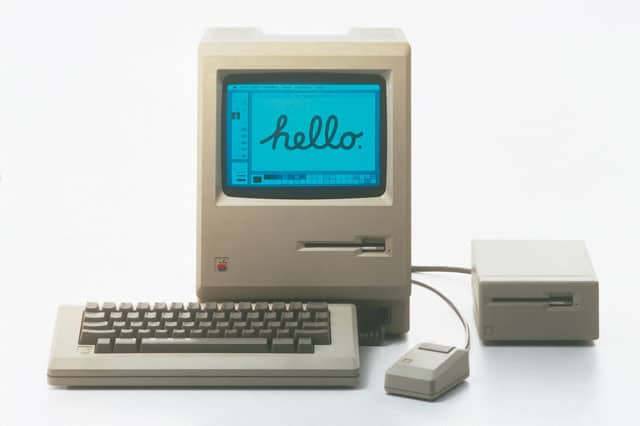
The Apple Macintosh revolutionized the entire computer industry by the year of 1984. Steve Jobs and his ingenious Macintosh team arranged for the computer to be used by the normal “person in the street” – and not only by experts.
“Insanely great” – Steve Jobs could hardly put into words his enthusiasm by the launch of the Macintosh. On the legendary annual general meeting of January 24th, 1984, in the Flint Center not far from the Apple Campus in Cupertino, the Apple co-founder initially quoted Bob Dylan’s “The Times They Are A-Changin’” in order to then polemicize against an imminent predominance of the young computer industry by IBM.
Steve Jobs’ introduction of the Apple Macintosh:
“The early 1980s. 1981 – Apple II has become the world’s most popular computer, and Apple has grown to a 300 million dollar corporation, becoming the fastest growing company in American business history. With over fifty companies vying for a share, IBM enters the personal computer market in November of 1981, with the IBM PC.
1983. Apple and IBM emerge as the industry’s strongest competitors, with each selling approximately one billion dollars worth of personal computers in 1983. The shakeout is in full swing. The first major personal computer firm goes bankrupt, with others teetering on the brink. Total industry losses for 1983 overshadow even the combined profits of Apple and IBM.
It is now 1984. It appears that IBM wants it all. Apple is perceived to be the only hope to offer IBM a run for its money. Dealers, after initially welcoming IBM with open arms, now fear an IBM dominated and controlled future and are turning back to Apple as the only force who can ensure their future freedom.
IBM wants it all, and is aiming its guns at its last obstacle to industry control, Apple. Will Big Blue dominate the entire computer industry? The entire information age? Was George Orwell right?“
The crowd, among them the complete Macintosh developer’s team, shouted back: “Nooooo!”
The introduction of the first Mac on January 24th, 1984; taken from the “Lost 1984 Videos”
There had been only two milestone products so far: the Apple II in 1977 and the IBM PC in 1981, Jobs continued. “Today (…) we are introducing the third industry milestone product, the Macintosh. Many of us have been working on Macintosh for over two years now and it has turned out insanely great.”
Steve Jobs
Taking a look at the history of the personal computer today, Steve Jobs was on the right track with his historical comparison. However, it would not be IBM that became the great dominator of the computer industry over the years, but rather, the alliance of Microsoft and Intel.
Previous to the Macintosh developer team, others had already tried to design a computer with a mouse and a graphical user interface – one year before Apple did, with its own business computer Lisa, which retailed for 10,000 dollars.
Microsoft and Apple have been business partners and tough competitors for many years. Back in the seventies, Steve Jobs and Bill Gates worked close together. In 1997 the Windows-manufacturer helped Steve Jobs saving Apple.
In the early seventies, there was no such thing as a personal computer. It took geniuses and visionaries like Steve Wozniak and Bill Gates to invent this new industry. The early computer geeks were energized by the arrival of the January 1975 issue of Popular Mechanics, which had on its cover the first personal computer kit, the Altair. The Altair wasn’t a real computer —more a $495 pile of parts that had to be soldered to a board that would then do little—but for hobbyists and hackers, it heralded the dawn of a new era. Bill Gates and Paul Allen read the magazine and started working on a version of BASIC, an easy-to-use programming language, for the Altair. It also caught the attention of Jobs and Wozniak.
Later Steve Jobs had to ask for the Microsoft BASIC because his friend Wozniak didn’t finish his own version of BASIC for the Apple II. “He was very childlike,” said Jobs later to the author of his biography, Walter Isaacson, about “Woz”. “He did a great version of BASIC, but then never could buckle down and write the floating-point BASIC we needed, so we ended up later having to make a deal with Microsoft. He was just too unfocused.”
With the rise of the Apple II in the late seventies, Microsoft became more and more successful – even before the IBM PC was invented. When Apple developed the Macintosh Bill Gates and his team was the most important software partner – despite the fact that Microsoft was also the driving force behind the IBM PC and the PC clones. And Steve Jobs even invited Bill Gates for the preview of the Mac: The high point of the October 1983 Apple sales conference in Hawaii was a skit based on a TV show called The Dating Game. Jobs played emcee, and his three contestants, whom he had convinced to fly to Hawaii, were Bill Gates and two other software executives, Mitch Kapor and Fred Gibbons. As the show’s jingly theme song played, the three took their stools.
Gates, looking like a high school sophomore, got wild applause from the 750 Apple salesmen when he said, “During 1984, Microsoft expects to get half of its revenues from software for the Macintosh.” Jobs, clean-shaven and bouncy, gave a toothy smile and asked if he thought that the Macintosh’s new operating system would become one of the industry’s new standards. Gates answered, “To create a new standard takes not just making something that’s a little bit different, it takes something that’s really new and captures people’s imagination. And the Macintosh, of all the machines I’ve ever seen, is the only one that meets that standard.”
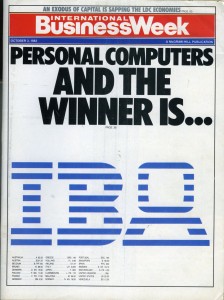
Title of BusinessWeek (October 3rd, 1983)
But even as Gates was speaking, Microsoft was edging away from being primarily a collaborator with Apple to being more of a competitor. It would continue to make application software, like Microsoft Word, for Apple, but a rapidly increasing share of its revenue would come from the operating system it had written for the IBM personal computer. The year before, 279,000 Apple IIs were sold, compared to 240,000 IBM PCs and its clones. But the figures for 1983 were coming in starkly different: 420,000 Apple IIs versus 1.3 million IBMs and its clones. And both the Apple III and the Lisa were dead in the water.
Just when the Apple sales force was arriving in Hawaii, this shift was hammered home on the cover of Business Week. Its headline: “Personal Computers: And the Winner Is . . . IBM.” The story inside detailed the rise of the IBM PC. “The battle for market supremacy is already over,” the magazine declared. “In a stunning blitz, IBM has taken more than 26% of the market in two years, and is expected to account for half the world market by 1985. An additional 25% of the market will be turning out IBM-compatible machines. (Walter Isaacson, p. 159-160)
Apple boss John Sculley’s marketing strategy for the launch of the Macintosh was obvious. The former Pepsi manager, who had been brought to Apple by Steve Jobs, intended to arrange a duel between IBM and Apple, black vs. white, with Apple playing the role of the underdog. Sculley wrote in his book Odyssey:
So we needed a campaign that would focus on a two-horse race to leverage off of Apple’s underdog status. Dozens of other computer companies were coming out with products and I was afraid we were going to get lost in the crowd. If we could create a two-horse race between us and IBM, we might be able to convince people that there are really only two computer companies competing in the marketplace. In any large consumer industry, few people remember the third- or fourth-largest competitor.
In the fight against competitors such as Atari, Commodore, Sinclair and Amstrad, the Apple strategy paid off well. But Sculley, as well as Steve Jobs, had completely underestimated that Microsoft, being an ally from the outset, would, with the aid of Apple, develop into a dominant power of the PC industry and even dwarf IBM.
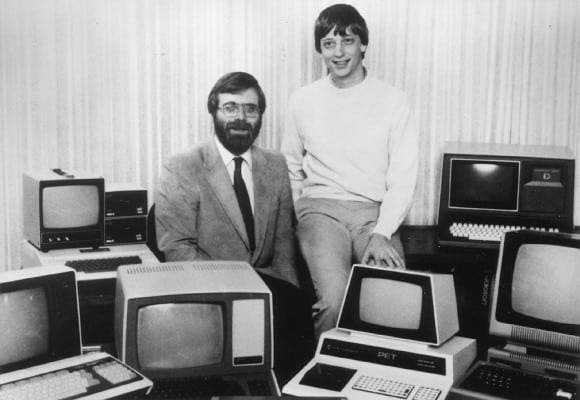
Bill Gates und Paul Allen (1981)
Bill Gates and Paul Allen founded Microsoft as a small software company in Albuquerque (New Mexico) in 1975 and developed the programming language BASIC for the legendary computer MITS Altair in collaboration with other co-workers. Due to fortunate circumstances, Microsoft landed an order from IBM to deliver not only BASIC but also the operating system for the first IBM PC in 1980. In the negotiation phase, the then-leading operating system manufacturer Digital Research (CP/M) did not want to engage in page-filling adhesion contracts from IBM – and thus lost this gigantic deal.
Microsoft did not have any operating system then, but this did not prevent Bill Gates and his companion Steve Ballmer from playing for high stakes while facing IBM. From their neighboring software shack Seattle Computers (in the meantime, Microsoft had moved to the northwest of the USA) they bought all rights for QDOS (Quick and Dirty Operating System) for no less than 50,000 dollars in July 1981 and renamed it as MS-DOS. Gates had been clever enough at that time not to have all rights to the system negotiated away by the IBM crew and was, therefore, able to win clone companies such as Compaq as customers later.
When Microsoft provided their BASIC for the Apple II, Steve Jobs and Bill Gates constantly ran into each other at that time. “Even before we finished our work on the IBM PC, Steve Jobs came and talked about what he wanted to do, what he thought he could do, sort of a Lisa but cheaper. We said boy, we’d love to help out”, Gates remembers. “The Lisa had all its own applications, but of course, they required a lot of memory, ah, and we thought we could do better, and so Steve signed a deal with us to actually provide bundled applications for the first Mac, and so we were big believers in the Mac and what Steve was doing there.”
Apple urgently needed software for the Mac, as there did not yet exist any program for the new system except for their in-house products MacWrite and MacPaint. Gates promised to have the programs Chart and File written for the Mac in addition to the spreadsheet program Excel. Steve Jobs appreciated the risk Microsoft took, but was not content with the first results though. “Most people don’t remember, but until the Mac, Microsoft was not in the applications business… it was dominated by Lotus. And Microsoft took a big gamble to write for the Mac.”
Apple still could have coped well with having given Microsoft’s new application business a leg up. However, Bill Gates tasted blood in the Macintosh project. Jeff Raikes, who was responsible for the Office business at Microsoft until early 2008, reviews: “And so we got started in early 1982 on our Macintosh software effort and I think at that point in time, you know, it really clicked with Bill that, you know, graphic user interface was going to be the way, the way of the future. But while Bill was having his own GUI revelation, Jobs believed that Apple’s true enemy was IBM.”
Raikes joined Apple Computer as the VisiCalc Engineering Manager in 1980. He worked at Apple for fifteen months before being recruited to Microsoft by Steve Ballmer in 1981 as a product manager. He was promoted to director of applications marketing in 1984 and was the chief strategist behind Microsoft’s investments in graphical applications for the Apple Macintosh and the Microsoft Windows operating system. In this role, he drove the product strategy and design of Microsoft Office.
Steve Jobs didn’t see much risk in bringing Microsoft into the Macintosh project. After all, the division of labor between Apple and Microsoft had worked well on the Apple II. The Apple II used some Microsoft software and Jobs reached out to Microsoft this time too. He didn’t want the company to make the Mac’s operating system. Apple was building that on its own. But he did want it to make stuff like spreadsheet software, and word processing.
Andy Hertzfeld, the technical lead for the Macintosh system software, recalls in the podcast “Land of the Giants” with Peter Kafka: “Microsoft was the first Macintosh developer. There was a partnership relationship from the very beginning between both companies. We needed to recruit the right partners that had both the technical skill and the vision to want to write software for the Macintosh. So Microsoft was the very first company we recruited.”
But Hertzfeld thought Microsoft wasn’t just going to be a partner. He thought Bill Gates was going to be a competitor too. “So I picked up on the idea that maybe Microsoft was besides writing applications, they were going to make their own version of the Macintosh. Seemed pretty obvious to me.” One of the guys on Microsoft’s Mac team was asking many questions about the Mac’s guts. He probably didn’t need to know this stuff to make software for the Mac.
Andy Hertzfeld: “I told Steve about it. He kind of laughed it off at first. He thought Microsoft didn’t have the skill to be able to do that.” Steve Jobs was half right. Microsoft didn’t create its own Macintosh. Instead, it created new software that turned other people’s computers into a sort of Macintoshes. And he used that same idea for a graphics-based interface. Gates it turned out had seen what Xerox Park was doing too. He unveiled his plan a few months before the Macintosh debuted.
Andy Hertzfeld: “In November of 1983 they announced their first version of Windows. Steve freaked out. He goes: ‘Get Gates down here right now.’ And I was thinking how are you going to do that? But like in a matter of hours Bill Gates was there. Steve just screamed at him. But Bill’s credit: he just listened to Steve scream and finally responded with a fairly famous response about where Steve said: ‘You’re ripping us off, you’re ripping us off’. And Bill said something like: “Well that’s not how I think about it. It’s more like we both had a rich neighbor named Xerox and you went in to steal the television set and found out it was already stolen.'”
Quote of the movie: “Pirates of Silicon Valley” – Microsoft steals from Apple
In June of 1985, Bill Gates sent a remarkable memo to both the then-CEO of Apple, John Sculley, and then-head of Macintosh development, Jean Louis Gassée, and urged them to spread their wings by licensing their hardware and operating system to other companies.
Apple must make Macintosh a standard. But no personal computer company, not even IBM, can create a standard without independent support. Even though Apple realized this, they have not been able to gain the independent support required to be perceived as a standard.
Apple ignored his advice.
Five months after he sent the memo, Windows 1.0 was released. Microsoft’s decision to do exactly as Gates had recommended to Apple resulted in market domination. If Apple had taken Gates’ advice, things could have been very different.
Apple co-founder Steve Wozniak has since said:
“The computer was never the problem. The company’s strategy was. Apple saw itself as a hardware company; in order to protect our hardware profits, we didn’t license our operating system. We had the most beautiful operating system, but to get it you had to buy our hardware at twice the price. That was a mistake. What we should have done was calculate an appropriate price to license the operating system. We were also naive to think that the best technology would prevail. It often doesn’t.”
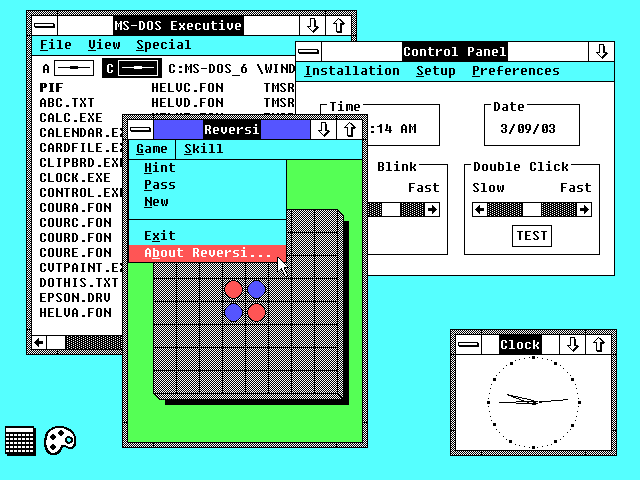
Windows 1.01 was based on DOS and was incredibly slow, but it reminded one of the Macintosh GUI in some features. In order to prevent Apple from taking legal action, Gates put the screws on Apple boss Sculley. His message was: As soon as Apple sends out the lawyers, Microsoft will immediately stop the development of Word and Excel for the Mac. Since Apple was depending on the Microsoft applications, Sculley licensed some of the Mac technologies to Microsoft.
As Microsoft went public with the next large version leap of Windows 2.03 at the beginning of 1988, Sculley tried to pull the ripcord and sued Microsoft and Hewlett-Packard for copyright infringement on March 17, 1988. John Sculley had been in a difficult situation, particularly as he had engaged in vague formulations in the contract with Microsoft in 1985, which gave great leeway to Gates and his lot. Moreover, he knew that his chances to win an action against Microsoft had been, purely from a legal viewpoint, not particularly good: “The look and feel, which is how it looks, the experience of using it, was not patentable, but it was copyrightable, but there was no precedent law. This was going to be a precedent-setting case.”
Parody of an advertising spot for Windows featuring Steve BallmerBill Gates recalls also reluctant this time.: “But it was a period of five years where, Microsoft er, our whole strategy would have been ruined because Windows was very important to us. (…) We assumed that the lawyers, the judges would all come to the right conclusion which eventually they did.” Sculley: “And Apple lost. But in that period of about six years that this case was going on it may have lulled us into a bit of complacency thinking that we were going to be insulated, you know, from the Windows attack.”
Windows 3.1
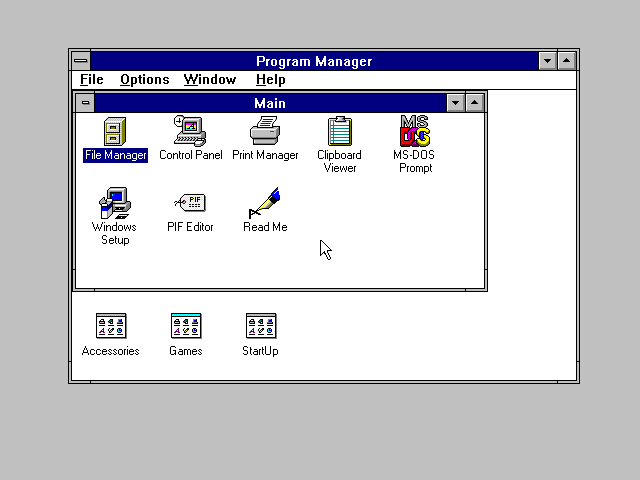
The introduction of Windows 3.1 in 1992 brought Microsoft the breakthrough in the “GUI war”. The system lacked the elegance and usability of the Macintosh system 7.0, but Windows appeared good enough to most PC users. With the help of Windows 95, which had been introduced with gigantic effort on August 24, 1995, Microsoft caught up closer to the Mac and in some aspects even appeared more progressive than the Mac OS, which had become dated in the meantime.
Steve Jobs, who, as the head of NeXT, had observed the advance of Windows from a distance, did not have any kind words for Bill Gates at the launch of Windows 95:
The only problem with Microsoft is they just have no taste, they have absolutely no taste, and what that means is – I don’t mean that in a small way, I mean that in a big way. In the sense that they don’t think of original ideas and they don’t bring much culture into their product, and you say why is that important – well you know proportionally spaced fonts come from type setting and beautiful books, that’s where one gets the idea – if it weren’t for the Mac, they would never have that in their products and so I guess I am saddened, not by Microsoft’s success – I have no problem with their success, they’ve earned their success for the most part. I have a problem with the fact that they just make really third rate products.
It is claimed that Jobs has apologized to Bill Gates for this remark later.
Steve Jobs about Microsoft (1995)
The relationship between Apple and Microsoft – and thus also between Steve Jobs and Bill Gates – did not get back to normal before the summer of 1997, when Steve Jobs returned to Apple and engaged in the support of Microsoft to make the troubled company profitable again.
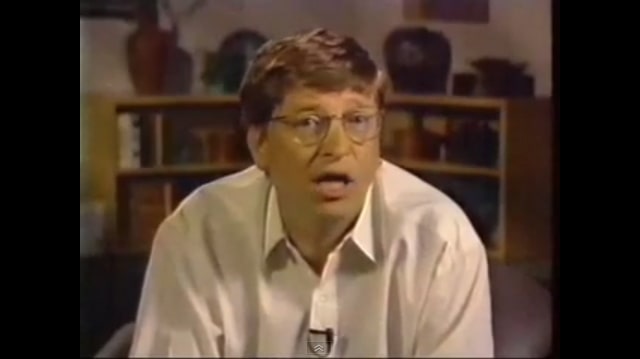
Bill Gates on the video screen at the MacWorld Expo 1997 in Boston
Many faithful Apple fans still remember with horror the moment when Steve Jobs announced the former archrival very pragmatically as the knight in shining armor at the MacWorld Expo 1997 in Boston with Bill Gates appearing on an oversized video screen just like “Big Brother.” Introducing Gates, Jobs said: “We have to let go of the notion that in order to for Apple to win, Microsoft has to lose. Relationships that are destructive don’t help anybody. The era of setting this up as a competition between Apple and Microsoft is over.”
According to certain rumors, Microsoft invested 150 million dollars in 150,000 Apple stocks and paid another 100 million dollars for copyright infringement over the past few years. At the same time, Gates obliged himself to continue the development of the Internet Explorer and Microsoft Office for the Mac for the following five years. Gates drew hisses from the audience of Apple faithful. The crowd also groaned when Steve Jobs said Apple would make Microsoft’s Internet Explorer the default browser for viewing the World Wide Web on Macintosh computers. That development was a blow to Netscape Communications Corp., which made a more popular competing browser and lost later on in the famous “browser war” against Microsoft.
In October 2015 Steve Ballmer appeared on Bloomberg TV where the former executive briefly touched on Microsoft’s monumental 1997 investment in Apple.
At the time, Microsoft’s deal with Apple not only helped rescue the company from the brink of bankruptcy, it gave Apple a much-needed lifeline, affording the company room and time to innovate. And as we all know, the deal ultimately helped set Apple up for the most astounding tech resurgence in history.
In 2010 – after a stunning comeback – Apple Inc. overtook Microsoft Corp. to become the most valuable technology company on optimism it can keep adding customers for its iPhone, Macintosh computer, and iPad. On May 26th by 4 p.m. New York time in Nasdaq Stock Market trading, Apple’s market value was at $222.1 billion, higher than Microsoft’s $219.2 billion. That made Apple the most valuable technology firm in the world.
In an interview with Kara Swisher and Walt Mossberg from the Wall Street Journal, Apple CEO Steve Jobs downplayed the significance of Apple’s passing Microsoft in market value. “For those of us who have been in the industry a long time, it’s surreal,” Jobs said. “But it doesn’t matter very much, it’s not what’s important.
“It’s not why any of our customers buy our products. So I think it’s good for us to keep that in mind.”
“They just don’t get it.” That’s how Steve Jobs described his digital rivals Microsoft and Google in an interview with his biographer Walter Isaacson.
For his biography, “Steve Jobs,” Isaacson conducted more than 40 taped interviews with the Apple co-founder and CEO – all of them done while Apple was on its ascent with one great product after another, but Jobs was on his decline, ill with a form of pancreatic cancer that would end his life at age 56.
Update:
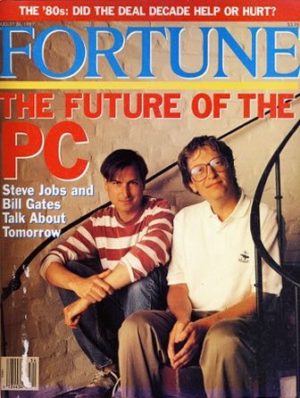
JOBS AND GATES TOGETHER The boy wonders of computing, now thirtysomething, argue over where innovation comes from and where PCs will go.
By Steven P. Jobs, William H. Gates III, Brenton R. Schlender
August 26, 1991
(FORTUNE Magazine) – The two college dropouts most responsible for unleashing the PC revolution rarely see each other anymore, though they say that they’re still friends. At FORTUNE’s invitation, Bill Gates and Steve Jobs met for a Sunday evening in late July to discuss the prospects for the tumultuous industry they shaped. Gates, 35, left Harvard in 1975 to co-found Microsoft. His big break came in 1980, when IBM asked him to provide the operating system — the program that manages a computer’s inner workings — for its now famous PC.
Jobs, 36, who left Reed College to sojourn in India, is best known for co-founding Apple Computer. He led the development of the Macintosh, a computer much easier to use than IBM’s somewhat nerdy PC. Gates has imitated many features of the Mac’s software with a popular PC program called Windows.
Since the mid-1980s the men have taken dramatically different paths. Gates, who owns more than $4 billion of Microsoft stock, remains a workaholic bachelor and an omnivorous reader — he has read several biographies of Napoleon. He has built Microsoft into the world’s largest and most profitable PC software company. It hasn’t all been rosy. Microsoft’s relationship with IBM soured this year, mainly because the two couldn’t agree on an operating- system strategy for future PCs. And the Federal Trade Commission recently began investigating Microsoft’s practices.
Jobs has been less visible but just as busy. In 1985 he started Next, aiming to build the personal computer of the 1990s. Next’s first machine appeared two years ago. Its basic software, NextStep, makes the machine unusually easy to customize; IBM was so impressed it licensed NextStep for its own computers. Despite the dazzling technology, the going has been slow at Next. For one thing, IBM never put NextStep on the market. But lately business has picked up — 10,000 systems rolled out of Next’s automated plant during the second quarter. Jobs has other reasons to smile. He and wife Laurene, who married earlier this year, are expecting their first child in September.
FORTUNE associate editor Brenton R. Schlender put the questions at the meeting. Beneath the conviviality, Jobs and Gates each had a business objective. Jobs lobbied for Gates to develop software for the Next computer. And Gates, whose company is being sued by Apple for allegedly pirating Macintosh software features, was hoping to learn more about the product’s origin.
Schlender: What did you think when the PC appeared ten years ago?
Jobs: When IBM entered the market, we did not take it seriously enough. It was a pretty heady time at Apple. We were shipping tens of thousands of machines a month — more computers than IBM was total. Even so, a lot of people think IBM invented the personal computer, which of course isn’t true.
Gates: A lot of people think Apple did, and that isn’t true either. Our first program was for the Altair ((a mail-order kit sold in 1975)).
Schlender: Does Microsoft’s control of PC operating systems stifle competition in the industry?
Gates: There’s not one element of the industry that’s not competitive. There are people who are cloning Intel’s chips; there are people who are cloning my operating system; there are many, many people who make PCs; and for every software application there are lots of people competing. There is no competitive imperfection.
Jobs: How come nobody has successfully competed with you? I’m not accusing you or Microsoft of anything. I’m not even saying it’s necessarily bad. I’m just saying it’s an interesting contrast. When I zoom back and look at this, there are hundreds of people making PCs, and hundreds of people writing applications programs for them.
Gates: Right.
Jobs: But they all have to travel through this very small orifice called Microsoft to get to one another.
Gates: It’s a very large orifice! ((Laughs.))
Jobs: But it’s only one company.
Gates: Are you saying there’s something wrong with our popularity? My approach to the PC market has been the same from the very beginning. The goal of Microsoft is to create the standard for the industry. Nothing has changed.
Schlender: What does the future hold for IBM and Apple? What do you think of their decision to collaborate on PC software?
Gates: It’s surprising to me.
Jobs: Yes, we are confused about that.
Gates: ((Apple President)) Mike Spindler has said they want to turn Apple into more of a software company. If that’s your goal, you don’t go and give the half of the company that is the future of Apple software to a joint venture. What is Apple getting in return? Here’s the part I don’t understand: What is the contribution from IBM? The IBM name? Did Apple feel so bad about their own work that they had to have that?
Jobs: I truly believe the challenge for IBM is that they can’t survive by selling the same thing you can buy from somebody else for 30% less money. Their cost structure doesn’t allow them to compete with companies that don’t do massive amounts of R&D, that don’t have twice as many employees as they need, et cetera, et cetera. So IBM has to do one of two things: One, suffer continuous erosion of its market share until eventually it goes out of business, which I hope doesn’t happen. Or two, come up with some way to add value. In my opinion the way to make your machines unique is with unique software.
Gates: I said that back in the Seventies! ((Laughs.)) There’s something else I don’t understand. If IBM already held a license to your NextStep software, why did they get all this going with Apple rather than just come to you and expand their license?
Jobs: I really want to answer this que
stion, but I’ve got to be careful what I say. It’s not my purpose to alienate anyone at IBM.
Gates: We share this interest. ((Both laugh.))
Jobs: Somebody at IBM a few years ago saw our NextStep operating system as a potential diamond to solve their biggest and most profound problem, that of adding value to their computers with unique software. Unfortunately, as I learned, IBM is not a monolith. It is a very large place with lots of faces, and they all play musical chairs. Somewhere along the line this diamond got dropped in the mud, and now it’s sitting on somebody’s desk who thinks it’s a dirt clod. Inside that dirt clod is still a diamond, but they don’t see it.
Schlender: Is the PC industry, which until now has been dominated by American companies, liable to get overrun by the Japanese?
Jobs: Computer companies fall on a spectrum of enthusiasm for manufacturing. On the left end are companies that look at manufacturing as a necessary evil, who wish they didn’t have to do it. And at the far right you have people who look at manufacturing as a competitive advantage. Clearly a lot of the Japanese companies look at themselves that way. Unfortunately a lot of American companies look at manufacturing as a necessary evil. You can say the same thing about the way they see software. My opinion is that the only two computer companies that are software-driven are Apple and Next, and I wonder about Apple. Most computer companies would rather that software didn’t even exist.
Gates: Good!
Jobs: It’s good for Microsoft today. But unfortunately all those companies could give way to Japanese companies a few years down the road.
Gates: I think you give up too easily on Americans. You pick one dimension . . .
Jobs: I focus on manufacturing because I care about it. I’ve seen IBM’s. I built Apple’s and Next’s, and I know what Sun does. Ultimately, I believe that most of the PCs will come from offshore. We’re just not good enough at manufacturing.Where will the key innovations come from? Established giants like Microsoft or upstarts like Next?
Gates: I contend technology breakthroughs can happen by extending what we already have. Let’s take handwriting computers. The hardware is coming from PC-compatible makers like Dell Computer ((of Austin, Texas)) and NCR and some Japanese companies. The software will come either from Microsoft or from a U.S. competitor named Go Corp. ((of Foster City, California)). That’s going to be a major breakthrough, and who do you give credit to?
Jobs: I think everybody gives credit to Go, but Go will be crushed.
Gates: That’s one of the nastiest comments I’ve ever heard. I’ve been working on handwriting since long before there ever was a Go Corp.
Jobs: Really? I didn’t know that. Most people would say that Go is the company that first tried to commercialize that technology.,
Gates: Well, Go hasn’t shipped anything yet, and I’ll ship my stuff before they ship theirs.
Jobs: My experience has been that creating a compelling new technology is so much harder than you think it will be that you’re almost dead when you get to the other shore. That’s why, when you take big leaps, like the Mac, or object- oriented programming, or handwriting recognition, you have to leave old technology behind. When Lindbergh was going to fly from New York to Paris, he had to decide what to take with him. There were a lot of demands. They fell into two categories — things that would make his journey safer or more comfortable, and things that would increase his chances of making it to Paris. Weight was a real problem. He could take more gas, which would increase his safety, or he could take a compass, which would increase his chances of getting to Paris. Every time he came down on the side of increasing his chances of getting to Paris at the sacrifice of safety or comfort. That’s why he made it.
Gates: Smart people like Steve ought to try to build things from scratch. That’s a worthy thing. But every time it should be a test. Right now there’s a test in handwriting PCs, in object-oriented operating systems, in multimedia computers. Those are the big questions for personal computing in the 1990s, and I’m the one who has to prove the validity of the evolutionary approach.
Jobs: It’s true, your evolutionary approach with Windows is bringing to PCs great new technologies that Apple and others pioneered. But in the meantime — and it’s been seven years since the Macintosh was introduced — I still think that tens of millions of PC owners needlessly use a computer that is far less good than it should be.
The only problem with Microsoft is they just have no taste, they have absolutely no taste, and what that means is – I don’t mean that in a small way I mean that in a big way. In the sense that they they don’t think of original ideas and they don’t bring much culture into their product ehm and you say why is that important – well you know proportionally spaced fonts come from type setting and beautiful books, that’s where one gets the idea – if it weren’t for the Mac they would never have that in their products and ehm so I guess I am saddened, not by Microsoft’s success – I have no problem with their success, they’ve earned their success for the most part. I have a problem with the fact that they just make really third rate products.
Steve Ballmer
I will admit quite frankly that I think Windows today is probably four years behind, three years behind where it would have been had we not danced with IBM for so long. Because the amount of split energy, split works, split IQ in the company really cost our end customer real innovation in our product line and so whenever I hear these criticisms which I gotta to say sting eh sometimes, I say to myself just you watch, just you watch Windows 95, Windows 9…there’s no lack of focus there hasn’t been here for the last three or four years since we didn’t have this big spot with IBM. Even in the operating systems here now, you’ll start to see clear, clear…and people will recognise clear leadership.
We have to let go of this notion that for Apple to win Microsoft has to lose.
On July 9, 1997, Gil Amelio was ousted as CEO of Apple by the board of directors after overseeing a 12 year record low stock price and crippling financial losses. Jobs stepped in as the interim CEO to begin a critical restructuring of the company’s product line. He would eventually become CEO and is serving in that position to the present day.
At the 1997 Macworld Expo, Steve Jobs announced that Apple would be entering into partnership with Microsoft. Included in this was a five-year commitment from Microsoft to release Microsoft Office for Macintosh as well a US$150 million investment in Apple. It was also announced that Internet Explorer would be shipped as the default browser on the Macintosh. Microsoft chairman Bill Gates appeared at the expo on-screen, further explaining Microsoft’s plans for the software they were developing for Mac, and stating that he was very excited to be helping Apple return to success.
https://www.youtube.com/watch?v=PEHNrqPkefI
Transcript Macworld Expo, Boston, August-06-1997
Steve Jobs:
Now I’d like to talk about meaningful partners. Apple lives in an ecosystem, and it needs help from other partners. It needs to help other partners. And relationships that are destructive don’t help anybody in this industry as it is today. So during the last several weeks, we have looked at some of the relationships, and one has stood out as a relationship that hasn’t been going so well but had the potential, I think, to be great for both companies. And I’d like to announce one of our first partnerships today, a very, very meaningful one. And that is one with Microsoft. [Mix of applause and boos.]
I’d like to take you through this. The discussions actually began because there were some patent disputes. And, rather than … [Laughter.]
I know. Rather than repeating history, I’m extremely proud of both companies that they have resolved these differences in a very, very professional way. And this has led, I think, to an overall relationship that we’re announcing today that has got several parts to it, and we’re extremely excited about.
First part of it is a patent settlement and cross-license. The two companies have received a full cross-license for all patents that exist and for patents that are filed within the next five years. It has been a very serious patent settlement. The second part of this is, Microsoft is committing to release Microsoft Office on Macintosh for the next five years. They are going to release the same number of major releases as they release on Windows during that time. Their first release, they’re going to target to have it out near the end of the year, it might slip a few months into next year, but they’re working real hard on it, and it looks very, very good.
Next, we have taken a look at browsers out there and Apple has decided to make Internet Explorer its default browser on the Macintosh. [Audience boos.] Since we believe in choice, we’re going to be shipping other Internet browsers, as well, on the Macintosh, and the user can, of course, change their default should they choose to. [Applause]
But we believe that Internet Explorer is a really good browser, and we think it’s going to make a fine default browser. Java. We are going to be collaborating with Microsoft on Java to ensure that we can get the best from each other and ensure that there’s compatibility between our virtual machines. We think that will serve everybody’s interests. And lastly, Microsoft is making an investment in Apple. Microsoft is buying $150 million worth of Apple stock at market price. It is non-voting shares. [Cheers]
And they’ve agreed not to sell them for at least three years. So what this means is that Microsoft is going to be part of the game with us as we restore this company back to health, have a vested interest in that stock price going up. We’re going to be working together on Microsoft Office, on Internet Explorer, on Java. And I think that it’s going to lead to a very healthy relationship. So it’s a package announcement today. We’re very, very happy about it. We’re very, very excited about it. And I happen to have a special guest with me today via satellite downlink. And if we could get him up on the stage right now …
[Gates appears on screen. Mix of applause and boos.]
Bill Gates:
Some of the most exciting work that I’ve done in my career has been the work that I’ve done with Steve on the Macintosh. Whether it’s the first introduction or doing products like Mac Excel, these have been major milestones, and it’s very exciting to renew our commitment to the Macintosh. We have over 8 million customers using Microsoft software on the Macintosh. We make it very easy for people who use Macintosh to take their, their documents and work with all kinds of machines. We’re very excited about the new release we’re building. This is called Mac Office 98. We do expect to get it out by the end of this year. And we’ve got some, some real exciting features. It’s a product that’s going to require no setup. It’s going to be an easy transition from people in the past. And I think it’s going to really set a new benchmark for doing a good job with performance, and exploiting unique Mac features. In many ways it’s more advanced than what we’ve done on the Windows platform. [Applause.]
We’re also excited about Internet Explorer. And we’ve got a very dedicated team that’s down in California that works on that product. And the code is really specially developed for the Macintosh. It’s not just a port of what we’ve done in the Windows environment. [Applause.] And so we’re pleased to be supporting Apple. We think Apple makes a huge contribution to the computer industry. We think it’s going to be a lot of fun helping out, and we look forward to the feedback from all of you as we move forward doing more Macintosh software. Thanks. [Applause]
Steve Jobs:
Thank you, Bill. You know, where we are right now, is we’re shepherding some of the greatest assets in the computer industry. And if we want to move forward, and see Apple healthy and prospering again, we have to let go of a few things here. We have to let go of this notion that for Apple to win Microsoft has to lose. [Applause.] We have to embrace a notion that for Apple to win, Apple has to do a really good job. And if others are going to help us, that’s great, because we need all the help we can get. And if we screw up and we don’t do a good job, it’s not somebody else’s fault. It’s our fault. So I think that’s a very important perspective. I think if we want Microsoft Office on the Mac, we better treat the company that puts it out with a little bit of gratitude. We’d like their software. So the era of setting this up as a competition between Apple and Microsoft is over as far as I’m concerned. This is about getting Apple healthy, and this is about Apple being able to make incredibly great contributions to the industry, to get healthy and prosper again. The last perspective I’d like to leave with you on this is sometimes points of view can really make you look at things differently. Like for me, when I was looking at the statistics and it hit me that Apple is the largest education company in the world, that was like a bolt of lightning. That’s huge. What an incredible base to build off of. Another bolt of lightning is that Apple plus Microsoft equals 100 percent of the desktop computer market. And so, whatever Apple and Microsoft agree to do, it’s a standard. And I think that you’ll see us work with Microsoft more because they’re the only other player in the desktop industry and I think that you’ll want to see Microsoft work with Apple more because Apple is the only other player in the desktop industry. So I hope we have even more cooperation in the future because the industry wants it.
Lastly, I want to just talk a little about Apple and the brand and what it means, I think, to a lot of us. You know, I think you always had to be a little different to buy an Apple computer. When we shipped the Apple II, you had to think different about computers. Computers were these things you saw in movies, they occupied giant rooms. They weren’t these things you had on your desktop. You had to think differently because there wasn’t any software at the beginning. You had to think differently when a first computer arrived at a school where there had never been one before and it was an Apple II. I think you had to think really differently when you bought a Mac. It was a totally different computer, worked in a totally different way, used a totally different part of your brain. And it opened up a computer world for a lot of people who thought differently. You were buying a computer with an installed base of one. You had to think differently to do that. And I think you still have to think differently to buy an Apple computer. And I think the people that do buy them do think differently and they are the creative spirits in this world. They are the people that are not just out to get a job done, they are out to change the world. And they’re out to change the world using whatever great tools they can get. And we make tools for those kinds of people. So hopefully what you’ve seen here today are some beginning steps that give you some confidence that we, too, are going to think differently, and serve the people that have been buying our products since the beginning. Because a lot of times people think that they’re crazy. But in that craziness, we see genius, and those are the people we’re making tools for. Thank you very much.
Steve Jobs realized later that the image of Gates looming over him and the audience was a mistake. “I wanted him to come to Boston,” Jobs told Walter Isaacson, author of the biography “Steve Jobs”. “That was my worst and stupidest staging event ever. It was bad because it made me look small, and Apple look small, and if everything was in Bill’s hands.” Gates was also embarrassed when he saw the videotape of the event. “I didn’t know that my face was going to be blown up to looming proportions,” he said.