The most famous Super Bowl ad –
The Hammer That Shattered the Monolith: How 60 Seconds Defined the Apple Mythos
It is January 22, 1984. Inside Tampa Stadium, Super Bowl XVIII is in full swing. The Los Angeles Raiders are systematically dismantling the Washington Redskins. But during a break in the third quarter, the game becomes a footnote. For 60 seconds, nearly 100 million Americans are pulled away from the grass and grit into a dystopian nightmare—and then shown a glimpse of a digital revolution.
This wasn’t just a commercial. It was a cinematic manifesto directed by Ridley Scott, a man who had just finished reshaping science fiction with Blade Runner.
The Aesthetic of the Abyss
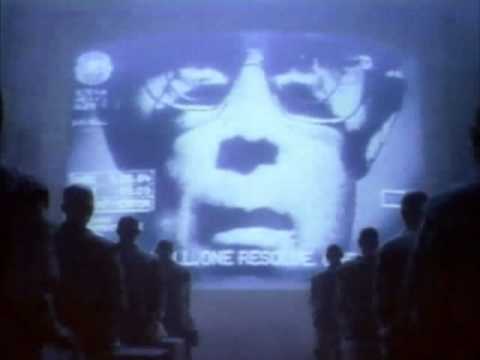
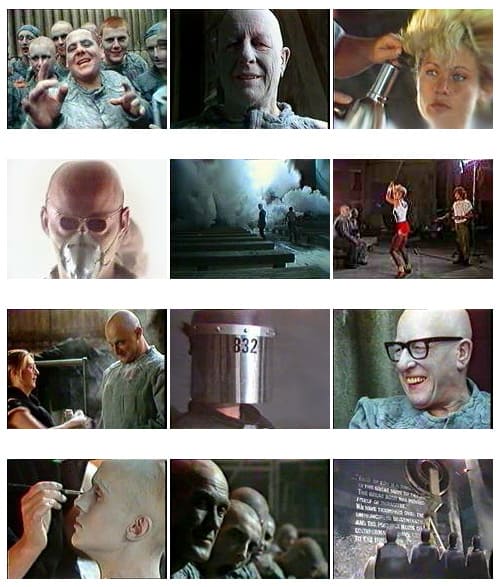
The spot opens on a monochrome, ash-colored world. Rows of hollow-eyed men, their heads shaved and spirits broken, march in lockstep through industrial corridors. They gather in a cold hall before a towering screen where a bespectacled “Big Brother”—a thinly veiled avatar for the then-dominant IBM—drones on about the “unification of thoughts.”
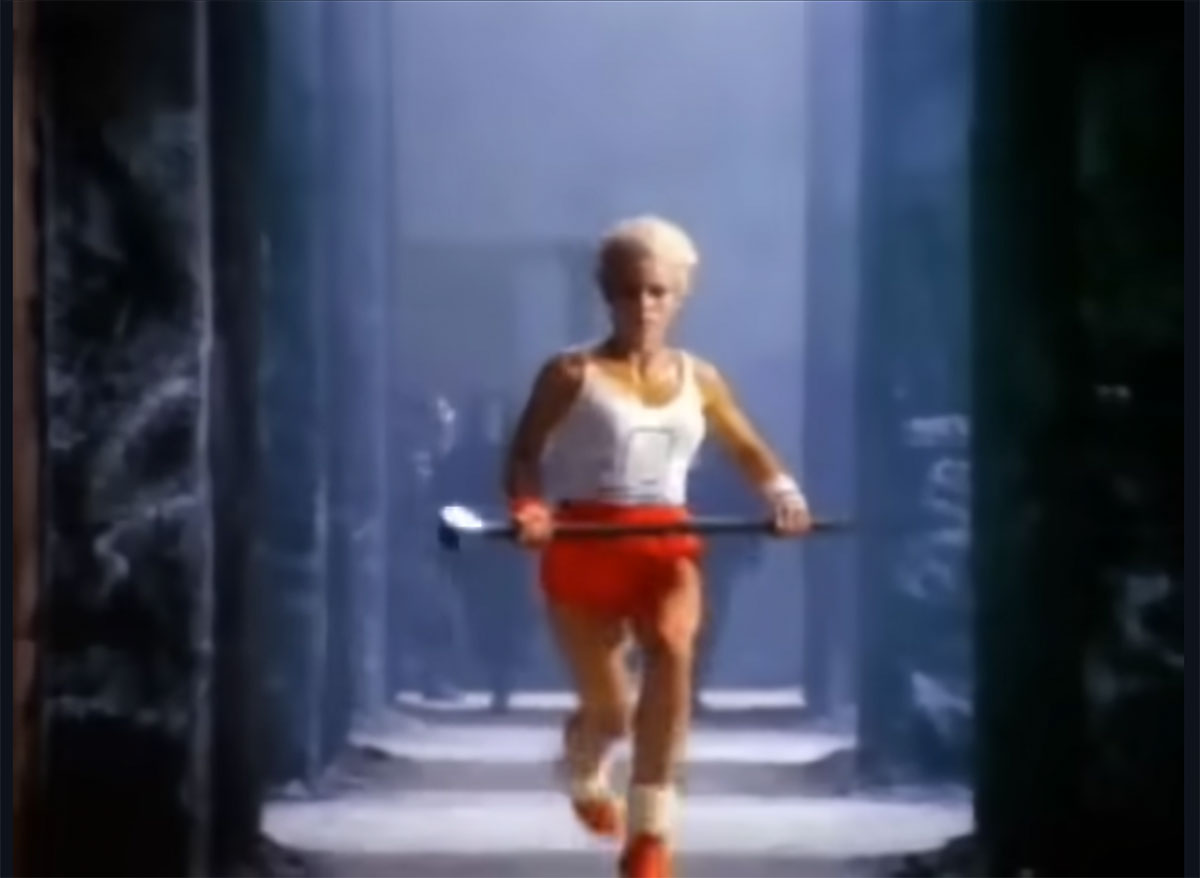
Then, a flash of color breaks the gray. A young woman (played by British athlete Anya Major) sprints toward the screen, pursued by riot police. She wears bright orange shorts and a white tank top emblazoned with a line drawing of a computer. In her hands, she swings a heavy sledgehammer with the grace of an Olympian. As she releases the hammer, it sails through the air and crashes directly into the face of the tyrant.
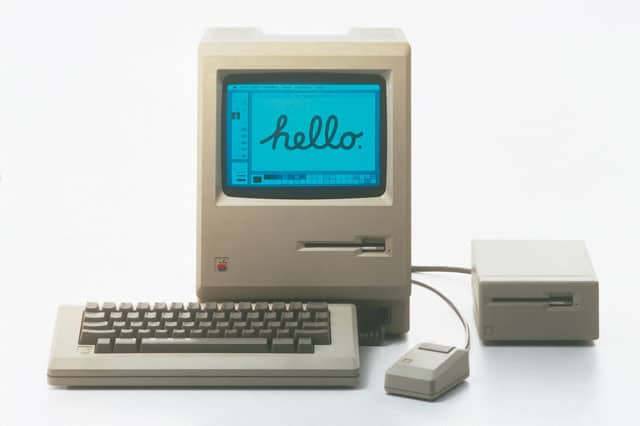
The screen explodes in a blinding white light. A voiceover—and a simple scroll of text—delivers the finishing blow: “On January 24th, Apple Computer will introduce Macintosh. And you’ll see why 1984 won’t be like ‘1984’.”
Corporate Cold Feet: The Board vs. The Visionaries
Today, the “1984” ad is heralded as the greatest commercial of all time. Yet, it almost never aired.
The backstory is a corporate thriller. The agency Chiat/Day had crafted the concept, and Steve Jobs was immediately electrified by it. He wanted a “thunderclap.” However, when the finished film was screened for Apple’s board of directors in December 1983, the reaction was icy silence.
Mike Markkula, Apple’s chairman and major investor, was horrified. “This is the worst ad I’ve ever seen. Who wants to fire the agency?” he reportedly asked. The board ordered CEO John Sculley to sell back the expensive Super Bowl airtime they had already purchased.
Wozniak’s Act of Rebellion
Steve Jobs, refusing to see his masterpiece buried, showed the spot to co-founder Steve Wozniak. “Woz” was so blown away that he offered to pay for half of the airtime out of his own pocket if the board refused to budge. “If Apple won’t run it, I’ll pay $400,000 and you pay $400,000,” Wozniak told Jobs.
In the end, it was a mix of chutzpah and luck: Chiat/Day claimed they couldn’t find a buyer for the 60-second slot in time. With the slot already paid for and no one to take it, Apple was forced to run the ad.
Skinheads and Discus Throws: The Making of a Legend
Ridley Scott’s production was grueling and authentic. Filmed at Shepperton Studios in London, Scott didn’t hire standard extras. To achieve the look of a true oppressed proletariat, he hired actual London skinheads for a pittance and the promise of a free lunch. The atmosphere on set was reportedly tense, with the extras’ rowdy behavior adding a layer of genuine grit to the film.
The choice of Anya Major for the lead role was a stroke of casting genius. Many models had auditioned, but most couldn’t even swing the hammer while running. Major was an experienced discus thrower; she had the muscle memory and the athletic form to hurl the sledgehammer with deadly precision.
The Legacy: When Advertising Became Art
The impact the next morning was unprecedented. News stations didn’t just talk about the ad; they replayed it in its entirety during their broadcasts. Apple generated over $5 million in free publicity. Overnight, the Macintosh became more than a piece of hardware; it became a symbol of individuality and freedom.
“1984” marked the moment advertising stopped merely explaining products and started creating myths. It was the birth of Apple as a lifestyle brand and Steve Jobs as the high priest of the digital counter-culture.
There is a modern irony to the story: today, critics often point at Apple’s massive market cap and closed ecosystem, suggesting the company has become the very “Big Brother” it once vowed to destroy. Regardless of the politics, the 60-second storm Ridley Scott and Steve Jobs unleashed remains a masterclass in storytelling—a hammer throw that changed the cultural trajectory of technology forever.
The commercial was rebroadcast in an updated version in 2004 on its 20th anniversary, with the heroine modified to be listening to an iPod. Viewers generally saw the Big Brother target of the Apple advertisement as being Microsoft, with the original villain, IBM, being all but forgotten.
Apple commercial “1984”: The Plot
The commercial opens with a dystopic, industrial setting in blue and gray tones, showing a line of people (of ambiguous gender) marching in unison through a long tunnel monitored by a string of telescreens. This is in sharp contrast to the full-color shots of the nameless runner (Anya Major). She looks like an Olympic track and field athlete, as she is carrying a large brass-headed hammer and is wearing an athletic “uniform” (bright orange athletic shorts, running shoes, a white tank top with a cubist picture of Apple’s Macintosh computer, a white sweat band on her left wrist, and a red one on her right).
As she is chased by four police officers (presumably agents of the Thought Police) wearing black uniforms, protected by riot gear, helmets with visors covering their faces, and armed with large night sticks, she races towards a large screen with the image of a Big Brother-like figure (David Graham, also seen on the telescreens earlier) giving a speech:
My friends, each of you is a single cell in the great body of the State. And today, that great body has purged itself of parasites. We have triumphed over the unprincipled dissemination of facts. The thugs and wreckers have been cast out. And the poisonous weeds of disinformation have been consigned to the dustbin of history. Let each and every cell rejoice! For today we celebrate the first, glorious anniversary of the Information Purification Directive! We have created, for the first time in all history, a garden of pure ideology. Where each worker may bloom secure from the pests purveying contradictory truths. Our Unification of Thoughts is more powerful a weapon than any fleet or army on earth. We are one people, with one will, one resolve, one cause. Our enemies shall talk themselves to death and we will bury them with their own confusion. We shall prevail!
The runner, now close to the screen, hurls the hammer towards it, right at the moment Big Brother announces, “we shall prevail!” In a flurry of light and smoke, the screen is destroyed, shocking the people watching the screen.
The commercial concludes with a portentous voiceover, accompanied by scrolling black text (in Apple’s early signature “Garamond” font); the hazy, whitish-blue aftermath of the cataclysmic event serves as the background. It reads:
On January 24th, Apple Computer will introduce Macintosh. And you’ll see why 1984 won’t be like “1984.
The screen fades to black as the voiceover ends, and the rainbow Apple logo appears.
Apple commercial “1984”: The Production
Development
The commercial was created by the advertising agency Chiat/Day, Venice, with copy by Steve Hayden, art direction by Brent Thomas and creative direction by Lee Clow. Ridley Scott (whose dystopian sci-fi film, Blade Runner was released two years prior) was hired by agency producer Richard O’Neill to direct it, with a then-“unheard-of production budget of $900,000.” The actors who appeared in the commercial were paid $25 per day.
Steve Jobs and John Sculley were so enthusiastic about the final product that they “…purchased one and a half minutes of ad time for the Super Bowl, annually the most-watched television program in America. In December 1983 they screened the commercial for the Apple Board of Directors. To Jobs’ and Sculley’s surprise, the entire board hated the commercial.” However, Scully himself got “cold feet” and asked Chiat/Day to sell off the two commercial spots.
Despite the board’s dislike of the film, Steve Jobs continued to support it. Steve Wozniak watched it and offered to pay for half of the spot personally if the board refused to air it.
Of the original ninety seconds booked, Chiat/Day managed to resell thirty seconds to another advertiser, leaving the other sixty second slot.
Intended message
Adelia Cellini states in a 2004 article for MacWorld, “The Story Behind Apple’s ‘1984’ TV Commercial“:
Let’s see – an all-powerful entity blathering on about Unification of Thoughts to an army of soulless drones, only to be brought down by a plucky, Apple-esque underdog. So Big Brother, the villain from Apple’s ‘1984’ Mac ad, represented IBM, right? According to the ad’s creators, that’s not exactly the case. The original concept was to show the fight for the control of computer technology as a struggle of the few against the many, says TBWA/Chiat/Day’s Lee Clow. Apple wanted the Mac to symbolize the idea of empowerment, with the ad showcasing the Mac as a tool for combating conformity and asserting originality. What better way to do that than have a striking blonde athlete take a sledghammer to the face of that ultimate symbol of conformity, Big Brother?
However, in his 1983 Apple keynote address, Steve Jobs made the following comment before showcasing a preview of the commercial to a select audience:
It is now 1984. It appears IBM wants it all. Apple is perceived to be the only hope to offer IBM a run for its money. Dealers initially welcoming IBM with open arms now fear an IBM dominated and controlled future. They are increasing and desperately turning back to Apple as the only force that can ensure their future freedom. IBM wants it all and is aiming its guns on its last obstacle to industry control, Apple. Will Big Blue dominate the entire computer industry? The entire information age? Was George Orwell right about 1984?
Apple commercial “1984”: The Reception
Awards
* 2007: Best Super Bowl Spot (in the game’s 40-year history)
* 1999: TV Guide – Number One Greatest Commercial of All Time
* 1995: Advertising Age – Greatest Commercial
* 1984: 31st Cannes Lions International Advertising Festival – Grand Prix
Social impact
Ted Friedman, in his 2005 text, Electric Dreams: Computers in American Culture, notes the impact of the commercial:
Super Bowl viewers were overwhelmed by the startling ad. The ad garnered millions of dollars worth of free publicity, as news programs rebroadcast it that night. It was quickly hailed by many in the advertising industry as a masterwork. Advertising Age named it the 1980s Commercial of the Decade, and it continues to rank high on lists of the most influential commercials of all time […] 1984 was never broadcast again, adding to its mystique.
1984 became a signature representation of Apple computers. It was scripted as a thematic element in the 1999 docudrama, Pirates of Silicon Valley, which explores the rise of Apple and Microsoft (the film opens and closes with references to the commercial including a re-enactment of the heroine running towards the screen of Big Brother and clips of the original commercial).
“1984” became a signature representation of Apple computers. It was scripted as a thematic element in the 1999 docudrama, Pirates of Silicon Valley, which explores the rise of Apple and Microsoft (the film opens and closes with references to the commercial including a re-enactment of the heroine running towards the screen of Big Brother and clips of the original commercial). The “1984” ad was also prominent in the 20th anniversary celebration of the Macintosh in 2004, as Apple reposted a new version of the ad on its website. In this updated version, an iPod, complete with signature white earbuds, was digitally added to the heroine. Attendees were given a poster showing the heroine with iPod as a commemorative gift.
Influence in media
A commercial for the video game Half-Life 2 was based on this commercial. A parody of the commercial is seen in the Futurama episode Future Stock, promoting Planet Express. Another parody appears in The Simpsons TV show episode Mypods and Boomsticks, featuring Steve Jobs as “Big Brother” and the Comic Book Guy as the runner.

For the 20th anniversary of the Macintosh, Apple re-released the ad with the runner wearing an iPod.

Further reading
- Cellini, Adelia. “The story behind Apple’s ‘1984’ TV commercial: Big Brother at 20.(Mac Beat).” Macworld, January, 2004.
- Clow, Lee. Lee Clow: His Masterpiece – 1984
- Friedman, Ted “Chapter Five: Apple’s 1984.” Electric Dreams: Computers in American Culture. New York: NYU Press, 2005: 100-120.
- —.Apple’s 1984: The Introduction of the Macintosh in the Cultural History of Personal Computers
- Hansen, Liane. “A Look Back at Apple’s Super Ad: Landmark 1984 Spot Smashed ‘Big Brother,’ Launched the Mac.” NPR, February 1, 2004. (Steve Hayden interview)
- Leopold, Todd. Why 2006 isn’t like ‘1984’. CNN, February 3, 2006.
- Maney, Kevin. “Apple’s ‘1984’ Super Bowl commercial still stands as watershed event.” USA Today, January 28, 2004.
- Mr. Showbiz. “Interview with Ridley Scott
- myoldmac.net. “In Memory of Jef Raskin … He Thought Different: The Making of 1984.”
- Moriarty, Sandra. “AN INTERPRETIVE STUDY OF VISUAL CUES IN ADVERTISING,” University of Colorado.
- Roszak, Theodore. “Raging Against the Machine: In its ‘1984’ Commercial, Apple Suggested that its Computers Would Smash Big Brother. But Technology Gave Him More Control.” Los Angeles Times, January 28, 2004.
- Scott, Linda. “For the Rest of Us”: A Reader-Oriented Interpretation of Apple’s ‘1984’ Commercial.” The Journal of Popular Culture, Volume 25 Issue 1, Summer 1991: 67-81.
Source:
1984 (advertisement). (2012, May 13). In Wikipedia, The Free Encyclopedia. Retrieved 12:12, June 2, 2012, from http://en.wikipedia.org/w/index.php?title=1984_(advertisement)&oldid=492407781
A Look Back at Apple’s Super Ad : NPR.
This article is licenced under the GNU Free Documentation License