Tag Archives: Jef Raskin

How Jef Raskin started the Macintosh project

It All Began with “Annie” – The Vision of a Computer for the Masses
(Updated: May 2018)

It had been a long way until the day of the official introduction of the Macintosh on January 24th, 1984. Five years earlier, in spring 1979, Apple chairman Mike Markkula wondered whether his company should bring a 500 dollar computer to market. Markkula then charged Jef Raskin with the secret “Annie” project.

Raskin was a “philosophical guy who could be both playful and ponderous”, writes Walter Isaacson in his book “Steve Jobs”. Raskin had studied computer science, taught music and visual arts, conducted a chamber opera company, and organized guerrilla theater. His 1967 doctoral thesis at U.C. San Diego argued that computers should have graphical rather than text-based interfaces.

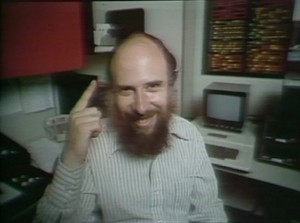
Jef Raskin

Jef Raskin

Raskin had been responsible for Apple’s publications, particularly manuals, and actually was to more intensely oversee the developers writing the applications for the Apple II. “I told him [Markkula] it was a fine project, but I wasn’t terribly interested in a 500-dollar game machine,” Raskin later remembered. “However, there was this thing that I’d been dreaming about – it was [that] it would be designed from a human factors perspective, which at that time was totally incomprehensible.”

In fall 1979, Raskin wrote his article “Computers by the Millions“, in which he drafted his version of a computer for the masses. Markkula insisted on the report to be treated as a confidential internal report. The essay was not published until 1982 in the SIGPC Newsletter, Vol. 5, No. 2.

Raskin had chosen a completely new approach, because until then, the “technically feasible” is what defined a computer’s design. The academic computer scientist, who had kept secret his diploma from the Apple founders at the time of his appointment (as Steve Wozniak and Steve Jobs approached academics extremely distrustfully), wanted to design a computer for the normal person in the street – which of course could not to be unattainable.

The expression of the “Person in the Street” formed by Raskin became a dictum at Apple – abbreviated as PITS. Raskin’s first draft envisioned a closed computer including monitor, keyboard and printer able to work without any external wires – and all that for 500 dollars. In return, the Macintosh should only be equipped with a tiny five inch display, a cheap CPU (6809) and a main memory calculated extremely tight at 64 kilobytes.

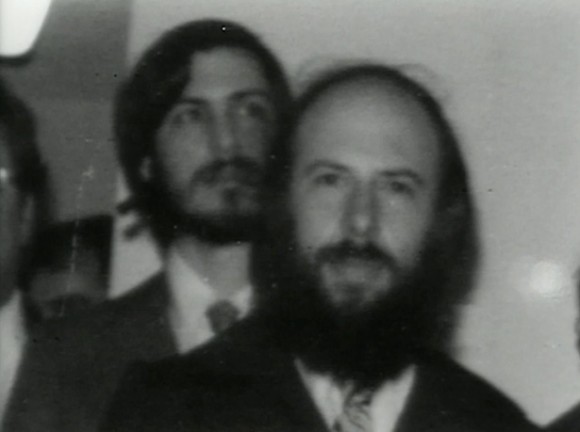
Steve Jobs and Jef Raskin

At that time, Steve Jobs had not taken particular interest in the Macintosh project – and due to some dim apprehension, Raskin tried everything to exclude the Apple co-founder. Yet in the summer of 1980, a serious conflict between Jobs and Apple’s president Mike Scott was brewing as Scott intended to edge Jobs out of the concrete development of the new Lisa. With his capricious and at times fairly aggressive management style, Jobs had snubbed many developers. In addition, Scott did not think him capable of a major management role and thus planned to assign him the less important role of a company spokesman and promoter in advance of Apple’s initial public offering on December 12th, 1980.

So, Jobs left the Lisa project – and looked at Jef Raskin’s baby. The Apple co-founder liked the concept of a cheap machine for the mass market, but he didn’t like Raskin’s design. “Jobs was enthralled by Raskin’s vision, but not by his willingness to make compromises to keep down the cost,” writes Isaacson. At one point in the fall of 1979 Jobs told him instead to focus on building what he repeatedly called an “insanely great” product. “Don’t worry about price, just specify the computer’s abilities,” Jobs told him. Raskin responded with a sarcastic memo. It spelled out everything you would want in the proposed computer: a high-resolution color display, a printer that worked without a ribbon and could produce graphics in color at a page per second, unlimited access to the ARPA net, and the capability to recognize speech and synthesize music, “even simulate Caruso singing with the Mormon tabernacle choir, with variable reverberation.” The memo concluded, “Starting with the abilities desired is nonsense. We must start both with a price goal, and a set of abilities, and keep an eye on today’s and the immediate future’s technology.” In other words, Raskin had little patience for Jobs’ belief that you could distort reality if you had enough passion for your product.

Jobs wanted to switch to the more powerful Motorola 68000 CPU. Raskin demanded a cheaper processor, and lost again. He had to brood and recalculate the cost of the Mac. The disagreements were more than just technical or philosophical; they became clashes of personality. “I think that he likes people to jump when he says jump,” Raskin once said. “I felt that he was untrustworthy, and that he does not take kindly to being found wanting. He doesn’t seem to like people who see him without a halo.” Jobs was equally dismissive of Raskin. “Jef was really pompous,” he said Isaacson. “He didn’t know much about interfaces. So, I decided to nab some of his people who were really good, like Atkinson, bring in some of my own, take the thing over and build a less expensive Lisa, not some piece of junk.”

Jobs asserted his control of the Macintosh group by canceling a brown-bag lunch seminar that Raskin was scheduled to give to the whole company in February 1981. Raskin happened to go by the room anyway and discovered that there were a hundred people there waiting to hear him; Jobs had not bothered to notify anyone else about his cancellation order. So Raskin went ahead and gave a talk, writes Isaacson.

That incident led Raskin to write a blistering memo to Mike Scott, who once again found himself in the difficult position of being a president trying to manage a company’s temperamental cofounder and major stockholder. It was titled “Working for/with Steve Jobs,” and in it Raskin asserted:

He is a dreadful manager… I have always liked Steve, but I have found it impossible to work for him… Jobs regularly misses appointments. This is so well-known as to be almost a running joke… He acts without thinking and with bad judgment… He does not give credit where due… Very often, when told of a new idea, he will immediately attack it and say that it is worthless or even stupid and tell you that it was a waste of time to work on it. This alone is bad management, but if the idea is a good one he will soon be telling people about it as though it was his own.

That afternoon Scott called in Jobs and Raskin for a showdown in front of Markkula. After a short dog fight Raskin was told to take a leave of absence. “They wanted to humor me and give me something to do, which was fine,” Jobs said Isaacson. “It was like going back to the garage for me. I had my own ragtag team and I was in control.”
It is somehow ironic that Jef Raskin was the person who convinced Steve Jobs to visit the Xerox Palo Alto Research Center (PARC). The scientists over there pioneered the concept of a graphical user interface (GUI). Bitmapping and graphical interfaces became features of Xerox PARC’s prototype computers, such as the Alto, and its object-oriented programming language, Smalltalk. Jef Raskin decided that these features were the future of computing. So, he began urging Jobs and other Apple colleagues to go check out Xerox PARC. Jobs first refused on the grounds that a large corporation couldn’t possibly be doing anything interesting. But in the end Jobs went to Xerox PARC in December 1979 – and was enlightened.

The rest of the story is well known. For Jobs it was a turning-point. Jobs decided that this was the way forward for Apple.

They showed me really three things. But I was so blinded by the first one I didn’t even really see the other two. One of the things they showed me was object orienting programming they showed me that but I didn’t even see that. The other one they showed me was a networked computer system…they had over a hundred Alto computers all networked using email etc., etc., I didn’t even see that. I was so blinded by the first thing they showed me which was the graphical user interface. I thought it was the best thing I’d ever seen in my life. Now remember it was very flawed, what we saw was incomplete, they’d done a bunch of things wrong. But we didn’t know that at the time but still though they had the germ of the idea was there and they’d done it very well and within you know ten minutes it was obvious to me that all computers would work like this some day.
Steve Jobs in “Thriumph of the Nerds”.


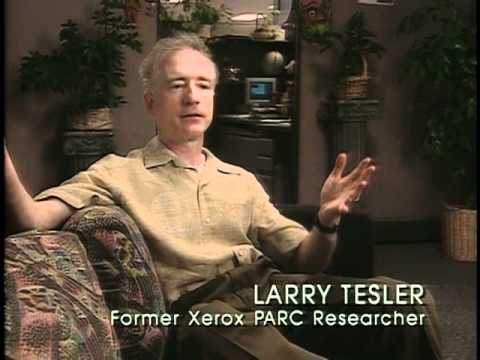
Larry Tesler, at this time a scientist at Xerox PARC, once said: “After an hour looking at demos they understood our technology, and what it meant more than any Xerox executive understood after years of showing it to them.” Jobs tried everything to improve the GUI he had seen at PARC for the new Apple Macintosh.

Andy Hertzfeld, one of the leading Software engineers in the Macintosh project, disputes the view, Jef Raskin was the father of the Apple Macintosh. In an interview with CNET Andy called Steve Jobs “The father of the Macintosh”:

Question: How about Jef Raskin?

Answer: Jef Raskin is the single individual who disagrees with the way I’m telling the story, and he was unhappy with the book (How The Mac Was Made) when he first found out about it, and I suspect he’s still unhappy now.

Jef does claim he invented certain key concepts when no one else thinks he did. Jef actually was not around for almost the entire time the Mac was developed. He left the day before I started (in 1981). Jef’s a tremendous individual and he deserves enormous credit for having the original vision for the Macintosh, starting the project and putting together a dynamite, small team. But then he got at odds with the team and left.

Jef had a lot of ideas about how the Macintosh should be, but they’re not in the Macintosh. If you’re interested: Jef, because he left early, by 1985 he had already designed and licensed a computer that does embody all his ideas–it’s called the Canon Cat.

Question: Then who would you consider the father of the Macintosh?
Answer: Steve Jobs is who I would call the father of the Mac. In second place I’d put Burrell Smith and in third place I’d put Bill Atkinson.

In 1982, Jef Raskin founded the company Information Appliance, Inc. in order to realize his original concept of the Macintosh project. The company brought the “SwyftCard” to market, which is a firmware card for the Apple II. The card featured a program package which was also offered on disk as SwyftWare. With the Swyft, Information Appliance later offered a laptop computer, which, however, experienced only moderate commercial success. Raskin licensed the Swyft design to Canon, which constructed the “Canon CAT” on its basis in 1987.
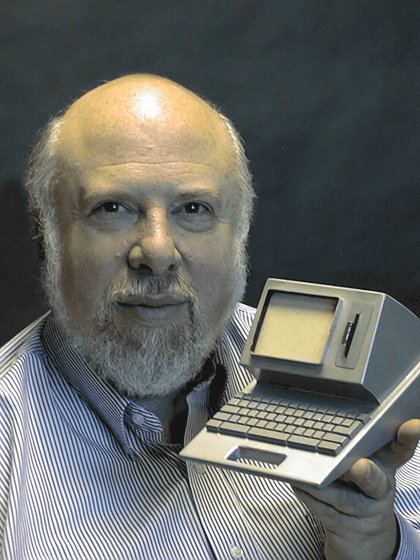
Despite the broad attention the Canon’s innovative interface attracted, this product did not achieve a breakthrough either. Canon stopped selling the CAT in 1988 – “after a brief and expensive “image” advertising campaign “that did not explain the product’s advantages in any way (Jef Raskin in an email to the “Amercian Scientist” in 1997. “A bitmapped, 68000-based machine, it was equal to the Macintosh of the time in power and screen resolution. The CAT had net-ready and BBS communications build in. In a disastrous miscalculation, Canon did not allow the product’s graphics capabilities to be advertised or mentioned in the manual because the daisy-wheel printer they wanted to sell with it couldn’t reproduce the graphics or offer a change of font on the fly.”

Raskin also blamed Steve Jobs for the failure, since it was Jobs who as the head of NeXT Computer persuaded Canon into giving up the Cat project. However, it was claimed that Cat also fell victim to internal rivalries at Canon.

In his book “The Humane Interface”, Raskin later described his vision of a computer interface constructed for the human being and oriented to human needs – rather than to technology.

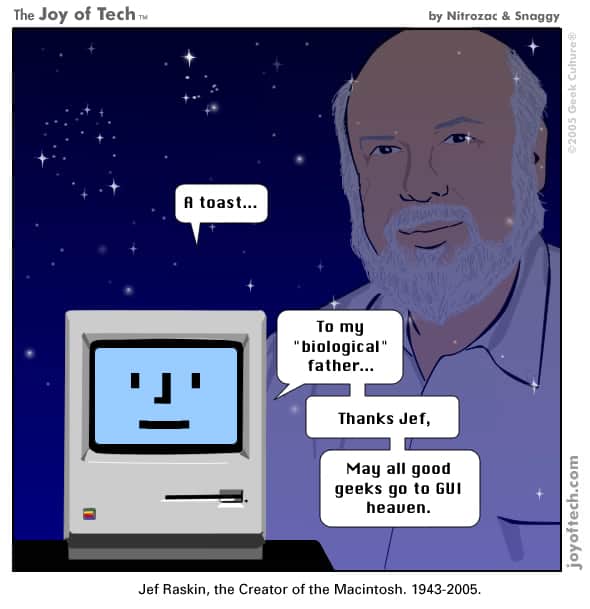
On February 26th, 2005, Jef Raskin died at the age of 61 years.
Did Steve Jobs steal everything from Xerox PARC?

Rich Neighbor with Open Doors

Screenshot of the movie “Pirates of Silicon Valley”

It is claimed again and again that in the course of the Macintosh’s development, Apple just resorted to the ideas the research laboratory Xerox PARC had hatched before. Fact or Fiction?

The myth says, Apple CEO Steve Jobs saw Xerox PARC product, such as the GUI, either on a tour or at a trade show. He then used the PARC GUI implementation without permission, to create the Apple Lisa and the original Mac OS / Macintosh GUI.

The myth entwines about a late 1979 visit to Xerox PARC by a group of Apple engineers and executives led by Steve Jobs. Alex Soojung-Kim Pang, author of “Making the Macintosh”, writes:

According to early reports, it was on this visit that Jobs discovered the mouse, windows, icons, and other technologies that had been developed at PARC. These wonders had been locked away at PARC by a staff that didn’t understand the revolutionary potential of what they had created. Jobs, in contrast, was immediately converted to the religion of the graphical user interface, and ordered them copied by Apple, starting down the track that would eventually yield the Lisa and “insanely great” Macintosh. The Apple engineers– that band of brothers, that bunch of pirates– stole the fire of the gods, and gave it to the people.

It’s a good story. Unfortunately, it’s also wrong in almost every way a story can be wrong. There are problems with chronology and timing. The testimony of a number of key figures at Apple suggests that the visit was not the revelation early accounts made it out to be. But the story also carries deeper assumptions about Apple, Xerox PARC, computer science in the late 1970s, and even the nature of invention and innovation that deserve to be examined and challenged.

Alex Soojung-Kim Pang

Let us take a closer look at what happend at Xerox PARC:

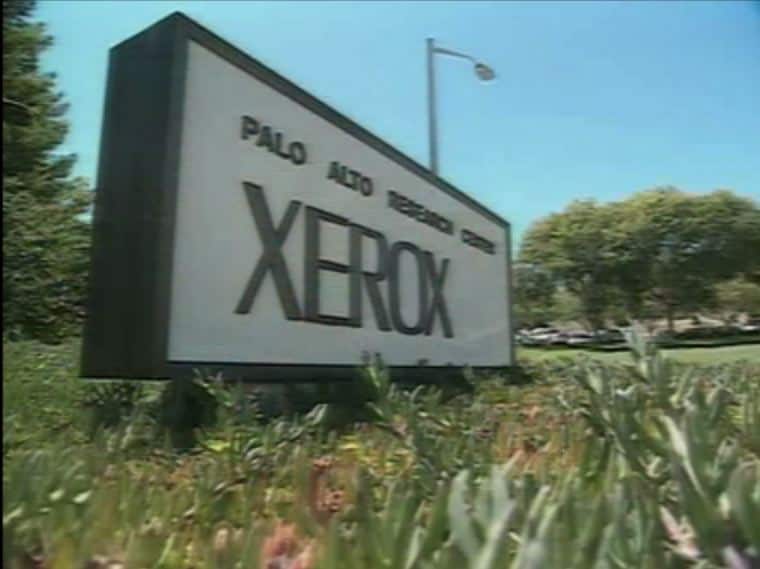
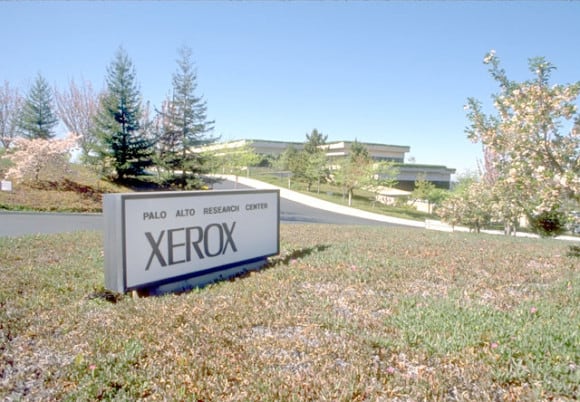
Entrance of Xerox PARC in the eighties

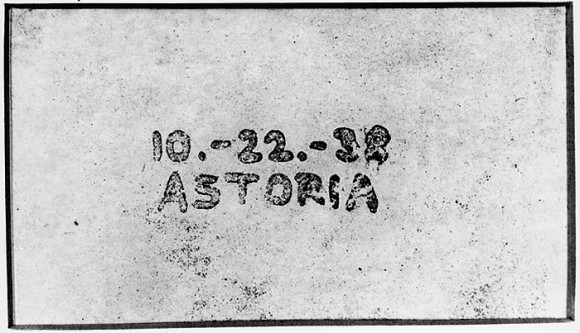
In the Untied States, the brand name “Xerox” denotes photocopying just as “Kleenex” stands for tissues or “Scotch tape” for adhesive film. After all, already in 1950, the Xerox Corp. was the world’s first company to actually transfer the “Xerography” invented by the American law student Chester Carlson into a functional product. Carlson received in 1937 a patent for a process that he called “electrophotography.” On 22 October 1938 followed the premiere in practice: With the help of a metal plate was coated with sulfur and a lamp Chester the lettering “10-22-38 Astoria” on a wax paper.

The first photocopy

By the end of the sixties, the Xerox management sensed the threat of Japanese companies catching up on Xerox’s technological advantage. Moreover, the Xerox head worried that the “paperless office” might emerge with the following computer generations, in which the Xerox would no longer have a place. Against this background, the Xerox Palo Alto Research Center (PARC) in California was founded in 1970. John Warnock, former researcher in the Xerox PARC and later one of the two founders of Adobe Systems, remembers: “The atmosphere was electric – there was total intellectual freedom. There was no conventional wisdom; almost every idea was up for challenge and got challenged regularly.”

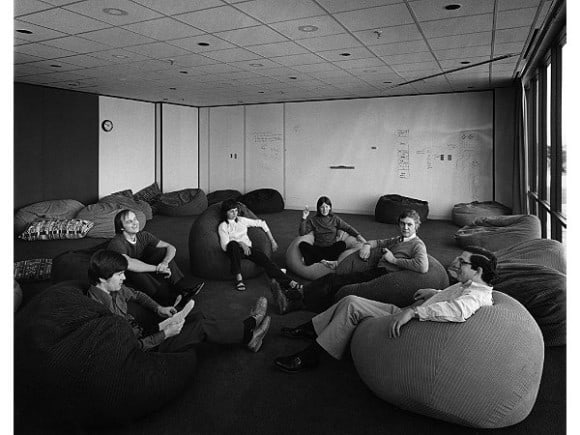
The PARC Computer Science Laboratory (CSL) – 1970 ca. – © PARC (Palo Alto Research Center, Incorporated)

Larry Tessler, who later took part in developing the Macintosh and the Newton PDA at Apple, also enjoyed the liberties the PARC provided in the seventies: “The management said go create the new world. We don’t understand it. Here are people who have a lot of ideas and tremendous talent, [are] young, energetic.” The problem, however, was that the company management at the East Coast of the USA did not [care a straw for] the PARC’s research results unless they were directly involved with photocopiers.

In his TV documentation “Triumph of the Nerds” Robert Cringley is interviewing researchers at the Xerox PARC

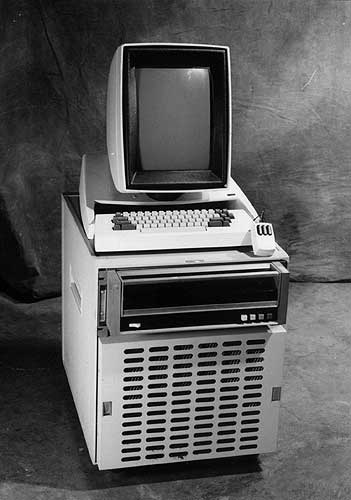
Within two years, the researchers at the PARC had designed the Alto, which was something like the first personal computer. The Alto did not feature character-oriented graphics, as did all the other computers of that time, but a bit-oriented version instead. A high quality printer could print exactly what the screen displayed.

A mouse. Removable data storage. Networking. A visual user interface. Easy-to-use graphics software. “What You See Is What You Get” (WYSIWYG) printing, with printed documents matching what users saw on screen. E-mail. Alto for the first time combined these and other now-familiar elements in one small computer.

Developed by Xerox as a research system, the Alto marked a radical leap in the evolution of how computers interact with people, leading the way to today’s computers.

By making human-computer communications more intuitive and user friendly, Alto and similar systems opened computing to wide use by non-specialists, including children.

People were able to focus on using the computer as a tool to accomplish a task rather than on learning their computer’s technical details.

The Computer History Museum about the Xerox Alto
Xerox Alto

However, this marvelous machine was not freely available on the market. Only small numbers were built initially, but by the late 1970s, about 1,000 were in use at various Xerox laboratories, and about another 500 in several universities. Total production was about 2,000 systems.

The revolutionary Alto would have been an expensive personal computer if put on sale commercially. Lead engineer Charles Thacker noted that the first one cost Xerox $12,000. As a product, the price tag might have been $40,000.

Commercial for the Xerox Alto (1972).

This commercial for Xerox’s Alto computer released in 1972 introduced the world to the first desktop computer with a graphical user interface. Named after Xerox PARC’s home city of Palo Alto, California, the computer introduced the world to the window-oriented mouse and keyboard interface we use today. The Alto also had a distinctive portrait screen — an idea that was well before its time.

The video showed how the computer could revolutionize your office life, with email, word processing and reminders all controlled by a cursor. It also shows the protagonist expressing his thoughts and actions out loud, as if in conversation with the Alto (which seems to be nicknamed “Fred”).

Some Apple engineers were already familiar with PARC, its work, or technologies like the mouse. Bill Atkinson had read about Smalltalk as an undergraduate. Some had worked at PARC: Jef Raskin spent time there during a sabbatical year at Stanford, and had a number of friends who were researchers there. Finally, there were even some Apple employees whose had learned about the mouse while working for Douglas Engelbart at SRI in the 1960s and early 1970s, or Tymshare in the later 1970s.

Read next page: How Apple discovered Xerox PARC

Steve Jobs Discovers the Macintosh Project

With the initial public offering of Apple Computers in December 1980, Steve Jobs became a multimillionaire – however, he possessed neither enough stock to lead Apple Computers alone nor to determine his own position within Apple. By the beginning of 1981, he actually found himself to be without management responsibility over any specific project. To Jef Raskin’s discomfort, he threw himself into the Macintosh project, which had not been taken really seriously by the Apple board of management at that time.

However, Steve Jobs knew what he wanted. He had seen the graphical user interface of the Xerox Alto at Xerox PARC. Instead of green letters on a dark background, white document windows with black text appeared – just like a sheet of paper. Several different fonts could be selected. The graphics board controlled individual pixels on the screen freely. By means of a mouse, a pointer could be moved on the screen in order to mark texts or issue commands. Files were represented by icons on a virtual desktop.


Demo of the Xerox Alto (quoted from: Triumph of the Nerds)

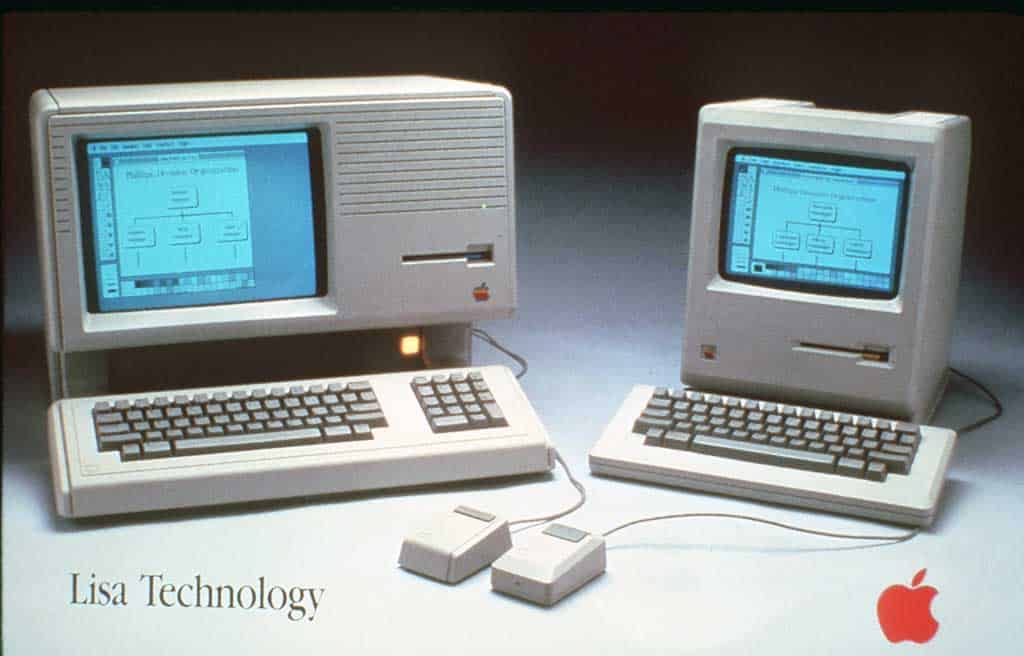
The Alto was not available on the market. For this experimental computer, the main memory alone would have cost about 7,000 dollars at the time. Jobs wanted a computer even better than the Alto – and also better than Apple’s Lisa. However, the new marvelous machine should cost only a fraction of the Lisa’s price, which was about 12,000 dollars, inclusive of external hard disk.

Pirate flag above the Mac
developers’ building “Bandley III”

Within Apple, Jobs gathered a small, conniving team – and he did not care for other projects in the company. Andy Hertzfeld, one of the most important software designers in the Macintosh developers team, remembers:

Steve Jobs kind of came bopping by my cubicle saying OK you’re working on the Mac now. And I said well I have to finish up this Apple 2 stuff I’m doing here. No you don’t that stinks that’s not going to amount to anything you gotta start now. And I said well just give me a few days to finish and he said no and what he did was he pulled the plug on my Apple 2 that I was programming just losing, losing the code I’m working on and start taking my computer and walking away with it and what could I do but follow him out to his car cause he had my machine he plopped it down in the trunk and drove me over to this remote building, took the computer out, walked upstairs, plopped it down on a desk, well you’re working on the Mac now. While Jobs pursued his MacMission he needed a more orthodox chief executive to run the company. A respectable face who could sell to corporate America. He chose Pepsi-Cola executive John Sculley. Sculley refused – leave Pepsi for a 4 year old company that had been set up in a garage! Are you serious?! But it was hard saying no to Steve Jobs.

The Macintosh Pirates

Above the roof of “Bandley III”, a pirate flag with the Apple symbol as eye patch was waving – and on deck of the virtual pirate ship, Steve Jobs was standing as a man who wanted to prove it to them all. Jobs’ first victim was Jef Raskin, who had fought against the application of a mouse and instead preferred a pen or a joystick. After Jobs had relieved his opponent of the responsibility for the software, Raskin gave in exasperatedly and left Apple Computers in March 1982. In retrospect, Raskin can claim that he was the first at Apple to have presented the vision of an inexpensive, easy to handle computer for the masses. Yet in order to keep “his” Macintosh below the price limit of 1,500 dollars, Raskin also wanted to make technical compromises which would have put at risk the Mac’s success. Thus, for instance, he insisted on limiting the main memory to a tiny 64 kilobytes. Jobs accomplished 128 kilobytes – and afterwards, even this space was actually far too tight for the system programmers.

Raskin did not particularly support the innovations the Lisa team had picked up in the Xerox PARC and therefore disapproved of the change to the more capable 68000 processor, which was included in the Lisa as well. It is hardly imaginable what would have become of the Mac if Raskin had asserted his extreme parsimony and his resistance to the mouse. After the internal disputes had been settled, the Mac team now fully concentrated on the in-house competition against the far larger Lisa developing team. Beforehand, Jobs had enticed away from the Lisa team ingenious programmers such as Bill Atkinson and Steve Capps.

Love and Hate

As a project manager, Steve Jobs had been highly controversial not only within Apple. “He’s also obnoxious and this comes from his high standards. He has extremely high standards and he has no patience with people who don’t either share those standards or perform to them,“ Bob Metcalfe remembers. He is the inventor of the networking standard Ethernet, who had worked as a researcher in the neighboring research institute Xerox PARC at that time. “He’s also obnoxious and this comes from his high standards. He has extremely high standards and he has no patience with people who don’t either share those standards or perform to them.” However, Metcalfe still thinks a lot of Jobs as he had made the vision created in the Xerox PARC become reality. “Steve Jobs is on my eternal heroes list, there’s nothing he can ever do to get off it.”

Larry Tessler and Bob Metcalfe about Steve Jobs (quoted from: Triumph of the Nerds)

The respect for Jobs is also shared by Andy Hertzfeld, who had written the Mac’s kernel in the Macintosh ROM, although he was sometimes afflicted with his boss’s tantrums: – quotation – Kenyon set to work again and shortened the booting process by further three seconds.

In the internal competition at Apple over whether the Lisa or the Macintosh would be finished first, Jobs got the short end of the stick. He lost a personal 5,000 dollar bet against the Lisa team leader John Couch when the Apple business computer was launched in January 1983 – at least one year previous to the Macintosh. However, the Lisa computer soon proved to be a huge flop. With a price of 10,000 dollars (exclusive of hard disk), it was far too expensive;the graphical user interface devoured Lisa’s power such that the computer did not work particularly briskly; and it lacked the necessary programs to induce the business world to buy the Lisa in large numbers. Moreover, the newly established distribution team could hardly resort to any experience in handling Corporate America.