Category Archives: Mac

Apple Super Bowl Commercial 1984

“1984″ – Apple’s famous Super Bowl Spot

The most famous Super Bowl ad

The Hammer That Shattered the Monolith: How 60 Seconds Defined the Apple Mythos

It is January 22, 1984. Inside Tampa Stadium, Super Bowl XVIII is in full swing. The Los Angeles Raiders are systematically dismantling the Washington Redskins. But during a break in the third quarter, the game becomes a footnote. For 60 seconds, nearly 100 million Americans are pulled away from the grass and grit into a dystopian nightmare—and then shown a glimpse of a digital revolution.

This wasn’t just a commercial. It was a cinematic manifesto directed by Ridley Scott, a man who had just finished reshaping science fiction with Blade Runner.

The Aesthetic of the Abyss

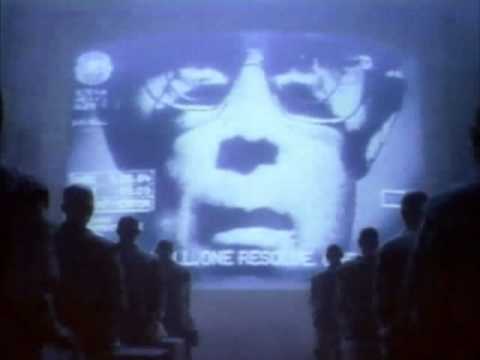
The spot opens on a monochrome, ash-colored world. Rows of hollow-eyed men, their heads shaved and spirits broken, march in lockstep through industrial corridors. They gather in a cold hall before a towering screen where a bespectacled “Big Brother”—a thinly veiled avatar for the then-dominant IBM—drones on about the “unification of thoughts.”

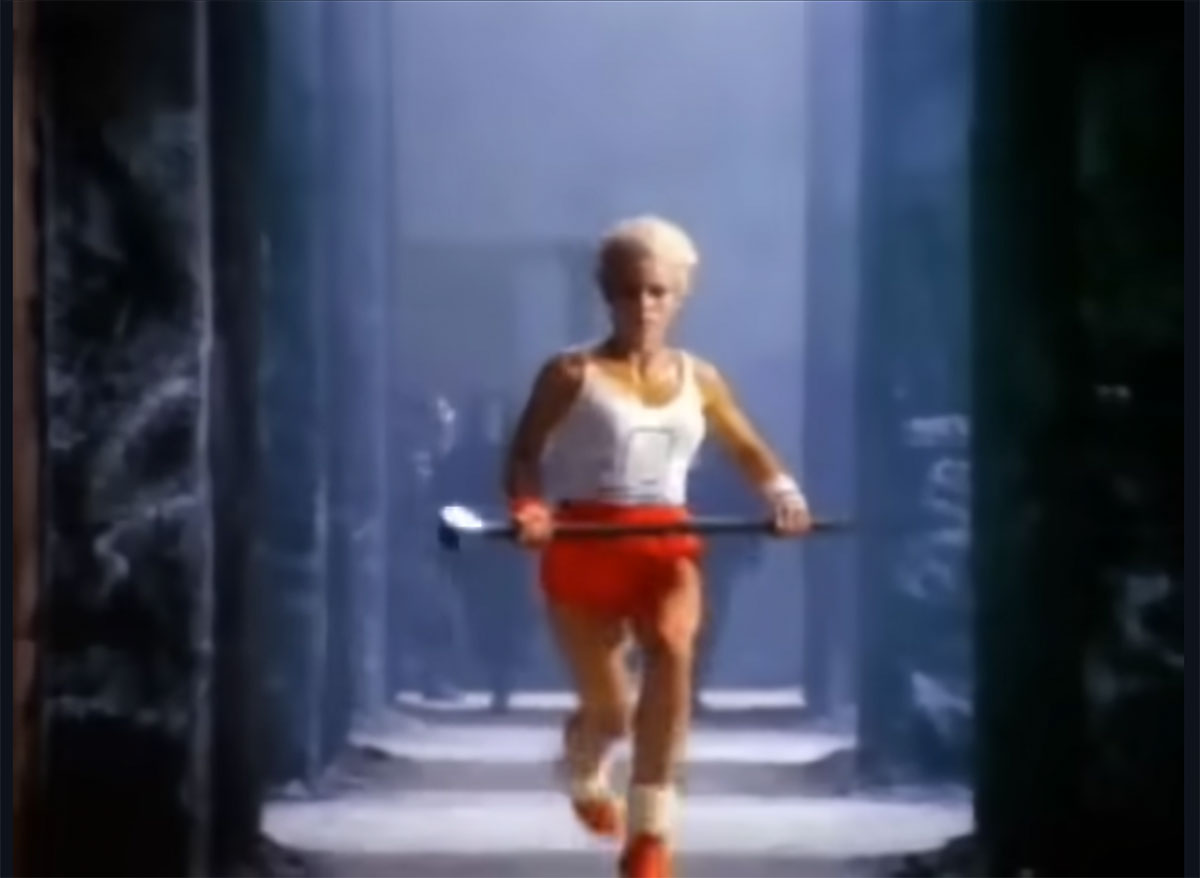
Then, a flash of color breaks the gray. A young woman (played by British athlete Anya Major) sprints toward the screen, pursued by riot police. She wears bright orange shorts and a white tank top emblazoned with a line drawing of a computer. In her hands, she swings a heavy sledgehammer with the grace of an Olympian. As she releases the hammer, it sails through the air and crashes directly into the face of the tyrant.

The screen explodes in a blinding white light. A voiceover—and a simple scroll of text—delivers the finishing blow: “On January 24th, Apple Computer will introduce Macintosh. And you’ll see why 1984 won’t be like ‘1984’.”

Corporate Cold Feet: The Board vs. The Visionaries

Today, the “1984” ad is heralded as the greatest commercial of all time. Yet, it almost never aired.

The backstory is a corporate thriller. The agency Chiat/Day had crafted the concept, and Steve Jobs was immediately electrified by it. He wanted a “thunderclap.” However, when the finished film was screened for Apple’s board of directors in December 1983, the reaction was icy silence.

Mike Markkula, Apple’s chairman and major investor, was horrified. “This is the worst ad I’ve ever seen. Who wants to fire the agency?” he reportedly asked. The board ordered CEO John Sculley to sell back the expensive Super Bowl airtime they had already purchased.

Wozniak’s Act of Rebellion

Steve Jobs, refusing to see his masterpiece buried, showed the spot to co-founder Steve Wozniak. “Woz” was so blown away that he offered to pay for half of the airtime out of his own pocket if the board refused to budge. “If Apple won’t run it, I’ll pay $400,000 and you pay $400,000,” Wozniak told Jobs.

In the end, it was a mix of chutzpah and luck: Chiat/Day claimed they couldn’t find a buyer for the 60-second slot in time. With the slot already paid for and no one to take it, Apple was forced to run the ad.

Skinheads and Discus Throws: The Making of a Legend

Ridley Scott’s production was grueling and authentic. Filmed at Shepperton Studios in London, Scott didn’t hire standard extras. To achieve the look of a true oppressed proletariat, he hired actual London skinheads for a pittance and the promise of a free lunch. The atmosphere on set was reportedly tense, with the extras’ rowdy behavior adding a layer of genuine grit to the film.

The choice of Anya Major for the lead role was a stroke of casting genius. Many models had auditioned, but most couldn’t even swing the hammer while running. Major was an experienced discus thrower; she had the muscle memory and the athletic form to hurl the sledgehammer with deadly precision.

The Legacy: When Advertising Became Art

The impact the next morning was unprecedented. News stations didn’t just talk about the ad; they replayed it in its entirety during their broadcasts. Apple generated over $5 million in free publicity. Overnight, the Macintosh became more than a piece of hardware; it became a symbol of individuality and freedom.

“1984” marked the moment advertising stopped merely explaining products and started creating myths. It was the birth of Apple as a lifestyle brand and Steve Jobs as the high priest of the digital counter-culture.

There is a modern irony to the story: today, critics often point at Apple’s massive market cap and closed ecosystem, suggesting the company has become the very “Big Brother” it once vowed to destroy. Regardless of the politics, the 60-second storm Ridley Scott and Steve Jobs unleashed remains a masterclass in storytelling—a hammer throw that changed the cultural trajectory of technology forever.

The commercial was rebroadcast in an updated version in 2004 on its 20th anniversary, with the heroine modified to be listening to an iPod. Viewers generally saw the Big Brother target of the Apple advertisement as being Microsoft, with the original villain, IBM, being all but forgotten.
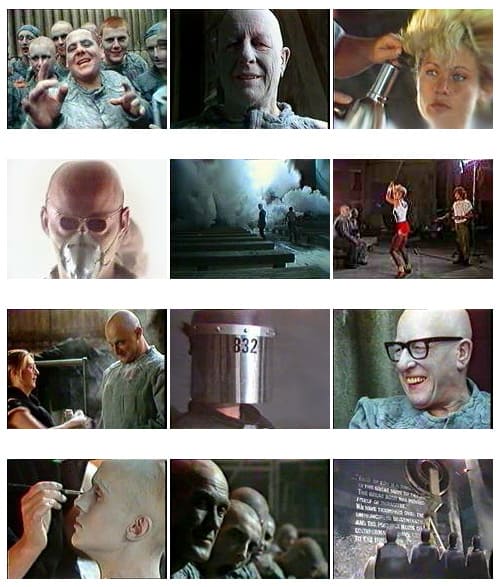
Making of the Apple Ad 1984

Apple commercial “1984”: The Plot

The commercial opens with a dystopic, industrial setting in blue and gray tones, showing a line of people (of ambiguous gender) marching in unison through a long tunnel monitored by a string of telescreens. This is in sharp contrast to the full-color shots of the nameless runner (Anya Major). She looks like an Olympic track and field athlete, as she is carrying a large brass-headed hammer and is wearing an athletic “uniform” (bright orange athletic shorts, running shoes, a white tank top with a cubist picture of Apple’s Macintosh computer, a white sweat band on her left wrist, and a red one on her right).

As she is chased by four police officers (presumably agents of the Thought Police) wearing black uniforms, protected by riot gear, helmets with visors covering their faces, and armed with large night sticks, she races towards a large screen with the image of a Big Brother-like figure (David Graham, also seen on the telescreens earlier) giving a speech:

My friends, each of you is a single cell in the great body of the State. And today, that great body has purged itself of parasites. We have triumphed over the unprincipled dissemination of facts. The thugs and wreckers have been cast out. And the poisonous weeds of disinformation have been consigned to the dustbin of history. Let each and every cell rejoice! For today we celebrate the first, glorious anniversary of the Information Purification Directive! We have created, for the first time in all history, a garden of pure ideology. Where each worker may bloom secure from the pests purveying contradictory truths. Our Unification of Thoughts is more powerful a weapon than any fleet or army on earth. We are one people, with one will, one resolve, one cause. Our enemies shall talk themselves to death and we will bury them with their own confusion. We shall prevail!

The runner, now close to the screen, hurls the hammer towards it, right at the moment Big Brother announces, “we shall prevail!” In a flurry of light and smoke, the screen is destroyed, shocking the people watching the screen.
The commercial concludes with a portentous voiceover, accompanied by scrolling black text (in Apple’s early signature “Garamond” font); the hazy, whitish-blue aftermath of the cataclysmic event serves as the background. It reads:

On January 24th, Apple Computer will introduce Macintosh. And you’ll see why 1984 won’t be like “1984.

The screen fades to black as the voiceover ends, and the rainbow Apple logo appears.

Apple commercial “1984”: The Production

Development

The commercial was created by the advertising agency Chiat/Day, Venice, with copy by Steve Hayden, art direction by Brent Thomas and creative direction by Lee Clow. Ridley Scott (whose dystopian sci-fi film, Blade Runner was released two years prior) was hired by agency producer Richard O’Neill to direct it, with a then-“unheard-of production budget of $900,000.” The actors who appeared in the commercial were paid $25 per day.

Steve Jobs and John Sculley were so enthusiastic about the final product that they “…purchased one and a half minutes of ad time for the Super Bowl, annually the most-watched television program in America. In December 1983 they screened the commercial for the Apple Board of Directors. To Jobs’ and Sculley’s surprise, the entire board hated the commercial.” However, Scully himself got “cold feet” and asked Chiat/Day to sell off the two commercial spots.

Despite the board’s dislike of the film, Steve Jobs continued to support it. Steve Wozniak watched it and offered to pay for half of the spot personally if the board refused to air it.

Of the original ninety seconds booked, Chiat/Day managed to resell thirty seconds to another advertiser, leaving the other sixty second slot.

Intended message

Adelia Cellini states in a 2004 article for MacWorld, “The Story Behind Apple’s ‘1984’ TV Commercial“:

Let’s see – an all-powerful entity blathering on about Unification of Thoughts to an army of soulless drones, only to be brought down by a plucky, Apple-esque underdog. So Big Brother, the villain from Apple’s ‘1984’ Mac ad, represented IBM, right? According to the ad’s creators, that’s not exactly the case. The original concept was to show the fight for the control of computer technology as a struggle of the few against the many, says TBWA/Chiat/Day’s Lee Clow. Apple wanted the Mac to symbolize the idea of empowerment, with the ad showcasing the Mac as a tool for combating conformity and asserting originality. What better way to do that than have a striking blonde athlete take a sledghammer to the face of that ultimate symbol of conformity, Big Brother?

However, in his 1983 Apple keynote address, Steve Jobs made the following comment before showcasing a preview of the commercial to a select audience:

It is now 1984. It appears IBM wants it all. Apple is perceived to be the only hope to offer IBM a run for its money. Dealers initially welcoming IBM with open arms now fear an IBM dominated and controlled future. They are increasing and desperately turning back to Apple as the only force that can ensure their future freedom. IBM wants it all and is aiming its guns on its last obstacle to industry control, Apple. Will Big Blue dominate the entire computer industry? The entire information age? Was George Orwell right about 1984?

Apple commercial “1984”: The Reception

Awards

* 2007: Best Super Bowl Spot (in the game’s 40-year history)

* 1999: TV Guide – Number One Greatest Commercial of All Time

* 1995: Advertising Age – Greatest Commercial

* 1984: 31st Cannes Lions International Advertising Festival – Grand Prix

Social impact

Ted Friedman, in his 2005 text, Electric Dreams: Computers in American Culture, notes the impact of the commercial:

Super Bowl viewers were overwhelmed by the startling ad. The ad garnered millions of dollars worth of free publicity, as news programs rebroadcast it that night. It was quickly hailed by many in the advertising industry as a masterwork. Advertising Age named it the 1980s Commercial of the Decade, and it continues to rank high on lists of the most influential commercials of all time […] 1984 was never broadcast again, adding to its mystique.

1984 became a signature representation of Apple computers. It was scripted as a thematic element in the 1999 docudrama, Pirates of Silicon Valley, which explores the rise of Apple and Microsoft (the film opens and closes with references to the commercial including a re-enactment of the heroine running towards the screen of Big Brother and clips of the original commercial).

“1984” became a signature representation of Apple computers. It was scripted as a thematic element in the 1999 docudrama, Pirates of Silicon Valley, which explores the rise of Apple and Microsoft (the film opens and closes with references to the commercial including a re-enactment of the heroine running towards the screen of Big Brother and clips of the original commercial). The “1984” ad was also prominent in the 20th anniversary celebration of the Macintosh in 2004, as Apple reposted a new version of the ad on its website. In this updated version, an iPod, complete with signature white earbuds, was digitally added to the heroine. Attendees were given a poster showing the heroine with iPod as a commemorative gift.

Influence in media

A commercial for the video game Half-Life 2 was based on this commercial. A parody of the commercial is seen in the Futurama episode Future Stock, promoting Planet Express. Another parody appears in The Simpsons TV show episode Mypods and Boomsticks, featuring Steve Jobs as “Big Brother” and the Comic Book Guy as the runner.

For the 20th anniversary of the Macintosh, Apple re-released the ad with the runner wearing an iPod.

Further reading

Source:

1984 (advertisement). (2012, May 13). In Wikipedia, The Free Encyclopedia. Retrieved 12:12, June 2, 2012, from http://en.wikipedia.org/w/index.php?title=1984_(advertisement)&oldid=492407781

A Look Back at Apple’s Super Ad : NPR.

This article is licenced under the GNU Free Documentation License

The History of the Apple Macintosh

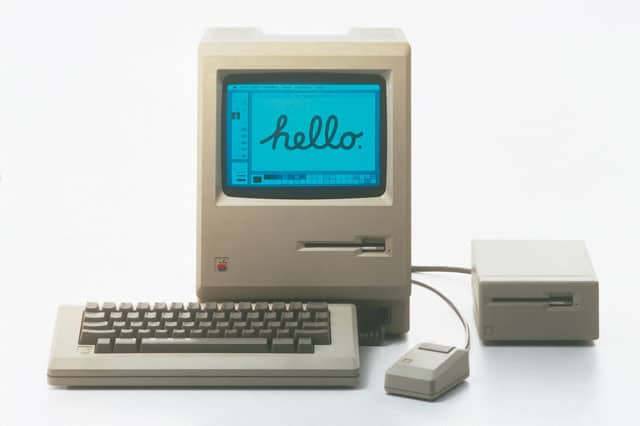
The Apple Macintosh revolutionized the entire computer industry by the year of 1984. Steve Jobs and his ingenious Macintosh team arranged for the computer to be used by the normal “person in the street” – and not only by experts.

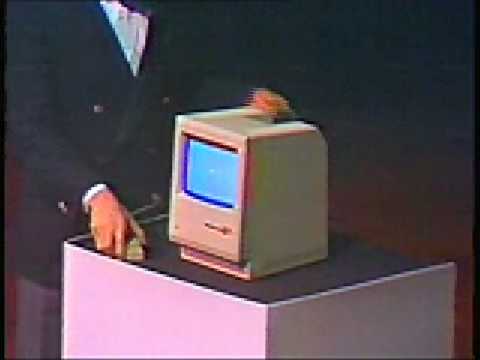
“Insanely great” – Steve Jobs could hardly put into words his enthusiasm by the launch of the Macintosh. On the legendary annual general meeting of January 24th, 1984, in the Flint Center not far from the Apple Campus in Cupertino, the Apple co-founder initially quoted Bob Dylan’s “The Times They Are A-Changin’” in order to then polemicize against an imminent predominance of the young computer industry by IBM.

Steve Jobs’ introduction of the Apple Macintosh:

The early 1980s. 1981 – Apple II has become the world’s most popular computer, and Apple has grown to a 300 million dollar corporation, becoming the fastest growing company in American business history. With over fifty companies vying for a share, IBM enters the personal computer market in November of 1981, with the IBM PC.

1983. Apple and IBM emerge as the industry’s strongest competitors, with each selling approximately one billion dollars worth of personal computers in 1983. The shakeout is in full swing. The first major personal computer firm goes bankrupt, with others teetering on the brink. Total industry losses for 1983 overshadow even the combined profits of Apple and IBM.

It is now 1984. It appears that IBM wants it all. Apple is perceived to be the only hope to offer IBM a run for its money. Dealers, after initially welcoming IBM with open arms, now fear an IBM dominated and controlled future and are turning back to Apple as the only force who can ensure their future freedom.

IBM wants it all, and is aiming its guns at its last obstacle to industry control, Apple. Will Big Blue dominate the entire computer industry? The entire information age? Was George Orwell right?

The crowd, among them the complete Macintosh developer’s team, shouted back: “Nooooo!”

The introduction of the first Mac on January 24th, 1984; taken from the “Lost 1984 Videos”

There had been only two milestone products so far: the Apple II in 1977 and the IBM PC in 1981, Jobs continued. “Today (…) we are introducing the third industry milestone product, the Macintosh. Many of us have been working on Macintosh for over two years now and it has turned out insanely great.”


Steve Jobs

Taking a look at the history of the personal computer today, Steve Jobs was on the right track with his historical comparison. However, it would not be IBM that became the great dominator of the computer industry over the years, but rather, the alliance of Microsoft and Intel.

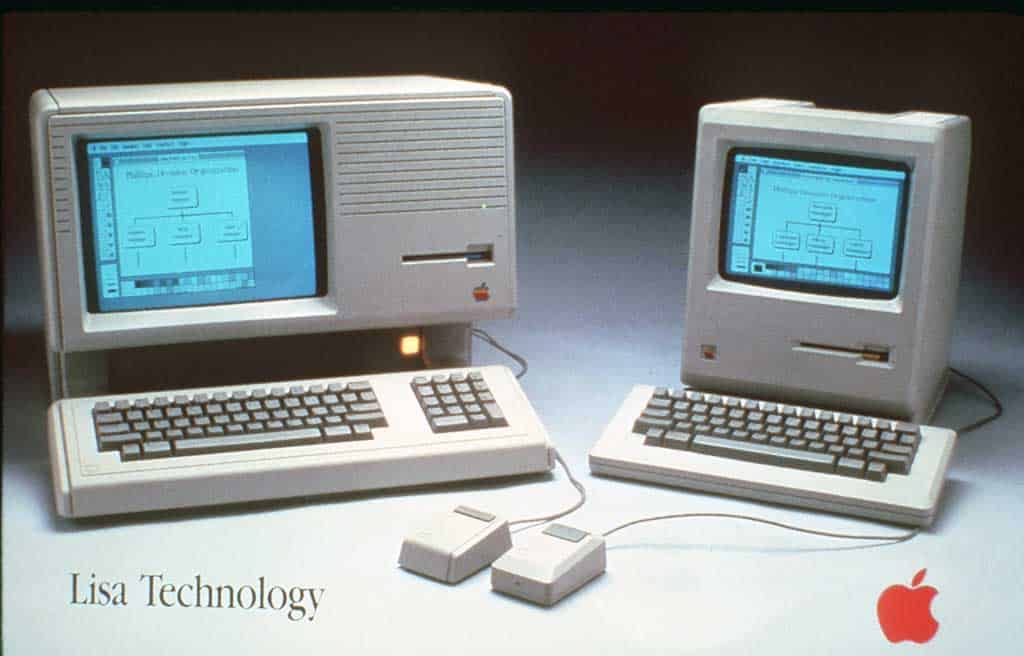
Previous to the Macintosh developer team, others had already tried to design a computer with a mouse and a graphical user interface – one year before Apple did, with its own business computer Lisa, which retailed for 10,000 dollars.

Continue reading

Twentieth Anniversary Macintosh

Twentieth Anniversary Macintosh

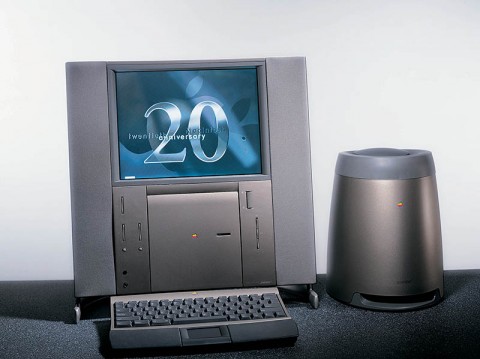
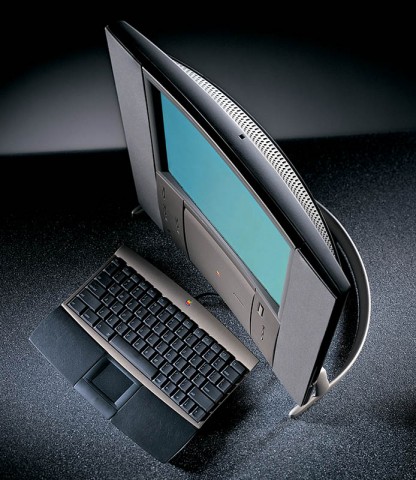
Apple is now (2017) the most valuable company in the world. But 20 years ago it looked like the company was about to completely implode. Nevertheless Apple was celebrating it’s anniversary. It had been twenty years since Apple had officially incorporated, and it marked the occasion with the Twentieth Anniversary Macintosh, or TAM. The machine was a technological showcase of the day, boasting a number of features beyond simple computing, and with a price tag aimed at the “executive” market.

Released on March 20, 1997, the TAM was essentially the computing version of a concept car, an innovation showcase. It compared to a car in another way: it was expensive, costing $7,499 upon its release. After its launch event, The New York Times called the ambitious effort a “Ferrari-on-a-desktop.”

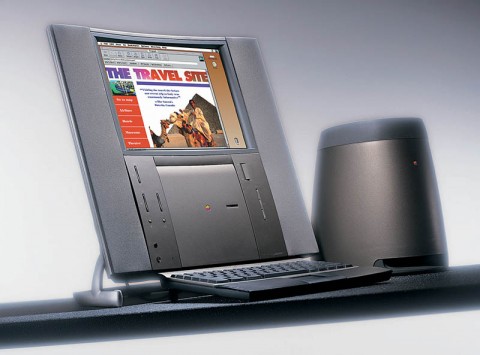
The TAM was an all-in-one PC, kind of a spiritual ancestor of the iMac, back when the whole idea of a monitor that contains the computer was totally crazy. It was designed by a young Jony Ive, who would go on to become Apple’s resident creative genius.

April 1, 1996 marked 20 years since the day that Steve Jobs, Steve Wozniak, and Ronald Wayne came together to form Apple Computer. As this milestone arrived and came to the attention of Apple’s then current executives, the decision was made to release a limited edition Macintosh computer to celebrate – and so the “Spartacus” (or “Pomona”, or “Smoke & Mirrors”) project was born.

The normal time-span to develop a new Macintosh computer was 18+ months, however they were already late to the party. Luckily the design team had already been working on several “dream” concepts, and soon settled on the most feasible of those – the (almost) “All-in-One” LCD-based design. To cut down on development time, many off-the-shelf components were used on the new computer’s internals.

The TAM was announced almost 20 years to the day after Jobs and Wozniak incorporated the company, in January 1997 at MacWorld Expo, San Francisco. It was given a release date of March 20, 1997, with a retail price of US$7,499. Originally intended as a mainstream product, the marketing group turned it into a pricey special edition.

Specifications and design

The TAM was to break the established form factor of the personal computer. One of the first projects of Jonathan “Jony” Ive, the design of the TAM was both a state-of-the-art futuristic vision of where computing could go whilst redeveloping Apple’s original objective to create a device that would integrate into people’s lives.

The TAM featured a 250 MHz PowerPC 603e processor and 12.1″ active matrix LCD powered by an ATI 3D Rage II video chipset with 2MB of VRAM capable of displaying up to 16bit color at either 800×600 or 640×480 pixels. It had a vertically mounted 4x SCSI CD-ROM and an Apple floppy Superdrive, a 2GB ATA hard drive, a TV/FM tuner, an S-Video input card, and a custom-made Bose sound system including two “Jewel” speakers and a subwoofer built into the externally located power supply “base unit”.

A thick “umbilical” cable connects the base unit to the head unit, supplying both power, and communications for the subwoofer. The umbilical connects via a multi-pin connector, which is a possible cause of the TAM’s one major fault – the “speaker buzz”. Inspections of units that received a repair by Apple due to the speaker buzz found an extra resistor/s had been installed in the umbilical. Ensuring the connectors are free of dust/dirt has also been known to resolve the “buzz”, though the buzz ultimately only affected a small percentage of machines. An Apple Engineer noted[5] that the thick umbilical was intended to power a higher end CPU, however that option was ultimately curtailed, though the diameter of the umbilical remained.

The TAM came with a unique 75 key ADB keyboard which featured leather palm-rests and a trackpad instead of a mouse. The trackpad could be detached from the keyboard if desired, with a small leather insert found underneath the keyboard ready to fill the gap. When not required, the keyboard could slide under the TAM’s head unit, leaving the trackpad exposed for continued access. The TAM also came with a remote control (standard with the Apple TV/FM Tuner card), but also featured buttons on the front panel that could control sound levels, CD playback, brightness, contrast, and TV mode. The pre-installed operating system was a specialized version of Mac OS 7.6.1, which allowed control over those features.

Expandability was offered via a 7 inch PCI slot and Apple Communication slot II for the addition of Ethernet. Later G3 upgrade options offered by Sonnet and NewerTechnologies made use of the TAM’s Level II Cache slot, which allow the computer to reach speeds of up to 500 MHz. All of these options come at the price of the TAM’s slim profile. The back panel must be removed, and replaced with an (included) “hunchback” cover that adds several inches to the depth of the machine.

One last unique feature of the TAM greeted owners when they turned the computer on—a special startup chime used only by the TAM. This chime does not sound the same when played on other devices, possibly simply due to the design of the Bose speakers.
Production/release

Apple CEO Gil Amelio praised the TAM:

For twenty years, Apple design engineers have been building bridges between what people dream about and the amazing new technologies that can take them beyond those dreams. It’s our magnificent obsession. It’s about working and playing and listening and learning and creating and communicating – sometimes all at the same time. It’s about the delight of doing things faster and better and easier. It’s about turning your back on conventional wisdom and finding new ways. Now, it’s about celebrating the last twenty years, and heralding the next twenty. It’s about the most beautiful thing we’ve ever built. It’s the Twentieth Anniversary Macintosh.

Apple manufactured 12,000 TAMs, with a release run of 11,601. The remaining 399 were kept by Apple for use as spare parts.
The TAM was only released in 5 countries: USA, Japan, France, Germany, and the UK.

Both of Apple’s founders, Steve Wozniak and Steve Jobs, received a TAM. When “Woz” allowed people to see into his office via webcam in the late 1990s, his TAM was visible on his desk.

Ten TAMs were sent to Apple Australia. One was given away as a prize via AU MacWorld magazine. Another was awarded as a prize at a gathering of Apple reseller staff. For some time one was on display in Apple’s Sydney HQ; the remainder were kept for use by Apple Australia executives.

Due to the scarcity of scale, rather than training all Apple authorized technicians in repairing the TAM, Apple opted to ship faulty units to three central locations worldwide—one per continent. The US location was the Eastman Kodak Company’s service center, Building 601, in Kodak Park (now known as Eastman Technology Park) in Rochester, New York. Apple’s Service Source CD, containing information for authorized technicians in the repair of Apple computers, lists the TAM as a “closed unit”, to be returned to said repair locations for all repairs. It does not contain a “take apart” guide for the TAM. Support from online forums is the best source of information for repairing a TAM now.

A prototype TAM was spotted on eBay circa 2010 featuring darker colored speaker panels, and missing the “Sound by Bose” label.

Websites

Rather than a simple page on Apple’s website, the TAM was given its own website, albeit only amounting to approximately 6 brief pages. This was nevertheless a departure from Apple’s standard advertising practice for its other Macintosh computers of the time.

Not long after the TAM’s release, a community website was created by Bob Bernardara, an original TAM owner in the U.S. He created the site for TAM owners around the world and it featured news and information about the TAM, along with links to useful software and a forum for discussions. Apple had an active link to the site shortly before the last TAM rolled off the assembly line.

Welcome to The 20th Anniversary Macintosh Web Site—the “Official” home of the TAM user community. This is the place where 20th Anniversary Macintosh owners can share a wealth of information on this “insanely great” product. The TAM (Twentieth Anniversary Macintosh) is a unique machine in the world of computers and this site will help you get the most out of yours.

The TAM site actively ran for several years and it eventually had to shut down when Bernardara could not contact Axon, the Australian hosting company who hosted the site, to make critical updates.

A number of newer TAM community websites have sprung up over the years, though none with the membership that Bernardara’s achieved

Limitations

Based on a PowerPC 603e processor, the TAM cannot run Mac OS X natively, but with the addition of a G3 or G4 aftermarket upgrade and the use of XPostFacto 4.0 software the TAM could run several versions of OS X, with some limitations.
Attempting to install Mac OS X otherwise can “brick” the TAM, and is ill-advised.

Discontinuation

Upon unveiling, the TAM was predicted to cost US$9,000, which would include a direct-to-door concierge delivery service. At release the price was reduced to $7,499. In the middle of its sales’ lifespan Apple dropped the price further to around US$3,500, and finally upon discontinuation in March 1998 the price was set to US$1,995. Customers who paid full price for the TAM, and then complained to Apple when the price was so drastically cut, were offered a free high-end Powerbook as compensation.

Steve Jobs returned to Apple in 1997. In March 1998 he made sweeping changes, including scrapping the Newton MessagePad. It was at this time that the TAM was discontinued, and remaining stocks reduced to US $1,995. The timing itself was not conspicuous – most Apple computers only feature a 1-year production run, and the TAM’s began in March 1997. However Jobs was on record stating that he hated the TAM, as it stood for everything that was wrong at Apple when he returned. The attempt to move the remaining stock by further reducing the price may have been a directive from Jobs himself.
Dealers in the US ran out of stock within 14 days of this final price drop.

Legacy

The Twentieth Anniversary Macintosh may not have been a well known machine in its time, nor a big seller (until the price reductions), but it has had a lasting legacy on personal computers. All-in-one LCD computers are now quite common, not least being Apple’s own modern iMac (starting with the G4 model), which clearly owes its design to the TAM, including using a vertically mounted removable drive (i.e. Superdrive). Even the removable trackpad has been replicated with Apple’s Magic Trackpad.

External power supplies were also used in later Apple computers such as the Power Mac G4 Cube and Mac Mini. Joint efforts with speaker manufacturers (originally Bose, but later Harman Kardon) have become common for several Apple computers.
Despite its poor sales, the TAM remains a “holy grail” amongst Macintosh collectors. As of 2010, complete working TAMs with boxes can sell for over US $1,000. As of early 2015, on eBay, complete working TAMs usually sell with boxes and rarely fetch less than about US$1600 with most examples priced starting at around $3200 and it’s not uncommon to find them listed for nearly twice that, sometimes more still.[6] TAM parts on eBay are rare.

Twentieth Anniversary Macintosh

Twentieth Anniversary Macintosh

Twentieth Anniversary Macintosh

In popular culture

Due to its unconventional design, the TAM has featured in numerous films and television series, including:
Seinfeld: Several episodes of the ninth season of Seinfeld in Jerry’s apartment.
Friends: Behind Chandler’s office desk in the fourth season of Friends in the episode “The One With the Worst Best Man Ever”.
The Real World: The housemates on MTV’s The Real World: Seattle.[7]
Serial Experiments Lain: The appearance of the NAVI computer seen in Serial Experiments Lain was greatly influenced by TAM.
Sabrina (1995): A prototype TAM on the desk of Linus Larrabee in the 1995 remake of the movie Sabrina. The TAM prototype sits on the far right side of Linus, on a dedicated side desk. The CD player has a see through port in the middle of the door that allows for the CD to be inserted and removed, this see through feature was removed in the production version that has a solid dark grey plastic door. The actual unit that Linus had on his desk was Apple’s in house development model that Apple lent to the studio.
Batman & Robin (1997): Used by Alfred to write a CD (a capability the real computer did not have) in Batman & Robin.[8]
Children of Men (2006): In Jasper’s hideout, in the film Children of Men, to show the video feeds of intruders breaking in is a TAM. In this movie it would be 30 years old.

References

Details

  • Code names: Pomona, Spartacus
  • introduced 1997.03.20 at $7,499, discontinued 1998.03.14
  • Part no.:
  • Gestalt ID: 512
  • upgrade path:

Mac OS

  • Requires Mac OS 7.6.1 through 9.1 (requires special version of Mac OS 8)

Core System

  • CPU: 250 MHz PPC 603e
  • Level 2 cache: 256 KB, expandable to 1 MB
  • Bus: 50 MHz
  • ROM: 4 MB
  • RAM: 32 MB (expandable to 128 MB, accepts two 168-pin 5V 60ns or faster EDO or FPM DIMMs)

Performance

  • CPU performance: 237, MacBench 4

Graphics

  • GPU: ATI 3D Rage II
  • VRAM: 2 MB VRAM
  • Video: 12.1″ 800 x 600 at 8- or 16-bit. 24-bit video support possible with ATI January 2002 retail drivers noted above, although the display itself only supports 18-bit output (6 bits per color channel).

Drives

  • floppy drive: 1.4M
  • Hard drive: 2 GB 2.5″ ATA/EIDE drive, 128 GB maximum, newer drives may requires a different drive bracket or modification of the original bracket.
  • CD-ROM: 4x

Expansion

  • ADB ports: 1
  • SCSI: DB-25 connector on back of computer
  • serial ports: 2 DIN-8 GeoPorts
  • PCI slots: 1 6.88″ slot
  • other expansion slots: 1 Comm Slot II, filled with 33.6kbps GeoPort modem

Physical

  • dimensions (HxWxD): 17.25″x16.5″x10.0″ (43.8×41.9×25.4 cm)
  • Weight: 14.9 lbs. (6.8 kg)

Online Resources


Source: Twentieth Anniversary Macintosh. (2017, April 5). In Wikipedia, The Free Encyclopedia. Retrieved 08:58, April 10, 2017, from https://en.wikipedia.org/w/index.php?title=Twentieth_Anniversary_Macintosh&oldid=773925246

Happy Birthday, Mac

Steve Jobs had assembled a dream team of genius programmers and engineers, whom he urged like a cult leader with flattery and verbal attacks to continually new heights. But the ever-changing demands of Jobs delayed the Mac project, so that the Apple co-founder finally lost his bet against the Lisa team. It was not until the 24th of January 1984, that the Mac was finally ready.

At the public presentation of the new computer model, Jobs recited the song “The Times They Are A-Changin” by Bob Dylan:

Come writers and critics

Who prophesize with your pen

And keep your eyes wide

The chance won’t come again

And don’t speak too soon

For the wheel’s still in spin

And there’s no tellin’ who

That it’s namin’

For the loser now

Will be later to win

For the times they are a-changin’

The Mac turns 25 @ computerworld.com

Opinion: The top 10 standout Macs of the past 25 years
Launched in January 1984, the first Apple Mac opened the door for a computer revolution that led to the PowerBook, the iMac and even the iPhone. Columnist Michael DeAgonia chooses the 10 Mac models that made the biggest splash.

In the beginning: The making of the Mac
Just how did the first Apple Macintosh computer come to be? The course of events that led to the Mac as we know it was convoluted, the result of luck or coincidence as much as planning. Here’s the story.

The Mac at 25: Successes and regrets, Apple’s had a few
In these heady days when Apple seems to be gaining ground in a number of places and ways, it’s important to remember that everything that followed from the first Mac was not a given. Here’s a look at five successes and five mistakes Apple made during the past 25 years.

Opinion: What will Macs be like in 25 years?
Columnist Seth Weintraub pulls out his crystal ball to predict the future of the Mac — including whether we’ll have Macs at all in 2034.

Timeline: Milestones in the Mac’s history
Take a trip down memory lane as we revisit the Mac’s highs, lows and in-betweens from 1978 to today.

Steve Jobs Discovers the Macintosh Project

With the initial public offering of Apple Computers in December 1980, Steve Jobs became a multimillionaire – however, he possessed neither enough stock to lead Apple Computers alone nor to determine his own position within Apple. By the beginning of 1981, he actually found himself to be without management responsibility over any specific project. To Jef Raskin’s discomfort, he threw himself into the Macintosh project, which had not been taken really seriously by the Apple board of management at that time.

However, Steve Jobs knew what he wanted. He had seen the graphical user interface of the Xerox Alto at Xerox PARC. Instead of green letters on a dark background, white document windows with black text appeared – just like a sheet of paper. Several different fonts could be selected. The graphics board controlled individual pixels on the screen freely. By means of a mouse, a pointer could be moved on the screen in order to mark texts or issue commands. Files were represented by icons on a virtual desktop.


Demo of the Xerox Alto (quoted from: Triumph of the Nerds)

The Alto was not available on the market. For this experimental computer, the main memory alone would have cost about 7,000 dollars at the time. Jobs wanted a computer even better than the Alto – and also better than Apple’s Lisa. However, the new marvelous machine should cost only a fraction of the Lisa’s price, which was about 12,000 dollars, inclusive of external hard disk.

Pirate flag above the Mac
developers’ building “Bandley III”

Within Apple, Jobs gathered a small, conniving team – and he did not care for other projects in the company. Andy Hertzfeld, one of the most important software designers in the Macintosh developers team, remembers:

Steve Jobs kind of came bopping by my cubicle saying OK you’re working on the Mac now. And I said well I have to finish up this Apple 2 stuff I’m doing here. No you don’t that stinks that’s not going to amount to anything you gotta start now. And I said well just give me a few days to finish and he said no and what he did was he pulled the plug on my Apple 2 that I was programming just losing, losing the code I’m working on and start taking my computer and walking away with it and what could I do but follow him out to his car cause he had my machine he plopped it down in the trunk and drove me over to this remote building, took the computer out, walked upstairs, plopped it down on a desk, well you’re working on the Mac now. While Jobs pursued his MacMission he needed a more orthodox chief executive to run the company. A respectable face who could sell to corporate America. He chose Pepsi-Cola executive John Sculley. Sculley refused – leave Pepsi for a 4 year old company that had been set up in a garage! Are you serious?! But it was hard saying no to Steve Jobs.

The Macintosh Pirates

Above the roof of “Bandley III”, a pirate flag with the Apple symbol as eye patch was waving – and on deck of the virtual pirate ship, Steve Jobs was standing as a man who wanted to prove it to them all. Jobs’ first victim was Jef Raskin, who had fought against the application of a mouse and instead preferred a pen or a joystick. After Jobs had relieved his opponent of the responsibility for the software, Raskin gave in exasperatedly and left Apple Computers in March 1982. In retrospect, Raskin can claim that he was the first at Apple to have presented the vision of an inexpensive, easy to handle computer for the masses. Yet in order to keep “his” Macintosh below the price limit of 1,500 dollars, Raskin also wanted to make technical compromises which would have put at risk the Mac’s success. Thus, for instance, he insisted on limiting the main memory to a tiny 64 kilobytes. Jobs accomplished 128 kilobytes – and afterwards, even this space was actually far too tight for the system programmers.

Raskin did not particularly support the innovations the Lisa team had picked up in the Xerox PARC and therefore disapproved of the change to the more capable 68000 processor, which was included in the Lisa as well. It is hardly imaginable what would have become of the Mac if Raskin had asserted his extreme parsimony and his resistance to the mouse. After the internal disputes had been settled, the Mac team now fully concentrated on the in-house competition against the far larger Lisa developing team. Beforehand, Jobs had enticed away from the Lisa team ingenious programmers such as Bill Atkinson and Steve Capps.

Love and Hate

As a project manager, Steve Jobs had been highly controversial not only within Apple. “He’s also obnoxious and this comes from his high standards. He has extremely high standards and he has no patience with people who don’t either share those standards or perform to them,“ Bob Metcalfe remembers. He is the inventor of the networking standard Ethernet, who had worked as a researcher in the neighboring research institute Xerox PARC at that time. “He’s also obnoxious and this comes from his high standards. He has extremely high standards and he has no patience with people who don’t either share those standards or perform to them.” However, Metcalfe still thinks a lot of Jobs as he had made the vision created in the Xerox PARC become reality. “Steve Jobs is on my eternal heroes list, there’s nothing he can ever do to get off it.”

Larry Tessler and Bob Metcalfe about Steve Jobs (quoted from: Triumph of the Nerds)

The respect for Jobs is also shared by Andy Hertzfeld, who had written the Mac’s kernel in the Macintosh ROM, although he was sometimes afflicted with his boss’s tantrums: – quotation – Kenyon set to work again and shortened the booting process by further three seconds.

In the internal competition at Apple over whether the Lisa or the Macintosh would be finished first, Jobs got the short end of the stick. He lost a personal 5,000 dollar bet against the Lisa team leader John Couch when the Apple business computer was launched in January 1983 – at least one year previous to the Macintosh. However, the Lisa computer soon proved to be a huge flop. With a price of 10,000 dollars (exclusive of hard disk), it was far too expensive;the graphical user interface devoured Lisa’s power such that the computer did not work particularly briskly; and it lacked the necessary programs to induce the business world to buy the Lisa in large numbers. Moreover, the newly established distribution team could hardly resort to any experience in handling Corporate America.