Steve Jobs was a visionary, a genius, a perfectionist, and sometimes a difficult contemporary. When the Apple co-founder died in 2011 at the age of 56, many Apple fans saw a bleak future for the company. However, things turned out differently.
It was unimaginable to think of Apple without Steve Jobs. But on October 5, 2011, the inevitable occurred: the charismatic Apple co-founder lost his long battle with cancer. Six weeks prior, on August 24, 2011, Jobs had appointed his confidant Tim Cook as the company’s new CEO. The decision surprised many observers as Cook had made a name for himself as a logistics and manufacturing expert, but he lacked the charisma that Jobs had regularly used to captivate the masses.
One of the skeptics was Larry Ellison, who had been close friends with the Apple co-founder for years. The head of software giant Oracle believed that Apple was doomed without Steve Jobs. In a TV interview, he drew a parallel to 1985, when Apple’s board of directors forced Steve Jobs out of the company. Over the next 12 years, Apple fell into such disrepair that by 1997 the company was on the verge of bankruptcy, and Jobs was brought back as a savior. “We saw Apple with Steve Jobs, we saw Apple without Steve Jobs. We saw Apple with Steve Jobs. Now we’re going to see Apple without Steve Jobs,” Ellison said. “I like Tim Cook. I think there are a lot of talented people there. But Steve is irreplaceable.”
But things have turned out very differently after Jobs’ death than Ellison had feared. Apple is selling more devices and services than ever before. In August 2018, the iPhone maker made financial history as the first U.S. company to reach a trillion-dollar valuation on the stock market. Just two years later, it was two trillion. In addition to the stock market boom, experts say the company’s customer loyalty was a major factor in its rise. “When a new user starts using an Apple smartphone, they tend to stay with an Apple smartphone,” says Jeriel Ong, an equity analyst at Deutsche Bank.
And the rally is not over. Since October 2011, the share price has risen from around $13 to an all-time high of just under $150. Cook is also regularly rewarding shareholders with dividends, something Jobs always refused to do.
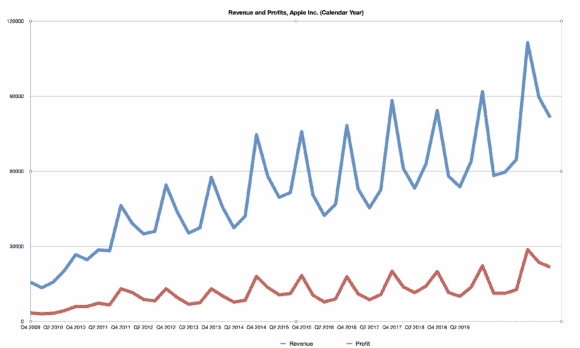
With the iPhone, Cook has managed to attract new groups of buyers. He also expanded the range of accessories, such as the Apple Watch computer watch and AirPods earphones, and launched subscription services such as iCloud and Apple TV+. It has also been able to charge higher prices for its products, so much so that a large portion of the industry’s profits now go to Apple.
Revenue and Profit, Apple Inc. (Calendar Year)
Still, Tim Cook is not a great presenter on stage. However, he has now set the tone that sets him apart from his predecessor. One example is the environment. In 2008, Steve Jobs had a heated exchange with Greenpeace when the environmentalists demanded that Apple stop using brominated flame retardants in its products. These can be toxic, difficult to break down in the environment, and accumulate in living organisms.
Under Cook’s leadership, Apple not only eliminated the controversial BFRs, but also all other environmental toxins in its manufacturing. He also switched the company entirely to renewable energy. This ambitious project will now be extended to the entire supply chain.
This change has also been noted by Greenpeace. “Since Tim Cook took the helm at Apple, he has made environmental protection an important part of the company’s identity,” the organization said in 2017, when it published a report on environmental standards at electronics manufacturers. Apple only lost out to smartphone maker Fairphone in the Greener Electronics ranking because the Dutch company’s devices are easier to repair.
In addition to the environmental issue, Apple under Cook is also trying harder to differentiate itself from the competition in the area of privacy. Last April, for example, Apple changed its iPhone software so that providers like Facebook would have to ask users for permission if they wanted to track their activities across different apps and websites. Jobs had announced this privacy principle at the D8 conference in 2010, but left the implementation to his successor.
When it comes to privacy, Cook already made his mark in 2016. At the time, the FBI demanded that Apple manipulate the iPhone’s iOS operating system to allow law enforcement to search the locked iPhone of the shooter in the San Bernardino terrorist attack. Cook rejected the request, saying it would not undermine the security features of the products.
But Cook has also faced setbacks on the issue. For example, Apple shelved plans to introduce a scanning feature on the iPhone that would prevent child abuse images from being uploaded to the cloud. There had been an outcry that Apple was taking the wrong approach in the legitimate fight against child pornography.
The biggest shortcoming of the Cook era, however, is that Jobs’ successor has yet to come up with a revolutionary new product. His predecessor regularly produced “one more thing” that disrupted entire industries: the iMac in 1999, the iPod and iTunes music service in 2001, the revolutionary iPhone in 2007, and the iPad in 2010. Under Cook, there have been rumors of revolutionary new products such as an Apple car or glasses for augmented reality applications, but so far Apple fans are waiting in vain.
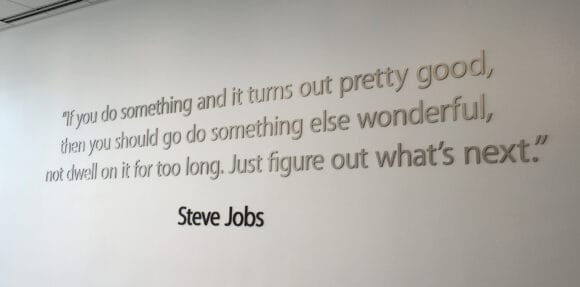
In this context, Cook’s critics point to a quote from Steve Jobs written in large letters on the wall of Apple’s old headquarters: “If you do something and it turns out pretty good, then you should go do something else wonderful, not dwell on it for too long. Just figure out what’s next.”
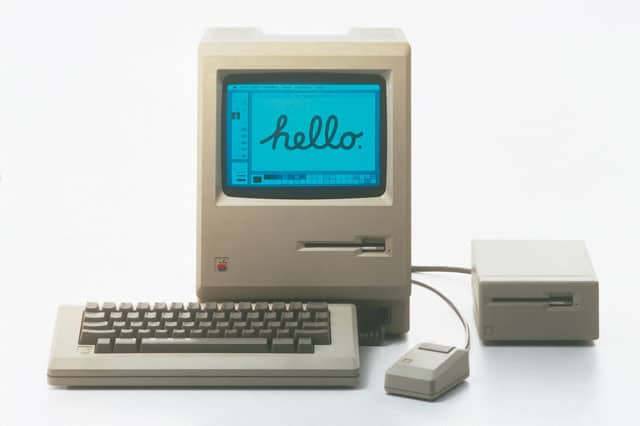
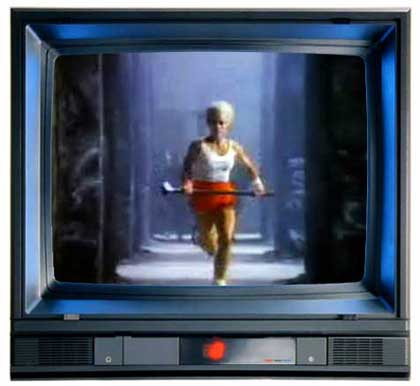
The Apple Macintosh revolutionized the entire computer industry by the year of 1984. Steve Jobs and his ingenious Macintosh team arranged for the computer to be used by the normal “person in the street” – and not only by experts.
“Insanely great” – Steve Jobs could hardly put into words his enthusiasm by the launch of the Macintosh. On the legendary annual general meeting of January 24th, 1984, in the Flint Center not far from the Apple Campus in Cupertino, the Apple co-founder initially quoted Bob Dylan’s “The Times They Are A-Changin’” in order to then polemicize against an imminent predominance of the young computer industry by IBM.
Steve Jobs’ introduction of the Apple Macintosh:
“The early 1980s. 1981 – Apple II has become the world’s most popular computer, and Apple has grown to a 300 million dollar corporation, becoming the fastest growing company in American business history. With over fifty companies vying for a share, IBM enters the personal computer market in November of 1981, with the IBM PC.
1983. Apple and IBM emerge as the industry’s strongest competitors, with each selling approximately one billion dollars worth of personal computers in 1983. The shakeout is in full swing. The first major personal computer firm goes bankrupt, with others teetering on the brink. Total industry losses for 1983 overshadow even the combined profits of Apple and IBM.
It is now 1984. It appears that IBM wants it all. Apple is perceived to be the only hope to offer IBM a run for its money. Dealers, after initially welcoming IBM with open arms, now fear an IBM dominated and controlled future and are turning back to Apple as the only force who can ensure their future freedom.
IBM wants it all, and is aiming its guns at its last obstacle to industry control, Apple. Will Big Blue dominate the entire computer industry? The entire information age? Was George Orwell right?“
The crowd, among them the complete Macintosh developer’s team, shouted back: “Nooooo!”
The introduction of the first Mac on January 24th, 1984; taken from the “Lost 1984 Videos”
There had been only two milestone products so far: the Apple II in 1977 and the IBM PC in 1981, Jobs continued. “Today (…) we are introducing the third industry milestone product, the Macintosh. Many of us have been working on Macintosh for over two years now and it has turned out insanely great.”
Steve Jobs
Taking a look at the history of the personal computer today, Steve Jobs was on the right track with his historical comparison. However, it would not be IBM that became the great dominator of the computer industry over the years, but rather, the alliance of Microsoft and Intel.
Previous to the Macintosh developer team, others had already tried to design a computer with a mouse and a graphical user interface – one year before Apple did, with its own business computer Lisa, which retailed for 10,000 dollars.
Microsoft and Apple have been business partners and tough competitors for many years. Back in the seventies, Steve Jobs and Bill Gates worked close together. In 1997 the Windows-manufacturer helped Steve Jobs saving Apple.
In the early seventies, there was no such thing as a personal computer. It took geniuses and visionaries like Steve Wozniak and Bill Gates to invent this new industry. The early computer geeks were energized by the arrival of the January 1975 issue of Popular Mechanics, which had on its cover the first personal computer kit, the Altair. The Altair wasn’t a real computer —more a $495 pile of parts that had to be soldered to a board that would then do little—but for hobbyists and hackers, it heralded the dawn of a new era. Bill Gates and Paul Allen read the magazine and started working on a version of BASIC, an easy-to-use programming language, for the Altair. It also caught the attention of Jobs and Wozniak.
Later Steve Jobs had to ask for the Microsoft BASIC because his friend Wozniak didn’t finish his own version of BASIC for the Apple II. “He was very childlike,” said Jobs later to the author of his biography, Walter Isaacson, about “Woz”. “He did a great version of BASIC, but then never could buckle down and write the floating-point BASIC we needed, so we ended up later having to make a deal with Microsoft. He was just too unfocused.”
With the rise of the Apple II in the late seventies, Microsoft became more and more successful – even before the IBM PC was invented. When Apple developed the Macintosh Bill Gates and his team was the most important software partner – despite the fact that Microsoft was also the driving force behind the IBM PC and the PC clones. And Steve Jobs even invited Bill Gates for the preview of the Mac: The high point of the October 1983 Apple sales conference in Hawaii was a skit based on a TV show called The Dating Game. Jobs played emcee, and his three contestants, whom he had convinced to fly to Hawaii, were Bill Gates and two other software executives, Mitch Kapor and Fred Gibbons. As the show’s jingly theme song played, the three took their stools.
Gates, looking like a high school sophomore, got wild applause from the 750 Apple salesmen when he said, “During 1984, Microsoft expects to get half of its revenues from software for the Macintosh.” Jobs, clean-shaven and bouncy, gave a toothy smile and asked if he thought that the Macintosh’s new operating system would become one of the industry’s new standards. Gates answered, “To create a new standard takes not just making something that’s a little bit different, it takes something that’s really new and captures people’s imagination. And the Macintosh, of all the machines I’ve ever seen, is the only one that meets that standard.”
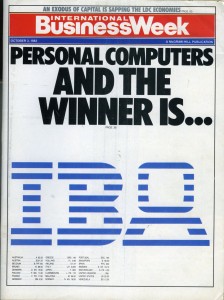
Title of BusinessWeek (October 3rd, 1983)
But even as Gates was speaking, Microsoft was edging away from being primarily a collaborator with Apple to being more of a competitor. It would continue to make application software, like Microsoft Word, for Apple, but a rapidly increasing share of its revenue would come from the operating system it had written for the IBM personal computer. The year before, 279,000 Apple IIs were sold, compared to 240,000 IBM PCs and its clones. But the figures for 1983 were coming in starkly different: 420,000 Apple IIs versus 1.3 million IBMs and its clones. And both the Apple III and the Lisa were dead in the water.
Just when the Apple sales force was arriving in Hawaii, this shift was hammered home on the cover of Business Week. Its headline: “Personal Computers: And the Winner Is . . . IBM.” The story inside detailed the rise of the IBM PC. “The battle for market supremacy is already over,” the magazine declared. “In a stunning blitz, IBM has taken more than 26% of the market in two years, and is expected to account for half the world market by 1985. An additional 25% of the market will be turning out IBM-compatible machines. (Walter Isaacson, p. 159-160)
Apple boss John Sculley’s marketing strategy for the launch of the Macintosh was obvious. The former Pepsi manager, who had been brought to Apple by Steve Jobs, intended to arrange a duel between IBM and Apple, black vs. white, with Apple playing the role of the underdog. Sculley wrote in his book Odyssey:
So we needed a campaign that would focus on a two-horse race to leverage off of Apple’s underdog status. Dozens of other computer companies were coming out with products and I was afraid we were going to get lost in the crowd. If we could create a two-horse race between us and IBM, we might be able to convince people that there are really only two computer companies competing in the marketplace. In any large consumer industry, few people remember the third- or fourth-largest competitor.
In the fight against competitors such as Atari, Commodore, Sinclair and Amstrad, the Apple strategy paid off well. But Sculley, as well as Steve Jobs, had completely underestimated that Microsoft, being an ally from the outset, would, with the aid of Apple, develop into a dominant power of the PC industry and even dwarf IBM.
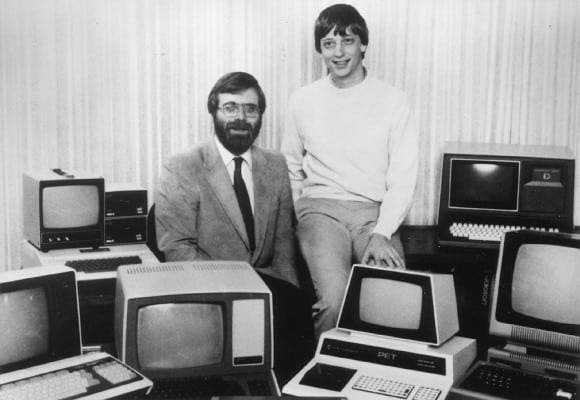
Bill Gates und Paul Allen (1981)
Bill Gates and Paul Allen founded Microsoft as a small software company in Albuquerque (New Mexico) in 1975 and developed the programming language BASIC for the legendary computer MITS Altair in collaboration with other co-workers. Due to fortunate circumstances, Microsoft landed an order from IBM to deliver not only BASIC but also the operating system for the first IBM PC in 1980. In the negotiation phase, the then-leading operating system manufacturer Digital Research (CP/M) did not want to engage in page-filling adhesion contracts from IBM – and thus lost this gigantic deal.
Microsoft did not have any operating system then, but this did not prevent Bill Gates and his companion Steve Ballmer from playing for high stakes while facing IBM. From their neighboring software shack Seattle Computers (in the meantime, Microsoft had moved to the northwest of the USA) they bought all rights for QDOS (Quick and Dirty Operating System) for no less than 50,000 dollars in July 1981 and renamed it as MS-DOS. Gates had been clever enough at that time not to have all rights to the system negotiated away by the IBM crew and was, therefore, able to win clone companies such as Compaq as customers later.
When Microsoft provided their BASIC for the Apple II, Steve Jobs and Bill Gates constantly ran into each other at that time. “Even before we finished our work on the IBM PC, Steve Jobs came and talked about what he wanted to do, what he thought he could do, sort of a Lisa but cheaper. We said boy, we’d love to help out”, Gates remembers. “The Lisa had all its own applications, but of course, they required a lot of memory, ah, and we thought we could do better, and so Steve signed a deal with us to actually provide bundled applications for the first Mac, and so we were big believers in the Mac and what Steve was doing there.”
Apple urgently needed software for the Mac, as there did not yet exist any program for the new system except for their in-house products MacWrite and MacPaint. Gates promised to have the programs Chart and File written for the Mac in addition to the spreadsheet program Excel. Steve Jobs appreciated the risk Microsoft took, but was not content with the first results though. “Most people don’t remember, but until the Mac, Microsoft was not in the applications business… it was dominated by Lotus. And Microsoft took a big gamble to write for the Mac.”
Apple still could have coped well with having given Microsoft’s new application business a leg up. However, Bill Gates tasted blood in the Macintosh project. Jeff Raikes, who was responsible for the Office business at Microsoft until early 2008, reviews: “And so we got started in early 1982 on our Macintosh software effort and I think at that point in time, you know, it really clicked with Bill that, you know, graphic user interface was going to be the way, the way of the future. But while Bill was having his own GUI revelation, Jobs believed that Apple’s true enemy was IBM.”
Raikes joined Apple Computer as the VisiCalc Engineering Manager in 1980. He worked at Apple for fifteen months before being recruited to Microsoft by Steve Ballmer in 1981 as a product manager. He was promoted to director of applications marketing in 1984 and was the chief strategist behind Microsoft’s investments in graphical applications for the Apple Macintosh and the Microsoft Windows operating system. In this role, he drove the product strategy and design of Microsoft Office.
Steve Jobs didn’t see much risk in bringing Microsoft into the Macintosh project. After all, the division of labor between Apple and Microsoft had worked well on the Apple II. The Apple II used some Microsoft software and Jobs reached out to Microsoft this time too. He didn’t want the company to make the Mac’s operating system. Apple was building that on its own. But he did want it to make stuff like spreadsheet software, and word processing.
Andy Hertzfeld, the technical lead for the Macintosh system software, recalls in the podcast “Land of the Giants” with Peter Kafka: “Microsoft was the first Macintosh developer. There was a partnership relationship from the very beginning between both companies. We needed to recruit the right partners that had both the technical skill and the vision to want to write software for the Macintosh. So Microsoft was the very first company we recruited.”
But Hertzfeld thought Microsoft wasn’t just going to be a partner. He thought Bill Gates was going to be a competitor too. “So I picked up on the idea that maybe Microsoft was besides writing applications, they were going to make their own version of the Macintosh. Seemed pretty obvious to me.” One of the guys on Microsoft’s Mac team was asking many questions about the Mac’s guts. He probably didn’t need to know this stuff to make software for the Mac.
Andy Hertzfeld: “I told Steve about it. He kind of laughed it off at first. He thought Microsoft didn’t have the skill to be able to do that.” Steve Jobs was half right. Microsoft didn’t create its own Macintosh. Instead, it created new software that turned other people’s computers into a sort of Macintoshes. And he used that same idea for a graphics-based interface. Gates it turned out had seen what Xerox Park was doing too. He unveiled his plan a few months before the Macintosh debuted.
Andy Hertzfeld: “In November of 1983 they announced their first version of Windows. Steve freaked out. He goes: ‘Get Gates down here right now.’ And I was thinking how are you going to do that? But like in a matter of hours Bill Gates was there. Steve just screamed at him. But Bill’s credit: he just listened to Steve scream and finally responded with a fairly famous response about where Steve said: ‘You’re ripping us off, you’re ripping us off’. And Bill said something like: “Well that’s not how I think about it. It’s more like we both had a rich neighbor named Xerox and you went in to steal the television set and found out it was already stolen.'”
Quote of the movie: “Pirates of Silicon Valley” – Microsoft steals from Apple
In June of 1985, Bill Gates sent a remarkable memo to both the then-CEO of Apple, John Sculley, and then-head of Macintosh development, Jean Louis Gassée, and urged them to spread their wings by licensing their hardware and operating system to other companies.
Apple must make Macintosh a standard. But no personal computer company, not even IBM, can create a standard without independent support. Even though Apple realized this, they have not been able to gain the independent support required to be perceived as a standard.
Apple ignored his advice.
Five months after he sent the memo, Windows 1.0 was released. Microsoft’s decision to do exactly as Gates had recommended to Apple resulted in market domination. If Apple had taken Gates’ advice, things could have been very different.
Apple co-founder Steve Wozniak has since said:
“The computer was never the problem. The company’s strategy was. Apple saw itself as a hardware company; in order to protect our hardware profits, we didn’t license our operating system. We had the most beautiful operating system, but to get it you had to buy our hardware at twice the price. That was a mistake. What we should have done was calculate an appropriate price to license the operating system. We were also naive to think that the best technology would prevail. It often doesn’t.”
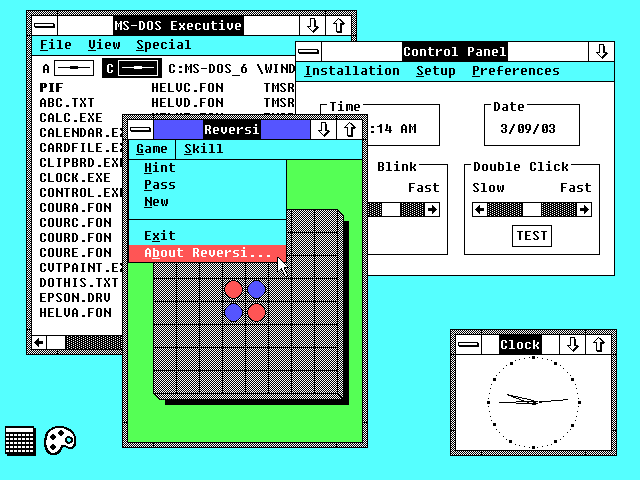
Windows 1.01 was based on DOS and was incredibly slow, but it reminded one of the Macintosh GUI in some features. In order to prevent Apple from taking legal action, Gates put the screws on Apple boss Sculley. His message was: As soon as Apple sends out the lawyers, Microsoft will immediately stop the development of Word and Excel for the Mac. Since Apple was depending on the Microsoft applications, Sculley licensed some of the Mac technologies to Microsoft.
As Microsoft went public with the next large version leap of Windows 2.03 at the beginning of 1988, Sculley tried to pull the ripcord and sued Microsoft and Hewlett-Packard for copyright infringement on March 17, 1988. John Sculley had been in a difficult situation, particularly as he had engaged in vague formulations in the contract with Microsoft in 1985, which gave great leeway to Gates and his lot. Moreover, he knew that his chances to win an action against Microsoft had been, purely from a legal viewpoint, not particularly good: “The look and feel, which is how it looks, the experience of using it, was not patentable, but it was copyrightable, but there was no precedent law. This was going to be a precedent-setting case.”
Parody of an advertising spot for Windows featuring Steve BallmerBill Gates recalls also reluctant this time.: “But it was a period of five years where, Microsoft er, our whole strategy would have been ruined because Windows was very important to us. (…) We assumed that the lawyers, the judges would all come to the right conclusion which eventually they did.” Sculley: “And Apple lost. But in that period of about six years that this case was going on it may have lulled us into a bit of complacency thinking that we were going to be insulated, you know, from the Windows attack.”
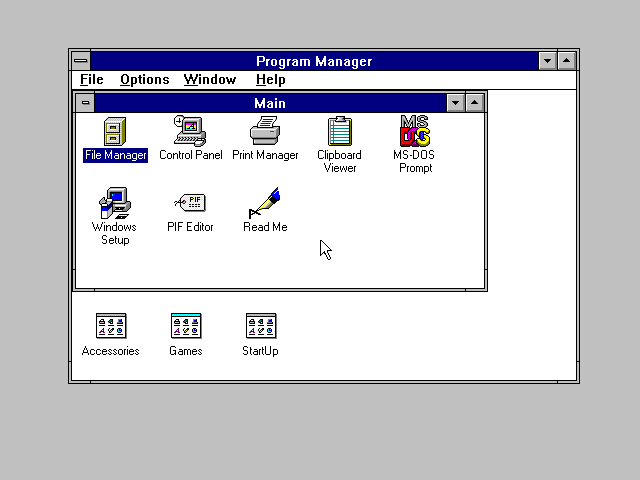
Windows 3.1
The introduction of Windows 3.1 in 1992 brought Microsoft the breakthrough in the “GUI war”. The system lacked the elegance and usability of the Macintosh system 7.0, but Windows appeared good enough to most PC users. With the help of Windows 95, which had been introduced with gigantic effort on August 24, 1995, Microsoft caught up closer to the Mac and in some aspects even appeared more progressive than the Mac OS, which had become dated in the meantime.
Steve Jobs, who, as the head of NeXT, had observed the advance of Windows from a distance, did not have any kind words for Bill Gates at the launch of Windows 95:
The only problem with Microsoft is they just have no taste, they have absolutely no taste, and what that means is – I don’t mean that in a small way, I mean that in a big way. In the sense that they don’t think of original ideas and they don’t bring much culture into their product, and you say why is that important – well you know proportionally spaced fonts come from type setting and beautiful books, that’s where one gets the idea – if it weren’t for the Mac, they would never have that in their products and so I guess I am saddened, not by Microsoft’s success – I have no problem with their success, they’ve earned their success for the most part. I have a problem with the fact that they just make really third rate products.
It is claimed that Jobs has apologized to Bill Gates for this remark later.
Steve Jobs about Microsoft (1995)
The relationship between Apple and Microsoft – and thus also between Steve Jobs and Bill Gates – did not get back to normal before the summer of 1997, when Steve Jobs returned to Apple and engaged in the support of Microsoft to make the troubled company profitable again.
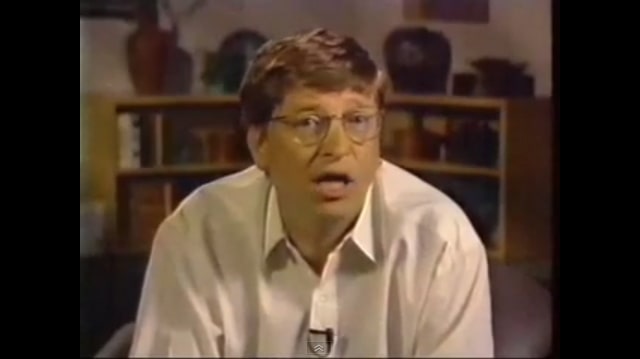
Bill Gates on the video screen at the MacWorld Expo 1997 in Boston
Many faithful Apple fans still remember with horror the moment when Steve Jobs announced the former archrival very pragmatically as the knight in shining armor at the MacWorld Expo 1997 in Boston with Bill Gates appearing on an oversized video screen just like “Big Brother.” Introducing Gates, Jobs said: “We have to let go of the notion that in order to for Apple to win, Microsoft has to lose. Relationships that are destructive don’t help anybody. The era of setting this up as a competition between Apple and Microsoft is over.”
According to certain rumors, Microsoft invested 150 million dollars in 150,000 Apple stocks and paid another 100 million dollars for copyright infringement over the past few years. At the same time, Gates obliged himself to continue the development of the Internet Explorer and Microsoft Office for the Mac for the following five years. Gates drew hisses from the audience of Apple faithful. The crowd also groaned when Steve Jobs said Apple would make Microsoft’s Internet Explorer the default browser for viewing the World Wide Web on Macintosh computers. That development was a blow to Netscape Communications Corp., which made a more popular competing browser and lost later on in the famous “browser war” against Microsoft.
In October 2015 Steve Ballmer appeared on Bloomberg TV where the former executive briefly touched on Microsoft’s monumental 1997 investment in Apple.
At the time, Microsoft’s deal with Apple not only helped rescue the company from the brink of bankruptcy, it gave Apple a much-needed lifeline, affording the company room and time to innovate. And as we all know, the deal ultimately helped set Apple up for the most astounding tech resurgence in history.
In 2010 – after a stunning comeback – Apple Inc. overtook Microsoft Corp. to become the most valuable technology company on optimism it can keep adding customers for its iPhone, Macintosh computer, and iPad. On May 26th by 4 p.m. New York time in Nasdaq Stock Market trading, Apple’s market value was at $222.1 billion, higher than Microsoft’s $219.2 billion. That made Apple the most valuable technology firm in the world.
In an interview with Kara Swisher and Walt Mossberg from the Wall Street Journal, Apple CEO Steve Jobs downplayed the significance of Apple’s passing Microsoft in market value. “For those of us who have been in the industry a long time, it’s surreal,” Jobs said. “But it doesn’t matter very much, it’s not what’s important.
“It’s not why any of our customers buy our products. So I think it’s good for us to keep that in mind.”
“They just don’t get it.” That’s how Steve Jobs described his digital rivals Microsoft and Google in an interview with his biographer Walter Isaacson.
For his biography, “Steve Jobs,” Isaacson conducted more than 40 taped interviews with the Apple co-founder and CEO – all of them done while Apple was on its ascent with one great product after another, but Jobs was on his decline, ill with a form of pancreatic cancer that would end his life at age 56.
Update:
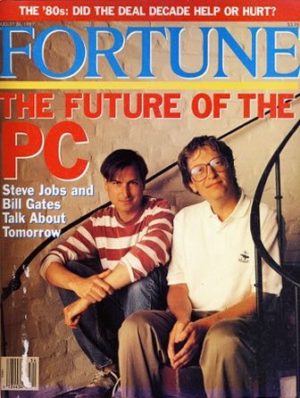
JOBS AND GATES TOGETHER The boy wonders of computing, now thirtysomething, argue over where innovation comes from and where PCs will go.
By Steven P. Jobs, William H. Gates III, Brenton R. Schlender
August 26, 1991
(FORTUNE Magazine) – The two college dropouts most responsible for unleashing the PC revolution rarely see each other anymore, though they say that they’re still friends. At FORTUNE’s invitation, Bill Gates and Steve Jobs met for a Sunday evening in late July to discuss the prospects for the tumultuous industry they shaped. Gates, 35, left Harvard in 1975 to co-found Microsoft. His big break came in 1980, when IBM asked him to provide the operating system — the program that manages a computer’s inner workings — for its now famous PC.
Jobs, 36, who left Reed College to sojourn in India, is best known for co-founding Apple Computer. He led the development of the Macintosh, a computer much easier to use than IBM’s somewhat nerdy PC. Gates has imitated many features of the Mac’s software with a popular PC program called Windows.
Since the mid-1980s the men have taken dramatically different paths. Gates, who owns more than $4 billion of Microsoft stock, remains a workaholic bachelor and an omnivorous reader — he has read several biographies of Napoleon. He has built Microsoft into the world’s largest and most profitable PC software company. It hasn’t all been rosy. Microsoft’s relationship with IBM soured this year, mainly because the two couldn’t agree on an operating- system strategy for future PCs. And the Federal Trade Commission recently began investigating Microsoft’s practices.
Jobs has been less visible but just as busy. In 1985 he started Next, aiming to build the personal computer of the 1990s. Next’s first machine appeared two years ago. Its basic software, NextStep, makes the machine unusually easy to customize; IBM was so impressed it licensed NextStep for its own computers. Despite the dazzling technology, the going has been slow at Next. For one thing, IBM never put NextStep on the market. But lately business has picked up — 10,000 systems rolled out of Next’s automated plant during the second quarter. Jobs has other reasons to smile. He and wife Laurene, who married earlier this year, are expecting their first child in September.
FORTUNE associate editor Brenton R. Schlender put the questions at the meeting. Beneath the conviviality, Jobs and Gates each had a business objective. Jobs lobbied for Gates to develop software for the Next computer. And Gates, whose company is being sued by Apple for allegedly pirating Macintosh software features, was hoping to learn more about the product’s origin.
Schlender: What did you think when the PC appeared ten years ago?
Jobs: When IBM entered the market, we did not take it seriously enough. It was a pretty heady time at Apple. We were shipping tens of thousands of machines a month — more computers than IBM was total. Even so, a lot of people think IBM invented the personal computer, which of course isn’t true.
Gates: A lot of people think Apple did, and that isn’t true either. Our first program was for the Altair ((a mail-order kit sold in 1975)).
Schlender: Does Microsoft’s control of PC operating systems stifle competition in the industry?
Gates: There’s not one element of the industry that’s not competitive. There are people who are cloning Intel’s chips; there are people who are cloning my operating system; there are many, many people who make PCs; and for every software application there are lots of people competing. There is no competitive imperfection.
Jobs: How come nobody has successfully competed with you? I’m not accusing you or Microsoft of anything. I’m not even saying it’s necessarily bad. I’m just saying it’s an interesting contrast. When I zoom back and look at this, there are hundreds of people making PCs, and hundreds of people writing applications programs for them.
Gates: Right.
Jobs: But they all have to travel through this very small orifice called Microsoft to get to one another.
Gates: It’s a very large orifice! ((Laughs.))
Jobs: But it’s only one company.
Gates: Are you saying there’s something wrong with our popularity? My approach to the PC market has been the same from the very beginning. The goal of Microsoft is to create the standard for the industry. Nothing has changed.
Schlender: What does the future hold for IBM and Apple? What do you think of their decision to collaborate on PC software?
Gates: It’s surprising to me.
Jobs: Yes, we are confused about that.
Gates: ((Apple President)) Mike Spindler has said they want to turn Apple into more of a software company. If that’s your goal, you don’t go and give the half of the company that is the future of Apple software to a joint venture. What is Apple getting in return? Here’s the part I don’t understand: What is the contribution from IBM? The IBM name? Did Apple feel so bad about their own work that they had to have that?
Jobs: I truly believe the challenge for IBM is that they can’t survive by selling the same thing you can buy from somebody else for 30% less money. Their cost structure doesn’t allow them to compete with companies that don’t do massive amounts of R&D, that don’t have twice as many employees as they need, et cetera, et cetera. So IBM has to do one of two things: One, suffer continuous erosion of its market share until eventually it goes out of business, which I hope doesn’t happen. Or two, come up with some way to add value. In my opinion the way to make your machines unique is with unique software.
Gates: I said that back in the Seventies! ((Laughs.)) There’s something else I don’t understand. If IBM already held a license to your NextStep software, why did they get all this going with Apple rather than just come to you and expand their license?
Jobs: I really want to answer this que
stion, but I’ve got to be careful what I say. It’s not my purpose to alienate anyone at IBM.
Gates: We share this interest. ((Both laugh.))
Jobs: Somebody at IBM a few years ago saw our NextStep operating system as a potential diamond to solve their biggest and most profound problem, that of adding value to their computers with unique software. Unfortunately, as I learned, IBM is not a monolith. It is a very large place with lots of faces, and they all play musical chairs. Somewhere along the line this diamond got dropped in the mud, and now it’s sitting on somebody’s desk who thinks it’s a dirt clod. Inside that dirt clod is still a diamond, but they don’t see it.
Schlender: Is the PC industry, which until now has been dominated by American companies, liable to get overrun by the Japanese?
Jobs: Computer companies fall on a spectrum of enthusiasm for manufacturing. On the left end are companies that look at manufacturing as a necessary evil, who wish they didn’t have to do it. And at the far right you have people who look at manufacturing as a competitive advantage. Clearly a lot of the Japanese companies look at themselves that way. Unfortunately a lot of American companies look at manufacturing as a necessary evil. You can say the same thing about the way they see software. My opinion is that the only two computer companies that are software-driven are Apple and Next, and I wonder about Apple. Most computer companies would rather that software didn’t even exist.
Gates: Good!
Jobs: It’s good for Microsoft today. But unfortunately all those companies could give way to Japanese companies a few years down the road.
Gates: I think you give up too easily on Americans. You pick one dimension . . .
Jobs: I focus on manufacturing because I care about it. I’ve seen IBM’s. I built Apple’s and Next’s, and I know what Sun does. Ultimately, I believe that most of the PCs will come from offshore. We’re just not good enough at manufacturing.Where will the key innovations come from? Established giants like Microsoft or upstarts like Next?
Gates: I contend technology breakthroughs can happen by extending what we already have. Let’s take handwriting computers. The hardware is coming from PC-compatible makers like Dell Computer ((of Austin, Texas)) and NCR and some Japanese companies. The software will come either from Microsoft or from a U.S. competitor named Go Corp. ((of Foster City, California)). That’s going to be a major breakthrough, and who do you give credit to?
Jobs: I think everybody gives credit to Go, but Go will be crushed.
Gates: That’s one of the nastiest comments I’ve ever heard. I’ve been working on handwriting since long before there ever was a Go Corp.
Jobs: Really? I didn’t know that. Most people would say that Go is the company that first tried to commercialize that technology.,
Gates: Well, Go hasn’t shipped anything yet, and I’ll ship my stuff before they ship theirs.
Jobs: My experience has been that creating a compelling new technology is so much harder than you think it will be that you’re almost dead when you get to the other shore. That’s why, when you take big leaps, like the Mac, or object- oriented programming, or handwriting recognition, you have to leave old technology behind. When Lindbergh was going to fly from New York to Paris, he had to decide what to take with him. There were a lot of demands. They fell into two categories — things that would make his journey safer or more comfortable, and things that would increase his chances of making it to Paris. Weight was a real problem. He could take more gas, which would increase his safety, or he could take a compass, which would increase his chances of getting to Paris. Every time he came down on the side of increasing his chances of getting to Paris at the sacrifice of safety or comfort. That’s why he made it.
Gates: Smart people like Steve ought to try to build things from scratch. That’s a worthy thing. But every time it should be a test. Right now there’s a test in handwriting PCs, in object-oriented operating systems, in multimedia computers. Those are the big questions for personal computing in the 1990s, and I’m the one who has to prove the validity of the evolutionary approach.
Jobs: It’s true, your evolutionary approach with Windows is bringing to PCs great new technologies that Apple and others pioneered. But in the meantime — and it’s been seven years since the Macintosh was introduced — I still think that tens of millions of PC owners needlessly use a computer that is far less good than it should be.
Turnarounds from the brink of death or irrelevance are in high demand these days. AOL, MySpace, Yahoo!, Nokia, and RIM have all had their moment in the sun as the celebrated leaders of hot markets. All of them lost it, and many more have done so as well. Some fell out of the sky with sales numbers plummeting 40% and more per year. Others dragged it out and, instead, slowly faded away. One of them was Apple in 1997. Now the most valuable company in the world, it had lost nearly 50% of its revenue and came pretty close to bankruptcy. But then they came back with a vengeance. In fact, they now seem nearly unstoppable, disrupting more and more markets. They are the only technology company that has been able to define not just one, but two computing eras: first, with the introduction of the Macintosh, which defined the PC era; and then the debut of the iPhone, which has ushered in the smartphone era. That leaves Marissa and us with two compelling questions: How did Steve Jobs do it? Can it be done again?
How did Steve Jobs turn around Apple?
Jobs had to steer Apple away from its main market in order to return and disrupt it. Apple didn’t have a chance to win against the Wintel monopoly by building better PCs. They were stuck in a niche and had to build momentum outside the mature personal computer market in order to have a real chance at disrupting it. In that regard, it was a boon for Apple that people thought the company had lost their way when they launched the iPod instead of a new Mac, MacBook or Newton.
People in the industry dismissed it and nobody tried to stop Apple from owning the online music business until it was too late. When Microsoft finally realized the iPod threat and came out with their own music device, the Zune, they failed to make even the smallest dent in Apple’s market dominance. By that point, “Apple 2.0”—with Jobs’ singular focus on design and innovation—was unstoppable. The iPod led to the iPhone, the iPhone led to the iPad, and both led to the MacBook Air and MacBook Pro with Retina Display, all of them taking away market- and mind-share from Microsoft, not to mention other PC and device competitors.
Not that long ago, Microsoft has acknowledged their strategic misery by launching their own tablet computer, the Microsoft Surface. They have decided to compete with their existing partners in order to survive in an Apple world, a clear indication that Microsoft is scared by Apple’s success.
With hindsight, we can easily see the cascade of waves that Steve Jobs surfed with Apple, with increasing size and momentum. To take away valuable turnaround lessons for other companies, it is instructive to segment the 6 different phases of Apple’s turnaround.
The severe cost cutting and Microsoft’s investment in Apple where mission-critical in giving him enough runway to bring a few new products to the market.
It takes a determined (or a truly desperate) mind to do this kind of cost cutting. And that is the reason why many companies fail before they even start. Delusion and ignorance are so much easier to implement (until you hit the ground). While accepting the hard truth about your failing company is difficult, it is the only chance you have. Steve Jobs did exactly that when he concluded that Apple can’t afford to continue fighting with Microsoft anymore.
Think Different told everyone believing in Apple why it was worthwhile to keep Apple alive and not follow Michael Dell’s advice. With this ad, Steve Jobs refreshed the meaning that every existing and future Apple product comes bundled with. It will turn out to be the hardest thing to copy for all competitors.
Phase 2: Focus your core business
But cost-cutting and image ads only carry you so far. Apple had to increase their top line in order to survive.
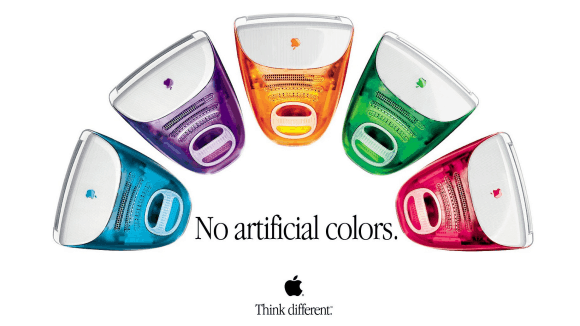
The first new product Apple released after Steve Jobs’ coming home was the original iMac. It was surprising what a difference a little color makes. Adding color to this cute little desktop computer became an instant success. It was also a nice showcase of everything Apple: beautiful to look at, simple to use and innovative. So far, everyone thought computers had to be beige or black and sell through their technical specs. Not anymore.
iMac in Colors
The iMac success helped to keep Apple alive and made it shine again for the first time. However, it didn’t change the underlying dynamic of the PC market. Microsoft owned it and Apple was still only surviving in a small niche.
Phase 3: Figure out where the puck will be going
The strategic genius of Steve Jobs is visible the most in what came next. He must have realized at this point that Apple cannot win against Microsoft and Intel the old fashioned way by building better, more reliable, easier to use and more beautiful but conventional computers. Those things just didn’t matter in a world where Microsoft Windows, Word and Excel were the standards in nearly every industry and nearly every user’s mind. The market for personal computers was in a pretty mature state at this point in time. There was no chance at all for Apple to be ten times better than the whole Windows ecosystem and get people and companies to switch. In order to win, Apple had to change the rules of the game. Further frontal attacks against Wintel were simply futile.
I don’t have any internal knowledge of Apple considerations at that time, but I am pretty sure that Steve Jobs was pretty aware that Moore’s Law will give us powerful pocket-size computers in a not too distant future. “A computer in every pocket” was the logical conclusion. That sounds awfully lot like “A computer on every desktop”, Bill Gates’ big and tremendously successful vision for Microsoft in the 80th. And Microsoft’s board might wonder why they missed this obvious next step after Microsoft succeeded with their initial vision in the 90th. Fortunately for Apple, Microsoft didn’t think ahead. Instead, they waisted a lot of time milking their customers and trying to be like Google.
Ironically, Apple made “a computer in every pocket” happen. They didn’t call it a computer though.
Phase 4: Take the first step
The first step to take advantage of the inevitable mobile revolution was not to launch a handheld computer. Apple tried that before with the Apple Newton and failed. Too complex, too expensive and too much of a niche market.
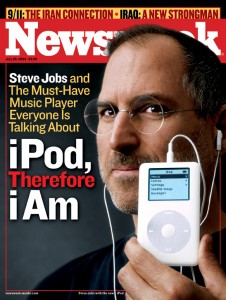
Steve Jobs and iPod on the cover of Newsweek
So Apple did something surprising. They launched the original iPod — no new computer, no better laptop and no new Newton, just a portable music player. Some Apple fan boys were up in arms: “iPoop…iCry. I was hoping for something more”. Nonetheless, the iPod became a hugh success and laid the groundwork for Apple to leapfrog Microsoft a few years later.
The beauty of the initial iPod for Apple was its simplicity. It just had one feature, playing your music on the go. Other than the Apple Newton, it addressed a clear need (all your music on the go) with a huge market potential (who doesn’t like music) and a lack of simple solutions (Sony, anybody?). At the same time, it was the first mobile computer product that reached mass adoption around the world and defined a new market. The enormous sales numbers enabled Apple to build a supply chain that is unmatched by their competitors.
It is difficult to overstate the strategic value of the iPod for Apple. The iPod sold like hot cakes and made a lot of money for Apple. It became a cultural icon and dramatically increased the number of people who own at least one Apple device. And because it worked well with Windows, iTunes for Windows became the first piece of Apple software that many people laid their hands on. Suddenly, many experienced the joy of using Apple products and decided to buy Apple computers instead of Windows PCs, creating Apple’s famous halo effect.
Steve Jobs made another strategic move to get as many people as possible experience an Apple product or service for the first time. He launched Apple’s own stores. What was dismissed by many experts (as usual, one might say), turned over time into one of the most successful retail business on Earth.
The iPod experience was strategic in two more ways, 1) iPods were bought by consumers, not enterprises and 2) iPods smoothly bundled a piece of hardware with software and services. Both aspects are disrupting multiple industries these days. The consumerization of IT broke Microsofts’ and RIM’s influence on IT departments and is here to stay. And the integration of hardware, software and services is the new black. Given Apple’s success, it is no big surprise that Google, Microsoft and Amazon changed course and copy Apple’s bundled approach for seamless integrated hardware, software and services.
Phase 5: Build momentum
The momentum of Apple’s iPod business soon overshadowed their old core business. After launching and developing multiple iPod variations, it was time to catch the next big wave. The rise of smartphones threatened to make iPods redundant some day. Smartphones had been around for a while but they still kind of sucked. They offered only a crippled Internet experience, where complicated to use and lacked a smooth music experience that could compete with the beloved iPod. In 2006, everyone and their grandmother was expecting Apple to build a so-called “iPhone”. Couldn’t Apple build a mobile phone that works elegantly like an iPod and excels as a phone and mobile computer? Well, they could.
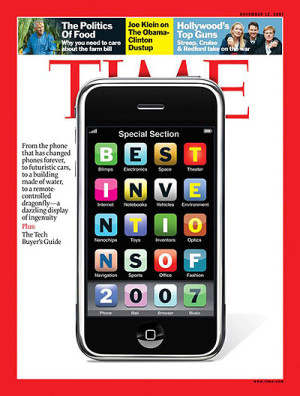
iPhone on the cover of Time Magazine
When Steve Jobs introduced the original iPhone in 2007, he answered the question how nearly all mobile computers will look like in the future. Regardless if competitors knew it or not, they only had two alternatives: 1) “slavishly copying the iPhone” or 2) choose ignorance and see their market share entering the free fall. Only three years after entering the mobile phone market, Apple already commanded more than 50% of the global profits.
The original iPhone promised to be “three products in one”- a music player, a mobile phone and a touch Internet terminal. It soon became much more than that. Against Steve Jobs’ desire to control the whole user experience, hackers enabled us to jailbreak our iPhone and install a fast growing number of useful (or at least entertaining) apps. Jailbroken iPhones soon became the better iPhones and Apple quickly changed course.
The following year, Apple launched the App Store and turned the iPhone into a full blown mobile computing platform. They managed to provide what turned out to be an explosive balance between openness and control. Apple still maintained control over the iPhone ecosystem, but now everyone could start writing apps for the iPhone and have Apple distribute them for free or 30% of the sales price for paid apps. It has never been easier to find, install and update software on a computer. Everyone did it. With more than a billion downloads and a default price point for most paid software of 99 cents, the App Store redefined the software business.
Again, the Microsoft board might wonder, why Microsoft didn’t use their monopoly to build a similar software distribution platform for PCs.
The iPhone soon became one of the fastest selling consumer devices in history. Fortunately, Apple didn’t have to start from scratch building a sufficient supply chain. While long lines in front of Apple stores around the world and temporally constrained supplies became the norm for every new launch, Apple always managed to catch up with the demand quickly by further optimizing their supply chain. First, they became more valuable than Microsoft, then they became the most valued public company on Earth.
The strategic value of the iPhone for Apple is gigantic. The market is enormous and still growing with high customer loyalty and a replacement cycle of less than 2 years for Apple’s iPhone. Owning the latest iPhone for many became the ultimate status symbol. Everyone stood in line to lay their hands on the latest model, Apple fan boys, corporate executives, teenagers, and not to forget the growing middle class in China, creating another strong halo effect for other Apple products.
In order to invent the iPhone, Apple had to answer the question how a mobile operating system has to look like. Steve Jobs concluded that a touch device asked for a fundamentally different interaction model than personal computers, and therefore Apple decided to build a new mobile operating system instead of using a downsized MacOS X. This decision to develop iOS turned out to be strategic. According to Steve Jobs, the PC ecosystem was caught in a kind of local optimum. You have to start fresh, ignoring many existing rules and explore completely new solutions to arrive at superior solutions. The resulting operating system iOS is designed for touch interfaces from the inside out. There are no windows anymore, no console, no file manager, and (nearly) no need to stop applications. Software installation is done with a click, automated updates inclusive. iOS devices are always on, ready to go in a second and still achieving a tremendous battery life. iOS achieved many things that PCs didn’t. They came without a manual and were used by toddlers and grandparents alike.
Phase 6: Finally disrupt the incumbent’s business
In 2010, it was time to take the lessons learned with the iPhone and apply them to the world of more traditional computers. Leveraging everything Apple had learned and built with the iPod and iPhone, they first released their own take on tablet computers.
The tablet market was around for a while but still irrelevant. That changed when Steve Jobs introduced the iPad. He believed it was the greatest thing they ever did and felt “annoyed and depressed” when people initially laughed at it. He was right non the less. The iPad sold even more quickly than the iconic iPhone and became thefastest selling consumer device in history. Within two years, many competitors tried and failed to match the iPad’s appeal to users. At the same time, PC makers started to feel its deep impact. PC shipments stalled. Companies, universities and schools started to deploy iPads replacing traditional PCs in troves and it soon became a shared believe that tablet shipments will dwarf PC shipments some day in the not to distant future.
Even without tablets, Apple won market share in the traditional PC market for more than 20 consecutive quarters. But Apple wanted more. Also in 2010, Apple added a second line of attack and started to bring iPhone/iOS innovations back to the Mac nurturing the famous halo effect. With the relaunch of the MacBook Air and MacBook Pro with Retina Display, Apple started to apply lessons learned in the mobile space directly in the PC space, leveraging parts of the same supply chain.
What I find most fascinating about Steve Jobs’ strategy to turn around Apple is the rigorous long-term thinking in so many dimensions. Many trends that put other companies on defense were leveraged by Apple many years ago. Microsoft and RIM are struggling with the consumerization of IT, Nokia is struggling with touch interfaces, BestBuy is struggling with “showrooming”, the PC ecosystem is struggling with complexity, Android is struggling with fragmentation. Motorola, HTC and LG struggling with commoditization. Apple addressed all these challenges early on. There have certainly been surprises and the need to rewrite parts of the strategy on the go like the decision to open up the iPhone more than planned in the first place. However, the executive team at Apple seemed to have applied long-term thinking to answer many detailed questions regarding their strategy.
In principle, a turnaround like Apple’s can be done again – at least in fields with a high degree of innovation. If there is innovation there will be disruption, and if there is disruption someone can catch the new wave, surf it and overthrow the incumbent. What Apple’s story tells us too, is that incremental improvements won’t be enough if you are losing. You have to identify a need that is not addressed well and be at least ten times better than existing solutions. Ideally, this need is shared by enough people and leads you in a direction you want to go in order to catch the next wave.
“A good hockey player plays where the puck is. A great hockey player plays where the puck is going to be.” Wayne Gretzky
The two things that played a major role for Apple’s turnaround that won’t be available for most other companies is the ideals Apple stood for and their loyal followers around the world. Even in Apple’s dark times around 1998, Apple was admired by many. Most people wanted Apple to succeed. That makes a difference and you might ask yourself how much this can be said about RIM, Microsoft, Nokia or Yahoo!?
Dieter Rams talks about being bum-rushed at a party by Philippe Starck, who exclaimed, “Apple is stealing from you!” But when it comes to Ive and Apple, Rams subscribes to the adage “Imitation is the sincerest form of flattery.”
And another interesting interview with Dieter Rams at Fastcodesign.com:
If you were to design a computer now, what would it look like?
It would look like one of Apple’s products. In many magazines, or on the Internet, people compare Apple products to things which I designed, with this or that transistor radio from 1965 or 1955. In terms of aesthetics, I think their designs are brilliant. I don’t consider it an imitation. I take it as a compliment.
Ron Wayne, Apple, Inc.’s sometimes forgotten third co-founder, has posted a short essay entitled “Why I Left Apple Computer After Only 12 Days, In My Own Words”. The piece notes that though he sold his share of Apple for pennies on the dollar, he has no regrets. Instead, he was looking to change the world in his own way:
I didn’t separate myself from Apple because of any lack of enthusiasm for the concept of computer products. Aside from any immediate apprehension in regard to financial risks, I left because I didn’t feel that this new enterprise would be the working environment that I saw for myself, essentially for the rest of my days. I had every belief would be successful but I didn’t know when, what I’d have to give up or sacrifice to get there, or how long it would take to achieve that success.
In addition to my rather mundane daily activities during my time as an Apple Co-founder—a full time job at Atari working for Al Acorn and directly answerable to Nolan Bushnell as Atari’s International Field Service engineer—I was writing my treatise on the true nature of money, Insolence of Office.
At the time I was earning $22,000 a year—$88,000 a year in today’s money—we’ve had at least 400% inflation since that time. The Dow Jones had just broken a thousand points. Something Steve Jobs and I had discussed many times—Jobs had asked me if I had thought the Dow Jones would ever break a thousand points. I told him that it would break 1,000, then 5,000 thousand, and at some point in the future, 10,000 points. These types of conversations were typical of those Jobs and I would have over lunch at some of the local diners surrounding Los Gatos, during our time together at Atari.
To counter much that has been written in the press about me as of late, I didn’t lose out on billions of dollars. That’s a long stretch between 1976 and 2012. Apple went through a lot of hard times and many thought Apple would simply go out of business at various times in its maturity. I perhaps lost tens of millions of dollars. And quite honestly, between just you and me, it was character building.
If I had known it would make 300 people millionaires in only four years, I would have stayed those four years. And then I still would have walked away. Steve and Steve had their project. They wanted to change the world in their way. I wanted to change the world in my own.
My book Insolence of Office is the result of 40 years of research.
We’ve had a 2500% increase in inflation since the end of World War II. The $2,300—$800 and then later, another $1500—I received from Apple Inc. in 1976 would be roughly the same as $9,200 today. I’m sure you would agree with me that’s not bad pay for only 12 days worth of work. However, that increase of inflation is something I predicted decades ago and the driving factors behind that inflation is something I discuss in great detail in my book.
I’m sure I’ve mentioned this to you before, as a belief that I truly hold (and I know this sounds arrogant as hell), but the writing and publication of Insolence is, in itself, enough to justify my existence on this planet.
Get the book on iTunes: http://bit.ly/yuXdcj Get the eBook for the Kindle: http://amzn.to/ziQ7cS Get the Paperback from Amazon: http://amzn.to/wBIXbf
What is it like inside a factory that makes Apple iPads? Tonight, an ABC Nightline special called “iFactory” gave us the first peak at actual factory working conditions and the people living on the assembly line.
Bill Weir, a reporter for ABC, traveled to Foxconn, a Chinese manufacturing company, soon after the media began taking a closer look at Apple’s assembly line practices. He went along with the Fair Labor Association, which Apple recently invited to audit its facilities in an effort to improve its conditions, or perhaps combat criticism. It also offered to post the audits to its website to keep transparency. Weir notes that Apple paid both to get into the FLA, and also for the audits it will preform, though an FLA employee assures that any “white-washing” will be obvious in the audit report.
Apple announced on August, 24 2011 that CEO and co-founder Steve Jobs had stepped down from his helm, but will serve as chairman of the board. Ray Suarez discusses Jobs’ lasting impact on innovation and what comes next for Apple and the tech world with Walter Mossberg of The Wall Street Journal and Charles Golvin of Forrester Research.
Steve Wozniak remembers building the first Apple Computer at Authors Business Series Luncheon talking about his book “iWoz: How I Invented the Personal Computer and Had Fun Along the Way”: