Category Archives: Tim Cook

Tim Cook pledges for a federal privacy law

In his most political speech ever Apple chief executive Tim Cook has demanded a tough new US data protection law.

Referring to the misuse of “deeply personal” data, he said it was being “weaponised against us with military efficiency”.

“We shouldn’t sugar-coat the consequences,” he added. “This is surveillance.”

The strongly-worded speech presented a striking defence of user privacy rights from a tech firm’s chief executive.

Mr Cook also praised the EU’s new data protection regulation, the General Data Protection Regulation (GDPR).
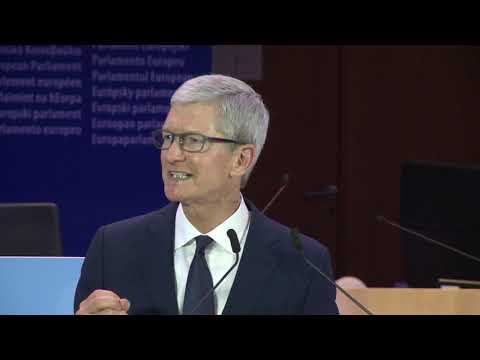
Here is a transcript of his speech:

Good morning.

It is an honor to be here with you today in this grand hall…a room that represents what is possible when people of different backgrounds, histories, and philosophies come together to build something bigger than themselves.

I am deeply grateful to our hosts. I want to recognize Ventsislav Karadjov for his service and leadership. And it’s a true privilege to be introduced by his co-host, a statesman I admire greatly, Giovanni Butarelli.

Now Italy has produced more than its share of great leaders and public servants. Machiavelli taught us how leaders can get away with evil deeds…And Dante showed us what happens when they get caught.

Giovanni has done something very different. Through his values, his dedication, his thoughtful work, Giovanni, his predecessor Peter Hustinx—and all of you—have set an example for the world. We are deeply grateful.

We need you to keep making progress—now more than ever. Because these are transformative times. Around the world, from Copenhagen to Chennai to Cupertino, new technologies are driving breakthroughs in humanity’s greatest common projects. From preventing and fighting disease…To curbing the effects of climate change…To ensuring every person has access to information and economic opportunity.

At the same time, we see vividly—painfully—how technology can harm rather than help. Platforms and algorithms that promised to improve our lives can actually magnify our worst human tendencies. Rogue actors and even governments have taken advantage of user trust to deepen divisions, incite violence, and even undermine our shared sense of what is true and what is false.

This crisis is real. It is not imagined, or exaggerated, or “crazy.” And those of us who believe in technology’s potential for good must not shrink from this moment.

Now, more than ever — as leaders of governments, as decision-makers in business, and as citizens — we must ask ourselves a fundamental question: What kind of world do we want to live in?

I’m here today because we hope to work with you as partners in answering this question.

At Apple, we are optimistic about technology’s awesome potential for good. But we know that it won’t happen on its own. Every day, we work to infuse the devices we make with the humanity that makes us. As I’ve said before, “Technology is capable of doing great things. But it doesn’t want to do great things. It doesn’t want anything. That part takes all of us.”

That’s why I believe that our missions are so closely aligned. As Giovanni puts it, “We must act to ensure that technology is designed and developed to serve humankind, and not the other way around.”

We at Apple believe that privacy is a fundamental human right. But we also recognize that not everyone sees things as we do. In a way, the desire to put profits over privacy is nothing new.

As far back as 1890, future Supreme Court Justice Louis Brandeis published an article in the Harvard Law Review, making the case for a “Right to Privacy” in the United States.

He warned: “Gossip is no longer the resource of the idle and of the vicious, but has become a trade.”

Today that trade has exploded into a data industrial complex. Our own information, from the everyday to the deeply personal, is being weaponized against us with military efficiency.

Every day, billions of dollars change hands, and countless decisions are made, on the basis of our likes and dislikes, our friends and families, Our relationships and conversations…Our wishes and fears…Our hopes and dreams.

These scraps of data…each one harmless enough on its own…are carefully assembled, synthesized, traded, and sold.

Taken to its extreme, this process creates an enduring digital profile and lets companies know you better than you may know yourself. Your profile is then run through algorithms that can serve up increasingly extreme content, pounding our harmless preferences into hardened convictions. If green is your favorite color, you may find yourself reading a lot of articles—or watching a lot of videos—about the insidious threat from people who like orange.

In the news, almost every day, we bear witness to the harmful, even deadly, effects of these narrowed worldviews.

We shouldn’t sugarcoat the consequences. This is surveillance. And these stockpiles of personal data serve only to enrich the companies that collect them.

This should make us very uncomfortable. It should unsettle us. And it illustrates the importance of our shared work and the challenges still ahead of us.

Fortunately, this year, you’ve shown the world that good policy and political will can come together to protect the rights of everyone. We should celebrate the transformative work of the European institutions tasked with the successful implementation of the GDPR. We also celebrate the new steps taken, not only here in Europe, but around the world. In Singapore, Japan, Brazil, New Zealand, and many more nations, regulators are asking tough questions and crafting effective reforms.

It is time for the rest of the world—including my home country—to follow your lead.

We at Apple are in full support of a comprehensive federal privacy law in the United States. There, and everywhere, it should be rooted in four essential rights: First, the right to have personal data minimized. Companies should challenge themselves to de-identify customer data—or not to collect it in the first place. Second, the right to knowledge. Users should always know what data is being collected and what it is being collected for. This is the only way to empower users to decide what collection is legitimate and what isn’t. Anything less is a sham. Third, the right to access. Companies should recognize that data belongs to users, and we should all make it easy for users to get a copy of…correct…and delete their personal data. And fourth, the right to security. Security is foundational to trust and all other privacy rights.

Now, there are those who would prefer I hadn’t said all of that. Some oppose any form of privacy legislation. Others will endorse reform in public, and then resist and undermine it behind closed doors.

They may say to you, ‘our companies will never achieve technology’s true potential if they are constrained with privacy regulation.’ But this notion isn’t just wrong, it is destructive.

Technology’s potential is, and always must be, rooted in the faith people have in it…In the optimism and creativity that it stirs in the hearts of individuals…In its promise and capacity to make the world a better place.

It’s time to face facts. We will never achieve technology’s true potential without the full faith and confidence of the people who use it.

At Apple, respect for privacy—and a healthy suspicion of authority—have always been in our bloodstream. Our first computers were built by misfits, tinkerers, and rebels—not in a laboratory or a board room, but in a suburban garage. We introduced the Macintosh with a famous TV ad channeling George Orwell’s 1984—a warning of what can happen when technology becomes a tool of power and loses touch with humanity.

And way back in 2010, Steve Jobs said in no uncertain terms: “Privacy means people know what they’re signing up for, in plain language, and repeatedly.”

It’s worth remembering the foresight and courage it took to make that statement. When we designed this device we knew it could put more personal data in your pocket than most of us keep in our homes. And there was enormous pressure on Steve and Apple to bend our values and to freely share this information. But we refused to compromise. In fact, we’ve only deepened our commitment in the decade since.

From hardware breakthroughs…that encrypt fingerprints and faces securely—and only—on your device…To simple and powerful notifications that make clear to every user precisely what they’re sharing and when they are sharing it.

We aren’t absolutists, and we don’t claim to have all the answers. Instead, we always try to return to that simple question: What kind of world do we want to live in.

At every stage of the creative process, then and now, we engage in an open, honest, and robust ethical debate about the products we make and the impact they will have. That’s just a part of our culture.

We don’t do it because we have to, we do it because we ought to. The values behind our products are as important to us as any feature.

We understand that the dangers are real—from cyber-criminals to rogue nation states. We’re not willing to leave our users to fend for themselves. And, we’ve shown, we’ll defend those principles when challenged.

Those values…that commitment to thoughtful debate and transparency…they’re only going to get more important. As progress speeds up, these things should continue to ground us and connect us, first and foremost, to the people we serve.

Artificial Intelligence is one area I think a lot about. Clearly, it’s on the minds of many of my peers as well.

At its core, this technology promises to learn from people individually to benefit us all. Yet advancing AI by collecting huge personal profiles is laziness, not efficiency. For Artificial Intelligence to be truly smart, it must respect human values, including privacy.

If we get this wrong, the dangers are profound.

We can achieve both great Artificial Intelligence and great privacy standards. It’s not only a possibility, it is a responsibility.

In the pursuit of artificial intelligence, we should not sacrifice the humanity, creativity, and ingenuity that define our human intelligence.

And at Apple, we never will.

In the mid-19th Century, the great American writer Henry David Thoreau found himself so fed up with the pace and change of Industrial society that he moved to a cabin in the woods by Walden Pond.

Call it the first digital cleanse.

Yet even there, where he hoped to find a bit of peace, he could hear a distant clatter and whistle of a steam engine passing by. “We do not ride on the railroad,” he said. “It rides upon us.”

Those of us who are fortunate enough to work in technology have an enormous responsibility.

It is not to please every grumpy Thoreau out there. That’s an unreasonable standard, and we’ll never meet it.

We are responsible, however, for recognizing that the devices we make and the platforms we build have real…lasting…even permanent effects on the individuals and communities who use them.

We must never stop asking ourselves…What kind of world do we want to live in?

The answer to that question must not be an afterthought, it should be our primary concern.

We at Apple can—and do—provide the very best to our users while treating their most personal data like the precious cargo that it is. And if we can do it, then everyone can do it.

Fortunately, we have your example before us.

Thank you for your work…For your commitment to the possibility of human-centered technology…And for your firm belief that our best days are still ahead of us.

Thank you very much.

Tim Cook: I’m proud to be gay

Apple’s chief executive publicly confirmed that he is gay in an essay published by Bloomberg Businessweek. The 53-year-old wrote he was inspired by Dr Martin Luther King to set aside his desire for privacy to do “something more important.”

Cook said he hopes to support and inspire others by coming out.

While I have never denied my sexuality, I haven’t publicly acknowledged it either, until now. So let me be clear: I’m proud to be gay, and I consider being gay among the greatest gifts God has given me.

Cook said he would continue to advocate for human rights and equality. “We pave the sunlit path toward justice together, brick by brick. This is my brick.”
Many colleagues already knew about his sexual orientation, he said.
On Twitter co-workers and colleges showed support for Cook.

https://twitter.com/pschiller/status/527806723524792321


[contextly_auto_sidebar id=”EyV1FX3hSFxlyvG0n8E7Dxi2Xxmonfds”]

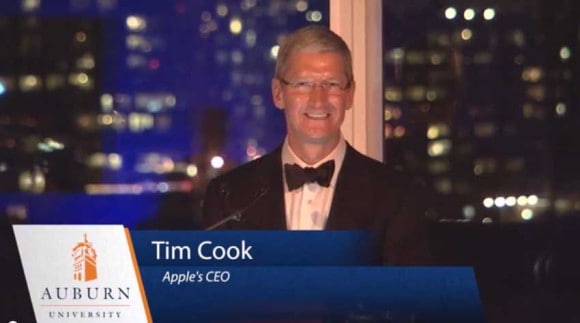
Tim Cook at Auburn University: “Cross-burning was a Symbol of Ignorance”

Tim Cook

Apple CEO Tim Cook isn’t known for talking much about himself, but in a speech this week, he talked about some of the early childhood experiences that shape his passions around fighting for human rights and equality.

“Growing up in Alabama in the 1960s, I saw the devastating impacts of discrimination,” Cook said, accepting a lifetime achievement award from Auburn University, his alma mater. “Remarkable people were denied opportunities and treated without basic human dignity, solely because of the color of their skin.”

He talked about seeing a cross-burning at the home of a nearby family.
“This image was permanently imprinted in my brain, and it would change my life forever,” Cook said. “For me, the cross-burning was a symbol of ignorance, of hatred, and a fear of anyone different than the majority. I could never understand it ,and I knew then that America’s and Alabama’s history would always be scarred by the hatred that it represented.”

More at AllThingsD

Tim Cook about his first year as Apple CEO

NBC News “Rock Center with Brian Williams,” December 6, 2012

Nobody remembers the guy who came after Thomas Edison. And nobody seems to recognize Tim Cook as we walk together across the teeming floor of Grand Central Station.

Tim Cook:

I’m a very private person, I like my being anonymous

As we walk: we’re surrounded by examples of what Apple has done to our society — both good and bad.

People now live their lives while listening to the soundtrack of their lives. Communicating with members of their own community while ignoring the actual community around them.

And in this marble monument to another time, where trains lumber to a halt, two stories beneath our feet — we go up the stairs into what we were told the future would look like. The red shirts greet us. And Tim Cook is home now — in the Apple Store — where the successor to Jobs is suddenly treated more like Jagger.

Tim Cook:

It’s pretty spectacular … who else would put a store like this in Grand Central Station?

And who else would have us believe they intend to be the one company that reverses hundreds of years of business history — by becoming the one company that never fades away into irrelevance.

Brian Williams:
You realize if you’re a company that can keep amazing us, consumers, if you’re a company that can stay fresh without an expiration date, you’ll be the first company ever to do that. There is a cycle, a circle of life, a life and death. And you’re trying to buck that trend.

Tim Cook:

Don’t bet against us, Brian. Don’t bet against us.

We started our day with Tim Cook in lower Manhattan, at another of his 250 austere Apple stores where we began the questioning with: what’s different about him.

Brian Williams:
How are you not Steve Jobs?

Tim Cook:

In many ways. One of the things he did for me — that removed a gigantic burden that would have normally existed is he told me, on a couple of occasions — before he passed away, to never question what he would have done. Never ask the question “What Steve would — do,” to just do what’s right.

Doing right has done well for Tim Cook so far. He’s had a good first year on the job – the company’s stock is up about 45% during his tenure, and think about this: he’s already presided over the rollout of 3 iPads, 2 iPhones and 3 Macs.

Brian Williams:
It’s beautiful.

Tim Cook:

Absolutely stunning. Every detail has been focused on.

Brian Williams:
So, you’ve got guys whose job it is to get this mesh right to get this curve right …

Tim Cook:

To get it precisely right.

In fairness, however — this past year, they haven’t gotten everything precisely right.

Starting with Siri … the small woman who lives in your iPhone. The service amazed all of us at first — but then came under criticism for not being … perfect … or as consistently amazing as Steve Jobs wanted it to be.

And then there are the maps … iPhones used to come with Google maps until they set out on their own — but Apple’s version wasn’t quite ready for launch. It lacked some critical street smarts. And in those early days — God help you if you went anywhere near the Brooklyn Bridge or the Hoover Dam. It was a rare and public embarrassment and Cook fired two top executives in charge.

Brian Williams:
How big of a setback was Maps?

Tim Cook:

It didn’t meet our customers’ expectation, and our expectations of ourselves are even higher than our customers’. However, I can tell ya — so we screwed up.

Brian Williams:
And you said goodbye to some executives.

Tim Cook:

Well, we screwed up. And we are putting the weight of the company behind correcting it.

As for the iPhone 5 itself … they have flown off those perfect Apple store shelves. Apple sold 5-million of them in the first weekend alone, breaking all previous sales records. But buyers of the iPhone 5 soon discovered they had to buy something else – none of the old power cords work on the new equipment.

Brian Williams:
Why did we have to buy new cords for this?

Tim Cook:

As it turns out, we had a connector, a 30-pin connector that we used for a decade or more-

Brian Williams:
I’ve got 500 of ‘em at home-

Tim Cook:

You have a few of those –

Brian Williams:
If you need any. Yeah.

Tim Cook:

On iPod. But, Brian, it was one of those things where we couldn’t make this product with that connector — but let me tell you; the product is so worth it.

And that’s the thing about Apple. Sleek isn’t cheap. Those white ear buds announce to the worldyou’ve got a of couple hundred dollars to spend. Your investment will buy you a staggeringly beautiful product that works unlike any other … and in a lot of workplaces, including our own, the Apple products you’ll see are the ones people bring in from home … they’re usually right there on the desk, next to the computers we have to use for work.

Apple prides itself on being equal parts computer-company and religion. Apple fans get whipped up into a stampeding froth with every new product release … customers famously camp outdoors and then emerge triumphant, emotionally spent. Journalists flock to those dramatic product rollouts — as if the CEO is going to reveal stone tablets instead of the kind with scratch-proof glass. And the legendary Apple culture of secrecy is designed to keep it that way.

Brian Williams:
Why are you institutionally so secretive? How is it that you know how many times I’ve listened to Bob Dylan or Kendrick Lamar or “Have Yourself a Merry Little Christmas” and yet we never get to know anything about you guys?

Tim Cook:

We think that holding our product plans secret is very important because people love surprises.

This was one surprise Apple may not have loved. The new Samsung ad campaign — its blistering, bold, damaging. It portrays Apple products and the people who love them … as somehow passé and uncool and even desperate. It’s a blunt instrument disguised as satire, and it’s a frontal attack on a giant that would have been unthinkable not too long ago.

(Samsung ad:)

Woman: Hey what’d you just do?
Man: I just sent him a playlist
Man: By touching phones?
Man: Yep, simple as that
Woman: It’s the Galaxy S3
Man: I’ll see you at the studio later
Woman: When do you think we’re going to be able to do that thing?
Mom: Hey
Son: Hey mom dad
Mom: Thanks for holding our spot
Son: You guys have fun — home by midnight you two
Announce: The next big thing is already here Samsung Galaxy S3
Mom: But honey this is the line for apps, I stand

The unmistakable message right there? Apple products are for your parents. Samsung makes the really cool stuff and they’re much more casual about it.

Brian Williams:
They came along and tried to paint those with white earbuds, Apple users, as losers. They’re trying to paint their product as cool and yours as not cool. Is this thermonuclear war?

Tim Cook:

We love our customers. And we’ll fight to defend them with anyone. Is it thermonuclear war? The reality is, is that we love competition, at Apple. We think it makes us all better. But we want people to invent their own stuff.

He’s talking about the legal fight between Apple and Samsung — they have sued each other in courts around the world over patent infringements. Apple won the last round in the U.S. when a jury ruled Samsung owed them a billion dollars for stealing ideas. Samsung was back in court just today appealing the judgment. Sometimes the business of making pretty things … can get ugly.

Brian Williams:
How tough is your business, how surprised would we civilians be at how rough it gets? Spying, skullduggery?

Tim Cook:

It’s tough. It’s very tough. You have people tryin’ to hack into systems on a constant basis. You have people trying to elicit confidential information — about future product plans. All of these things are things that we constantly fight.

And then there’s Tim Cook’s larger challenge: the man who rhapsodizes about the perfectly rounded edges of his products … vows to always keep Apple cutting edge.

Brian Williams:
It sounded to me that you and I grew up the same American life, kind of grindingly simple and normal American middle class household — when you and I as kids would go to a neighbor’s house and see, under their new TV, Sony Trinitron, that would tell us something instantly. And you’re smiling. And that brand lasted up until — Walkman, Discman. But then, fast-forward to today, it’s less meaningful. How do you not become Sony, with all apologies to Sony?

Tim Cook:

We’re very simple people at Apple. We focus on making the world’s best products and enriching people’s lives. I think some companies — maybe even the one that you mention, maybe they decided that they could do everything. We have to make sure, at Apple, that we stay true to focus, laser focus — we know we can only do great things a few times, only on a few products.

But will the next great thing be Apple’s long-rumored move … into the television business?

Tim Cook:

It’s a market that we have intense interest in, and it’s a market that we see that has been left behind.

Tim Cook has more to say about Apple’s entry into television … in part two of our interview, when we come right back.

Visit NBCNews.com for breaking news, world news, and news about the economy

In August 2011, Tim Cook was made CEO of Apple. Steve Jobs reduced his own role to Chairman of the Board, then less than two months later he was gone … after a long fight with pancreatic cancer.

It was Tim Cook who was chosen to preside over the private memorial service for Apple employees — thousands of people gathered as the face of the founder gazed down upon them from the side of the building.

Tim Cook:

It was — it was the saddest time in my life.

Brian Williams:
Did you know how sick he was?

Tim Cook:

I always thought that he would bounce back. Because he always did. And it wasn’t until extremely close to the end that I reached a — sort of an intellectual point that — that he couldn’t bounce this time.

It’s his company to run now, and after a peaceful transition of power, he was quickly forced into crisis footing because of the situation in China … where so many Apple products are assembled by skilled workers. There’s been trouble, and Cook travelled there after harsh criticism of poor working conditions and low wages dissolved into violence. The situation was later parodied on “SNL” — by cast members who actually make up the heart of Apple’s demographic.

“SNL’S” FRED ARMISEN:

Ohhhhh, no. Talk about Apple Map. It won’t work, right? It take you to wrong place? You want Starbuck, it take you to Dunkin’ Donut? That must be… so hard for you!

China remains a major issue for Apple, and Tim Cook seems to have a ready answer for it.

Brian Williams:
Why can’t you be a made-in-America company?

Tim Cook:

You know, this iPhone, as a matter of fact, the engine in here is made in America. And not only are the engines in here made in America, but engines are made in America and are exported. The glass on this phone is made in Kentucky. And so we’ve been working for years on doing more and more in the United States. Next year, we will do one of our existing Mac lines in the United States.

Brian Williams:
Let’s say our Constitution was a little different and Barack Obama called you in tomorrow and said, “Get everybody outta China, and do whatever you have to do. Make these, make everything you make in the United States.” What would that do to the price of this device?

Tim Cook:

Honestly, it’s not so much about price it’s about the skills, et cetera. Over time, there are skills that are associated with manufacturing that have left the U.S. Not necessarily people, but the education system stopped producing them.

Cook says Apple has already created more than 600,000 jobs here in the US. That includes everything from research and development, to retail to a solar power farm. He also points to the APP industry — another one of those that didn’t exist before Apple came along … all those icons and all those downloads employ a lot of people.

It was such a different world just six years ago when we sat down with Steve Jobs for one of his last television interviews. He showed us around Apple’s flagship store on 5th Avenue in New York, which six years later is still the big glass granddaddy of them all. Back then he was, as usual, all about the future.

{SOT STEVE JOBS Interview}:

We’ve got some really great ideas of the products we’re going to build next year and the year after that we’re working real hard on. So I think that’s- our focal length is always forward.

Brian Williams:
You’re so different. He was all black turtleneck and the glass frames and mystical and mysterious, and — you know, forgive me, you and I could work at a Best Buy. We’re, you know, plain-looking people. You’re a much more conventional-seeming guy. But there’s obviously brain power he saw in you that you brought to bear on this job.

Tim Cook:

I’m not sure a conventional person would’ve come to Apple at that point in time. Almost everyone I know thought I was crazy.

That’s because Apple was on the ropes back in 1998, Steve Jobs had just come back and was trying to steal Cook away from Compaq Computer … a now-faded name that was actually vibrant back then.

Tim Cook:

I just got to Compaq, I’d just gotten to Houston. I agreed to come out and talk — five minutes into my conversation with him, I was willing to throw caution to the wind and come to Apple. And the rest is history.

Tim Cook’s personal history starts in Robertsdale, Alabama — the son of a Gulf Coast shipyard worker and a mom that stayed at home. After working in an aluminum factory as a teenager he went off to Auburn and then to Duke for an MBA. Among what little else we know about him: he’s got a lot of Bob Dylan on his iPod, and Bobby Kennedy was his hero. He still has his accent from the South. These days he finds solitude in the West.

Brian Williams:
For all the folks trying to get to know you and figure you out — where do you go when you need to go someplace?

Tim Cook:

I work out to keep stress away. I’m in the gym by 5a.m. every morning. If I have some free time, I go to a National Park. I love getting in nature and so this – these are the things that calm my mind and allow me to think clearly so that’s what I do.

Brian Williams:
This is kind of your television-coming-out, and I’m glad you did this. Does this mean you have reached a cruising altitude?

Tim Cook:

There’s no – maybe for other CEOs. There’s no cruising altitude at Apple.

Tim Cook is a manager with a vision — who is following in the footsteps of a visionary turned manager. While he has to worry about global issues like the counterfeiters who instantly turn fake copies of every new Apple product: Cook has to keep one eye on the stock price, constantly, and the other on the future and that sure sounds like it means TV.

Brian Williams:
What can Apple do for television watching? What do you know that is gonna change the game, that we don’t know yet?

Tim Cook:

It’s a market that we see, that has been left behind. You know, I used to watch “The Jetsons” as a kid.

Brian Williams:
Absolutely.

Tim Cook:

I love “The Jetsons.”

Brian Williams:
I was right there with Elroy.

Tim Cook:

We’re living “The Jetsons” with this.

{SOT “The Jetsons:” George you’ll never guess what happened}

Brian Williams:
Facetime is “The Jetsons” but television is still television.

Tim Cook:

It’s an area of intense interest. I can’t say more than that. But …

Brian Williams:
I’m not shocked. All right, complete this sentence “Ten years from now, Americans are going to be amazed that they ever ___” What’s the — give us broad generalities. What’s the new thing?

Tim Cook:

(LAUGH)

Brian Williams:
It’s okay to tell me.

Tim Cook:

Love it. I love it.

Brian Williams:
Let this stuff out. Whatever you’re thinking of for the future … it’s all right.

Tim Cook:

Our whole role in life is to give you something you didn’t know you wanted. And then once you get it, you can’t imagine your life without it.

Brian Williams:
Starting with?

Tim Cook:

And you can count on Apple doing that.

Brian Williams:
Oh man, that’s frustrating.