Exceptionally detailed account of all of Job’s successes and failures
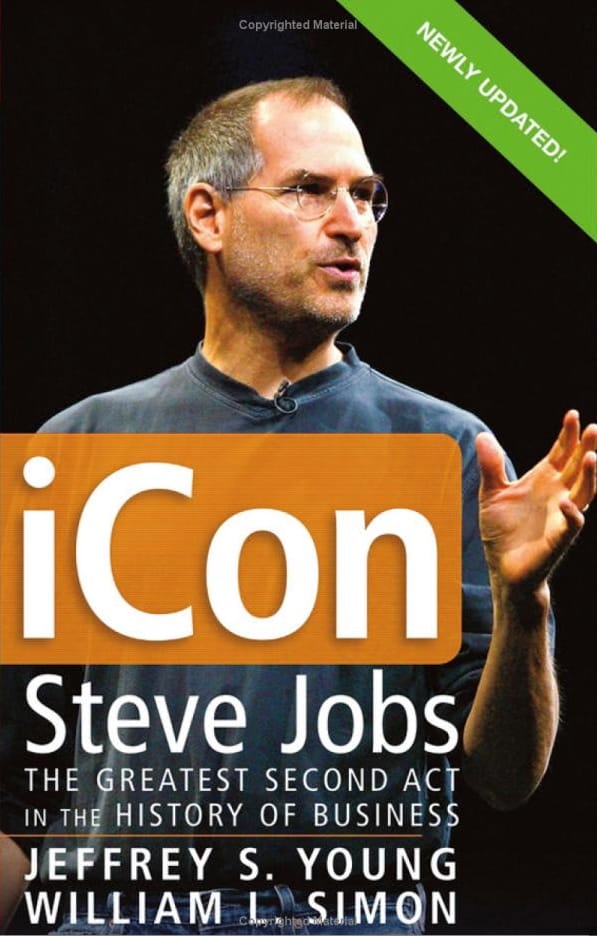
Cover iCon Steve Jobs
iCon Steve Jobs: The Greatest Second Act in the History of Business, retraces the dizzying path of successes and failures of entrepreneur and life long ambassador of technology Steve Jobs. Authors Jeffrey S. Young and William L. Simon produce a detailed account of Jobs’ life and work which begins with Jobs’ adoption and early childhood and ends with his (and Apple’s) success with the iPod and iTunes.
Young and Simon provide an in depth and seemingly unbiased thrashing and congratulatory depiction of what Steve Jobs has accomplished. There is a lot about Jobs covered in this book, and those with an interest in the man behind Apple, the I-pod, and Pixar will find this book fascinating.
Among Steve Jobs accomplishments:
- Created the Apple II, making Apple the first computer giant
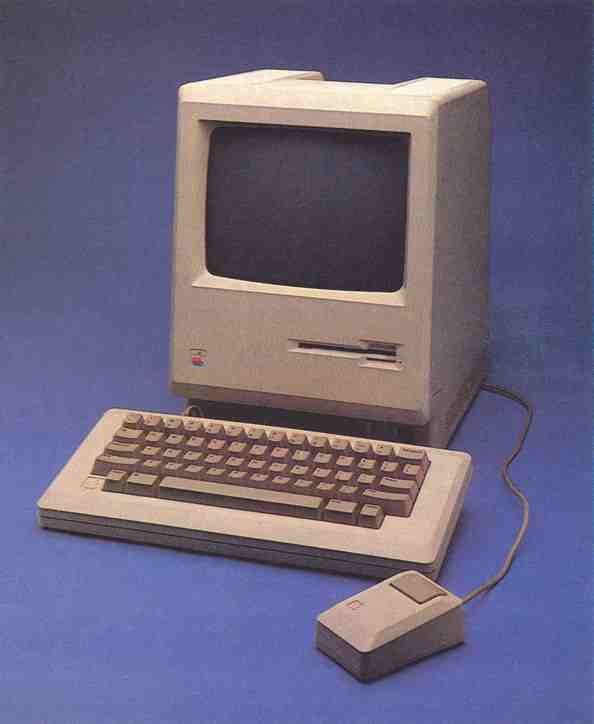
- Created the first windows platform with the Mac
- Created the mouse (respectively made the mouse popular)
- Funded Pixar against all logic becoming the largest animator in history
- Made more money selling a failed company than he did in the original Apple IPO
- Current largest stockholder in Disney, Pixar, and ABC
- Negotiated the first music store with the music industry in the wake of a long list of heavy failures by major companies to accomplish the same (and paving the way for countless since)
- Beat cancer
- Despite a long list of failures, is back on top
- Created 7 blockbuster movies in a row
Among his failures:
- Pissed off enough co workers/employees to nearly fill a stadium.
- Blew a chance to develop the windows system for the PC – paving the way for Microsoft.
- Wasted more money on failed projects than any computer company in history.
I had written a summary after I read the book that provides a full overview of the entire account. For those already interested in the book, I suggest reading the book instead of finishing my review. For those seeking a summarization of the content of the book, the rest of my review is for you.
—–
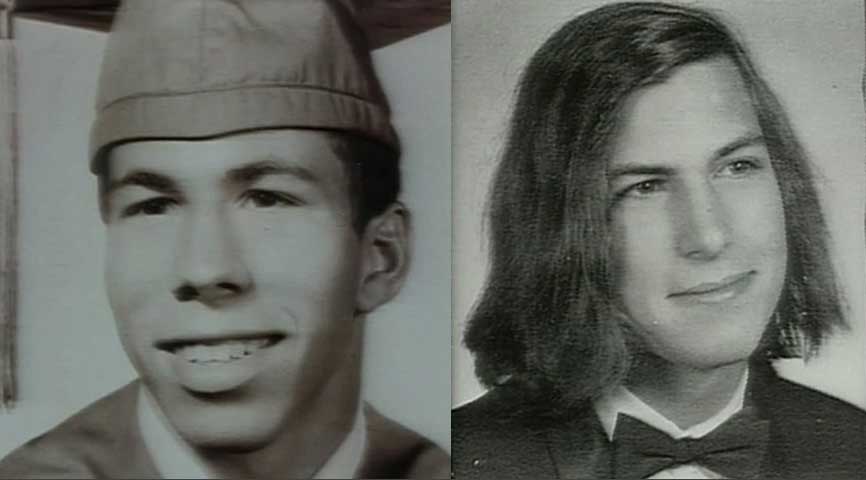
Apple Founders Steve Wozniak and Steve Jobs
Steve was essentially the muscle early on behind his startup, where the other Steve (Steve “Woz” Wozniak) was the schematic genius. Jobs really couldn’t build a schematic with the complexity that Woz could, but Woz could not convince, sell, market, raise money, or operate a business the way Jobs could. It was a perfect combination of skills. Early on they sold illegal boxes that permitted people to make free long distance calls. At that point, they realized there was money in developing their chips which up to that point had only been a hobby. They set out with no money to develop a computer, with Woz doing the designing and Jobs doing the business and sales. Jobs eventually sold 100 computers to a retail store, which when delivered would make them $25,000. They didn’t get paid until they delivered, so Jobs negotiated to get all the supplies on credit using the agreement he had with the store as collateral. This was the start of Apple, and quite smart money management considering Jobs was still a teenager with long hippie hair and wore only jeans and t-shirts.
Apple was selling a lot of basic kits, but nothing of any great magnitude. With Woz being the brains behind the design of the actual computers, Jobs then took it up a notch. He would go to computer fairs all the time and he began to recognize what people were becoming impressed with. Most of the buyers of computers were what he considered computer geeks who had tech knowledge, so they designed the Apple I to suit them. Jobs recognized that these guys liked to get into the circuitry and see what was going on, so he had Woz design all the wiring in very organized straight lines, as opposed to soldering wires haphazardly, which was common at the time. It was the right call, and they sold enough circuit boards to get the Apple name out there. Next they designed the Apple II, based on Jobs view of what it would take to get into homes. For the early 80’s, the Apple II was such a hit that the company went public and Jobs was worth $300 million by age 24.
At this point, Jobs could do no wrong. Things would change however. He was a visionary in one major way; he focused all his energy on what consumers wanted. This led to his products being known for their quality and design…something Apple is still known for to this day. The problem was that this often times took the focus away from budgeting, producing some fairly unrealistic costs. Apple eventually would put out products that were much better than anything out there but were not priced for the market they aimed at, thus becoming failures. This was evident in the next two huge leaps Apple made at Job’s direction. He was so shrewd that he made a deal with Xerox to view what they were doing behind closed doors in exchange for some big discounts on services Apple was working on for Xerox (Xerox was also an investor/owner). What they discovered was a user interface that inspired Jobs to come up with what we now know today as windows and a mouse. This was revolutionary.
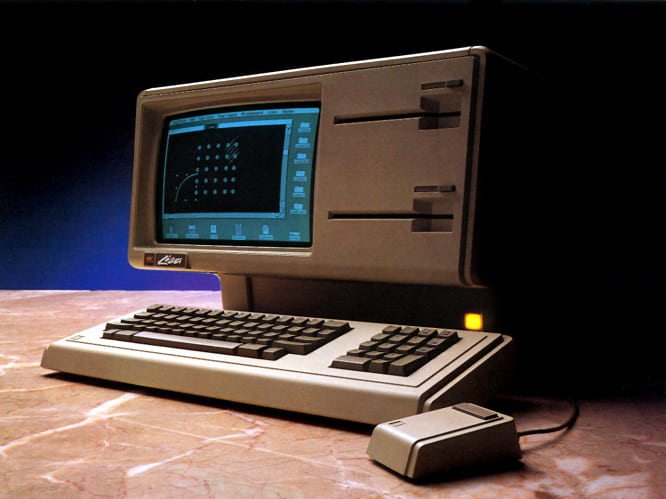
Apple Lisa
Apple went ahead with a windows style computer…two of them. The first, the Lisa, was the beginning of problems with Jobs. He was a visionary, but he also was at times a complete disaster when dealing with people. He was so convinced that what he was working on was the future of computers (which in hindsight is interesting) and thus refused to accept anyone else’s opinion about anything. This resulted in two revolutionary computers being developed, and two total flops. The Lisa had a sales price of $10,000 and never sold. The Macintosh, the computer that is still revered as the most revolutionary breakthrough in computers, although a big seller, never sold what it needed to live up to its reputation as a smashing success. Essentially, the computer was viewed by the public as the best thing since sliced bread, but the cost prevented it from outselling more than IBM PC’s.

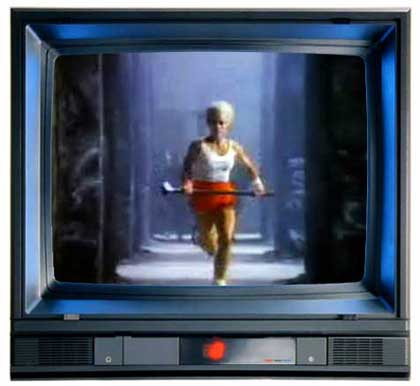
Job’s had been spot on about what the computer meant to Apple and the computer industry, but as a result had totally blew the cost analysis of what it would take to become profitable. At this point, people in Apple disagreed so vehemently with him that the board was split about what to do to, and he was eventually voted out. This was the same board of course that was 100% against his view on using the Superbowl commercial Jobs liked to much to present the Mac, which is still the most famous SB commercial ever. Again, Jobs was right, but his total inability to give any focus to cost analysis or people skills got him ousted.
Jobs then went on to start Next. At this point, his net worth was about $90 million (because Apple stock had dropped). He cashed out and used it to fund Next and eventually to buy Pixar, a failing computer company trying to sell computers for artistic design. Both companies were trying to create new computers, something Jobs did at Apple. For years he poured money into both companies, with neither ever developing any notable profit. Early on at Next, IBM approached him about using their operating system to run on IBM computers. They had been negotiating and were coming to an agreement, but Jobs was so difficult to deal with that it caused significant delays. Eventually, the exec at IBM that was interested in Next’s system left the company, and IBM chose to look elsewhere. They went with Microsoft, and the rest of that story is history. This was an eye opener for Jobs, a lesson he would not easily forget.
Jobs eventually was finally willing to admit temporary defeat, and that neither company was producing a computer that was going to challenge on the market. Although Next sold hundreds of millions of dollars in revenue, this was nothing compared to what Apple and leading PC retailers were doing, so while considered a success to most, this was a failure for Jobs who was known as a revolutionary. Thus, Jobs stopped all computer sales in both companies and focused on software. This changed everything.
With Next, the company was in the brink of bankruptcy when Jobs decided he would make an effort to sell the software to Apple (the software what Mac OS X today is based on). When he went to Apple, he found them surprising receptive because the software was very good, and one of Job’s biggest strengths was presentation. Jobs identified that Apple was interested and took the negotiation up a notch. He said that if Apple was interested in the software, they would best be served by gaining all the technology and staff of the whole company, essentially they should buy Next. They did, and paid nearly $1 billion which put half a billion in profit right into Job’s pocket. This was remarkable considering the company didn’t have enough revenue to support itself. In terms of sales, this was among the greatest of all time. But it worked out for Apple as well, because that software was the future of the industry.
With Pixar, Jobs was putting up to a million a month into the company to keep it afloat. He was making so many cuts that the only thing left in the company was its division on animation with 3D graphics. Jobs eventually pressed Disney to do a movie for them, at Disney’s cost. This was the beginning of what became the most profitable venture in Job’s life. After creating Toy Story, they went on to develop seven blockbusters in a row, bringing the company public, and making Job’s far richer than Apple or Next ever did. He was finally a billionaire.
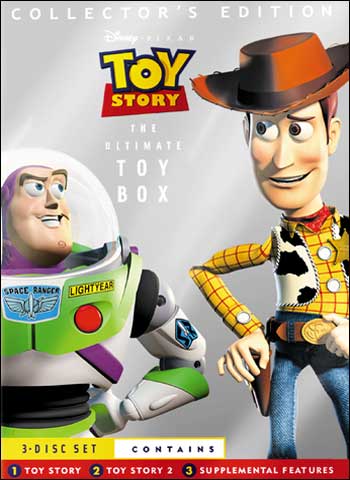
Pixar Blockbuster: Toy Story
In addition, the seven straight blockbusters gained Pixar so much revenue that they became the biggest studio (based on revenue) in Hollywood history, bigger than Paramount, bigger than Lucasfilm, bigger than them all. The bigger they got, the harder Job’s negotiated, and eventually they were more powerful than Disney in the animation department. Disney had no other choice left except to buy Pixar, making Jobs the current largest shareholder in all of Disney, Pixar, and ABC all at once. With that purchase, he became more powerful in the media industry than Ted Turner.
Back at Apple, they were facing serious issues ever since the failure of the Mac. Nothing had worked out, and they decided to try giving Jobs another shot. They never looked back. He cut so many Apple projects that he made the company profitable in six months. However, they were no longer a dominant in the market, taking a huge backseat to other major players. Job’s sold the Next software to Microsoft to get some profits back and Microsoft went on to use it to design Windows 95. Steve was so focused on quality though, that eventually Apple would regain its reputation. He focused on giving to schools, and got all the kids in the current generation using Macs…what would be a brilliant move for the future. Every school in California was given countless Macs and thus all the kids these days using are Macs…as are the teachers.
The hand held market was taking off in the early 2000’s and Job’s had to decide what direction to go. He made an unprecedented move by totally discontinuing all Apple’s interest in the hand help market. He said he just didn’t see a future in it and decided he wanted to go in the direction of music applications. At this point, there were many companies in music that were announcing failures. The invention of Napster had upset the music community so badly that it was near impossible to create anything profitable. Jobs had a different idea. He assessed what the music industry wanted and decided it was a good point to begin negotiations. The music industry feared losing its ability to make residuals because of theft and duplication. They were proposing some of the most ridiculous software which had chased out weaker negotiators, but not Jobs. The music industry wanted features such as monthly subscriptions but no downloads, or, downloads but only onto a single computer, or, downloads that would expire meaning music you bought disappeared after a while. Essentially, the concept of a music store with this type of guidelines would be a ridiculous venture. Steve took the initiative and went to all the top producers and many major labels and bands and presented his case for being able to offer the store with downloads that would have protection, meaning they could not be copied on to other computers or shared, but could be downloaded onto a single music player. In addition, if there was an attempt to transfer the music, it would automatically delete all music on that computer (a feature long gone). This was what Jobs had to doin order for the music industry to agree, and the only way he could offer this was to develop his own software with all these protections. Counter to what is believed to be manipulative marketing strategy to sell his I-pods, this was the reason I-tunes was designed in the limiting manner.
What would happen next changed the industry. Selling music for 99 cents each created billions for the industry, and the music industry eased up considerably as they saw internet sales as a viable way to sell their music and still make a lot of money on residuals. Essentially, Job’s had negotiated so hard with so many restrictions that initially the success of I-tunes meant that the music industry would lessen their desire to have so many restrictions, setting the table for many other music stores with FAR less restrictions.
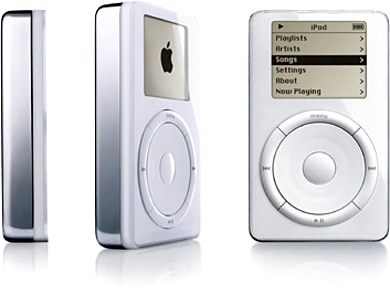
The first iPod (2001)
The iPod sold on its own merit. Jobs had a goal to make a player that was the easiest to use on the market. If you had to hit more than three buttons to reach any song, it would not be acceptable. He designed the pinwheel approach and the iPod sold on its own accord, and became the bedrock of digital music. Job’s was also brilliant in negotiating music legends to do their advertisements for free. He convinced them that the advertisements were just as much an endorsement for them as it was for Apple, so they agreed. .
At this point, he has been spot on for many projects in a row. Surprisingly, it was Pixar that made Job’s the most money, but his comeback at Apple making it one of the major players and viable competition for Microsoft’s dominance may end up being the ultimate story.
Text by Todd Arone (Thanks for the kind permission)
iCon Steve Jobs: The Greatest Second Act in the History of Business (Paperback)
by Jeffrey S. Young (Author), William L. Simon (Author)
Paperback: 368 pages
Publisher: Wiley; 1 edition (April 14, 2006)
Language: English
ISBN-10: 0471787841
ISBN-13: 978-0471787846