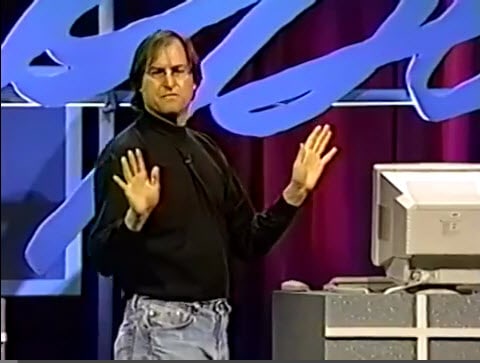
In this vintage nine-minute video, cofounders Steve Jobs and Steve Wozniak looked back at some of it, dating all the way back to 1976’s Apple I.
The speaker at the start of the video is Paul Terrell, who founded one of the world’s first computer stores, the Byte Shop, in Mountain View, California, in 1975. The next year, he played a significant role in Apple history by placing an order for 50 of Wozniak and Jobs’s Apple I computers—on the contingency that they supply them fully assembled, rather than as a solder-it-yourself kit.
In 1976, The Apple 1 computer went on sale for a retail price of $666.66. Steve Wozniak, who co-founded Apple with Steve Jobs and designed that product, remembers the early days.
1976The Apple I computer goes on sale for a retail price of $666.66.
You said you saw a revolution coming. Do you think Steve Jobs did? He had always spoken about wanting to be a person that moves the world forward, but he couldn’t really create things and design them like I could. Steve wanted a company real badly. His thinking was not necessarily about what computers would do for the average Joe in the average home. Steve found the words that explained what these computers would do for people and how important it was a little later in life.
You mentioned you didn’t like conflict. Did Steve like conflict? Steve was going to make sure that his position was strong and forceful and heard by others. Thankfully he had the best brain. He usually had a little, tiny suggestion, but almost always he was right.
How many computers did you sell? We only sold about a hundred Apple I’s. Of the Apple II’s, we probably sold a few thousand through the first year. And then [we designed] a spreadsheet program that let small businessmen do more work in one hour than they could do in 10 years with pencil and paper. Sales shot up. It was maybe five years before we sold a million—the first computer ever to sell a million.
Did you think Apple would become a behemoth? When we started the company, I knew that the computer was so far ahead of anything the rest of the world had ever seen. We knew we had a revolution. Everyone who joined Apple, this was the greatest thing in their life.
Directly from a VHS tape (probably second generation analog copy), digitized April 2013 by Jason Molenda. The Original file can be downloaded from http://molenda.com/videos/1997-wwdc-steve-jobs/
Update (November 2022): The Youtube video was deleted on Apple’s request. “This video is no longer available due to a copyright infringement complaint from Apple Inc.” But the internet never forgets. The video file is still available at the Internet Archive.
Turnarounds from the brink of death or irrelevance are in high demand these days. AOL, MySpace, Yahoo!, Nokia, and RIM have all had their moment in the sun as the celebrated leaders of hot markets. All of them lost it, and many more have done so as well. Some fell out of the sky with sales numbers plummeting 40% and more per year. Others dragged it out and, instead, slowly faded away. One of them was Apple in 1997. Now the most valuable company in the world, it had lost nearly 50% of its revenue and came pretty close to bankruptcy. But then they came back with a vengeance. In fact, they now seem nearly unstoppable, disrupting more and more markets. They are the only technology company that has been able to define not just one, but two computing eras: first, with the introduction of the Macintosh, which defined the PC era; and then the debut of the iPhone, which has ushered in the smartphone era. That leaves Marissa and us with two compelling questions: How did Steve Jobs do it? Can it be done again?
How did Steve Jobs turn around Apple?
Jobs had to steer Apple away from its main market in order to return and disrupt it. Apple didn’t have a chance to win against the Wintel monopoly by building better PCs. They were stuck in a niche and had to build momentum outside the mature personal computer market in order to have a real chance at disrupting it. In that regard, it was a boon for Apple that people thought the company had lost their way when they launched the iPod instead of a new Mac, MacBook or Newton.
People in the industry dismissed it and nobody tried to stop Apple from owning the online music business until it was too late. When Microsoft finally realized the iPod threat and came out with their own music device, the Zune, they failed to make even the smallest dent in Apple’s market dominance. By that point, “Apple 2.0”—with Jobs’ singular focus on design and innovation—was unstoppable. The iPod led to the iPhone, the iPhone led to the iPad, and both led to the MacBook Air and MacBook Pro with Retina Display, all of them taking away market- and mind-share from Microsoft, not to mention other PC and device competitors.
Not that long ago, Microsoft has acknowledged their strategic misery by launching their own tablet computer, the Microsoft Surface. They have decided to compete with their existing partners in order to survive in an Apple world, a clear indication that Microsoft is scared by Apple’s success.
With hindsight, we can easily see the cascade of waves that Steve Jobs surfed with Apple, with increasing size and momentum. To take away valuable turnaround lessons for other companies, it is instructive to segment the 6 different phases of Apple’s turnaround.
The severe cost cutting and Microsoft’s investment in Apple where mission-critical in giving him enough runway to bring a few new products to the market.
It takes a determined (or a truly desperate) mind to do this kind of cost cutting. And that is the reason why many companies fail before they even start. Delusion and ignorance are so much easier to implement (until you hit the ground). While accepting the hard truth about your failing company is difficult, it is the only chance you have. Steve Jobs did exactly that when he concluded that Apple can’t afford to continue fighting with Microsoft anymore.
Think Different told everyone believing in Apple why it was worthwhile to keep Apple alive and not follow Michael Dell’s advice. With this ad, Steve Jobs refreshed the meaning that every existing and future Apple product comes bundled with. It will turn out to be the hardest thing to copy for all competitors.
Phase 2: Focus your core business
But cost-cutting and image ads only carry you so far. Apple had to increase their top line in order to survive.
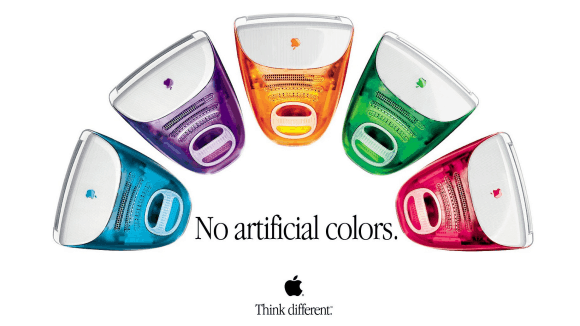
The first new product Apple released after Steve Jobs’ coming home was the original iMac. It was surprising what a difference a little color makes. Adding color to this cute little desktop computer became an instant success. It was also a nice showcase of everything Apple: beautiful to look at, simple to use and innovative. So far, everyone thought computers had to be beige or black and sell through their technical specs. Not anymore.
iMac in Colors
The iMac success helped to keep Apple alive and made it shine again for the first time. However, it didn’t change the underlying dynamic of the PC market. Microsoft owned it and Apple was still only surviving in a small niche.
Phase 3: Figure out where the puck will be going
The strategic genius of Steve Jobs is visible the most in what came next. He must have realized at this point that Apple cannot win against Microsoft and Intel the old fashioned way by building better, more reliable, easier to use and more beautiful but conventional computers. Those things just didn’t matter in a world where Microsoft Windows, Word and Excel were the standards in nearly every industry and nearly every user’s mind. The market for personal computers was in a pretty mature state at this point in time. There was no chance at all for Apple to be ten times better than the whole Windows ecosystem and get people and companies to switch. In order to win, Apple had to change the rules of the game. Further frontal attacks against Wintel were simply futile.
I don’t have any internal knowledge of Apple considerations at that time, but I am pretty sure that Steve Jobs was pretty aware that Moore’s Law will give us powerful pocket-size computers in a not too distant future. “A computer in every pocket” was the logical conclusion. That sounds awfully lot like “A computer on every desktop”, Bill Gates’ big and tremendously successful vision for Microsoft in the 80th. And Microsoft’s board might wonder why they missed this obvious next step after Microsoft succeeded with their initial vision in the 90th. Fortunately for Apple, Microsoft didn’t think ahead. Instead, they waisted a lot of time milking their customers and trying to be like Google.
Ironically, Apple made “a computer in every pocket” happen. They didn’t call it a computer though.
Phase 4: Take the first step
The first step to take advantage of the inevitable mobile revolution was not to launch a handheld computer. Apple tried that before with the Apple Newton and failed. Too complex, too expensive and too much of a niche market.
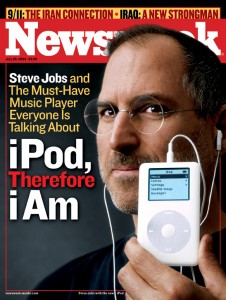
Steve Jobs and iPod on the cover of Newsweek
So Apple did something surprising. They launched the original iPod — no new computer, no better laptop and no new Newton, just a portable music player. Some Apple fan boys were up in arms: “iPoop…iCry. I was hoping for something more”. Nonetheless, the iPod became a hugh success and laid the groundwork for Apple to leapfrog Microsoft a few years later.
The beauty of the initial iPod for Apple was its simplicity. It just had one feature, playing your music on the go. Other than the Apple Newton, it addressed a clear need (all your music on the go) with a huge market potential (who doesn’t like music) and a lack of simple solutions (Sony, anybody?). At the same time, it was the first mobile computer product that reached mass adoption around the world and defined a new market. The enormous sales numbers enabled Apple to build a supply chain that is unmatched by their competitors.
It is difficult to overstate the strategic value of the iPod for Apple. The iPod sold like hot cakes and made a lot of money for Apple. It became a cultural icon and dramatically increased the number of people who own at least one Apple device. And because it worked well with Windows, iTunes for Windows became the first piece of Apple software that many people laid their hands on. Suddenly, many experienced the joy of using Apple products and decided to buy Apple computers instead of Windows PCs, creating Apple’s famous halo effect.
Steve Jobs made another strategic move to get as many people as possible experience an Apple product or service for the first time. He launched Apple’s own stores. What was dismissed by many experts (as usual, one might say), turned over time into one of the most successful retail business on Earth.
The iPod experience was strategic in two more ways, 1) iPods were bought by consumers, not enterprises and 2) iPods smoothly bundled a piece of hardware with software and services. Both aspects are disrupting multiple industries these days. The consumerization of IT broke Microsofts’ and RIM’s influence on IT departments and is here to stay. And the integration of hardware, software and services is the new black. Given Apple’s success, it is no big surprise that Google, Microsoft and Amazon changed course and copy Apple’s bundled approach for seamless integrated hardware, software and services.
Phase 5: Build momentum
The momentum of Apple’s iPod business soon overshadowed their old core business. After launching and developing multiple iPod variations, it was time to catch the next big wave. The rise of smartphones threatened to make iPods redundant some day. Smartphones had been around for a while but they still kind of sucked. They offered only a crippled Internet experience, where complicated to use and lacked a smooth music experience that could compete with the beloved iPod. In 2006, everyone and their grandmother was expecting Apple to build a so-called “iPhone”. Couldn’t Apple build a mobile phone that works elegantly like an iPod and excels as a phone and mobile computer? Well, they could.
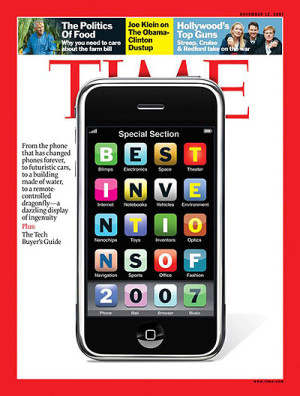
iPhone on the cover of Time Magazine
When Steve Jobs introduced the original iPhone in 2007, he answered the question how nearly all mobile computers will look like in the future. Regardless if competitors knew it or not, they only had two alternatives: 1) “slavishly copying the iPhone” or 2) choose ignorance and see their market share entering the free fall. Only three years after entering the mobile phone market, Apple already commanded more than 50% of the global profits.
The original iPhone promised to be “three products in one”- a music player, a mobile phone and a touch Internet terminal. It soon became much more than that. Against Steve Jobs’ desire to control the whole user experience, hackers enabled us to jailbreak our iPhone and install a fast growing number of useful (or at least entertaining) apps. Jailbroken iPhones soon became the better iPhones and Apple quickly changed course.
The following year, Apple launched the App Store and turned the iPhone into a full blown mobile computing platform. They managed to provide what turned out to be an explosive balance between openness and control. Apple still maintained control over the iPhone ecosystem, but now everyone could start writing apps for the iPhone and have Apple distribute them for free or 30% of the sales price for paid apps. It has never been easier to find, install and update software on a computer. Everyone did it. With more than a billion downloads and a default price point for most paid software of 99 cents, the App Store redefined the software business.
Again, the Microsoft board might wonder, why Microsoft didn’t use their monopoly to build a similar software distribution platform for PCs.
The iPhone soon became one of the fastest selling consumer devices in history. Fortunately, Apple didn’t have to start from scratch building a sufficient supply chain. While long lines in front of Apple stores around the world and temporally constrained supplies became the norm for every new launch, Apple always managed to catch up with the demand quickly by further optimizing their supply chain. First, they became more valuable than Microsoft, then they became the most valued public company on Earth.
The strategic value of the iPhone for Apple is gigantic. The market is enormous and still growing with high customer loyalty and a replacement cycle of less than 2 years for Apple’s iPhone. Owning the latest iPhone for many became the ultimate status symbol. Everyone stood in line to lay their hands on the latest model, Apple fan boys, corporate executives, teenagers, and not to forget the growing middle class in China, creating another strong halo effect for other Apple products.
In order to invent the iPhone, Apple had to answer the question how a mobile operating system has to look like. Steve Jobs concluded that a touch device asked for a fundamentally different interaction model than personal computers, and therefore Apple decided to build a new mobile operating system instead of using a downsized MacOS X. This decision to develop iOS turned out to be strategic. According to Steve Jobs, the PC ecosystem was caught in a kind of local optimum. You have to start fresh, ignoring many existing rules and explore completely new solutions to arrive at superior solutions. The resulting operating system iOS is designed for touch interfaces from the inside out. There are no windows anymore, no console, no file manager, and (nearly) no need to stop applications. Software installation is done with a click, automated updates inclusive. iOS devices are always on, ready to go in a second and still achieving a tremendous battery life. iOS achieved many things that PCs didn’t. They came without a manual and were used by toddlers and grandparents alike.
Phase 6: Finally disrupt the incumbent’s business
In 2010, it was time to take the lessons learned with the iPhone and apply them to the world of more traditional computers. Leveraging everything Apple had learned and built with the iPod and iPhone, they first released their own take on tablet computers.
The tablet market was around for a while but still irrelevant. That changed when Steve Jobs introduced the iPad. He believed it was the greatest thing they ever did and felt “annoyed and depressed” when people initially laughed at it. He was right non the less. The iPad sold even more quickly than the iconic iPhone and became thefastest selling consumer device in history. Within two years, many competitors tried and failed to match the iPad’s appeal to users. At the same time, PC makers started to feel its deep impact. PC shipments stalled. Companies, universities and schools started to deploy iPads replacing traditional PCs in troves and it soon became a shared believe that tablet shipments will dwarf PC shipments some day in the not to distant future.
Even without tablets, Apple won market share in the traditional PC market for more than 20 consecutive quarters. But Apple wanted more. Also in 2010, Apple added a second line of attack and started to bring iPhone/iOS innovations back to the Mac nurturing the famous halo effect. With the relaunch of the MacBook Air and MacBook Pro with Retina Display, Apple started to apply lessons learned in the mobile space directly in the PC space, leveraging parts of the same supply chain.
What I find most fascinating about Steve Jobs’ strategy to turn around Apple is the rigorous long-term thinking in so many dimensions. Many trends that put other companies on defense were leveraged by Apple many years ago. Microsoft and RIM are struggling with the consumerization of IT, Nokia is struggling with touch interfaces, BestBuy is struggling with “showrooming”, the PC ecosystem is struggling with complexity, Android is struggling with fragmentation. Motorola, HTC and LG struggling with commoditization. Apple addressed all these challenges early on. There have certainly been surprises and the need to rewrite parts of the strategy on the go like the decision to open up the iPhone more than planned in the first place. However, the executive team at Apple seemed to have applied long-term thinking to answer many detailed questions regarding their strategy.
In principle, a turnaround like Apple’s can be done again – at least in fields with a high degree of innovation. If there is innovation there will be disruption, and if there is disruption someone can catch the new wave, surf it and overthrow the incumbent. What Apple’s story tells us too, is that incremental improvements won’t be enough if you are losing. You have to identify a need that is not addressed well and be at least ten times better than existing solutions. Ideally, this need is shared by enough people and leads you in a direction you want to go in order to catch the next wave.
“A good hockey player plays where the puck is. A great hockey player plays where the puck is going to be.” Wayne Gretzky
The two things that played a major role for Apple’s turnaround that won’t be available for most other companies is the ideals Apple stood for and their loyal followers around the world. Even in Apple’s dark times around 1998, Apple was admired by many. Most people wanted Apple to succeed. That makes a difference and you might ask yourself how much this can be said about RIM, Microsoft, Nokia or Yahoo!?
In his famous interview with Bob Cringley for PBS TV series “Thriumpf of the nerds”, Steve Jobs said: We read about (…) the story Esquire magazine about this guy named “Captain Crunch”, who could supposedly make free telephone calls. You heard about this, I’m sure. And we – again – were captivated: How could anybody do this? And we thought, it must be a hoax. And we started looking through libraries, looking for the secret tones that would allow you to do this. And it turned out we were at Stanford Linear Accelerator Centre one night, and way in the bowels of their technical library way down at the last bookshelf in the corner bottom rack we found an AT&T technical journal that laid out the whole thing. And that’s another moment I’ll never forget – we saw this journal we though – “My God, it’s all real” – (laughs) and so we set out to build a device to make these tones.
And the way it worked was: You know, you make a long-distance call, you used to hear “tüdülüdülü” right in the background. They were tones that sounded like the touch tone you can make on your phone. But they were different frequencies, so you could make them. It turned out, that was the signal from one telephone computer to another – controlling the computers on the network. And AT&T made a fatal flaw when they designed the original telephone network, digital telephone network. They put the signaling from computer to computer in the same band as your voice, which meant, that if you could make those same signals you could put it right in through the handset. And literally the entire AT&T international phone network would think, you were an AT&T computer.
So after three weeks we finally built a box like this that worked. And I remember the first call we made was down to L.A. to one of Woz’s relatives down in Pasadena. We dialed the wrong number, but we woke some guy up in the middle of the night – yelling at him like “Don’t you understand? We made this call for free!”. And this person didn’t appreciate that. But it was miraculous. And we built these boxes to do “blue boxing”, as it was called. An we put a little note in the bottom of them. Our logo was: “He’s got the whole world in his hand”. (laughs) And they worked.
>We built the best blue box in world. It was all digital, no adjustments. And you could go to a pay phone, and you could take a trunk over White Plaines, then take a satellite over Europe and go to Turkey, take a cable back to Atlanta, you could go around the world, around the world five or six times. Because we learned all the codes for how to get on the satellite and stuff. And then you could call a pay phone next door, and you could shout in the phone and after about a minute would come out the other phone. It was miraculous.
And you might ask: “What so interesting about that?” What’s so interesting is that we were young and what we learned was, that we could build something ourselves that could control billions of dollars’ worth of infrastructure in the world. That was what we learned. That it was us two – you know, we didn’t know much – we could build a little thing, that could control a giant thing. And that was incredible lesson. I don’t think there would have ever been an Apple Computer had there not been blue boxing.
Bob Cringely: Woz said, you called the Pope.
Steve Jobs: Yes, we did call Pope. He pretended to be Henry Kissinger. We got the number of the Vatican. And we called the Pope. They started waking people up in the hierarchy, you know. I don’t know, cardinals and this and that. And they actually sent someone to wake up the Pope. When finally we just burst out laughing they realized that we weren’t Henry Kissinger. And so we never got to talk to the Pope. But it was very funny, so.
———————————-
Woz remembers blue boxing:
So we’re sitting in the payphone trying to make a blue box call. And the operator comes back on the line. And we’re all scared and we’d try it again. … And she comes back on the line; we’re all scared so we put in money. And then a cop car pulls up. And Steve was shaking, you know, and he got the blue box back into my pocket. I got it– he got it to me because the cop turned to look in the bushes for drugs or something, you know? So I put the box in my pocket. The cop pats me down and says, “What’s this?” I said, “It’s an electronic music synthesizer.” Wasn’t too musical. Second cop says, “What’s the orange button for?” “It’s for calibration,” says Steve.
— Steve Wozniak, lecture at Computer History Museum, 2002
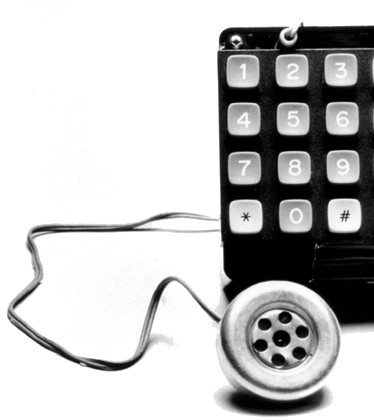
Wozniak and Jobs Blue Box, ca. 1972. The Blue Box allowed electronics hobbyists to make free telephone calls.
The “Blue Box” was a simple electronic gizmo that bypassed telephone company billing computers, allowing anyone to make free telephone calls anywhere in the world.
The “two Steves” had a great deal of fun building and using them for “ethical hacking,” with Wozniak building the kits and Jobs selling them—a pattern which would emerge again and again in the lives of these two innovators. (Wozniak once telephoned the Vatican, pretended to be Henry Kissinger and asked to speak to the Pope—just to see if he could. When someone answered, Woz got scared and hung up.)
These early playful roots are what Wozniak remembers most fondly of Jobs. As columnist Mike Cassidy recalled in a San Jose Mercury News interview, what these two friends most remembered was “not bringing computers to the masses … or the many ‘aha’ moments designing computers. Instead, it’s the time the two tried to unfurl a banner depicting a middle finger salute from the roof of Homestead High School…” or their many Blue Box exploits. Walter Isaacson, Jobs’s official biographer, cites Jobs reflecting on the Blue Box:
If it hadn’t been for the Blue Boxes, there would have been no Apple. I’m 100% sure of that. Woz and I learned how to work together, and we gained the confidence that we could solve technical problems and actually put something into production.
(Isaacson, p. 30)
So far with the story told by Steve Jobs building ‘blue boxes’ about making free phone calls around the world. Now hear it directly from the man who gave Steve Job the idea. Steve Wozniak found a “fiction” article with too much detail to be false. They helped themselves to the library at the Stanford Linear Accelerator and discovered the article was, in fact, real. But he emphasizes they called around the world to explore not to rip off Ma Bell. All his legit calls were made from home and he had a high phone bill as a result.
(This is an Oct. 4, 1984 speech the Apple co-founder gave to the Denver Apple Pi club at the Colorado School of mines. NOTE: This is assembled from two dubs to fix playback errors. Every word is included, but video quality worsens in the second half.) Kudos to Vince Patton who discovered this video.
Apple’s CEO Tim Cook remembered the company’s late cofounder, Steve Jobs on the one-year anniversary of Jobs’ passing. The letter with a video montage appeared on Apple’s website to remember his life and death. The nearly two-minute video presents a slideshow of Jobs throughout his career and it softly ends with “Remembering Steve”.
Jobs died on Oct. 4, 2011. After he passed, at just 56 years old, news of his death flooded the Internet, TV, newspapers, and homes. Millions of people immediately emailed Apple, and the company subsequently created a “Remembering Steve” page to display a massive compilation of condolences that poured in from around the world.
The tribute letter from Apple’s current CEO appears upon completion of the “Remembering Steve” video. In the message, Cook describes Jobs’ death as a “sad and difficult time”. The executive hopes, however, that everyone will “reflect on [Jobs’] extraordinary life and the many ways he made the world a better place.”
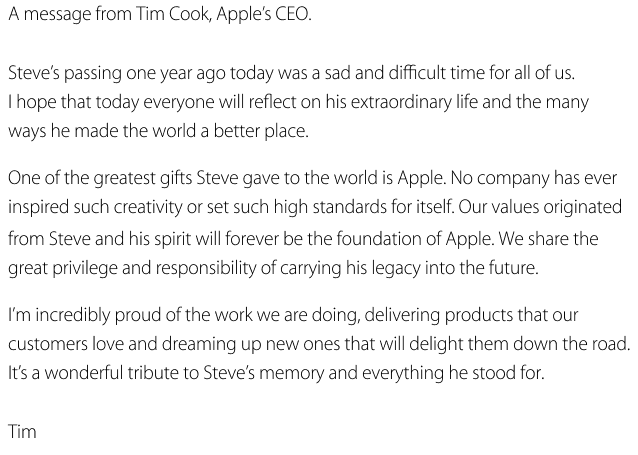
A Message from Tim Cook, Apple’s CEO.
Steve’s passing one year ago today was a sad and difficult time for all of us. I hope that today everyone will reflect on his extraordinary life and the many ways he made the world a better place.
One of the greatest gifts Steve gave to the world is Apple. No company has ever inspired such creativity or set such high standards for itself. Our values originated from Steve and his spirit will forever be the foundation of Apple. We share the great privilege and responsibility of carrying his legacy into the future.
I’m incredibly proud of the work we are doing, delivering products that our customers love and dreaming up new ones that will delight them down the road. It’s a wonderful tribute to Steve’s memory and everything he stood for.
– Tim
Few men have changed our everyday world of work, leisure, and human communication in the way that Apple founder, Steve Jobs, has done. This PBS documentary looks not only at how his talent, his style and his imagination have shaped all of our lives, but also at the influences that shaped and moulded the man himself. Since his untimely death, tributes from around the world have secured Steve’s place in the pantheon of great Americans.
PBS talked to the people who changed the man, who changed our world. Through interviews with the people who worked closely with him or chronicled his life, PBS gaines unique insight into what made him tick. In a never before broadcast, exclusive interview, Steve Jobs expounds his own philosophy of life, and offers advice to us all on changing our own lives to achieve our ambitions, our desires, and our dreams. “Life can be much broader once you discover one simple fact; that everything around you that you call life was made up by people no smarter than you…the minute you understand that, you can poke life; you can change it, you can mould it, embrace it, make you mark upon it. Once you learn that…. you’ll never be the same again.”
Steve Jobs was a product of the two great social movements that emanated from the San Francisco Bay Area in the late 1960s. The first was the counterculture of hippies and antiwar activists, which was marked by psychedelic drugs, rock music, and antiauthoritarianism. The second was the high-tech and hacker culture of Silicon Valley, filled with engineers, geeks, wireheads, phreakers, cyberpunks, hobbyists, and garage entrepreneurs. Overlying both were various paths to personal enlightenment—Zen and Hinduism, meditation and yoga, primal scream therapy and sensory deprivation, Esalen and est.
A little while ago Guy Kawasaki made this speech at the Harker School in San Jose. In it, he explained the lessons that he learned working for Steve Jobs.