Steve Jobs was a visionary, a genius, a perfectionist, and sometimes a difficult contemporary. When the Apple co-founder died in 2011 at the age of 56, many Apple fans saw a bleak future for the company. However, things turned out differently.
It was unimaginable to think of Apple without Steve Jobs. But on October 5, 2011, the inevitable occurred: the charismatic Apple co-founder lost his long battle with cancer. Six weeks prior, on August 24, 2011, Jobs had appointed his confidant Tim Cook as the company’s new CEO. The decision surprised many observers as Cook had made a name for himself as a logistics and manufacturing expert, but he lacked the charisma that Jobs had regularly used to captivate the masses.
One of the skeptics was Larry Ellison, who had been close friends with the Apple co-founder for years. The head of software giant Oracle believed that Apple was doomed without Steve Jobs. In a TV interview, he drew a parallel to 1985, when Apple’s board of directors forced Steve Jobs out of the company. Over the next 12 years, Apple fell into such disrepair that by 1997 the company was on the verge of bankruptcy, and Jobs was brought back as a savior. “We saw Apple with Steve Jobs, we saw Apple without Steve Jobs. We saw Apple with Steve Jobs. Now we’re going to see Apple without Steve Jobs,” Ellison said. “I like Tim Cook. I think there are a lot of talented people there. But Steve is irreplaceable.”
But things have turned out very differently after Jobs’ death than Ellison had feared. Apple is selling more devices and services than ever before. In August 2018, the iPhone maker made financial history as the first U.S. company to reach a trillion-dollar valuation on the stock market. Just two years later, it was two trillion. In addition to the stock market boom, experts say the company’s customer loyalty was a major factor in its rise. “When a new user starts using an Apple smartphone, they tend to stay with an Apple smartphone,” says Jeriel Ong, an equity analyst at Deutsche Bank.
And the rally is not over. Since October 2011, the share price has risen from around $13 to an all-time high of just under $150. Cook is also regularly rewarding shareholders with dividends, something Jobs always refused to do.
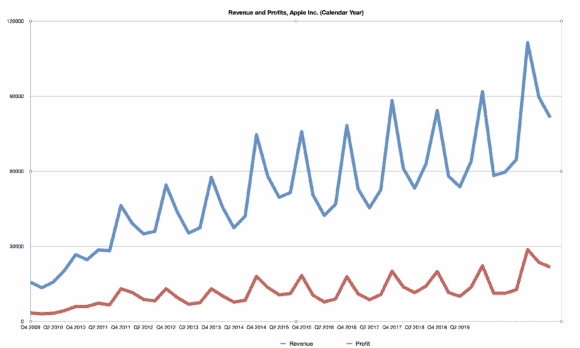
With the iPhone, Cook has managed to attract new groups of buyers. He also expanded the range of accessories, such as the Apple Watch computer watch and AirPods earphones, and launched subscription services such as iCloud and Apple TV+. It has also been able to charge higher prices for its products, so much so that a large portion of the industry’s profits now go to Apple.
Revenue and Profit, Apple Inc. (Calendar Year)
Still, Tim Cook is not a great presenter on stage. However, he has now set the tone that sets him apart from his predecessor. One example is the environment. In 2008, Steve Jobs had a heated exchange with Greenpeace when the environmentalists demanded that Apple stop using brominated flame retardants in its products. These can be toxic, difficult to break down in the environment, and accumulate in living organisms.
Under Cook’s leadership, Apple not only eliminated the controversial BFRs, but also all other environmental toxins in its manufacturing. He also switched the company entirely to renewable energy. This ambitious project will now be extended to the entire supply chain.
This change has also been noted by Greenpeace. “Since Tim Cook took the helm at Apple, he has made environmental protection an important part of the company’s identity,” the organization said in 2017, when it published a report on environmental standards at electronics manufacturers. Apple only lost out to smartphone maker Fairphone in the Greener Electronics ranking because the Dutch company’s devices are easier to repair.
In addition to the environmental issue, Apple under Cook is also trying harder to differentiate itself from the competition in the area of privacy. Last April, for example, Apple changed its iPhone software so that providers like Facebook would have to ask users for permission if they wanted to track their activities across different apps and websites. Jobs had announced this privacy principle at the D8 conference in 2010, but left the implementation to his successor.
When it comes to privacy, Cook already made his mark in 2016. At the time, the FBI demanded that Apple manipulate the iPhone’s iOS operating system to allow law enforcement to search the locked iPhone of the shooter in the San Bernardino terrorist attack. Cook rejected the request, saying it would not undermine the security features of the products.
But Cook has also faced setbacks on the issue. For example, Apple shelved plans to introduce a scanning feature on the iPhone that would prevent child abuse images from being uploaded to the cloud. There had been an outcry that Apple was taking the wrong approach in the legitimate fight against child pornography.
The biggest shortcoming of the Cook era, however, is that Jobs’ successor has yet to come up with a revolutionary new product. His predecessor regularly produced “one more thing” that disrupted entire industries: the iMac in 1999, the iPod and iTunes music service in 2001, the revolutionary iPhone in 2007, and the iPad in 2010. Under Cook, there have been rumors of revolutionary new products such as an Apple car or glasses for augmented reality applications, but so far Apple fans are waiting in vain.
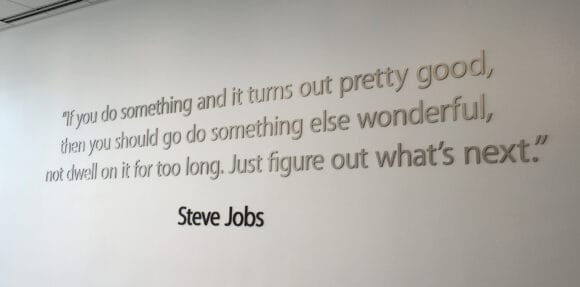
In this context, Cook’s critics point to a quote from Steve Jobs written in large letters on the wall of Apple’s old headquarters: “If you do something and it turns out pretty good, then you should go do something else wonderful, not dwell on it for too long. Just figure out what’s next.”
Larry Tesler talks about Steve Jobs’ trips to Xerox’s Palo Alto Research Center, including the one where Jobs eyed the company’s graphical user interface prototype — which ended up on Mac OS.
Introducer: Larry Tesler, I believe you took Steve on a tour of Xerox PARC and showed him some technology that became important. I wonder if you could tell us about that that tour?
Larry Tesler: Well it wasn’t the physical facility. It was a tour of the software it was part of that demonstration . Xerox was facing a lot of competition from Asian companies in copiers when their patents expired and one thing they found was that they had a very high manufacturing cost and they were really having trouble competing with these new forces in the market. At the same time they had Xerox PARC, developing very exciting technologies including the Ethernet, GUIs with windows and improved mice from what existed before.
They started worrying that they would not be able to manufacture those cheaply enough when they moved into that market. So they looked around and saw that Apple was cranking out Apple ][s for really cheap and selling lots of them and they thought, “Well, we should partner with a company like Apple and they’ll make our machines for us”. Or something like that. Xerox had some kind of idea of [that] type, so some business development peope came from the East Coast to PARC and when they got to Apple they made a deal where in exchange for various business arrangements, distribution and future discussion of manufacture and so on, Apple would sell them stock. This was a very appealing thing because it was very clear Apple was going to have a very successful IPO, […] and in exchange though, Steve Jobs required information… disclosure, everything cool going on at Xerox PARC [laughter] [voice commenting “Good bargain!”]. Nobody checked with the PARC people first but the business development people signed the deal.
So there was a number of visits [by Apple to PARC]. I was involved in a couple of them. One was [Apple] executives visiting and meeting with some of us [PARC researchers] trying to just get information out of us or an agenda for how to get the information out of us.
That was a little bit of a tense meeting but I remember at one point Steve was pacing the room trying not to be in charge of the meeting because he was not the CEO of the company – Mike Scott was – and at one point he just said “Stop! Stop! Stop! Stop! Stop this discussion! We need to tell them about the Lisa!” and all the Apple people kind of froze… “Come on! Come on, we need to tell them about the Lisa! This conversation is gonna go nowhere!”. So we got perked up, because it was us disclosing to them, not them disclosing to us, but finally they threw up their hands “OK, tell ’em about the Lisa!” so somebody told us a little about the Lisa, which at that time did not have a GUI but it was powerful enough to do the kinds of thing that they thought we were doing.
The next thing I remember was another meeting where apparently Apple people had been demoed in-between but they weren’t satisfied with the demo. They knew there was lot more than [what] we were showing them. There were a lot of people at PARC that didn’t want to show Apple everything. And in fact we all felt like we didn’t want to show them everything, but I was one of those who felt we should show them more. There were people who wanted to hold back everything we could. So they arranged a new set of demos, where more people came, Bill [Atkinson] was there, John Couch, Mike Scott, obviously Steve, Jef Raskin, [and] a couple of other people.
The room as pretty full and there were two or three of us from PARC at a time, one person sitting at the computer, getting the demonstration and the other people waiting their turn or observing. So, during that demo, Steve again got very excited. He was pacing around the room and occasionally looking at the screen. he was mostly just looking and reacting and taking it all in, trying to process it and at one point he said “You’re still not showing us everything!” And the meeting paused, there were some phone calls [made], and [then] “OK, we’re going to show you more.” [laughter]
So I gave my demo, then Dan Ingalls gave a demo for Smalltalk and they started asking us lot of questions. Bill and, Bruce Daniels was there too, he had joined Apple from MIT… those technical people just asking us questions and we were answering the questions and frankly I was amazed.
I had looked into Apple earlier, a couple of years before, because someone tried to get me to work there, and I found these people who were Homebrew Computer Club kinda hackers. Suddenly there were all these computer scientists in the room and they were asking really good questions! So I got a completely different view about what Apple was like from that meeting. But Jobs was saying “What is going on here? You’re sitting on a gold mine! Why aren’t you doing something with this technology? You could change the world!” And his buddies, who were trying to arrange the negotiation of some kind, were trying to quite him down [laughter] “Don’t be so excited!” But it was really clear to him that we [at Xerox] were never really gonna do anything with this, and by that I mean the kinds of revolutionary things that he was envisioning.
The irony was that when they left we still had shown the like only 1% of what PARC was doing but it was enough that they got really excited and decided they were going to retarget the Lisa to be something like what they had seen, in terms of GUI. They fell in love with the mouse and that changed everything. And seven months after I was working at Apple.”
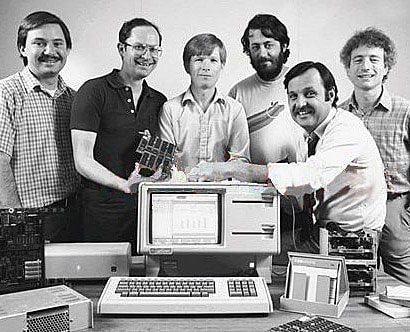
Apple Lisa team: Paul Baker, Bruce Daniels, Chris Franklin, Rich Page, John Couch, and Larry Tesler.
Turnarounds from the brink of death or irrelevance are in high demand these days. AOL, MySpace, Yahoo!, Nokia, and RIM have all had their moment in the sun as the celebrated leaders of hot markets. All of them lost it, and many more have done so as well. Some fell out of the sky with sales numbers plummeting 40% and more per year. Others dragged it out and, instead, slowly faded away. One of them was Apple in 1997. Now the most valuable company in the world, it had lost nearly 50% of its revenue and came pretty close to bankruptcy. But then they came back with a vengeance. In fact, they now seem nearly unstoppable, disrupting more and more markets. They are the only technology company that has been able to define not just one, but two computing eras: first, with the introduction of the Macintosh, which defined the PC era; and then the debut of the iPhone, which has ushered in the smartphone era. That leaves Marissa and us with two compelling questions: How did Steve Jobs do it? Can it be done again?
How did Steve Jobs turn around Apple?
Jobs had to steer Apple away from its main market in order to return and disrupt it. Apple didn’t have a chance to win against the Wintel monopoly by building better PCs. They were stuck in a niche and had to build momentum outside the mature personal computer market in order to have a real chance at disrupting it. In that regard, it was a boon for Apple that people thought the company had lost their way when they launched the iPod instead of a new Mac, MacBook or Newton.
People in the industry dismissed it and nobody tried to stop Apple from owning the online music business until it was too late. When Microsoft finally realized the iPod threat and came out with their own music device, the Zune, they failed to make even the smallest dent in Apple’s market dominance. By that point, “Apple 2.0”—with Jobs’ singular focus on design and innovation—was unstoppable. The iPod led to the iPhone, the iPhone led to the iPad, and both led to the MacBook Air and MacBook Pro with Retina Display, all of them taking away market- and mind-share from Microsoft, not to mention other PC and device competitors.
Not that long ago, Microsoft has acknowledged their strategic misery by launching their own tablet computer, the Microsoft Surface. They have decided to compete with their existing partners in order to survive in an Apple world, a clear indication that Microsoft is scared by Apple’s success.
With hindsight, we can easily see the cascade of waves that Steve Jobs surfed with Apple, with increasing size and momentum. To take away valuable turnaround lessons for other companies, it is instructive to segment the 6 different phases of Apple’s turnaround.
The severe cost cutting and Microsoft’s investment in Apple where mission-critical in giving him enough runway to bring a few new products to the market.
It takes a determined (or a truly desperate) mind to do this kind of cost cutting. And that is the reason why many companies fail before they even start. Delusion and ignorance are so much easier to implement (until you hit the ground). While accepting the hard truth about your failing company is difficult, it is the only chance you have. Steve Jobs did exactly that when he concluded that Apple can’t afford to continue fighting with Microsoft anymore.
Think Different told everyone believing in Apple why it was worthwhile to keep Apple alive and not follow Michael Dell’s advice. With this ad, Steve Jobs refreshed the meaning that every existing and future Apple product comes bundled with. It will turn out to be the hardest thing to copy for all competitors.
Phase 2: Focus your core business
But cost-cutting and image ads only carry you so far. Apple had to increase their top line in order to survive.
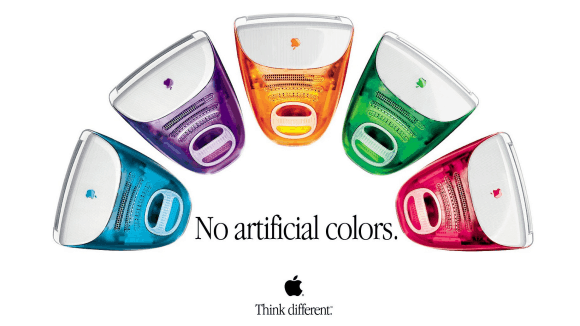
The first new product Apple released after Steve Jobs’ coming home was the original iMac. It was surprising what a difference a little color makes. Adding color to this cute little desktop computer became an instant success. It was also a nice showcase of everything Apple: beautiful to look at, simple to use and innovative. So far, everyone thought computers had to be beige or black and sell through their technical specs. Not anymore.
iMac in Colors
The iMac success helped to keep Apple alive and made it shine again for the first time. However, it didn’t change the underlying dynamic of the PC market. Microsoft owned it and Apple was still only surviving in a small niche.
Phase 3: Figure out where the puck will be going
The strategic genius of Steve Jobs is visible the most in what came next. He must have realized at this point that Apple cannot win against Microsoft and Intel the old fashioned way by building better, more reliable, easier to use and more beautiful but conventional computers. Those things just didn’t matter in a world where Microsoft Windows, Word and Excel were the standards in nearly every industry and nearly every user’s mind. The market for personal computers was in a pretty mature state at this point in time. There was no chance at all for Apple to be ten times better than the whole Windows ecosystem and get people and companies to switch. In order to win, Apple had to change the rules of the game. Further frontal attacks against Wintel were simply futile.
I don’t have any internal knowledge of Apple considerations at that time, but I am pretty sure that Steve Jobs was pretty aware that Moore’s Law will give us powerful pocket-size computers in a not too distant future. “A computer in every pocket” was the logical conclusion. That sounds awfully lot like “A computer on every desktop”, Bill Gates’ big and tremendously successful vision for Microsoft in the 80th. And Microsoft’s board might wonder why they missed this obvious next step after Microsoft succeeded with their initial vision in the 90th. Fortunately for Apple, Microsoft didn’t think ahead. Instead, they waisted a lot of time milking their customers and trying to be like Google.
Ironically, Apple made “a computer in every pocket” happen. They didn’t call it a computer though.
Phase 4: Take the first step
The first step to take advantage of the inevitable mobile revolution was not to launch a handheld computer. Apple tried that before with the Apple Newton and failed. Too complex, too expensive and too much of a niche market.
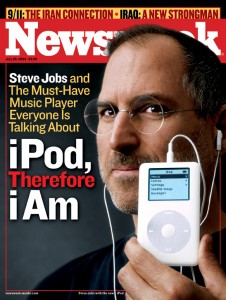
Steve Jobs and iPod on the cover of Newsweek
So Apple did something surprising. They launched the original iPod — no new computer, no better laptop and no new Newton, just a portable music player. Some Apple fan boys were up in arms: “iPoop…iCry. I was hoping for something more”. Nonetheless, the iPod became a hugh success and laid the groundwork for Apple to leapfrog Microsoft a few years later.
The beauty of the initial iPod for Apple was its simplicity. It just had one feature, playing your music on the go. Other than the Apple Newton, it addressed a clear need (all your music on the go) with a huge market potential (who doesn’t like music) and a lack of simple solutions (Sony, anybody?). At the same time, it was the first mobile computer product that reached mass adoption around the world and defined a new market. The enormous sales numbers enabled Apple to build a supply chain that is unmatched by their competitors.
It is difficult to overstate the strategic value of the iPod for Apple. The iPod sold like hot cakes and made a lot of money for Apple. It became a cultural icon and dramatically increased the number of people who own at least one Apple device. And because it worked well with Windows, iTunes for Windows became the first piece of Apple software that many people laid their hands on. Suddenly, many experienced the joy of using Apple products and decided to buy Apple computers instead of Windows PCs, creating Apple’s famous halo effect.
Steve Jobs made another strategic move to get as many people as possible experience an Apple product or service for the first time. He launched Apple’s own stores. What was dismissed by many experts (as usual, one might say), turned over time into one of the most successful retail business on Earth.
The iPod experience was strategic in two more ways, 1) iPods were bought by consumers, not enterprises and 2) iPods smoothly bundled a piece of hardware with software and services. Both aspects are disrupting multiple industries these days. The consumerization of IT broke Microsofts’ and RIM’s influence on IT departments and is here to stay. And the integration of hardware, software and services is the new black. Given Apple’s success, it is no big surprise that Google, Microsoft and Amazon changed course and copy Apple’s bundled approach for seamless integrated hardware, software and services.
Phase 5: Build momentum
The momentum of Apple’s iPod business soon overshadowed their old core business. After launching and developing multiple iPod variations, it was time to catch the next big wave. The rise of smartphones threatened to make iPods redundant some day. Smartphones had been around for a while but they still kind of sucked. They offered only a crippled Internet experience, where complicated to use and lacked a smooth music experience that could compete with the beloved iPod. In 2006, everyone and their grandmother was expecting Apple to build a so-called “iPhone”. Couldn’t Apple build a mobile phone that works elegantly like an iPod and excels as a phone and mobile computer? Well, they could.
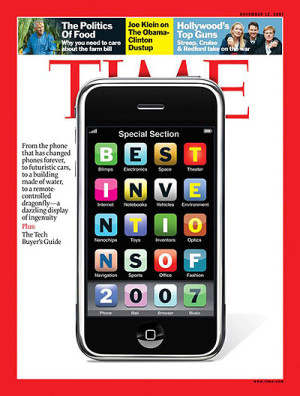
iPhone on the cover of Time Magazine
When Steve Jobs introduced the original iPhone in 2007, he answered the question how nearly all mobile computers will look like in the future. Regardless if competitors knew it or not, they only had two alternatives: 1) “slavishly copying the iPhone” or 2) choose ignorance and see their market share entering the free fall. Only three years after entering the mobile phone market, Apple already commanded more than 50% of the global profits.
The original iPhone promised to be “three products in one”- a music player, a mobile phone and a touch Internet terminal. It soon became much more than that. Against Steve Jobs’ desire to control the whole user experience, hackers enabled us to jailbreak our iPhone and install a fast growing number of useful (or at least entertaining) apps. Jailbroken iPhones soon became the better iPhones and Apple quickly changed course.
The following year, Apple launched the App Store and turned the iPhone into a full blown mobile computing platform. They managed to provide what turned out to be an explosive balance between openness and control. Apple still maintained control over the iPhone ecosystem, but now everyone could start writing apps for the iPhone and have Apple distribute them for free or 30% of the sales price for paid apps. It has never been easier to find, install and update software on a computer. Everyone did it. With more than a billion downloads and a default price point for most paid software of 99 cents, the App Store redefined the software business.
Again, the Microsoft board might wonder, why Microsoft didn’t use their monopoly to build a similar software distribution platform for PCs.
The iPhone soon became one of the fastest selling consumer devices in history. Fortunately, Apple didn’t have to start from scratch building a sufficient supply chain. While long lines in front of Apple stores around the world and temporally constrained supplies became the norm for every new launch, Apple always managed to catch up with the demand quickly by further optimizing their supply chain. First, they became more valuable than Microsoft, then they became the most valued public company on Earth.
The strategic value of the iPhone for Apple is gigantic. The market is enormous and still growing with high customer loyalty and a replacement cycle of less than 2 years for Apple’s iPhone. Owning the latest iPhone for many became the ultimate status symbol. Everyone stood in line to lay their hands on the latest model, Apple fan boys, corporate executives, teenagers, and not to forget the growing middle class in China, creating another strong halo effect for other Apple products.
In order to invent the iPhone, Apple had to answer the question how a mobile operating system has to look like. Steve Jobs concluded that a touch device asked for a fundamentally different interaction model than personal computers, and therefore Apple decided to build a new mobile operating system instead of using a downsized MacOS X. This decision to develop iOS turned out to be strategic. According to Steve Jobs, the PC ecosystem was caught in a kind of local optimum. You have to start fresh, ignoring many existing rules and explore completely new solutions to arrive at superior solutions. The resulting operating system iOS is designed for touch interfaces from the inside out. There are no windows anymore, no console, no file manager, and (nearly) no need to stop applications. Software installation is done with a click, automated updates inclusive. iOS devices are always on, ready to go in a second and still achieving a tremendous battery life. iOS achieved many things that PCs didn’t. They came without a manual and were used by toddlers and grandparents alike.
Phase 6: Finally disrupt the incumbent’s business
In 2010, it was time to take the lessons learned with the iPhone and apply them to the world of more traditional computers. Leveraging everything Apple had learned and built with the iPod and iPhone, they first released their own take on tablet computers.
The tablet market was around for a while but still irrelevant. That changed when Steve Jobs introduced the iPad. He believed it was the greatest thing they ever did and felt “annoyed and depressed” when people initially laughed at it. He was right non the less. The iPad sold even more quickly than the iconic iPhone and became thefastest selling consumer device in history. Within two years, many competitors tried and failed to match the iPad’s appeal to users. At the same time, PC makers started to feel its deep impact. PC shipments stalled. Companies, universities and schools started to deploy iPads replacing traditional PCs in troves and it soon became a shared believe that tablet shipments will dwarf PC shipments some day in the not to distant future.
Even without tablets, Apple won market share in the traditional PC market for more than 20 consecutive quarters. But Apple wanted more. Also in 2010, Apple added a second line of attack and started to bring iPhone/iOS innovations back to the Mac nurturing the famous halo effect. With the relaunch of the MacBook Air and MacBook Pro with Retina Display, Apple started to apply lessons learned in the mobile space directly in the PC space, leveraging parts of the same supply chain.
What I find most fascinating about Steve Jobs’ strategy to turn around Apple is the rigorous long-term thinking in so many dimensions. Many trends that put other companies on defense were leveraged by Apple many years ago. Microsoft and RIM are struggling with the consumerization of IT, Nokia is struggling with touch interfaces, BestBuy is struggling with “showrooming”, the PC ecosystem is struggling with complexity, Android is struggling with fragmentation. Motorola, HTC and LG struggling with commoditization. Apple addressed all these challenges early on. There have certainly been surprises and the need to rewrite parts of the strategy on the go like the decision to open up the iPhone more than planned in the first place. However, the executive team at Apple seemed to have applied long-term thinking to answer many detailed questions regarding their strategy.
In principle, a turnaround like Apple’s can be done again – at least in fields with a high degree of innovation. If there is innovation there will be disruption, and if there is disruption someone can catch the new wave, surf it and overthrow the incumbent. What Apple’s story tells us too, is that incremental improvements won’t be enough if you are losing. You have to identify a need that is not addressed well and be at least ten times better than existing solutions. Ideally, this need is shared by enough people and leads you in a direction you want to go in order to catch the next wave.
“A good hockey player plays where the puck is. A great hockey player plays where the puck is going to be.” Wayne Gretzky
The two things that played a major role for Apple’s turnaround that won’t be available for most other companies is the ideals Apple stood for and their loyal followers around the world. Even in Apple’s dark times around 1998, Apple was admired by many. Most people wanted Apple to succeed. That makes a difference and you might ask yourself how much this can be said about RIM, Microsoft, Nokia or Yahoo!?
Steve Jobs had assembled a dream team of genius programmers and engineers, whom he urged like a cult leader with flattery and verbal attacks to continually new heights. But the ever-changing demands of Jobs delayed the Mac project, so that the Apple co-founder finally lost his bet against the Lisa team. It was not until the 24th of January 1984, that the Mac was finally ready.
At the public presentation of the new computer model, Jobs recited the song “The Times They Are A-Changin” by Bob Dylan:
Screenshot of the movie “Pirates of Silicon Valley”
It is claimed again and again that in the course of the Macintosh’s development, Apple just resorted to the ideas the research laboratory Xerox PARC had hatched before. Fact or Fiction?
The myth says, Apple CEO Steve Jobs saw Xerox PARC product, such as the GUI, either on a tour or at a trade show. He then used the PARC GUI implementation without permission, to create the Apple Lisa and the original Mac OS / Macintosh GUI.
The myth entwines about a late 1979 visit to Xerox PARC by a group of Apple engineers and executives led by Steve Jobs. Alex Soojung-Kim Pang, author of “Making the Macintosh”, writes:
According to early reports, it was on this visit that Jobs discovered the mouse, windows, icons, and other technologies that had been developed at PARC. These wonders had been locked away at PARC by a staff that didn’t understand the revolutionary potential of what they had created. Jobs, in contrast, was immediately converted to the religion of the graphical user interface, and ordered them copied by Apple, starting down the track that would eventually yield the Lisa and “insanely great” Macintosh. The Apple engineers– that band of brothers, that bunch of pirates– stole the fire of the gods, and gave it to the people.
It’s a good story. Unfortunately, it’s also wrong in almost every way a story can be wrong. There are problems with chronology and timing. The testimony of a number of key figures at Apple suggests that the visit was not the revelation early accounts made it out to be. But the story also carries deeper assumptions about Apple, Xerox PARC, computer science in the late 1970s, and even the nature of invention and innovation that deserve to be examined and challenged.
Alex Soojung-Kim Pang
Let us take a closer look at what happend at Xerox PARC:
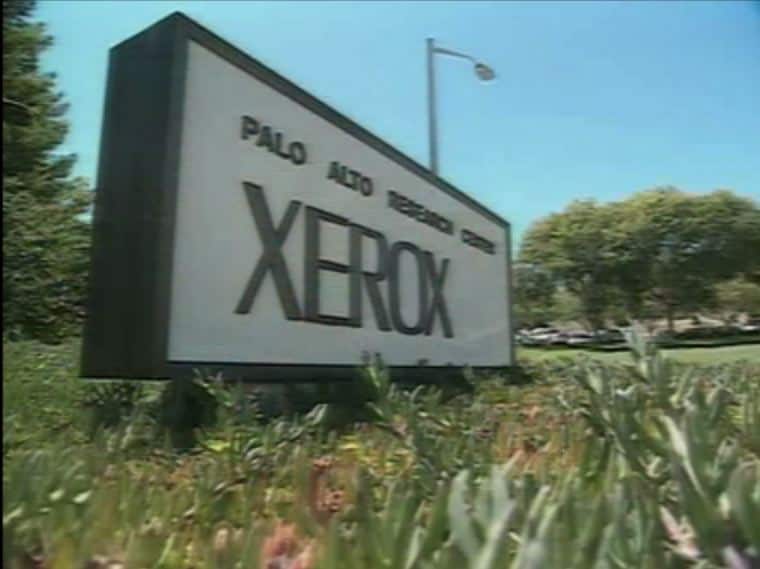
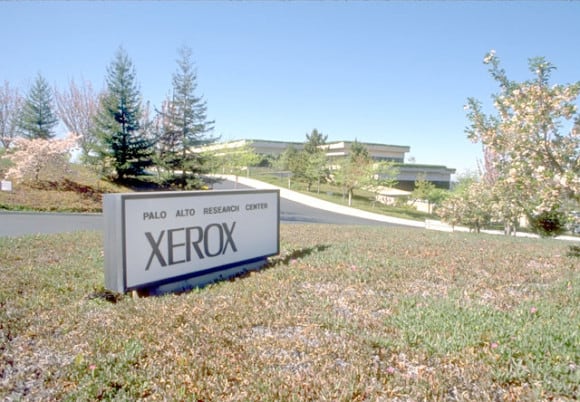
Entrance of Xerox PARC in the eighties
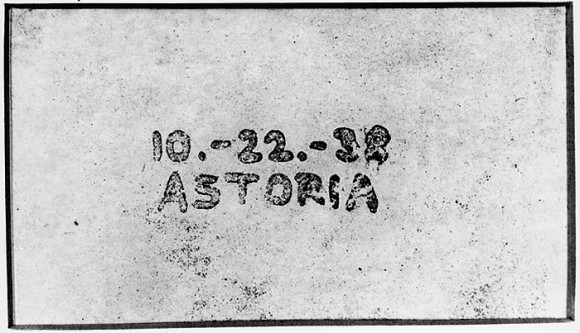
In the Untied States, the brand name “Xerox” denotes photocopying just as “Kleenex” stands for tissues or “Scotch tape” for adhesive film. After all, already in 1950, the Xerox Corp. was the world’s first company to actually transfer the “Xerography” invented by the American law student Chester Carlson into a functional product. Carlson received in 1937 a patent for a process that he called “electrophotography.” On 22 October 1938 followed the premiere in practice: With the help of a metal plate was coated with sulfur and a lamp Chester the lettering “10-22-38 Astoria” on a wax paper.
The first photocopy
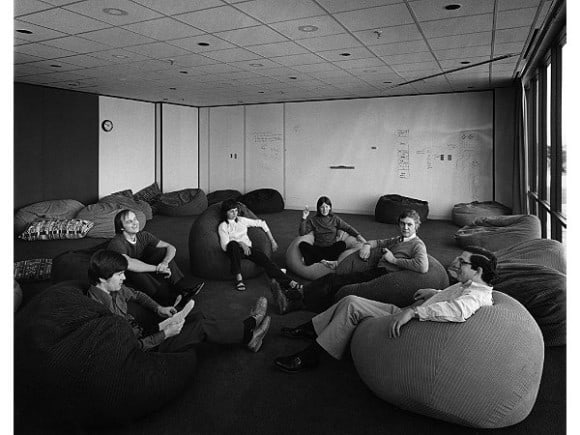
By the end of the sixties, the Xerox management sensed the threat of Japanese companies catching up on Xerox’s technological advantage. Moreover, the Xerox head worried that the “paperless office” might emerge with the following computer generations, in which the Xerox would no longer have a place. Against this background, the Xerox Palo Alto Research Center (PARC) in California was founded in 1970. John Warnock, former researcher in the Xerox PARC and later one of the two founders of Adobe Systems, remembers: “The atmosphere was electric – there was total intellectual freedom. There was no conventional wisdom; almost every idea was up for challenge and got challenged regularly.”
Larry Tessler, who later took part in developing the Macintosh and the Newton PDA at Apple, also enjoyed the liberties the PARC provided in the seventies: “The management said go create the new world. We don’t understand it. Here are people who have a lot of ideas and tremendous talent, [are] young, energetic.” The problem, however, was that the company management at the East Coast of the USA did not [care a straw for] the PARC’s research results unless they were directly involved with photocopiers.
In his TV documentation “Triumph of the Nerds” Robert Cringley is interviewing researchers at the Xerox PARC
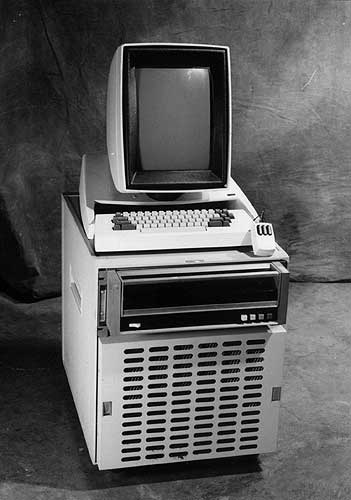
Within two years, the researchers at the PARC had designed the Alto, which was something like the first personal computer. The Alto did not feature character-oriented graphics, as did all the other computers of that time, but a bit-oriented version instead. A high quality printer could print exactly what the screen displayed.
A mouse. Removable data storage. Networking. A visual user interface. Easy-to-use graphics software. “What You See Is What You Get” (WYSIWYG) printing, with printed documents matching what users saw on screen. E-mail. Alto for the first time combined these and other now-familiar elements in one small computer.
Developed by Xerox as a research system, the Alto marked a radical leap in the evolution of how computers interact with people, leading the way to today’s computers.
By making human-computer communications more intuitive and user friendly, Alto and similar systems opened computing to wide use by non-specialists, including children.
People were able to focus on using the computer as a tool to accomplish a task rather than on learning their computer’s technical details.
However, this marvelous machine was not freely available on the market. Only small numbers were built initially, but by the late 1970s, about 1,000 were in use at various Xerox laboratories, and about another 500 in several universities. Total production was about 2,000 systems.
The revolutionary Alto would have been an expensive personal computer if put on sale commercially. Lead engineer Charles Thacker noted that the first one cost Xerox $12,000. As a product, the price tag might have been $40,000.
Commercial for the Xerox Alto (1972).
This commercial for Xerox’s Alto computer released in 1972 introduced the world to the first desktop computer with a graphical user interface. Named after Xerox PARC’s home city of Palo Alto, California, the computer introduced the world to the window-oriented mouse and keyboard interface we use today. The Alto also had a distinctive portrait screen — an idea that was well before its time.
The video showed how the computer could revolutionize your office life, with email, word processing and reminders all controlled by a cursor. It also shows the protagonist expressing his thoughts and actions out loud, as if in conversation with the Alto (which seems to be nicknamed “Fred”).
Some Apple engineers were already familiar with PARC, its work, or technologies like the mouse. Bill Atkinson had read about Smalltalk as an undergraduate. Some had worked at PARC: Jef Raskin spent time there during a sabbatical year at Stanford, and had a number of friends who were researchers there. Finally, there were even some Apple employees whose had learned about the mouse while working for Douglas Engelbart at SRI in the 1960s and early 1970s, or Tymshare in the later 1970s.