Few computers – indeed, few consumer items of any kind – have generated such a wide range of opinions as the Macintosh. Criticized as an expensive gimmick and hailed as the liberator of the masses, the Mac is a potentially great system. Whether it lives up to that potential remains to be seen.
The Apple Macintosh
Personally, I think the Macintosh is a wonderful machine. I use one daily at work, and then at night I play with the one I have at home. Or, at least, I try to play with it. You see, my wife – who for years resisted all my attempts to introduce her to computers – has fallen in love with the Mac (her words, not mine). She uses it to type up medical reports, notes on her clients, and personal letters. In fact, she’s suggested that we get a second Macintosh so that we won’t have to fight over the one we have.
The Macintosh is not without its problems. Resources are tight – it needs more memory and disk space – and software has been slow in coming to market. Many have criticized its price ($2495). In fact, there are indications that Apple considered a lower price ($1995) and then rejected it. It doesn’t seem to have hurt the Mac’s market – people are still buying them faster than Apple can make them – but there’s the potential for backlash if the machine doesn’t deliver on all its promises.
Whatever its problems and limitations, the Mac represents a breakthrough in adapting computers to work with people instead of vice versa. Time and again, I’ve seen individuals with little or no computer experience sit down in front of a Mac and accomplish useful tasks with it in a matter of minutes. Invariably, they use the same words to describe it: “amazing” and “fun.” The question is whether “powerful” can be added to that list.
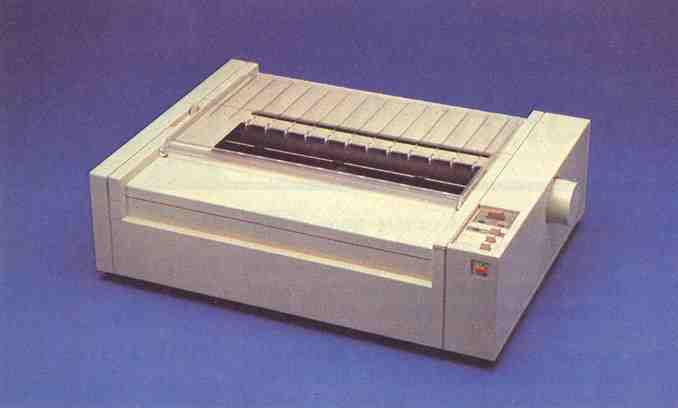
The Macintosh dot-matrix printer
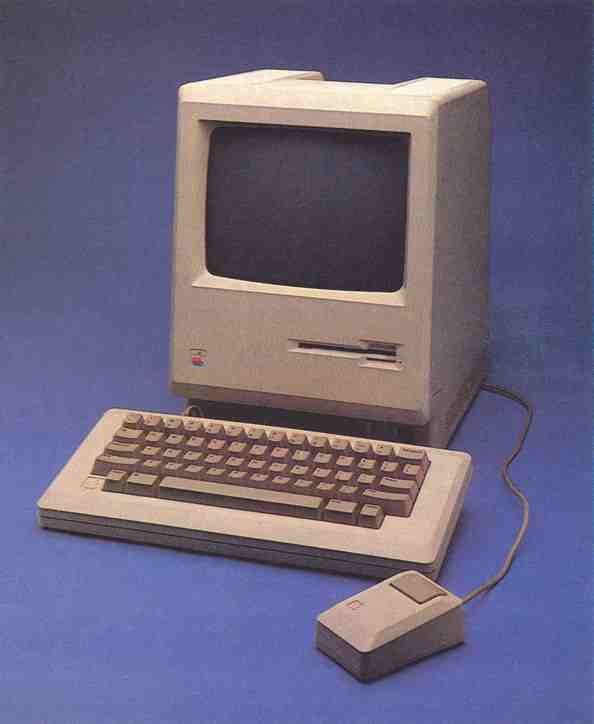
In an industry rapidly filling up with IBM PC clones, the Macintosh represents a radical departure from the norm. It is a small, lightweight computer with a high-resolution screen, a detached keyboard, and a mouse (see photo 1). It comes with 128K bytes of RAM (random-access read/write memory), 64K bytes of ROM (read-only memory), and a 400K-byte 3?-inch disk drive. If you throw in an Imagewriter printer (see photo 2 and figure 1) the system costs $2990. The processor is a Motorola 68000, running a name-less operating system (see the text box, “A Second Opinion” on page 248 for a fit description). It has absolutely no IBM PC/MS-DOS compatibility, and it would appear Apple plans none. Continue reading →
A sidebar to the Apple Macintosh review published in Byte, issue 8/1984, pp. 241-242.
At a glance
Apple Macintosh Review Byte
Name
Macintosh
Manufacturer
Apple Computer Inc.
20525 Mariani Ave.
Cupertino, CA 95014
(408) 996-1010
Components
Size: 13.5 by 9.7 by 10.9 inches (main unit)
2.6 by 13.2 by 5.8 inches (keyboard)
Weight: 19.5 pounds
Processor: Motorola 68000 (7,8336 MHz)
Memory: 128K bytes of RAM; 64K bytes of ROM
Display: 9-inch built-in monitor; high-resolution bit-mapped display (512 by 342 pixels); adjustable
Keyboard: 58 keys, detached, standard layout, no function keys, software-mapped
Mouse: single button, mechanical tracking, optical shaft encoding
Mass storage: built-in single-sided 3½-inch Sony drive (400K bytes)
Sound generator: four-voice sound
Interfaces: two RS-422A serial ports (230.4K bps transfer rate); external-disk interface for second (optional) disk drive; mouse interface; synchronous serial keyboard bus
The Memory Size graph shows the standard and optional memory available for the computers under comparison. The Disk Storage graph shows the highest capacity of a single floppy-disk drive for each system. The Bundled Software graph shows the number of software packages included with each system. The Price graph shows the list price of a system with two high-capacity floppy-disk drives, a monochrome monitor, graphics and color-display capability, a printer port and a serial port, 256K bytes of memory (64K bytes for 8-bit systems), the standard operating system for each system, and the standard BASIC interpreter for each system. The Mac’s price includes 128K bytes of memory only.
Apple Macintosh Review Byte - Benchmark 2
The graph for Disk Access in BASIC shows how long it takes to write a 64K-byte sequential text file to a blank floppy disk and how long it takes to read this file (For the program listings, see “The Chameleon Plus,” by Rich Krajewski, June 1984, page 327.) The BASIC Performance graph shows how long it takes to run one iteration of the Sieve of Eratosthenes prime-number benchmark. In the same graph, the Calculations results show how long it takes to do 10,000 multiplication and division operations using single-precision numbers. The System Utilities graph shows how long it takes to transfer a 40K-byte file using the system utilities. The Spreadsheet graph shows how long the computers take to load and recalculate a 25- by 25-cell spread-sheet where each cell equals 1.001 times the cell to its left. The spreadsheet program used was Microsoft Multiplan. The time for the format/disk copy test on the Macintosh reflects using the disk-copy utility on a single-drive system. Four disk-swaps are required for the complete disk copy, the time for which is included in the benchmark.
* The Sieve benchmark couldn’t be run on the Mac (see text for details).
** The new Disk Copy program was not available at press time.
The Macintosh is advertised as a 128K-byte machine. In reality, the Finder (Macintosh’s operating system) and other systems software take about 40K bytes. Subtract from this another 40K to 70K bytes for any applications programs that may be in memory and the 128K-byte Macintosh becomes an 18K- to 38K-byte machine. For example, when Mac’s Microsoft BASIC package is loaded on top of the resident software, there is only 13K bytes of space for programs and data left. Similarly, MacWrite, Macintosh’s word-processing program, only allows documents with a maximum size of about 24K bytes. This problem seems to be an inherent limitation in the current design of the Macintosh because there is no way to expand the memory capacity of the machine. When 256K-bit memory chips become available the Macintosh will be upgraded to a 512K-byte machine, enough space for the most ambitious application programs. However, at the time of this writing these chips are only in the development stage. This means that they will not be commercially available before 1985. Continue reading →
It is now 1984. It appears IBM wants it all. Apple is perceived to be the only hope to offer IBM a run for its money. Dealers initially welcoming IBM with open arms now fear an IBM dominated and controlled future. They are increasing and desperately turning back to Apple as the only force that can ensure their future freedom. IBM wants it all and is aiming its guns on its last obstacle to industry control, Apple. Will Big Blue dominate the entire computer industry? The entire information age? Was George Orwell right about 1984?
The only problem with Microsoft is they just have no taste, they have absolutely no taste, and what that means is – I don’t mean that in a small way I mean that in a big way. In the sense that they they don’t think of original ideas and they don’t bring much culture into their product ehm and you say why is that important – well you know proportionally spaced fonts come from type setting and beautiful books, that’s where one gets the idea – if it weren’t for the Mac they would never have that in their products and ehm so I guess I am saddened, not by Microsoft’s success – I have no problem with their success, they’ve earned their success for the most part. I have a problem with the fact that they just make really third rate products.
Steve Ballmer
I will admit quite frankly that I think Windows today is probably four years behind, three years behind where it would have been had we not danced with IBM for so long. Because the amount of split energy, split works, split IQ in the company really cost our end customer real innovation in our product line and so whenever I hear these criticisms which I gotta to say sting eh sometimes, I say to myself just you watch, just you watch Windows 95, Windows 9…there’s no lack of focus there hasn’t been here for the last three or four years since we didn’t have this big spot with IBM. Even in the operating systems here now, you’ll start to see clear, clear…and people will recognise clear leadership.
The importance of Apple’s early days is often forgotten by the Mac community in our focus on a product that was released 7 years into Apple’s life. It is certainly long-forgotten by most of the rest of the world. The Apple I and, to a far larger extent, the Apple II were the first truly useful computers that you could *own* and have in your home or office. Certainly other products came online shortly thereafter, but it was Apple that really lit the way.
The History Channel Pays Homage To Apple, Steve Jobs, & Steve Wozniak: