Mac OS 7.0
Leave a reply
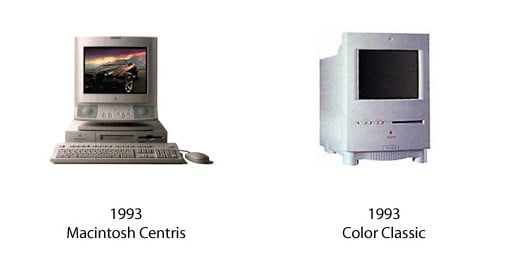
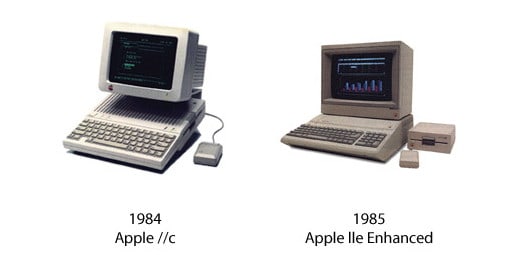
Macintosh, commonly nicknamed Mac is a brand name which covers several lines of personal computers designed, developed, and marketed by Apple Inc. The Macintosh 128K was released on January 24, 1984; it was the first commercially successful personal computer to feature a mouse and a graphical user interface (GUI) rather than a command line interface. Through the second half of the 1980s, the company built market share only to see it dissipate in the 1990s as the personal computer market shifted towards IBM PC Compatible machines running MS-DOS and Microsoft Windows. Apple consolidated multiple consumer-level desktop models into the 1998 iMac all-in-one, which sold extremely well and saw the Macintosh brand revitalized. Current Mac systems are mainly targeted at the home, education, and creative professional markets. They are: the aforementioned (though upgraded) iMac and the entry-level Mac mini desktop models, the workstation-level Mac Pro tower, the MacBook, MacBook Air and MacBook Pro laptops, and the Xserve server.
Production of the Mac is based on a vertical integration model in that Apple facilitates all aspects of its hardware and creates its own operating system that is pre-installed on all Macs. This is in contrast to most IBM compatible PCs, where multiple vendors create hardware intended to run another company’s software. Apple exclusively produces Mac hardware, choosing internal systems, designs, and prices. Apple does use third party components, however; current Macintosh CPUs use Intel’s x86 architecture. Previous models used the AIM alliance’s PowerPC and early models used Motorola’s 68k. Apple also develops the operating system for Macs, currently Mac OS X 10.5 “Leopard”. The modern Mac, like other personal computers, is capable of running alternative operating systems such as Linux, FreeBSD, and Microsoft Windows, the latter of which is considered to be the Mac’s biggest competitor
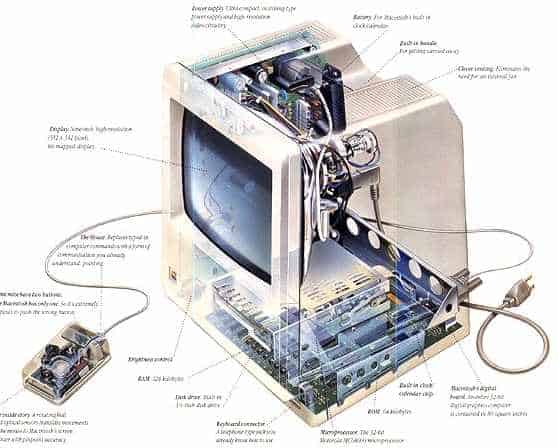
The Macintosh project started in the late 1970s with Jef Raskin, an Apple employee, who envisioned an easy-to-use, low-cost computer for the average consumer. In September 1979, Raskin was authorized to start hiring for the project, and he began to look for an engineer who could put together a prototype.
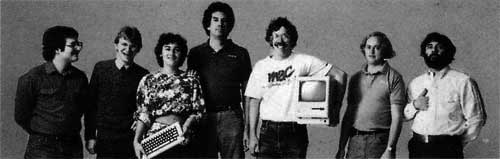
Bill Atkinson, a member of Apple’s Lisa team (which was developing a similar but higher-end computer), introduced him to Burrell Smith, a service technician who had been hired earlier that year. Over the years, Raskin assembled a large development team that designed and built the original Macintosh hardware and software; besides Raskin, Atkinson and Smith, the team included Chris Espinosa, Joanna Hoffman, George Crow, Jerry Manock, Susan Kare, Andy Hertzfeld, and Daniel Kottke.

Smith’s first Macintosh board was built to Raskin’s design specifications: it had 64 kilobytes (KB) of RAM, used the Motorola 6809E microprocessor, and was capable of supporting a 256×256 pixel black-and-white bitmap display. Bud Tribble, a Macintosh programmer, was interested in running the Lisa’s graphical programs on the Macintosh, and asked Smith whether he could incorporate the Lisa’s Motorola 68000 microprocessor into the Mac while still keeping the production cost down. By December 1980, Smith had succeeded in designing a board that not only used the 68000, but bumped its speed from 5 to 8 megahertz (MHz); this board also had the capacity to support a 384×256 pixel display. Smith’s design used fewer RAM chips than the Lisa, which made production of the board significantly more cost-efficient. The final Mac design was self-contained and had the complete QuickDraw picture language and interpreter in 64 Kb of ROM – far than most other computers; it had 128 KB of RAM, in the form of sixteen 64 kilobit (Kb) RAM chips soldered to the logicboard. Though there were no memory slots, its RAM was expandable to 512 KB by means of soldering sixteen chip sockets to accept 256 Kb RAM chips in place of the factory-installed chips. The final product’s screen was a 9-inch, 512×342 pixel monochrome display, exceeding the prototypes.
The original 1984 Mac OS desktop featured a radically new graphical user interface. Users communicated with the computer not through abstract lines of code but rather using a metaphorical desktop that included items that the user was already familiar with.
The design caught the attention of Steve Jobs, co-founder of Apple. Realizing that the Macintosh was more marketable than the Lisa, he began to focus his attention on the project. Raskin finally left the Macintosh project in 1981 over a personality conflict with Jobs, and the final Macintosh design is said to be closer to Jobs’ ideas than Raskin’s.
After hearing of the pioneering GUI technology being developed at Xerox PARC, Jobs had negotiated a visit to see the Xerox Alto computer and Smalltalk development tools in exchange for Apple stock options. The Lisa and Macintosh user interfaces were partially influenced by technology seen at Xerox PARC and were combined with the Macintosh group’s own ideas. Jobs also commissioned industrial designer Hartmut Esslinger to work on the Macintosh line, resulting in the “Snow White” design language; although it came too late for the earliest Macs, it was implemented in most other mid- to late-1980s Apple computers.[4] However, Jobs’ leadership at the Macintosh project was short-lived; after an internal power struggle with new CEO John Sculley, Jobs angrily resigned from Apple in 1985, went on to found NeXT, another computer company, and did not return until 1997.
1984: Introduction
This television commercial, which aired during the Super Bowl, launched the original Macintosh.
The Macintosh 128k was announced to the press in October 1983, followed by an 18-page brochure included with various magazines in December. The Macintosh was introduced by the now famous US$1.5 million Ridley Scott television commercial, “1984”. The commercial most notably aired during the third quarter of Super Bowl XVIII on 22 January 1984 and is now considered a “watershed event” and a “masterpiece.” 1984 used an unnamed heroine to represent the coming of the Macintosh (indicated by her white tank top with a Picasso-style picture of Apple’s Macintosh computer on it) as a means of saving humanity from “conformity” (Big Brother). These images were an allusion to George Orwell’s noted novel, Nineteen Eighty-Four, which described a dystopian future ruled by a televised “Big Brother.”
For a special post-election edition of Newsweek in November 1984, Apple spent more than US$2.5 million to buy all 39 of the advertising pages in the issue. Apple also ran a “Test Drive a Macintosh” promotion, in which potential buyers with a credit card could take home a Macintosh for 24 hours and return it to a dealer afterwards. While 200,000 people participated, dealers disliked the promotion, the supply of computers was insufficient for demand, and many were returned in such a bad shape that they could no longer be sold. This marketing campaign caused CEO John Sculley to raise the price from US$1,995 to US$2,495 (adjusting for inflation, about $5,000 in 2007).
Two days after the 1984 ad aired, the Macintosh went on sale. It came bundled with two applications designed to show off its interface: MacWrite and MacPaint. Although the Mac garnered an immediate, enthusiastic following, it was too radical for some, who labeled it a mere “toy.” Because the machine was entirely designed around the GUI, existing text-mode and command-driven applications had to be redesigned and the programming code rewritten; this was a challenging undertaking that many software developers shied away from, and resulted in an initial lack of software for the new system. In April 1984 Microsoft’s MultiPlan migrated over from MS-DOS, followed by Microsoft Word in January 1985. In 1985, Lotus Software introduced Lotus Jazz after the success of Lotus 1-2-3 for the IBM PC, although it was largely a flop. Apple introduced Macintosh Office the same year with the lemmings ad. Infamous for insulting its own potential customers, it was not successful.
Feature stories about the Apple Macintosh on this web site:
Source:
Macintosh. (2008, October 9). In Wikipedia, The Free Encyclopedia. Retrieved 17:51, October 12, 2008, from http://en.wikipedia.org/w/index.php?title=Macintosh&oldid=244185329
This article is published under the GNU General Public License
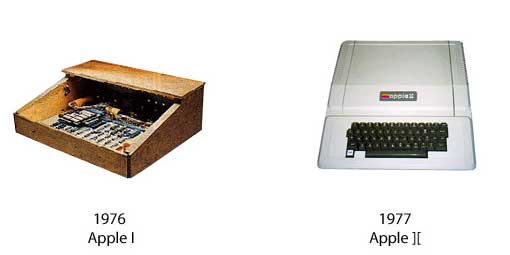
Apple I |
Apple II |
||
|
CPU |
CPU |
||
| CPU: MOS Technology 6502 | CPU: MOS Technology 6502 | ||
| CPU Speed: 1 MHz | CPU Speed: 1 MHz | ||
| FPU: none | FPU: none | ||
| Bus Speed: 1 MHz | Bus Speed: 1 MHz | ||
| Data Path: 8 bit | Data Path: 8 bit | ||
| Onboard RAM: 8 kB | ROM: 12 kB | ||
| Maximum RAM: 32 kB | RAM slots: 1st expansion slot can be used | ||
| Expansion Slots: 8 proprietary | |||
| Video | Video | ||
| VRAM: 1 kB | |||
| Max Resolution: 60.05 Hz, 40×24 char | Max Resolution: 6 color at 280×192, 4-bit color at 40×48 | ||
| Storage | |||
| Floppy Drive: optional | |||
| Input / Output | |||
| Serial: optional expansion card | |||
| Speaker: mono | |||
| Miscellaneous | Miscellaneous | ||
| Codename: ? | Floppy Drive: optional | ||
| Power: 58 Watts | Codename: ? | ||
| Introduced: April 1976 | Introduced: 1977 | ||
| Terminated: 1977 | Terminated: 1980 | ||
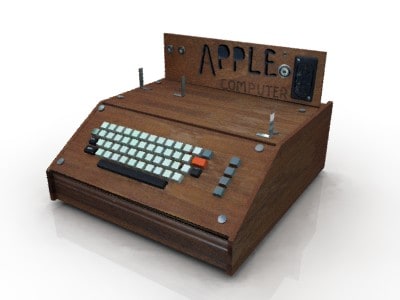
Apple I
The Apple I is sometimes credited as the first personal computer to be sold in fully assembled form; however, some argue that the honor rightfully belongs to other machines, such as the MOS Technology KIM-1, Datapoint 2200, or more commonly the Altair 8800 (which could be bought in kit or assembled form at extra cost). One major difference sets the Apple I apart — it was the first personal computer to use a keyboard.
The Apple I’s built-in computer terminal circuitry was distinctive. All one needed was a keyboard and an inexpensive video monitor. Competing machines such as the Altair 8800 generally were programmed with front-mounted toggle switches and used indicator lights (red LEDs, most commonly) for output, and had to be extended with separate hardware to allow connection to a computer terminal or a teletype machine. This made the Apple I an innovative machine for its day. In April 1977 the price was dropped to $475.[5]. It continued to be sold through August 1977, despite the introduction of the Apple II in April 1977, which began shipping in June of that year.[6] The Apple II was otherwise identical to the Apple I, except it added more RAM, color graphics, sound capabilities, additional expansion slots and was notably contained in a styled plastic case with an integrated keyboard. Apple had dropped the Apple 1 from its price list by October 1977, officially discontinuing it.
As of 2008, an estimated 30 to 50 Apple Is are still known to exist, making it a very rare collector’s item. An Apple I reportedly sold for $50,000 at auction in 1999; however, a more typical price for an Apple I is in the $14,000–$16,000 range. A software-compatible clone of the Apple I (Replica 1) produced using modern components, was released in 2003 at a price of around $200.
Source:
Apple I. (2008, September 28). In Wikipedia, The Free Encyclopedia. Retrieved 11:50, October 12, 2008, from http://en.wikipedia.org/w/index.php?title=Apple_I&oldid=241506300
The Apple II (often written as Apple ][ or Apple //) was the first mass produced microcomputer product, manufactured by Apple Computer (now Apple Inc.). It was among the first home computers on the market, and became one of the most recognizable and successful. In terms of ease of use, features and expandability the Apple II was a major technological advancement over its predecessor, the Apple I, a limited production bare circuit board computer for electronics hobbyists which pioneered many features that made the Apple II a commercial success. Introduced at the West Coast Computer Faire in 1977, the Apple II was among the first successful personal computers and responsible for launching the Apple company into a successful business. Throughout the years a number of different models were introduced and sold, with the most popular model manufactured having relatively minor changes even into the 1990s. By the end of its production in 1993, somewhere between five and six million Apple II series computers (including approximately 1.25 million Apple IIGS models) had been produced.
Throughout the 1980s and much of the 1990s, the Apple II was the de facto standard computer in American education; some of them are still operational in classrooms today. The Apple II was popular with business users as well as with families and schools, particularly after the release of the popular spreadsheet, VisiCalc, which initially ran only on the Apple II.
The original Apple II operating system was only the built-in BASIC interpreter contained in ROM. Apple DOS was added to support the diskette drive; the last version was “Apple DOS 3.3”. Apple DOS was superseded by ProDOS to support a hierarchical filesystem and larger storage devices. With an optional Z80 based expansion card the Apple II could even run the popular Wordstar and dBase software under the CP/M operating system. At the height of its evolution, towards the late 1980s, the platform had the graphical look of a hybrid of the Apple II and Macintosh with the introduction of the Apple IIGS. By 1992, the platform featured 16-bit processing capabilities, a mouse driven Graphical User Interface and graphic and sound capabilities far beyond the original.
After years of focus on Apple’s Macintosh product line, it finally eclipsed the Apple II series in the early 1990s. Even after the introduction of the Macintosh, the Apple II had remained Apple’s primary revenue source for years: the Apple II and its associated community of third-party developers and retailers were once a billion-dollar-a-year industry. The Apple IIGS model was sold through to the end of 1992. The Apple IIe model was removed from the product line on October 15, 1993, ending an era.
Source:
Apple II series. (2008, October 11). In Wikipedia, The Free Encyclopedia. Retrieved 11:54, October 12, 2008, from http://en.wikipedia.org/w/index.php?title=Apple_II_series&oldid=244519623
This article is published under the GNU General Public License
System 7 (codenamed “Big Bang” and sometimes called Mac OS 7) is a single-user graphical user interface-based operating system for Macintosh computers. It was introduced on May 13, 1991 by Apple Computer. It succeeded System 6, and was the main Macintosh operating system until it was succeeded by Mac OS 8 in 1997. Features added with the System 7 release included cooperative multitasking, virtual memory, personal file sharing, an improved user interface, QuickTime, and QuickDraw 3D.
“System 7” is often used generically to refer to all 7.x versions. With the release of version 7.6 in 1997, Apple officially renamed the operating system “Mac OS”, a name which had first appeared on System 7.5.1’s boot screen. System 7 was developed for the Motorola 68k processor, but was ported to the PowerPC after Apple adopted the new processor.
Features
Compared with System 6, System 7 offered:
Software
System 7 was the first version of the Mac OS that required a hard drive as it was too large to work comfortably from floppy disk. It was also the first Apple operating system to be available on CD. System 7 itself did not come bundled with major software packages, however newly purchased Macintosh computers were often bundled with software such as HyperCard, ClarisWorks, Power Pete, Mac-Chess, and Netscape. PowerPC Macintoshes included Graphing Calculator. System 7 also included networking and file sharing software in the form of system extensions and control panels.
The basic utilities installed by default with System 7 included TeachText (superseded by the more flexible SimpleText in later versions) for basic text editing tasks and reading readme documents. Also available on the additional “Disk Tools” floppy disk are Disk First Aid for disk repair and Apple HD SC Setup for initializing and partitioning disks.
Later versions of System 7, specifically System 7.5 and Mac OS 7.6, came with a dedicated “Utilities” folder and “Apple Extras” folder including: AppleScript, Disk Copy, QuickDraw GX Extras and QuickTime Movie Player. More optional extras and utilities could be manually installed from the System CD.
Transition to PowerPC
System 7.1.2 was the first version of the Mac OS to support Apple’s new PowerPC-based computers. 68k applications which had not yet been updated to run natively on these systems were emulated transparently (without users’ knowledge) by a built-in 68k processor emulator. Fat binaries, which contained the code necessary to run natively on both PowerPC and 68k systems, became common during this time. This process was similar to the distribution of universal binaries during Apple’s transition from PowerPC to Intel processors in 2006.
PC compatibility
System 7.0 through 7.1 offered a utility called Apple File Exchange, which could access the contents of FAT- and Apple II-formatted floppy disks. System 7 Pro, System 7.5 and up shipped with PC Exchange, previously a separate product, which allowed the system to mount FAT-formatted floppy disks on the desktop in the same manner as regular Macintosh disks. System 7 also can read HPFS and NTFS formatted drives. OS/2 disks were read as PC-DOS disks, due to fact that OS/2 used the FAT file system. At this time, Macs could also read and write UNIX file systems with the help of extra software. System 7 allowed users to access PC networks and allowed communication. Third party software such as SoftPC allowed compatibility between MS-DOS and Microsoft Windows programs while others such a Connectix Virtual PC allowed the Mac to run Windows and the Mac OS to run via emulation. Others took a more native approach by running Windows and MS-DOS by using x86 expansion cards with an x86 chip on the card.
[edit]Miscellaneous
At the time of its release, many users noticed that performance suffered as a result of upgrading from System 6 to System 7, though newer hardware soon made up for the speed differential. Another problem was System 7’s large “memory footprint”: System 6 could boot the system from a single floppy disk and took up about 600 KB of RAM, whereas System 7 used well over a megabyte, and could no longer be usefully run from floppy-only machines without the aid of an external SCSI hard drive. (Versions up to 7.5 could boot from a floppy, but there would be no room for other applications, although it was possible to access an AFP server on an AppleTalk network.) It was some time before the average Mac shipped with enough RAM built in for System 7 to be truly comfortable. Offsetting this was the inclusion of a hard disk as standard in most Mac models; only the long-lived Mac Plus and certain models of the Macintosh SE did not ship with one.
System 7.0 was adopted quite rapidly by Mac users, and quickly became one of the base requirements for new software.
The engineering group within Apple responsible for System 7 came to be known as the “Blue Meanies”, named after the blue index cards on which were written the features that could be implemented in a relatively short time. In comparison, the pink index card features were handled by the Pink group, later becoming the ill-fated Taligent project.
System 7.0 was the last version of the Macintosh operating system that Apple made available without charge and allowed to be freely redistributed. Although it could be purchased from Apple, the cost was nominal and considered to only cover duplication and media. It was perfectly legal to copy a friend’s System 7 installation floppies, and it was common for Macintosh dealers to allow customers to use the store’s demo machines to copy System 7 install disks for the cost of a box of floppies. Many CD-ROM magazines such as Nautilus included System 7 on their disks. Apple started selling the Mac OS as a retail product with System 7.1. (System 7.5.3r2 is now similarly available for free from Apple’s web site, but was not posted until after it had been superseded.)
Source: Article “System 7”. (2008, December 10). In Wikipedia, The Free Encyclopedia. Retrieved 09:02, December 24, 2008, from http://en.wikipedia.org/w/index.php?title=System_7&oldid=257154261
This entry is published under the GNU General Public License.

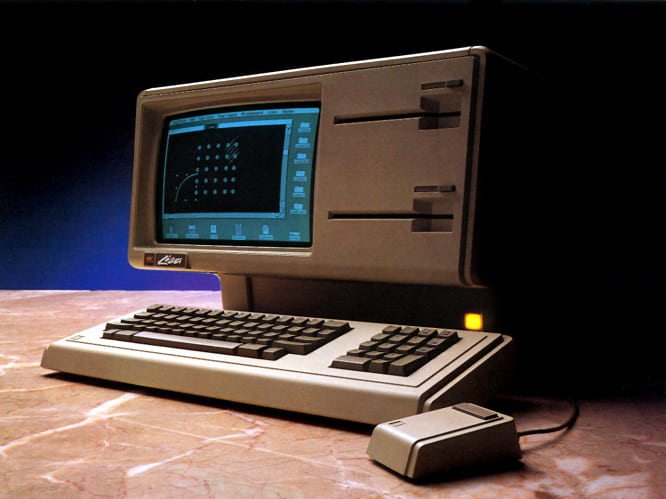
The Apple Lisa was a personal computer designed at Apple Computer, Inc. during the early 1980s. Officially, “Lisa” stood for “Local Integrated Software Architecture”, but it was also the name of Apple co-founder Steve Jobs’ daughter.
The Lisa project was started at Apple in 1978 and evolved into a project to design a powerful personal computer with a graphical user interface (GUI) that would be targeted toward business customers.
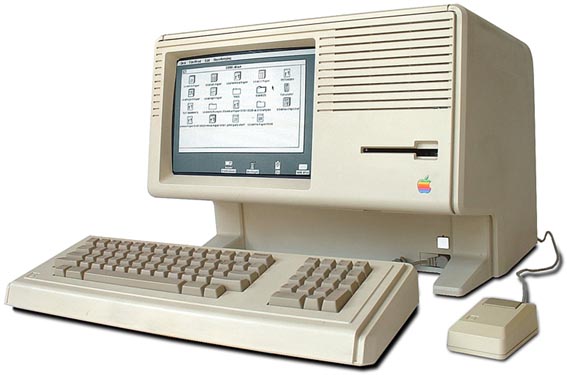
In September 1980, Steve Jobs was forced out of the Lisa project, so he joined the Macintosh project instead. Contrary to popular belief, the Macintosh is not a direct descendant of Lisa, although there are obvious similarities between the systems and the final revision, the Lisa 2/10, was modified and sold as the Macintosh XL.

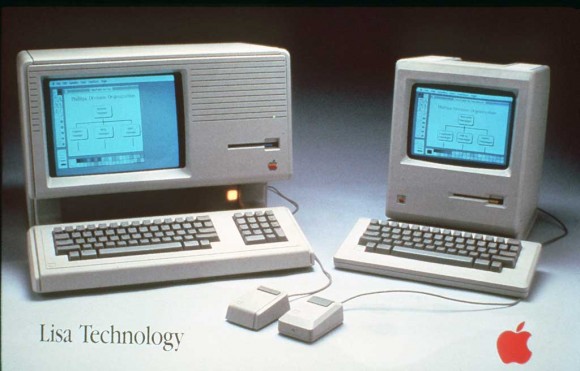
The Lisa was a more advanced (and far more expensive) system than the Macintosh of that time in many respects, such as its inclusion of protected memory, cooperative multitasking, a generally more sophisticated hard disk based operating system, a built-in screensaver, an advanced calculator with a paper tape and RPN, support for up to 2 megabytes of RAM, expansion slots, and a larger higher resolution display. It would be many years before many of those features were implemented on the Macintosh platform. Protected memory, for instance, did not arrive until the Mac OS X operating system was released in 2001. The Macintosh, however, featured a faster 68000 processor (7.89 MHz) and sound. The complexity of the Lisa operating system and its programs taxed the 5 MHz Motorola 68000 microprocessor so that the system felt sluggish, particularly when scrolling in documents.
Etymology
While the documentation shipped with the original Lisa only ever referred to it as The Lisa, officially, Apple stated that the name was an acronym for Local Integrated Software Architecture or “LISA”. Since Steve Jobs’ first daughter (born in 1978) was named Lisa Jobs, it is normally inferred that the name also had a personal association, and perhaps that the acronym was invented later to fit the name. Hertzfeld states that the acronym was reverse engineered from the name “Lisa” in autumn 1982 by the Apple marketing team, after they had hired a marketing consultancy firm to come up with names to replace “Lisa” and “Macintosh” (at the time considered by Rod Holt to be merely internal project codenames) and then rejected all of the suggestions. Privately, Hertzfeld and the other software developers used “Lisa: Invented Stupid Acronym”, a recursive backronym. It is also important to note that Lisa team member Larry Tesler’s daughter is named Lisa.
Hardware
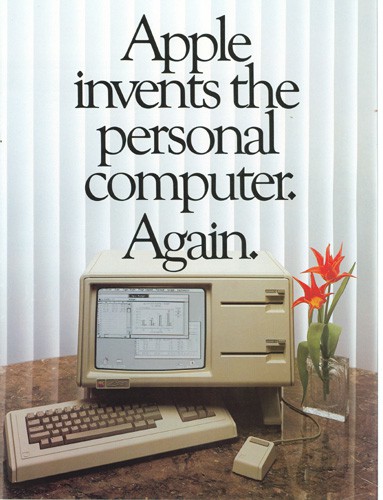
The Lisa was first introduced in January 19, 1983 at a cost of $9,995 US ($21,482.26 in 2008 dollars). It is one of the first commercial personal computers to have a GUI and a mouse. It used a Motorola 68000 CPU at a 5 MHz clock rate and had 1 MB RAM.
The original Lisa has two Apple FileWare 5¼ inch double-sided floppy disk drives, more commonly known by Apple’s internal code name for the drive, “Twiggy”. They have a capacity of approximately 871 kilobytes each, but required special diskettes. The drives have the reputation of not being reliable, so the Macintosh, which was originally designed to have a single Twiggy, was revised to use a Sony 400k microfloppy drive in January 1984. An optional external 5 MB or, later, a 10 MB Apple ProFile hard drive (originally designed for the Apple III) was also offered.

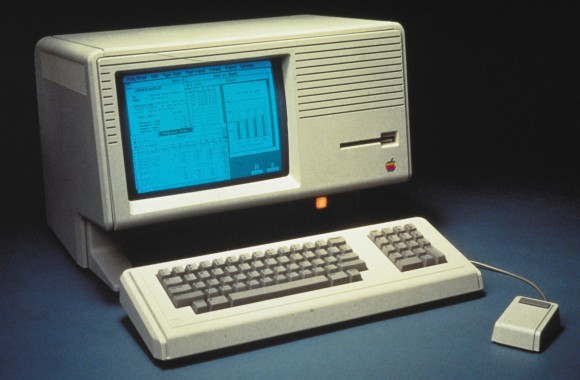
The first hardware revision, the Lisa 2, released in January 1984 priced between $3,495 and $5,495 US, was much less expensive than the original model and dropped the Twiggy floppy drives in favor of a single 400k Sony microfloppy. It was possible to purchase the Lisa 2 with a ProFile and with as little as 512k RAM. The final version of the Lisa available includes an optional 10 MB internal proprietary hard disk manufactured by Apple, known as the “Widget”. In 1984, at the same time the Macintosh was officially announced, Apple announced that it was providing free upgrades to the Lisa 2 to all Lisa 1 owners, by swapping the pair of Twiggy drives for a single 3½ inch drive, and updating the boot ROM and I/O ROM. In addition, a new front faceplate was included to accommodate the reconfigured floppy disk drive. With this change, the Lisa 2 had the notable distinction of introducing the new Apple inlaid logo, as well as the first Snow White design language features.
There were relatively few third-party hardware offerings for the Lisa, as compared to the earlier Apple II. AST offered a 1.5 MB memory board, which when combined with the standard Apple 512 KB memory board, expanded the Lisa to a total of 2 MB of memory, the maximum the MMU could address.
Late in the product life of the Lisa, there were third-party hard disk drives, SCSI controllers, and double-sided 3½ inch floppy-disk upgrades. Unlike the Macintosh, the Lisa features expansion slots. It is an “open system” like the Apple II.
The Lisa 2 motherboard is a very basic backplane with virtually no electronic components, but plenty of edge connector sockets/slots. There are 2 RAM slots, 1 CPU slot & 1 I/O slot all in parallel placement to each other. At the other end, there are 3 ‘Lisa’ slots, parallel to each other. This flexibility provides the potential for a developer to create a replacement for the CPU ‘card’ to upgrade the Lisa to run a newer CPU, albeit with potential limitations from other parts of the system.
Software
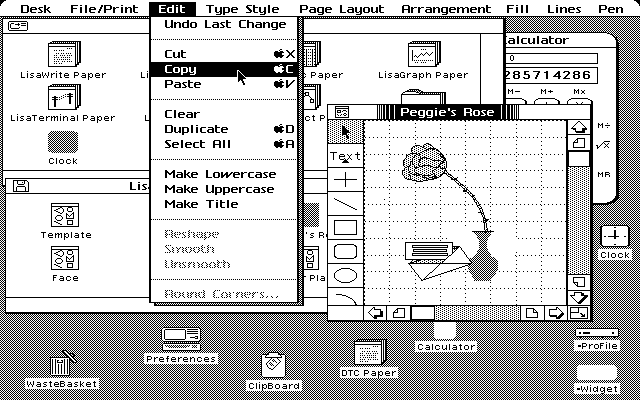
The Lisa operating system features cooperative (non-preemptive) multitasking and virtual memory, then extremely advanced features for a personal computer. The use of virtual memory coupled with a fairly slow disk system makes the system performance seem sluggish at times.

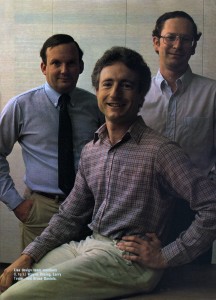
Based in part on advanced elements from the failed Apple III SOS operating system released 3 years earlier, the Lisa also organized its files in hierarchal directories, making the use of large hard drives practical. The Macintosh would eventually adopt this disk organizational design as well for its HFS filing system. Conceptually, the Lisa resembles the Xerox Star in the sense that it was envisioned as an office computing system; consequently, Lisa has two main user modes: the Lisa Office System and the Workshop. The Lisa Office System is the GUI environment for end users. The Workshop is a program development environment, and is almost entirely text-based, though it uses a GUI text editor. The Lisa Office System was eventually renamed “7/7”, in reference to the seven supplied application programs: LisaWrite, LisaCalc, LisaDraw, LisaGraph, LisaProject, LisaList, and LisaTerminal.
Third-party software
A significant impediment to third-party software on the Lisa was the fact that, when first launched, the Lisa Office System could not be used to write programs for itself: a separate development OS was required called Lisa Workshop. An engineer runs the two OSes in a dual-boot config, writing and compiling code on one machine and testing it on the other. Later, the same Lisa Workshop was used to develop software for the Macintosh. After a few years, Macintosh-native development system was developed. For most of its lifetime, the Lisa never went beyond the original seven applications that Apple had deemed enough to do “everything.”
MacWorks
In April 1984, following the success of the Macintosh, Apple introduced MacWorks, a software emulation environment which allowed the Lisa to run Macintosh System software and applications. MacWorks helped make the Lisa more attractive to potential customers, but did not enable the Macintosh emulation to access the hard disk until September. In January 1985, re-branded MacWorks XL, it became the primary system application designed to turn the Lisa into the Macintosh XL.
Business blunder
The Apple Lisa turned out to be a commercial failure for Apple, the largest since the Apple III disaster of 1980. The intended business computing customers balked at Lisa’s high price and largely opted to run less expensive IBM PCs, which were already beginning to dominate business desktop computing. The largest Lisa customer was NASA, which used LisaProject for project management and which was faced with significant problems when the Lisa was discontinued.
The Lisa is also seen as being a bit slow in spite of its innovative interface. The release of the Apple Macintosh in 1984, which received far better marketing, was the most significant factor in the Lisa’s demise. The Macintosh appeared, on the surface due to its GUI and mouse, to be a wholesale improvement and was far less expensive. Two later Lisa models were released (the Lisa 2 and its Mac ROM-enabled sibling Macintosh XL) before the Lisa line was discontinued in April 1985. In 1986, Apple offered all Lisa/XL owners the opportunity to turn in their computer and along with US$1,498.00, would receive a Macintosh Plus and Hard Disk 20 (a US$4,098.00 value at the time).

See also:
Demo Apple Lisa (1983) | Mac History
Source:
Apple Lisa. (2008, September 29). In Wikipedia, The Free Encyclopedia. Retrieved 16:08, October 12, 2008, from http://en.wikipedia.org/w/index.php?title=Apple_Lisa&oldid=241738203
Walter Isaacson: Steve Jobs, Simon & Schuster, New York, 2011, Page 110.
This article is published under the GNU General Public License


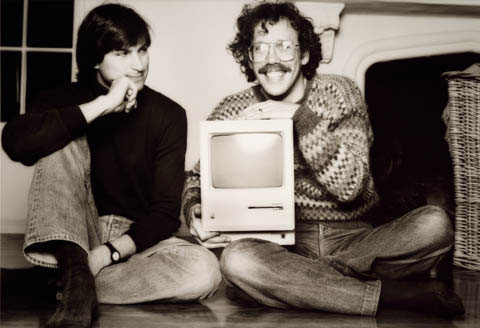
Steve Jobs and Bill Atkinson (Photo: Norman Seiff)
Jobs: Another thing is that you can run RS-422A twisted pairs, which means I can run these things for several hundred meters. I can string lines if I have a laboratory and a computer on my desk, do whatever I want to do. They aren’t DB-25s. We’ve been living with giant connectors now for years but using only a few of the pins. So, again, we tried to save a little bit of space in the back because the connector space we have is limited. We tried to cut down the cost to the customers again, and so, for connecting to devices like printers and modems, which we offer and which are the most prominent, we just supply the cables. We also will supply cables from one of these things to a variety of DB-25s – for the modem version, the printer version.
Atkinson: Lines 2 and 3 are switched on a modem versus a printer, so you just use a modem cable or a printer cable.
BYTE: From a very early time you knew that you wanted to take advantage of Lisa’s software technology, and you also had the goal of making that possible at low cost. When did you have a consensus on exactly what this hardware would have to be to achieve that goal?
Smith: In 1981 we started looking at the Lisa. I came up with a proposal that said it ends up costing $14 more to use a 68000 with 64K bytes of memory than it does with 6809-based machines, if you count power supply. It turns out that it’s actually easier to interface memory to a 68000 than to a 6809. So in January we started really looking at the 68000 and the work that Bill was doing.
In June of 1982 we finally decided on what we thought was enough video. It turns out that the original machine had 384 by 256 pixels. We chose that because we thought we had a shot at squeezing the machine down into 64K bytes, and we didn’t want to throw away a quarter of the memory just for the screen.
Atkinson: The thing that drove us is the 80 columns. In a word processor, we really wanted the lines to break on the screen at the same place they break on the printer. There are two kinds of word processors. There are the ones where you just have a string of characters and you see them however they wrap on the screen. Screen wrap is a function of the screen, and how characters wrap on the printer is the printer’s doing. Then there are word processors where what you see is what you get. You lay out a line and you know it’s going to break at the same place on the printer as the screen, so you can do columns and tabs and a couple of columns of numbers. Then you have to have enough pixels to generate a full printer line across. We thought we could do it with 384, and we tried it with real live documents – and we couldn’t do it. You could do it with 512, but you couldn’t do it with 384.
Smith: The diagonal lines look better, too; the jaggies are removed somewhat, and things like that. So, with that, we said, OK, what’s that going to mean? And we ended up with 128K and…
Atkinson: 22K bytes on the screen, and in a 64K-byte machine you couldn’t have afforded it. That drove us to 16 RAM chips instead of 8. Hertzfeld: By then, we knew we were going with 128K bytes anyway, to run the applications.
Jobs: I just thought I’d show this to you. This is the IBM video board; it’s only video, nothing else. It’s 69 integrated circuits, more chips than an entire Macintosh, and it basically does nothing. And it doesn’t even do that very well.
Espinosa: Forty percent more chips than the Mac.
Jobs: So that sort of gives you a feeling. And again, that just has the video on it. Macintosh, in addition to having video that’s far higher in resolution and far faster, has a 32-bit microprocessor, 128K bytes of RAM, 64K bytes of ROM, two serial ports, the mouse, the serial, keyboard, and mouse interface, the incredible sound, the clock calendar, the disk controller…
Smith: We rolled the whole disk controller into one chip.
Hertzfeld: And it has Lisa’s graphics and user-interface software built into every board.
Jobs: Andy was sort of the software technical leader behind the project, from its inception. As Andy puts it, software sometimes stands on its head to get rid of a chip in the hardware. And so, with a system as powerful as this, we wanted to take advantage of all the features, for instance, in the serial chip and the disk and stuff. We really wanted to be able to have the serial ports reading while the disk is spinning, while the mouse is moving, while it’s making sound. You know, all with that single board.
BYTE: What were the roots of that operating system?
Kenyon: When we started, of course, we were looking at the work Lisa was doing, and the Lisa group was rolling its own operating system, and it just didn’t seem appropriate. We took the graphics software, which was perfect for our machine.
Capps: The Lisa’s operating system took a lot of the user interface. For the window manager, even the memory manager, we started with what Lisa had.
Hertzfeld: It turns out that Quickdraw is built on top of what Lisa would call the intrasegment memory manager. You relocate little objects. We took that because Quickdraw required that support, and we sort of turned it into our system-wide memory manager. Even the Lisa group uses it only for the intra-application memory manager. Someone mentioned a neat way to do a file system, and we thought about it and said, “Gee, that’s a good way of doing it,” and so we did. A lot of it was experience on the Apple II, knowing what was sort of bad there – what we wanted to do great here. That at least was the conception of the asynchronous I/O. I knew from the Apple II that when you make a disk request it waits there for a whole second, a million microseconds, just waiting for the disk to come up to speed. We should be able to do other useful work while that’s happening. On the Apple II if you want to make a beep, the whole processor, the entirety of the machine, is devoted to making a beep. And when you’ve got all the horsepower of the 68000 there, you don’t want to waste it all on making sounds.
Atkinson: We still make a beep with the processor.
Hertzfeld: But we time-slice the processor such that you can be doing other things. It happens on the interrupt level instead of being dedicated. Macintosh uses the processor for everything, just like the Apple II does. In terms of the disk, we have the same disk-controller architecture as the Apple II, but we are just a little more sophisticated in how we use interrupts. We give the time back to the applications while the I/O is going on.
BYTE: Can you say more about the custom disk controller?
Smith: Sure. A long time ago we sort of figured that everybody who was doing designs at Apple with disks loved what Woz [Steve Wozniak] had done on the Apple II. Ill never forget, the first time I looked at the Woz controller I said, “OK. Well, this must be the interface disk controller. Where’s the disk controller?” I never found the disk controller. And we’ve just been in love with the way that that’s done. It’s used to modify group code. One of the things we knew, though, was that disks would be going faster in the future. So we initially designed this chip so the whole company would be able to have an ultra-low-cost way of using Wozniak’s disk technology for every product. But we knew that we weren’t just going to be going at 4 microseconds per bit, that twice that would become an industry standard … at least an Apple internal standard. So we built in a mode, a high-speed mode, so that it can go twice as fast.
Atkinson: While you’re getting input from the serial port at 19,200 bps, you can be writing to the disk and not missing a beat. It’s not the buffer that’s doing that. It’s Larry Kenyon. Every 4 nibbles, you look to see if there’s something on the port, because in one sector’s time, 24 bytes go by.
Jobs: After we reexamined everything, including the disk format, we said, “Do we want to go to MFM [modified frequency modulation]?” And the more we reexamined it, what became clear was that the original idea that we had for a disk in 1978, which we are still using, is great.
Atkinson: We get 400K bytes on this thing, while most people get only 270.
Jobs: As an example, our scheme has twice the margin of MFM. In other words, when you’re shipping a mil- lion or two million computers a year, which we intend to do, when people are buying media from 10 different sources and they expect to take disks out that were recorded in Alaska in really cold weather and stick them into machines in Florida in a heat wave and have them work, that margin is really important. If you want to equate that to reliability, we are significantly more reliable than any other disk system on the market, while having higher capacity. So that was the key decision, to stick with the same encoding format and the same scheme that we’ve used since 1978. So, while everyone else is running at roughly the same rates as Apple II, the IBM PC, and everything else, we doubled it on Macintosh. We set a new internal standard with the 3V2-inch disk and this new single-chip controller. And every new 32-bit product at Apple will use that new standard. The media, the sector format on that media, the disk controller, and the routines and everything to drive them is a new Apple 32-bit standard that you’ll see com- ing out in every future product that we do in that family.
Smith: There were some voices within the company that said, “Oh, you guys ought to go with standard formats and things like that.” We looked at doing that and it turns out that it takes more chips to interface to a standard floppy-disk controller, and we have…
Jobs: Well, I can go get the IBM floppy board. It looks to have about 45 to 50 chips on it…
Espinosa: I’ll come and help you carry it.
Jobs: .. .including an LSI [large-scale integration] disk controller – far less performance, far less capacity, far higher cost.
Atkinson: And less reliability.
Jobs: Oh, far less reliability. Larry’s software senses the disk speed, and Burrell’s hardware can adjust to one of four hundred speeds. So if it’s written on something that’s a little out of whack, we can just adjust right down to the necessary speed and read it. Everything on the Macintosh board – the serial timing, the disk timings, the microprocessor timings, the video timings, the sound timings – comes from one crystal oscillator and is synchronized from one source. And, again, it’s better, of course, technically to do it that way. Everything works much better, but it also saves parts, and we can offer this thing cheaper to customers. And most of this stuff customers will never ever realize or care about anyway. I mean, who cares how many crystal oscillators you have? But you do care about how big your computer is. You do care about how much it costs, and you do care about how well it works.
Atkinson: If you ever drop your computer you find out quickly how many crystal oscillators you have.
BYTE: So with the variable speed in the disk drives, I guess there’s no problem having two drives that are 3 percent different in speed.
Jobs: We read it and adjust it so that the speed is accurate relative to that crystal. That crystal on the board is superaccurate. We can adjust the disk drive relative to that superaccuracy.
Atkinson: You force all the disks to go at exactly the same speed by having the software constantly monitoring the speed and saying, “Ah, it’s running a little slow; jack it up a little bit,” so that each disk doesn’t have to be adjusted at all. You switch disk drives, and the new one will run at exactly the same speed because you force them all to.
Smith: It turns out that the speed variations occur partly because you plug in a new cassette that loads the motor down in a different way and also because of temperature variations that cause very long-term drifts in the disk speed. Using a little bit of the processor to fix that doesn’t cost us any performance at all on the system.
BYTE: What about the display electronics?
Atkinson: Where is the display controller?
Hertzfeld: It’s hidden.
Jobs: If you bite into that IBM display board, it’ll totally flicker if you do it at the wrong time. You’ve seen that, right? Woz just came up with this really brilliant way to do the Apple II. He realized that memory was about twice as fast as the microprocessor needed it and twice as fast as the video needed it. So he put the microprocessor over here and he put in essence the video over here, and he put some multiplexers in the middle. He shared the exact same memory between the two in a way such that this one thought it had all the memory all the time and this one thought it had all the memory all the time, yet they shared the same memory! All this thing had to do was write into certain memory locations and, magically, it would appear on the screen. The microprocessor never even had to think about the screen. All it did was look at memory locations.
Atkinson: And there was no way to glitch the video because accesses were mutually exclusive.
Jobs: Right. And so it turns out that, try as we might, we have never been able to find a better way to do it.
Atkinson: At the same time that the processors have gotten faster, memory’s gotten faster; the memory is still twice as fast as the processor.
Jobs: And so, again, it gives you greater performance, because you don’t have to write only at special times and slow yourself down. It cuts the chip count way down because you don’t need two banks of RAMs, so the customer’s not paying for these extra chips, and it just makes a more elegant product.
BYTE: How far does the similarity extend between the Apple II video and the Mac’s video?
Smith: We have a three-part memory architecture on Mac. We have a DMA window for sound, video, and CPU… shared by three devices. Also, what we do that is a little more sophisticated than Apple II is return memory cycles to the processor during horizontal and vertical retrace. And with the analog design we’re able to lengthen the horizontal retrace interval, which gives us more performance for graphics by making more time available to the processor from memory and giving the analog electronics more time to retrace the beam. On the Apple II, Woz sort of designed this logic board and the power supply was kind of added. On Mac, we really designed the entire system as a complete system from the ground up, so we used different constraints. I would say there’s not much similarity. The great thing about Mac as a product is that it really wasn’t designed as just this piece over there and this piece over there and this other piece… All of it was designed in parallel, everybody knowing what everyone else’s job was.
BYTE: How did you decide on the appearance of the machine?
Manock: Our goal in the beginning was portability. We actually had this cardboard model that looked amazingly like the Osborne. And that was way before the Osborne came out. As I said, portability was primary here, and this version had an attached keyboard that had a sort of rubber boot around it that would fold up and give you protection over the screen. Steve really changed the emphasis of the product one day when he said that we didn’t want portability to be the primary aspect of this, but we did want it to take minimal desk space. With that goal in mind, we realized that the keyboard didn’t have to be exactly the width of the computer.
Jobs: To use the earlier design you had to have some sort of arrangement to tilt it up. And what we noticed was, well, fine, what if you just lift the back up here like this? Then, because you have all this space underneath, you could put the floppy disk underneath. So you make a unit that’s more vertical, has a smaller footprint.
Atkinson: It has to be up enough so your eyes can see it anyway; you need the height.
Manock: Steve thought, too, I think – in a gut reaction sort of way – that everybody was going low profile and wide, and we never have wanted to be a “me, too.” I think our vertical format is correct when you think of human factors.
Hoffman: Jerry, you might want to turn the back around. We made it truly international. I think it’s one of the few products aside from Lisa that is completely usable anywhere you care to take it.
Manock: Did you see the icons on the back?
Hoffman: We started out with the case and went from the outside in, trying to make it more and more international the more we thought about it. And Jerry was just great as soon as he realized that we really did want to bring it to the whole world. He had marvelous ideas on how to eliminate every word of text, take everything off the package so that we don’t have to be an American product anywhere that we go.
Jobs: In Mac, there’s no English on the outside of the case. Everything’s iconic. And there is absolutely no English in the ROM. It is universal in nature. When the thing comes on it puts a few icons on the screen. If something goes wrong, it can’t boot or something, it puts a frowning Mac on. If it’s booting it puts a happy Mac on. It loads all the languages, all the country-specific stuff, off the disk. So, because the keyboard is detachable and mapped anyway, to localize Mac all you do is change the keyboard, manuals, and the disks. Nothing in the box has to change.
And another real breakthrough is this thing called Resources that Bruce Horn invented.
Hertzfeld: The data is factored out from the code. You know, most programs are a mixture of control logic and just raw code.
Atkinson: The virtual-memory architecture on the data parts of the program allows us to factor it out so that, without rewriting a program at all, without recompiling or relinking the program, I can take a copy of Mac Paint and in 15 minutes make a German version.
Hertzfeld: Because all the text is kept in a well-known, well-defined place.
Horn: Until December, people didn’t really know what the resource manager was, because they really hadn’t had any contact with it, besides me. I knew what I wanted from it because I had to do Finder and all that other stuff. Andy just looked at it over time and figured out what you could do with it. And I was trying to say, well, this can do this and this… It was really Andy having the biggest view of the system saying that this could really be a great thing for a lot of stuff.
Hertzfeld: Another thing to ask Bruce about is the Finder, which is our most important application, the first thing that comes up on the machine. That’s the program with all the little icons, the desktop manager, I guess we’re calling it. That’s Bruce’s conception and communication.
Hoffman: There are numerous subtleties with this. Picture a dialogue box, for example. A dialogue box, when you put English text in German, starts overflowing its limits and starts looking very different. You have a button that says, “Put this away.” In German, that takes a paragraph and overflows the box… But Resources lets us change not only the text but also the physical look of those dialogue boxes, or anything, through something called Resource Editors.
Jobs: Otherwise, you’d have to get into the source listing. You’d have to change not only the languages, as Joanna said, but also the geometries of the dialogue boxes and make them bigger. It would take you awhile; it’s not something that’s impossible, but it’s something that never gets done. And it’s certainly something that you have to be the originator of the program to do. What we’ve done by pulling all the language-specific stuff out, through this beautiful mechanism called Resources, is write these other programs called Resource Editors. By running a Resource Editor, you could, if you knew German, simply run a program on the program, get in there – literally on the screen – and just stretch the boxes bigger. You could select a text and retype it in. German and move things around if you wanted. You can examine every icon, every dialogue box, every alert box, every pull-down menu, everything, without being a programmer, without getting the source code, and very quickly, too, using the user interface of the Macintosh.
Atkinson: Anything that XYZ software company put together, even though the company didn’t think about Taiwan, will run in Taiwan.
Jobs: But do we want it to run in Taiwan?
BYTE: Are you going to market it aggressively in Japan?
Jobs: Yes.
Hertzfeld: My favorite thing about Resources, being selfish, is that the same facilities that allow us to translate English into 7, 10, 20, a million different languages are the same facilities we use to translate technish to English in the first place.
Hoffman: The other component of this is that it allows us to not just introduce products that feel to the native user like a native machine, natural to them, but also that we can start coming very close to making simultaneous product introductions. The software that is developed in the U.S. can fly over there for them, for the fragmented markets in Europe, for example. Europe does not allow for the same kind of development of software houses as the U.S. because the markets are all so fragmented you can’t amortize development of the software over as large a user base. But given that the Europeans now have the capability of using a localized, globalized software, if you will, their market grows because each individual software developer in France now can view the whole world as a market. We feel that it will give an impetus to the development of software developers, third parties, in Europe, and in more fragmented markets as well.
Smith: An international power supply, too, so the exact same unit basically can be used anywhere in the world.
Egner: It doesn’t care whether it’s 50-Hz input.
Manock: Just one additional thing on these: the icons on the back are from the International Electrotechnical Commission (IEC). We didn’t invent all these ourselves.. .wherever possible we used symbols that already existed – for example, AC line power – that are world standards. Where we didn’t have symbols that existed, we used the IEC’s closest symbol as best we could and then added what we thought made sense. For example, we needed a symbol for a modem, so we started with IEC’s telephone symbol. We tested them to make sure there was good recognition. Well submit these new icons to the IEC to have it suggest that they be the standards added to its encyclopedia of symbols.
BYTE: What is this machine going to make possible that other comparably priced machines have not made possible? How will it change the personal computing scene?
Jobs: Right now, as you know, when you use a word processor, it will do two or three things. The first thing Macintosh will do is make the existing types of applications an order of magnitude easier and more approachable for people. Therefore the available market for this machine is going to be giant compared to the available market for the people who are willing to invest 40 to 100 hours learning to use their computers. That’s the first thing.
The second thing is that there are going to be new types of applications available that could not be available on the current generation of personal computers – it is technically impossible to do. The perfect example is Paint. Paint is impossible to do on an Apple II or an IBM PC or any of the other first-generation products. You can do a mockery of it, but you can’t really do it. And there are going to be lots of applications like that. You’ve seen Lisa Project. That, of course, will be running on Mac. And we don’t even know the kinds of applications that are going to come out in six months to a year. As an example, well be able to laser-print output from this thing by next June, and that is pretty exciting to us. So, if we sell these on a university campus, you’ll be able to take your disk into the library and get output off a laser printer, which will be approaching typeset quality. That’s the kind of stuff we’re doing; you just can’t do that on a current-generation personal computer.
And then the third thing is what Burrell and Larry and Andy and the other software people have done. When we shipped the Apple II, we fundamentally shipped about 2K bytes of ROM with system code. The IBM system’s got 8K bytes, but it’s really kind of loose as a goose; it’s about 4K bytes by our standards of code. Mac has 64K bytes of the tightest, most elegant code that this company’s ever written. Most of the computers now are basically shipping a file system and a few drives, but what’s really interesting is that on top of that, we’ve layered on memory management and on top of this is Quickdraw.
Jobs: Mac’s a completely open machine – we’ve got a book called Inside Macintosh that tells all the secrets of it. But we’re going to try to get a little uniformity through the carrot rather than the stick. And the carrot is that there’s a finite amount of RAM in this machine, and we’ve done all these things for you in ROM. Now, you can do them yourself, there’s nothing that says you can’t do them yourself, but if you do, you’ve got to write them, which is going to take time and means you’re going to be slower to get to market; you’ve got to chew up precious RAM space, and the chances are pretty good that we did a better job than you’ll do. So we’re going to try through the carrot to get a little bit of uniformity in the user interface in some of the ways the things are done.
Hertzfeld: See, we’re really a 192K-byte machine, and if the programmers want to throw away 64K, then they’re doing a dumb thing.
Jobs: We’re a 192K-byte machine that deep-freezes 64K.
Hertzfeld: Highly timed, tested, debugged, highly compact, very fast, very high-quality consistent code.
BYTE: What are all the factors in this that make it go so fast?
Hertzfeld: Sweat.
Jobs: Burrell, Andy, Larry, Bill – how long did you work on Quickdraw?
Atkinson: Four years.
Hertzfeld: All of us care a lot about performance. Surprisingly, that’s unusual. A lot of people don’t care if their system’s…
Atkinson: Like Quickdraw. I won’t even count the first runs in Pascal, but the first runs in assembly language were running 160K bytes, before I added a lot of the new features. It’s now down to 24K bytes with lots more stuff in it. Character-drawing speed is one you look at for drawing an arbitrary size character, an arbitrary starting pixel clipped to an arbitrary area. We were running, when it was being developed on Lisa, about 1000 characters per second the first time. Well, I got that up to 4000. Mac is running about 7000. That’s seven times 9600 baud. This is typical of all of our software packages here. You go through, get the best algorithms first, get the stuff right. Then crunch it down, make a first pass in Pascal, get the algorithms right, find the cleanest algorithms, find all the corners, and make sure they’re tested. Then I translate it into loose assembly language to get down into assembly language and get it working. Then I’ll go through and get all the bugs out again, and I’ll go through and do fine register alloca- tion to figure out what’s the most important thing. This little baby, the 68000, has sixteen 32-bit registers sitting there, and the way you get performance out of that is to keep them full. Keep the registers full of important stuff all the time. That’s the way you make this processor sing. So you go down and you do register alloca- tion, and then you don’t stop. Then you feed it back, you get your people to use it.
Quickdraw was designed by “pull” from applications rather than “push” from the design team. You provide a facility, watch the applications group try to use it, understand where they misunderstood something – maybe you’ve got a bad model, you want to make it simpler and cleaner – or where they don’t have enough performance. And then you go back and you measure, measure, measure, measure. Optimization without measuring is wasted time. Find out where the application’s really spending time and go whump on that code. And any other cases they’re very seldom using, squeeze them down in size, and stretch the other ones. There’s always a trade-off between size and speed. Stretch out the common cases, let them be bigger and much faster, and then keep the generality by squeezing down the infrequent cases. So play your odds. People draw characters in OR mode a whole lot, and OR mode is about twice as fast as the other modes, so 95 percent of all characters are drawn in OR mode. Statistical measuring of the use of the thing allows you to get much more performance on your average throughput than you can if you don’t go back and measure.
I think we all believe that system software should be done in assembly language at this stage of the game because high-level languages can’t give you the performance and the code density that you can get out of assembly language.
BYTE: So far, it has seemed that with all the systems that have mice, all those that are on the market, you pay a great price in terms of performance to get ease of use.
Atkinson: You make a responsive system; it isn’t just draw some characters out there. It’s also, remember where you put them because if the guy touches on them you want to light them up. There’s a lot more guts in that application.
Jobs: It’s not just systems that have mice. What’s happening is there are a whole bunch of things that go with the mouse. It’s not just hanging a mouse on a first-generation personal computer and using the same old, fixed-pitch text and things like that, just replacing four cursor keys. What we’ve done here is take a quantum leap, where, in addition to having the mouse be the major pointing device, we’ve gone to full proportionally spaced fonts, totally software-painted on the screen, any size, any shape… totally new architecture for displaying things to the user.
Atkinson: But the responsiveness is where the code goes.
Jobs: The responsiveness and the fact that there isn’t a mouse-based system out yet that uses a 68000. We’re obviously using the power of the 68000 in addition to this code.
Smith: There are some tricks we played in the hardware, too. For example, we knew that the ROMs would have real important things in them. So we made the ROMs sort of read-only cache memory, whereas the RAM has to contend with video and sound for access, so we cut that down to the bare bones, but the code that’s in ROM, like Bill’s graphics and the other stuff, can run as fast as you can run a 68000.
Jobs: If you look at the really great applications, even on first-generation personal computers, most of them are written in assembly language – Visicalc, 1-2-3 – it’s like if you’re going to sell a million of something, it pays to handcraft it in assembly. If you’re going to sell 10 of something, it prob- ably doesn’t. If we’d written this in Pascal, we would have been able to fit a fourth as much code in the ROM or would have to have four times the ROM, and you wouldn’t have had the performance. Because we’re going to sell 10 million of these things in the long run, it pays to super-handcraft it; we only have to do it once. Every time these ROMs are burned, it doesn’t cost us any more engineering. . .it’s all been done up front.
Capps: Because we cared enough to do it as well as we possibly could.
Jobs: We took a 12K-byte Pascal program running on a Lisa and we said we want to do this in 2K and make it faster. But we had that extra year to do that. And we also had the motivation, of course.
Atkinson: When you’re writing assembly, you know each instruction is going to take 2 microseconds, it’s going to take 4 bytes of memory. In Pascal, you’re removed from that, so you don’t concentrate on performance as much. When I’m doing I/O stuff in assembly language I look at the theoretical maximum speed you can run at. Why not do it as fast as you can possibly do it? Especially when you’re doing disk I/O stuff. How fast can you get into an interrupt and out?
BYTE: Andy, let’s talk about the early days, after it had become Macintosh.
Hertzfeld: I don’t know, there’s something that makes a job a little more fun to work on when the odds are against you. And that’s sort of how it was in the early days. I was maybe the fifth or sixth person to come work on it. Steve took me over to this little building separate from everywhere else, where there were these incredibly great people working on this little wire-wrap PC board. All it could do when you turned it on was write “hello” on the screen about 80 times. And everyone was incredibly excited to see it write “hello” on the screen because it meant that the central processing unit was there and all that potential was there to be mined. I spent my time mining that potential.
The very first time we got an early version of Quickdraw running, and we got the mouse going – that’s just an incredible thrill. Or getting back the first PC board – we all went out for pizza on Friday night. We got the boards in about four o’clock Friday afternoon, and Steve said, “Well, if you get these done before midnight, we’ll take you for pizza,” and we stayed there…not because we wanted the pizza, but because we wanted to see that board working. And I think that none of our Mac PC boards have ever had to have a wire run to fix something, which is pretty amazing. That’s the attention to detail that you just can’t get people to do for money. We do it for love.. .this is the most important thing in our lives .. .to make that great computer.
It’s fun for me because I like operating on a systems program where I can operate in an environment where there’s not that much support. In the early days when I first started here, the first thing I did was come in and write all kinds of crazy demos, stretching things around on the screen and making balls bounce, and one reason to do it was that I didn’t want to write the system code until I was good at writing 68000 programs. So I just wanted to learn by having fun, and the other reason is that it gets people excited about it. Just this raw hardware sitting there doesn’t do too much, but once you start making this fun thing happen and that fun thing happen, the excitement starts getting generated. You get to attract other good people, and one by one we picked up on more and more people. We were very, very selective; it was very hard to find people to work on Mac software, because on one hand we had the very high goals of doing this research, Xerox PARC-like stuff with uncommon, high technical standards. On the other hand, we had a very inexpensive, limited-memory machine. So all the Xerox PARC-type guys who came and interviewed said, “Oh, you don’t have 2 megabytes? Forget it, I don’t want to work on this thing.” They’re all used to their Dorados. But gradually we found great people like Larry and Bruce who were turned on by the dream, and they came and joined our band, and I guess we reached critical mass.
Atkinson: Most of the early people were recruited from Apple.. .and we have a pirate’s flag that we sometimes put on the roof. The idea is we’re pirates and we go around and try to steal the best we can from anywhere we can get it, and mostly that’s been from Lisa. A lot of it’s been from Lisa, but it’s true in initially putting together the team, too; we try to get the best people we can from anywhere in the company.
Hertzfeld: One of the slogans Steve came up with when we had a retreat in January was “Let’s be pirates,” the idea being that we were mavericks out to blow people’s minds and overturn standards, create new standards, not do things like everyone else.
Atkinson: There was always the thrill that this was going to be the one project that was probably the most amazing thing you were going to be doing in your life.
Hertzfeld: And the other slogan was “The journey is the reward.”