While watching the video, I couldn’t help but notice two snippets at the 7:36 mark from 1982 about scroll bars.
https://www.youtube.com/watch?v=Xi1vYYn-1Jo
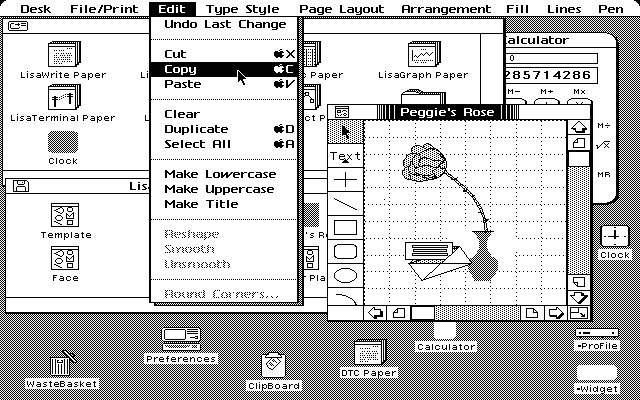
First, an Apple engineer shows how scrolling works in the Lisa, followed immediately by a similar demo from Xerox. This juxtaposition immediately struck me as interesting because Apple detractors are quick to reference Xerox Parc when dismissing the graphical interface innovations of the Lisa and Macintosh. While there is no denying Xerox’s influence, these two snippets perfectly illustrate massive amounts of design and refinement championed by Apple during that era. Read for yourself.
The instructions from the Apple bit:
To scroll by one line, click in an arrow. To repeatedly scroll a line at a time, hold the mouse button down in an arrow. Note that the arrows point towards the data that will be exposed when pressed. To scroll by one windowful, click in a grey region. To repeatedly scroll by windowfuls, hold the mouse button down in a grey region. To scroll immediately to a desired location, press in the thumb, drag to the desired location and release. To abort the scroll, drag out of the scroll bar before releasing the button.
Now the Xerox Parc segment (emphasis mine):
The Cedar Document Editor [Kiyoga?] provides vertical scroll bars to the left edge of document windows. When the cursor enters into a scroll bar, the scroll bar darkens and the cursor indicates that scrolling is available. Each of the three mouse buttons corresponds to a scrolling operation. When a mouse button is depressed, the cursor shape indicates the enabled scrolling action. When the mouse button is released, the command is invoked. Scroll up moves the line of text adjacent to the cursor to the top of the window. Scroll down moves the line of text at the top of the document window to be adjacent to the cursor. Thumb causes display of the location in the document corresponding to the vertical position of the cursor in the scroll bar. The grey rectangle indicates the location in the document which is currently visible.
People who think UI design is easy might think the differences here are trivial; those who know that UI design is difficult know otherwise.
Macintosh, commonly nicknamed Mac is a brand name which covers several lines of personal computers designed, developed, and marketed by Apple Inc. The Macintosh 128K was released on January 24, 1984; it was the first commercially successful personal computer to feature a mouse and a graphical user interface (GUI) rather than a command line interface. Through the second half of the 1980s, the company built market share only to see it dissipate in the 1990s as the personal computer market shifted towards IBM PC Compatible machines running MS-DOS and Microsoft Windows. Apple consolidated multiple consumer-level desktop models into the 1998 iMac all-in-one, which sold extremely well and saw the Macintosh brand revitalized. Current Mac systems are mainly targeted at the home, education, and creative professional markets. They are: the aforementioned (though upgraded) iMac and the entry-level Mac mini desktop models, the workstation-level Mac Pro tower, the MacBook, MacBook Air and MacBook Pro laptops, and the Xserve server.
Production of the Mac is based on a vertical integration model in that Apple facilitates all aspects of its hardware and creates its own operating system that is pre-installed on all Macs. This is in contrast to most IBM compatible PCs, where multiple vendors create hardware intended to run another company’s software. Apple exclusively produces Mac hardware, choosing internal systems, designs, and prices. Apple does use third party components, however; current Macintosh CPUs use Intel’s x86 architecture. Previous models used the AIM alliance’s PowerPC and early models used Motorola’s 68k. Apple also develops the operating system for Macs, currently Mac OS X 10.5 “Leopard”. The modern Mac, like other personal computers, is capable of running alternative operating systems such as Linux, FreeBSD, and Microsoft Windows, the latter of which is considered to be the Mac’s biggest competitor
Apple Macintosh
The Macintosh project started in the late 1970s with Jef Raskin, an Apple employee, who envisioned an easy-to-use, low-cost computer for the average consumer. In September 1979, Raskin was authorized to start hiring for the project, and he began to look for an engineer who could put together a prototype.
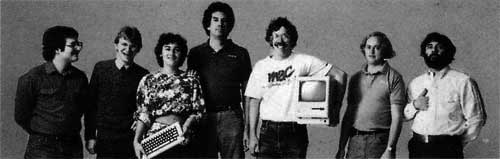
Bright engineers: Andy Hertzfeld, Chris Espinosa, Joanna Hoffman, George Crow, Bill Atkinson, Burrell Smith and Jerry Mannock
Bill Atkinson, a member of Apple’s Lisa team (which was developing a similar but higher-end computer), introduced him to Burrell Smith, a service technician who had been hired earlier that year. Over the years, Raskin assembled a large development team that designed and built the original Macintosh hardware and software; besides Raskin, Atkinson and Smith, the team included Chris Espinosa, Joanna Hoffman, George Crow, Jerry Manock, Susan Kare, Andy Hertzfeld, and Daniel Kottke.
Macintosh Commercial
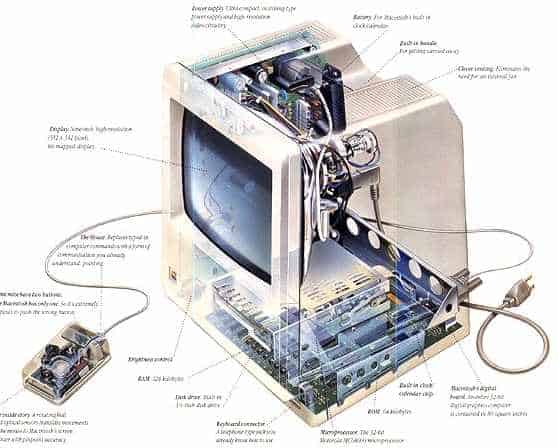
Smith’s first Macintosh board was built to Raskin’s design specifications: it had 64 kilobytes (KB) of RAM, used the Motorola 6809E microprocessor, and was capable of supporting a 256×256 pixel black-and-white bitmap display. Bud Tribble, a Macintosh programmer, was interested in running the Lisa’s graphical programs on the Macintosh, and asked Smith whether he could incorporate the Lisa’s Motorola 68000 microprocessor into the Mac while still keeping the production cost down. By December 1980, Smith had succeeded in designing a board that not only used the 68000, but bumped its speed from 5 to 8 megahertz (MHz); this board also had the capacity to support a 384×256 pixel display. Smith’s design used fewer RAM chips than the Lisa, which made production of the board significantly more cost-efficient. The final Mac design was self-contained and had the complete QuickDraw picture language and interpreter in 64 Kb of ROM – far than most other computers; it had 128 KB of RAM, in the form of sixteen 64 kilobit (Kb) RAM chips soldered to the logicboard. Though there were no memory slots, its RAM was expandable to 512 KB by means of soldering sixteen chip sockets to accept 256 Kb RAM chips in place of the factory-installed chips. The final product’s screen was a 9-inch, 512×342 pixel monochrome display, exceeding the prototypes.
The original 1984 Mac OS desktop featured a radically new graphical user interface. Users communicated with the computer not through abstract lines of code but rather using a metaphorical desktop that included items that the user was already familiar with.
The design caught the attention of Steve Jobs, co-founder of Apple. Realizing that the Macintosh was more marketable than the Lisa, he began to focus his attention on the project. Raskin finally left the Macintosh project in 1981 over a personality conflict with Jobs, and the final Macintosh design is said to be closer to Jobs’ ideas than Raskin’s.
After hearing of the pioneering GUI technology being developed at Xerox PARC, Jobs had negotiated a visit to see the Xerox Alto computer and Smalltalk development tools in exchange for Apple stock options. The Lisa and Macintosh user interfaces were partially influenced by technology seen at Xerox PARC and were combined with the Macintosh group’s own ideas. Jobs also commissioned industrial designer Hartmut Esslinger to work on the Macintosh line, resulting in the “Snow White” design language; although it came too late for the earliest Macs, it was implemented in most other mid- to late-1980s Apple computers.[4] However, Jobs’ leadership at the Macintosh project was short-lived; after an internal power struggle with new CEO John Sculley, Jobs angrily resigned from Apple in 1985, went on to found NeXT, another computer company, and did not return until 1997.
1984: Introduction
This television commercial, which aired during the Super Bowl, launched the original Macintosh. The Macintosh 128k was announced to the press in October 1983, followed by an 18-page brochure included with various magazines in December. The Macintosh was introduced by the now famous US$1.5 million Ridley Scott television commercial, “1984”. The commercial most notably aired during the third quarter of Super Bowl XVIII on 22 January 1984 and is now considered a “watershed event” and a “masterpiece.” 1984 used an unnamed heroine to represent the coming of the Macintosh (indicated by her white tank top with a Picasso-style picture of Apple’s Macintosh computer on it) as a means of saving humanity from “conformity” (Big Brother). These images were an allusion to George Orwell’s noted novel, Nineteen Eighty-Four, which described a dystopian future ruled by a televised “Big Brother.”
For a special post-election edition of Newsweek in November 1984, Apple spent more than US$2.5 million to buy all 39 of the advertising pages in the issue. Apple also ran a “Test Drive a Macintosh” promotion, in which potential buyers with a credit card could take home a Macintosh for 24 hours and return it to a dealer afterwards. While 200,000 people participated, dealers disliked the promotion, the supply of computers was insufficient for demand, and many were returned in such a bad shape that they could no longer be sold. This marketing campaign caused CEO John Sculley to raise the price from US$1,995 to US$2,495 (adjusting for inflation, about $5,000 in 2007).
Two days after the 1984 ad aired, the Macintosh went on sale. It came bundled with two applications designed to show off its interface: MacWrite and MacPaint. Although the Mac garnered an immediate, enthusiastic following, it was too radical for some, who labeled it a mere “toy.” Because the machine was entirely designed around the GUI, existing text-mode and command-driven applications had to be redesigned and the programming code rewritten; this was a challenging undertaking that many software developers shied away from, and resulted in an initial lack of software for the new system. In April 1984 Microsoft’s MultiPlan migrated over from MS-DOS, followed by Microsoft Word in January 1985. In 1985, Lotus Software introduced Lotus Jazz after the success of Lotus 1-2-3 for the IBM PC, although it was largely a flop. Apple introduced Macintosh Office the same year with the lemmings ad. Infamous for insulting its own potential customers, it was not successful.
Feature stories about the Apple Macintosh on this web site:
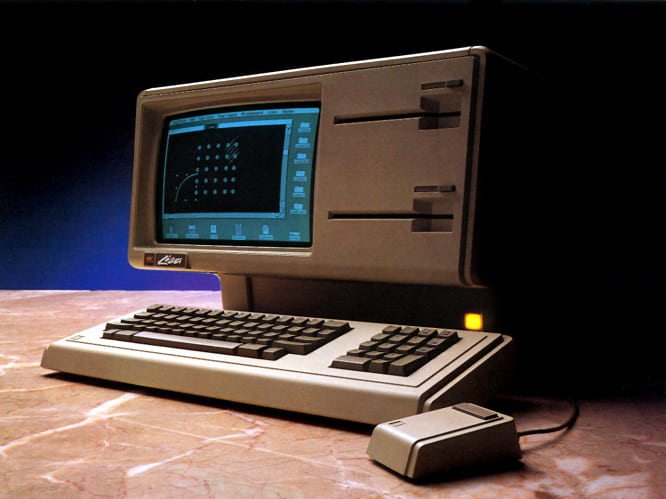
The Apple Lisa was a personal computer designed at Apple Computer, Inc. during the early 1980s. Officially, “Lisa” stood for “Local Integrated Software Architecture”, but it was also the name of Apple co-founder Steve Jobs’ daughter.
The Lisa project was started at Apple in 1978 and evolved into a project to design a powerful personal computer with a graphical user interface (GUI) that would be targeted toward business customers.
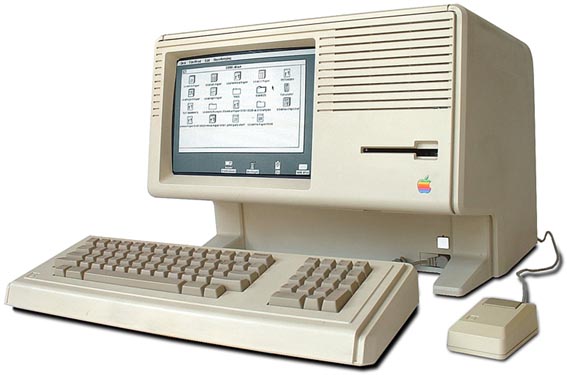
Apple Lisa (1983)
In September 1980, Steve Jobs was forced out of the Lisa project, so he joined the Macintosh project instead. Contrary to popular belief, the Macintosh is not a direct descendant of Lisa, although there are obvious similarities between the systems and the final revision, the Lisa 2/10, was modified and sold as the Macintosh XL.
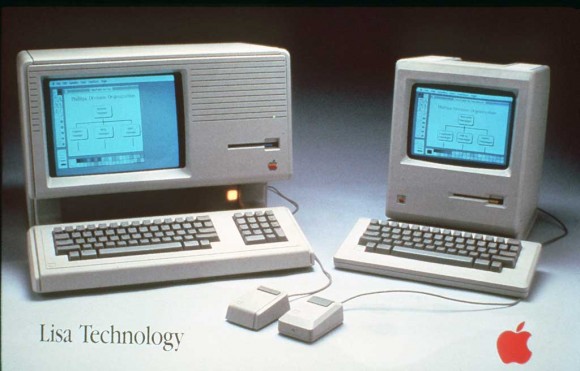
Apple Lisa and Apple Macintosh (1984)
The Lisa was a more advanced (and far more expensive) system than the Macintosh of that time in many respects, such as its inclusion of protected memory, cooperative multitasking, a generally more sophisticated hard disk based operating system, a built-in screensaver, an advanced calculator with a paper tape and RPN, support for up to 2 megabytes of RAM, expansion slots, and a larger higher resolution display. It would be many years before many of those features were implemented on the Macintosh platform. Protected memory, for instance, did not arrive until the Mac OS X operating system was released in 2001. The Macintosh, however, featured a faster 68000 processor (7.89 MHz) and sound. The complexity of the Lisa operating system and its programs taxed the 5 MHz Motorola 68000 microprocessor so that the system felt sluggish, particularly when scrolling in documents.
Apple Lisa
Etymology
While the documentation shipped with the original Lisa only ever referred to it as The Lisa, officially, Apple stated that the name was an acronym for Local Integrated Software Architecture or “LISA”. Since Steve Jobs’ first daughter (born in 1978) was named Lisa Jobs, it is normally inferred that the name also had a personal association, and perhaps that the acronym was invented later to fit the name. Hertzfeld states that the acronym was reverse engineered from the name “Lisa” in autumn 1982 by the Apple marketing team, after they had hired a marketing consultancy firm to come up with names to replace “Lisa” and “Macintosh” (at the time considered by Rod Holt to be merely internal project codenames) and then rejected all of the suggestions. Privately, Hertzfeld and the other software developers used “Lisa: Invented Stupid Acronym”, a recursive backronym. It is also important to note that Lisa team member Larry Tesler’s daughter is named Lisa.
Hardware
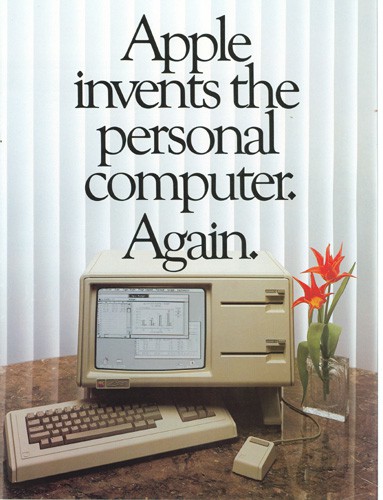
Advertising for Apple Lisa
The Lisa was first introduced in January 19, 1983 at a cost of $9,995 US ($21,482.26 in 2008 dollars). It is one of the first commercial personal computers to have a GUI and a mouse. It used a Motorola 68000 CPU at a 5 MHz clock rate and had 1 MB RAM.
The original Lisa has two Apple FileWare 5¼ inch double-sided floppy disk drives, more commonly known by Apple’s internal code name for the drive, “Twiggy”. They have a capacity of approximately 871 kilobytes each, but required special diskettes. The drives have the reputation of not being reliable, so the Macintosh, which was originally designed to have a single Twiggy, was revised to use a Sony 400k microfloppy drive in January 1984. An optional external 5 MB or, later, a 10 MB Apple ProFile hard drive (originally designed for the Apple III) was also offered.
Apple Lisa (1983)
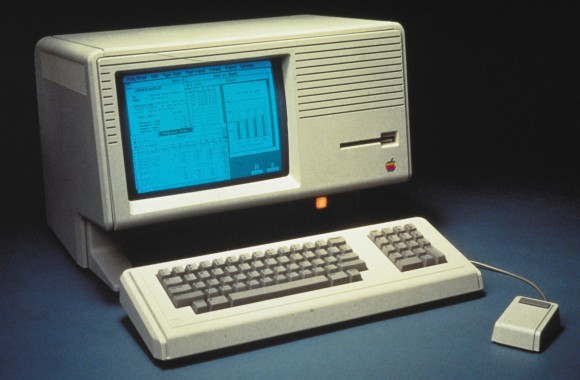
The first hardware revision, the Lisa 2, released in January 1984 priced between $3,495 and $5,495 US, was much less expensive than the original model and dropped the Twiggy floppy drives in favor of a single 400k Sony microfloppy. It was possible to purchase the Lisa 2 with a ProFile and with as little as 512k RAM. The final version of the Lisa available includes an optional 10 MB internal proprietary hard disk manufactured by Apple, known as the “Widget”. In 1984, at the same time the Macintosh was officially announced, Apple announced that it was providing free upgrades to the Lisa 2 to all Lisa 1 owners, by swapping the pair of Twiggy drives for a single 3½ inch drive, and updating the boot ROM and I/O ROM. In addition, a new front faceplate was included to accommodate the reconfigured floppy disk drive. With this change, the Lisa 2 had the notable distinction of introducing the new Apple inlaid logo, as well as the first Snow White design language features.
There were relatively few third-party hardware offerings for the Lisa, as compared to the earlier Apple II. AST offered a 1.5 MB memory board, which when combined with the standard Apple 512 KB memory board, expanded the Lisa to a total of 2 MB of memory, the maximum the MMU could address.
Late in the product life of the Lisa, there were third-party hard disk drives, SCSI controllers, and double-sided 3½ inch floppy-disk upgrades. Unlike the Macintosh, the Lisa features expansion slots. It is an “open system” like the Apple II.
The Lisa 2 motherboard is a very basic backplane with virtually no electronic components, but plenty of edge connector sockets/slots. There are 2 RAM slots, 1 CPU slot & 1 I/O slot all in parallel placement to each other. At the other end, there are 3 ‘Lisa’ slots, parallel to each other. This flexibility provides the potential for a developer to create a replacement for the CPU ‘card’ to upgrade the Lisa to run a newer CPU, albeit with potential limitations from other parts of the system.
Software
Screenshot Apple Lisa
The Lisa operating system features cooperative (non-preemptive) multitasking and virtual memory, then extremely advanced features for a personal computer. The use of virtual memory coupled with a fairly slow disk system makes the system performance seem sluggish at times.
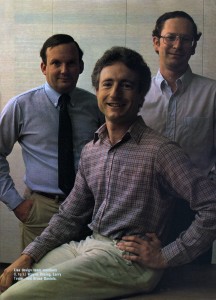
Lisa design team members
Based in part on advanced elements from the failed Apple III SOS operating system released 3 years earlier, the Lisa also organized its files in hierarchal directories, making the use of large hard drives practical. The Macintosh would eventually adopt this disk organizational design as well for its HFS filing system. Conceptually, the Lisa resembles the Xerox Star in the sense that it was envisioned as an office computing system; consequently, Lisa has two main user modes: the Lisa Office System and the Workshop. The Lisa Office System is the GUI environment for end users. The Workshop is a program development environment, and is almost entirely text-based, though it uses a GUI text editor. The Lisa Office System was eventually renamed “7/7”, in reference to the seven supplied application programs: LisaWrite, LisaCalc, LisaDraw, LisaGraph, LisaProject, LisaList, and LisaTerminal.
Third-party software
A significant impediment to third-party software on the Lisa was the fact that, when first launched, the Lisa Office System could not be used to write programs for itself: a separate development OS was required called Lisa Workshop. An engineer runs the two OSes in a dual-boot config, writing and compiling code on one machine and testing it on the other. Later, the same Lisa Workshop was used to develop software for the Macintosh. After a few years, Macintosh-native development system was developed. For most of its lifetime, the Lisa never went beyond the original seven applications that Apple had deemed enough to do “everything.”
MacWorks
In April 1984, following the success of the Macintosh, Apple introduced MacWorks, a software emulation environment which allowed the Lisa to run Macintosh System software and applications. MacWorks helped make the Lisa more attractive to potential customers, but did not enable the Macintosh emulation to access the hard disk until September. In January 1985, re-branded MacWorks XL, it became the primary system application designed to turn the Lisa into the Macintosh XL.
Business blunder The Apple Lisa turned out to be a commercial failure for Apple, the largest since the Apple III disaster of 1980. The intended business computing customers balked at Lisa’s high price and largely opted to run less expensive IBM PCs, which were already beginning to dominate business desktop computing. The largest Lisa customer was NASA, which used LisaProject for project management and which was faced with significant problems when the Lisa was discontinued.
The Lisa is also seen as being a bit slow in spite of its innovative interface. The release of the Apple Macintosh in 1984, which received far better marketing, was the most significant factor in the Lisa’s demise. The Macintosh appeared, on the surface due to its GUI and mouse, to be a wholesale improvement and was far less expensive. Two later Lisa models were released (the Lisa 2 and its Mac ROM-enabled sibling Macintosh XL) before the Lisa line was discontinued in April 1985. In 1986, Apple offered all Lisa/XL owners the opportunity to turn in their computer and along with US$1,498.00, would receive a Macintosh Plus and Hard Disk 20 (a US$4,098.00 value at the time).
Apple Lisa. (2008, September 29). In Wikipedia, The Free Encyclopedia. Retrieved 16:08, October 12, 2008, from http://en.wikipedia.org/w/index.php?title=Apple_Lisa&oldid=241738203
Walter Isaacson: Steve Jobs, Simon & Schuster, New York, 2011, Page 110.