
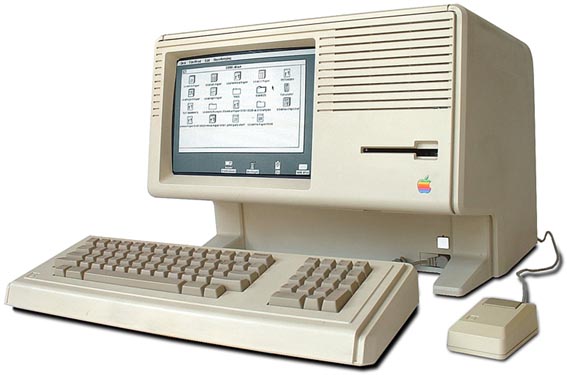
The Apple Lisa was a personal computer designed at Apple Computer, Inc. during the early 1980s. Officially, “Lisa” stood for “Local Integrated Software Architecture”, but it was also the name of Apple co-founder Steve Jobs’ daughter.
The Lisa project was started at Apple in 1978 and evolved into a project to design a powerful personal computer with a graphical user interface (GUI) that would be targeted toward business customers.
In September 1980, Steve Jobs was forced out of the Lisa project, so he joined the Macintosh project instead. Contrary to popular belief, the Macintosh is not a direct descendant of Lisa, although there are obvious similarities between the systems and the final revision, the Lisa 2/10, was modified and sold as the Macintosh XL.
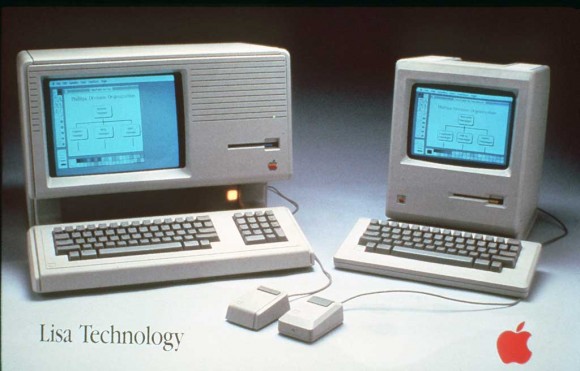
The Lisa was a more advanced (and far more expensive) system than the Macintosh of that time in many respects, such as its inclusion of protected memory, cooperative multitasking, a generally more sophisticated hard disk based operating system, a built-in screensaver, an advanced calculator with a paper tape and RPN, support for up to 2 megabytes of RAM, expansion slots, and a larger higher resolution display. It would be many years before many of those features were implemented on the Macintosh platform. Protected memory, for instance, did not arrive until the Mac OS X operating system was released in 2001. The Macintosh, however, featured a faster 68000 processor (7.89 MHz) and sound. The complexity of the Lisa operating system and its programs taxed the 5 MHz Motorola 68000 microprocessor so that the system felt sluggish, particularly when scrolling in documents.
Etymology
While the documentation shipped with the original Lisa only ever referred to it as The Lisa, officially, Apple stated that the name was an acronym for Local Integrated Software Architecture or “LISA”. Since Steve Jobs’ first daughter (born in 1978) was named Lisa Jobs, it is normally inferred that the name also had a personal association, and perhaps that the acronym was invented later to fit the name. Hertzfeld states that the acronym was reverse engineered from the name “Lisa” in autumn 1982 by the Apple marketing team, after they had hired a marketing consultancy firm to come up with names to replace “Lisa” and “Macintosh” (at the time considered by Rod Holt to be merely internal project codenames) and then rejected all of the suggestions. Privately, Hertzfeld and the other software developers used “Lisa: Invented Stupid Acronym”, a recursive backronym. It is also important to note that Lisa team member Larry Tesler’s daughter is named Lisa.
Hardware
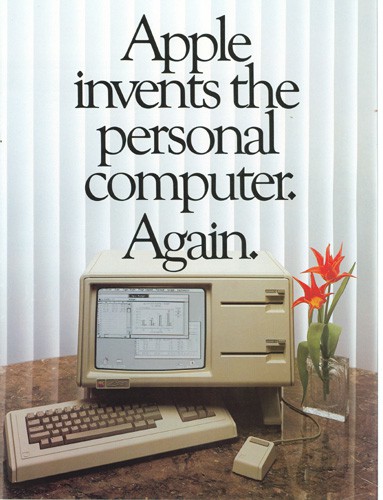
The Lisa was first introduced in January 19, 1983 at a cost of $9,995 US ($21,482.26 in 2008 dollars). It is one of the first commercial personal computers to have a GUI and a mouse. It used a Motorola 68000 CPU at a 5 MHz clock rate and had 1 MB RAM.
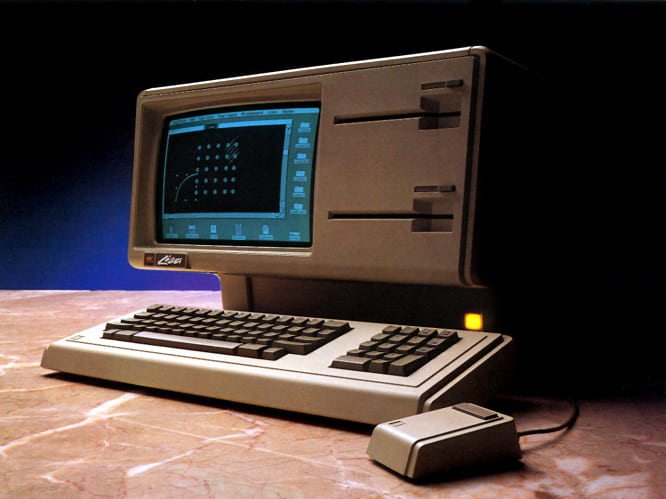
The original Lisa has two Apple FileWare 5¼ inch double-sided floppy disk drives, more commonly known by Apple’s internal code name for the drive, “Twiggy”. They have a capacity of approximately 871 kilobytes each, but required special diskettes. The drives have the reputation of not being reliable, so the Macintosh, which was originally designed to have a single Twiggy, was revised to use a Sony 400k microfloppy drive in January 1984. An optional external 5 MB or, later, a 10 MB Apple ProFile hard drive (originally designed for the Apple III) was also offered.
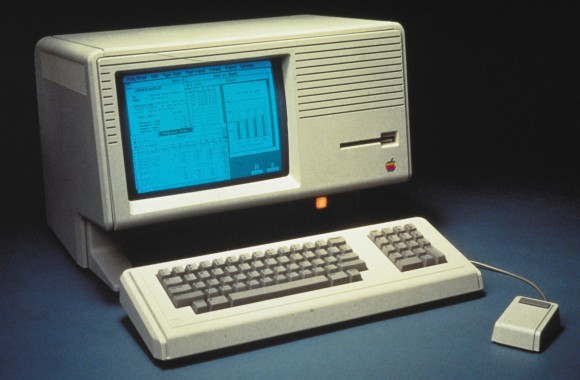
The first hardware revision, the Lisa 2, released in January 1984 priced between $3,495 and $5,495 US, was much less expensive than the original model and dropped the Twiggy floppy drives in favor of a single 400k Sony microfloppy. It was possible to purchase the Lisa 2 with a ProFile and with as little as 512k RAM. The final version of the Lisa available includes an optional 10 MB internal proprietary hard disk manufactured by Apple, known as the “Widget”. In 1984, at the same time the Macintosh was officially announced, Apple announced that it was providing free upgrades to the Lisa 2 to all Lisa 1 owners, by swapping the pair of Twiggy drives for a single 3½ inch drive, and updating the boot ROM and I/O ROM. In addition, a new front faceplate was included to accommodate the reconfigured floppy disk drive. With this change, the Lisa 2 had the notable distinction of introducing the new Apple inlaid logo, as well as the first Snow White design language features.
There were relatively few third-party hardware offerings for the Lisa, as compared to the earlier Apple II. AST offered a 1.5 MB memory board, which when combined with the standard Apple 512 KB memory board, expanded the Lisa to a total of 2 MB of memory, the maximum the MMU could address.
Late in the product life of the Lisa, there were third-party hard disk drives, SCSI controllers, and double-sided 3½ inch floppy-disk upgrades. Unlike the Macintosh, the Lisa features expansion slots. It is an “open system” like the Apple II.
The Lisa 2 motherboard is a very basic backplane with virtually no electronic components, but plenty of edge connector sockets/slots. There are 2 RAM slots, 1 CPU slot & 1 I/O slot all in parallel placement to each other. At the other end, there are 3 ‘Lisa’ slots, parallel to each other. This flexibility provides the potential for a developer to create a replacement for the CPU ‘card’ to upgrade the Lisa to run a newer CPU, albeit with potential limitations from other parts of the system.
Software
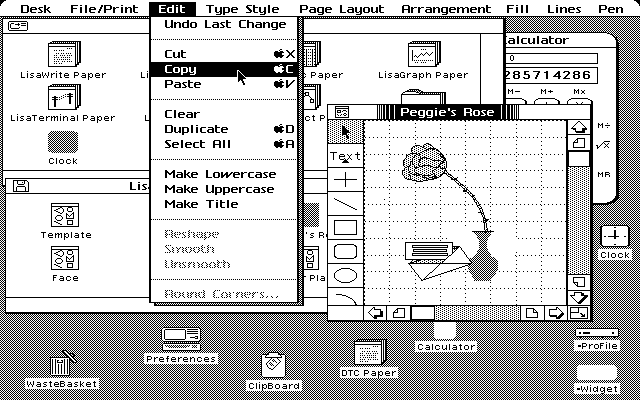
The Lisa operating system features cooperative (non-preemptive) multitasking and virtual memory, then extremely advanced features for a personal computer. The use of virtual memory coupled with a fairly slow disk system makes the system performance seem sluggish at times.
Based in part on advanced elements from the failed Apple III SOS operating system released 3 years earlier, the Lisa also organized its files in hierarchal directories, making the use of large hard drives practical. The Macintosh would eventually adopt this disk organizational design as well for its HFS filing system. Conceptually, the Lisa resembles the Xerox Star in the sense that it was envisioned as an office computing system; consequently, Lisa has two main user modes: the Lisa Office System and the Workshop. The Lisa Office System is the GUI environment for end users. The Workshop is a program development environment, and is almost entirely text-based, though it uses a GUI text editor. The Lisa Office System was eventually renamed “7/7”, in reference to the seven supplied application programs: LisaWrite, LisaCalc, LisaDraw, LisaGraph, LisaProject, LisaList, and LisaTerminal.
Third-party software
A significant impediment to third-party software on the Lisa was the fact that, when first launched, the Lisa Office System could not be used to write programs for itself: a separate development OS was required called Lisa Workshop. An engineer runs the two OSes in a dual-boot config, writing and compiling code on one machine and testing it on the other. Later, the same Lisa Workshop was used to develop software for the Macintosh. After a few years, Macintosh-native development system was developed. For most of its lifetime, the Lisa never went beyond the original seven applications that Apple had deemed enough to do “everything.”
MacWorks
In April 1984, following the success of the Macintosh, Apple introduced MacWorks, a software emulation environment which allowed the Lisa to run Macintosh System software and applications. MacWorks helped make the Lisa more attractive to potential customers, but did not enable the Macintosh emulation to access the hard disk until September. In January 1985, re-branded MacWorks XL, it became the primary system application designed to turn the Lisa into the Macintosh XL.
Business blunder
The Apple Lisa turned out to be a commercial failure for Apple, the largest since the Apple III disaster of 1980. The intended business computing customers balked at Lisa’s high price and largely opted to run less expensive IBM PCs, which were already beginning to dominate business desktop computing. The largest Lisa customer was NASA, which used LisaProject for project management and which was faced with significant problems when the Lisa was discontinued.
The Lisa is also seen as being a bit slow in spite of its innovative interface. The release of the Apple Macintosh in 1984, which received far better marketing, was the most significant factor in the Lisa’s demise. The Macintosh appeared, on the surface due to its GUI and mouse, to be a wholesale improvement and was far less expensive. Two later Lisa models were released (the Lisa 2 and its Mac ROM-enabled sibling Macintosh XL) before the Lisa line was discontinued in April 1985. In 1986, Apple offered all Lisa/XL owners the opportunity to turn in their computer and along with US$1,498.00, would receive a Macintosh Plus and Hard Disk 20 (a US$4,098.00 value at the time).
See also:
Demo Apple Lisa (1983) | Mac History
Source:
Apple Lisa. (2008, September 29). In Wikipedia, The Free Encyclopedia. Retrieved 16:08, October 12, 2008, from http://en.wikipedia.org/w/index.php?title=Apple_Lisa&oldid=241738203
Walter Isaacson: Steve Jobs, Simon & Schuster, New York, 2011, Page 110.
This article is published under the GNU General Public License


[…] electronics can do for us, and raised the bar for what we expect in quality from film animation to user interfaces and experiences. Whether or not people are Apple fans or even use Apple products, the world […]
[…] Lisa 2 (1984) […]
[…] of the Apple II and the competitors’ machines in both the user interface and her design. Excellent history and other factoids about Lisa. Photo credit: […]
[…] Apple Lisa […]
[…] vero peccato che il Lisa, la versione maggiorata del primo Macintosh del 1984, con pregi e stranezze uniche, non abbia avuto […]
[…] didn’t help that the machine cost nearly $10,000 when it was released in 1983, according to Mac History […]
[…] [1] [2] […]
Guten Tag,
Very good Lisa article with many wonderful facts. Thank you for providing this information.
One area of the Lisa program development which you may want to add is the LISA TOOLKIT. This was a collection of object-based libraries and a modified Lisa Pascal compiler which the Lisa developer used within the Lisa Workshop. The Tool Kit provided a Lisa developer with what was called an “application framework” which contained the key programming structures for a Lisa program. The Tool Kit allowed the Lisa developer to focus on the content of their program and let the Tool Kit handle the program framework such as windows, scrolling, mice, dialogs, printing, copying/pasting.
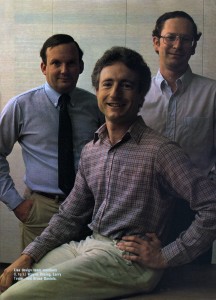
The Tool Kit used a special version of the Apple Lisa Pascal compiler which was used by Apple’s internal and third party developers. This compiler implemented object-based programming and was called the Clascal compiler (Clascal = Classes with Pascal). Clascal was developed by a small team of Lisa developers headed by Larry Tesler who was the original manager of the Lisa applications group (e.g. they developed programs such as LisaWrite).
For more details about the Tool Kit and Clascal see the wonderful collection of Apple materials at BitSavers.org:
The Lisa Tool Kit was later modified to run on the Apple Macintosh within its MPW development environment where it was called MacApp. Larry Tesler et al were also responsible for MacApp.
http://www.mirrorservice.org/sites/www.bitsavers.org/pdf/apple/lisa/toolkit_university/Clascal_Reference_Manual_Mar83.pdf
Tschuess
– David Craig July 8, 2016
PS: The figure labeled “Screenshot Apple Lisa” originated on my Lisa. Note the “DTC Paper” icon which is a LisaWrite stationery document, the “DTC” are my name initials “David T Craig”.
[…] Mac-history: Apple Lisa […]
[…] is 2^50 bytes. This makes me chuckle as I remember drooling over the words “…support for up to 2 megabytes of RAM“ as a n00b to the world of computing and Macintosh. Nevertheless, I digress. That data has a […]
[…] Petabytes. That is 2^50 bytes. This makes me chuckle as I remember drooling over the words "…support for up to 2 megabytes of RAM" as a n00b to the world of computing and Macintosh. Nevertheless, I digress. That data has a […]
[…] I can think of one company that worked this way: Apple. And even Apple had the Lisa, an expensive mistake that illustrated the high risks of the “artistic savant” approach to […]
[…] Apple Lisa @ Mac History […]
[…] Mac Lisa,Mac History。 […]
[…] Apple termékek sosem voltak jók. Egy rövid ideig a design révén elhittük, hogy különlegesek, amelyről az árcédula […]
[…] | Gerhard »GeWalt« Walter, Mac HistoryEn Xataka | Project Pomona: así fue el primer y desconocido ordenador “todo en uno” de […]
[…] | Gerhard »GeWalt« Walter, Mac History En Xataka | Project Pomona: así fue el primer y desconocido ordenador “todo en uno” de […]
[…] | Gerhard »GeWalt« Walter, Mac HistoryEn Xataka | Project Pomona: así fue el primer y desconocido ordenador “todo en uno” de […]
[…] | Gerhard »GeWalt« Walter, Mac History En Xataka | Project Pomona: así fue el primer y desconocido ordenador “todo en uno” de […]
[…] | Gerhard »GeWalt« Walter, Mac HistoryEn Xataka | Project Pomona: así fue el primer y desconocido ordenador "todo en uno" de […]
[…] | Gerhard »GeWalt« Walter, Mac HistoryEn Xataka | Project Pomona: así fue el primer y desconocido ordenador "todo en uno" de […]
[…] | Gerhard »GeWalt« Walter, Mac HistoryEn Xataka | Project Pomona: así fue el primer y desconocido ordenador “todo en uno” de […]
[…] | Gerhard »GeWalt« Walter, Mac History En Xataka | Project Pomona: así fue el primer y desconocido ordenador “todo en uno” de […]
[…] Mac History […]
[…] Mac History reader comments 29 Share this story […]
[…] Mac History reader comments Eighty one […]
[…] Image: Mac History […]
[…] Image: Mac History […]
[…] Image: Mac History […]
[…] Image: Mac History […]
[…] Image: Mac History […]
[…] Image: Mac History […]
[…] Image: Mac History […]
[…] Source […]
[…] 1983, Apple released Lisa. It was one of the first computers to use a bitmapped graphical interface and mouse. In short, the […]
[…] 1983, Apple released Lisa. It was one of the first computers to use a bitmapped graphical interface and mouse. In short, the […]
[…] Eram nove páginas de conversa de geek, sobre RAM, MHz, CPU e características do computador. […]
[…] But before the GUI revolution, computers were mostly text-based affairs. After you were presented with a command prompt, you typed in commands to run programs that were mostly made of text (and maybe some primitive graphics). Many believe that Apple’s first GUI-driven computer was the first Mac, released in January 1984. But Apple’s Lisa, with a similar GUI, was released a full year earlier in January 1983.[7] […]
[…] Then there was the whole NeXT computer debacle. Apple had numerous product launch failures – do you remember Apple Lisa? […]
[…] The History of the Apple Lisa by Christoph Dembach, Mac History […]
[…] The History of the Apple Lisa by Christoph Dembach, Mac History […]
[…] designed it, thought people would be familiar with a watch but not an hourglass, which the earlier Apple Lisa had used). Now it uses that infuriating beach ball. It was Windows, Microsoft’s operating system, […]
[…] Here are the ages when Steve Jobs made his major career accomplishments:Sources: [1][2][3][4][5][6][7][8][9][10][11][12][13][14][15][16][17] […]
[…] The History of the Apple Lisa by Christoph Dembach, Mac History […]
[…] When he’s young and desperate to get laid, what geeky lad wouldn’t stoop to Victor Frankenstein levels to “simulate” himself a girlfriend? Moreover, who cares about the embarrassment of a head brazier when they’re cooking up a smoking hot sorceress girl on their outlandishly expensive 80s computer? […]
[…] নতুন কম্পিউটার “লিসা“-র উৎপাদন শেষ […]
[…] úttörő fejlesztéseit, az egeret és a grafikus kezelőfelületet, amit később a Lisánál és a Macnél is […]
[…] az egéré és a grafikus kezelőfelületeké, ezért az Apple következő nagyágyújának szánt Lisát már ezek köré kezdték kidolgozni. A Xerox azonban előnnyel indult, így még az első, […]
[…] called Hovey-Kelley Designs) was commissioned to design a mouse for Apple’s marketing-altering Lisa computer. Back then, Xerox had mice that retailed for an eye-watering $400 due to their fussy […]
[…] Apple Lisa, Mac History : https://www.mac-history.net/apple-history-2/apple-lisa/2007-10-12/apple-lisa […]
[…] that are into restoring and preserving said hardware. For that group of people, something like a Lisa (the immediate precursor to the Macintosh) or a NeXT Cube (Steve Jobs follow-up to the Macintosh, […]
[…] Increased competition combined with less than stellar sales of the Apple III and its follow-up, the LISA, caused the company to lose nearly half its market to IBM. Faced with declining sales, Jobs […]
[…] Apple Lisa […]
[…] 1983, Apple released Lisa. It was one of the first computers to use a bitmapped graphical interface and mouse. In short, the […]
[…] The last time inflation was this high, Ronald Reagan was president and Apple was on the verge of releasing the Lisa. […]
[…] The last time inflation was this high, Ronald Reagan was president and Apple was on the verge of releasing the Lisa. […]
[…] time inflation was this high, Ronald Reagan was president and Apple was on the verge of releasing the Lisa.That’s interesting history to some – searches for ‘who was president in 1982‘ […]
[…] แอ็ปเปิ้ล ลิซ่าภาพจาก Apple Lisa › Mac History (mac-history.net) […]
[…] took this information back to Apple. By 1983, Apple had shipped its first computer with a mouse, the Lisa, followed by the first Macintosh in […]
[…] took this information back to Apple. By 1983, Apple had shipped its first computer with a mouse, the Lisa, followed by the first Macintosh in […]
[…] image-source :- Mac-history […]
[…] image-source :- Mac-history […]
[…] took this information back to Apple. By 1983, Apple had shipped its first computer with a mouse, the Lisa, followed by the first Macintosh in […]
[…] stepped into the 1980s with the wrong foot when Apple III and Lisa computers drastically failed in 1980 and 1983 respectively. The turning point was not until […]
[…] una serie de primicias para la empresa y la industria tecnológica en general. Lanzado en 1983, Historial de Mac señala que el desarrollo de Apple Lisa comenzó en 1978. «Lisa» significaba «Arquitectura de […]
[…] first commercial use of GUI came in 1983 with Apple's Lisa computer. This was followed by the now-iconic Macintosh in 1984, and Microsoft's Windows 1.0 in […]
[…] (2007). Apple Lisa › Mac History. [online] Available at: https://www.mac-history.net/apple-history-2/apple-lisa/2007-10-12/apple-lisa#:~:text=The%20Lisa%20wa… [Accessed 21 Sep. […]
[…] Lisa – MacStoriesApple Lisa – Mac HistoryHere’s the Moment Steve Jobs Finally Admitted Apple’s Lisa Computer Was Named After His […]
[…] short for “Local Integrated Software Architecture.” (Inside Apple, the joke was it stood for “Lisa: Invented Stupid Acronym.”) The Lisa’s $10,000 price tag, more than $29,000 in today’s money, was out of reach for most […]
[…] and the Macintosh both had five-year, and largely separate, development processes. The Lisa project began in 1978 and aimed to build a powerful business computer with a relatively conventional user interface, […]
[…] काफी हद तक अलग-अलग थीं। लिसा परियोजना 1978 में शुरू हुआ और इसका लक्ष्य अपेक्षाकृत पारंपरिक […]
[…] the Macintosh each had five-year, and largely separate, improvement processes. The Lisa challenge began in 1978 and aimed to construct a robust enterprise pc with a comparatively standard person interface, […]
[…] and the Macintosh both had five-year, and largely separate, development processes. The Lisa project began in 1978 and aimed to build a powerful business computer with a relatively conventional user interface, […]
[…] and the Macintosh both had five-year, and largely separate, development processes. The Lisa project began in 1978 and aimed to build a powerful business computer with a relatively conventional user interface, […]