Category Archives: Apple People

TechRepublic – The remarkable odyssey of Bill Fernandez 

Perhaps best known as the guy who introduced Steve Jobs and Steve Wozniak, Bill Fernandez speaks out on Apple’s founding magic, how love built the first Mac, and the interface of the future.

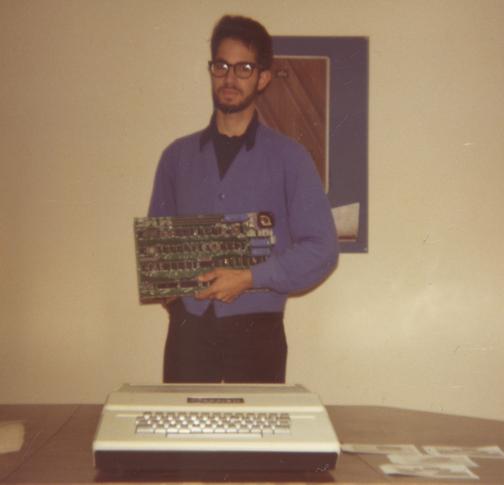
Bill Fernandez holds an Apple I, with an Apple II on the desk.
Photo courtesy of Bill Fernandez

The Apple II got there first. It was the Wright Flyer I of personal computers.When the Wright brothers made their historic first flight in 1903, lots of other inventors were trying to fling their own shoddy little planes into the air. And in 1977, when Steve Wozniak and Steve Jobs unveiled the Apple II, there were a zillion other nerds working on building a personal computer.

But Woz beat them to it, and Jobs knew how to sell it.The Apple II was the product that turned Apple into Apple. It was the iPhone of its era, the product that redefined every machine like it that came afterward.Its real magic was Wozniak’s minimalism. He integrated many technologies and components that no one else had put together in the same device, and he did it with as few parts as possible. It was, as Wozniak wrote in his autobiography, “the first low-cost computer which, out of the box, you didn’t have to be a geek to use.

“But as genius as Wozniak was, the Apple II almost didn’t make it out of his brain and into a product that the rest of the world could use.Daniel Kottke, one of Apple’s first dozen employees, said, “[In 1976] the Apple II did not even work. Woz’s prototype worked. But when they laid it out as a circuit board, it did not work reliably… It was unacceptable. And Woz did not have the skills to fix that… But, it was even worse than that. They did not even have a schematic.”

Newly funded by investors, Apple had just hired Rod Holt as the company’s first engineering chief, and this was one of the big problems that Holt walked into when he took the job. At the time Woz’s Apple II prototype was a bunch of wires and chips in a cardboard shoebox. The tiny Apple team had to take this amazing concept machine and turn it into a product that could be manufactured and sold in stores.So Holt handed the first task to Apple technician Bill Fernandez.

Source: Apple’s first employee: The remarkable odyssey of Bill Fernandez – Feature – TechRepublic

See also:

 Bill Fernandez: Apple Employee #4

The Wizards behind the Macintosh

The making of Macintosh – An Interview with The Macintosh Design Team (Byte – Feb, 1984)

Bill Atkinson

Bill Atkinson nearly had his Ph.D. in neurochemistry before he admitted to himself that his real love was computers. He “got a quick E.E.” and started his own company. He was happily minding his own business when his friend ]eff Raskin asked him to come see what was happening at Apple, which was then six months old. Bill wasn’t really interested, but airplane tickets showed up in the mail, so he took a look. What he saw was “several years reaching into the future” of anything he could do where he was. He stayed to write Apple’s Pascal and later became Mr. User Interface for Lisa before he moved over to the Mac team.

Andy Hertzfeld

Andy Hertzfeld says, “The Apple II changed my life.” The computer people at Berkeley were a little narrow-minded about letting a grad student really get into the computer as Andy wanted to. So he spent nearly all the money he had in the world on an Apple II and had a computer he could control completely. He decided the Apple was more interesting than his classes and began writing programs for magazines. When Apple bought one of Andy’s programs, Steve Jobs offered him a job, which he took when he finished school. He worked on silent-type printers and Apple III demos until a shake-up in his part of the company shook him loose. He looked around and decided to go with Mac.

Larry Kenyon

Larry Kenyon arrived at Apple from Amdahl with a double degree in psychology and computer science. He was working on Apple III products when the same shake-up that shook Andy loose freed him, too. Andy asked Larry to join the Mac crew because he was one of the few people who understood the arcane art of making the Apple II work with printer peripherals, and anybody who can do that has to be good. No one in the company really believed that Mac was a product when Larry joined the Mac team. It was just a research effort, and there was some risk involved: would you still have your job in a few months?

Joanna Hoffman

Joanna Hoffman is still on leave from her Ph.D. program in archaeology at the University of Chicago. She has a background in anthropology, physics, and linguistics. She came to Apple because of Mac. After using her computer skills in the field of archaeology for so long, she was tired of looking at the past and turned to the future. She was Mac’s entire marketing department for more than a year. She wants to make Mac a tool that feels natural for international users by making it speak their languages.

Burrell Carver Smith

Burrell Carver Smith encountered the Homebrew Computer Club in 1975, got hooked on microprocessors, and moved to the Bay Area. Just riding around in a borrowed truck one day, he saw Apple and decided to drop in. The only job Apple had available was in the service department, repairing Apple IIs. He took the job and fixed at least a thousand Apple II boards and got involved in other projects before Jeff Raskin and Bill Atkinson recruited him for Mac. He talked the Lisa engineers out of some chips and stuff and got a prototype running over Christmas 1979. He was the first full-time Mac person after Jeff Raskin.

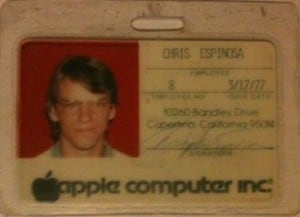
Chris Espinosa says, “There was no life before Apple.” At 13 years old he could be found cruising up and down the bus line in his home town, spending a few hours at each Byte Shop on the line until the owner threw him out. He discovered the way to keep from getting thrown out was to write demo programs for the machines, so he wrote for whatever was lying around: ”Altairs, IMSAIs, or this weird new machine called Apple I. His mom worried when he was offered a ride to the Homebrew Computer Club meeting with two scruffy characters named Jobs and Wozniak, but she gave in, and the rest is history. Chris spent a Christmas vacation debugging Apple’s BASIC in exchange for a whole row of 4K-byte RAM chips, which he thought was a pretty good deal. He worked part-time during college writing BASIC programs and reference manuals and signed on full-time when he graduated. He likes being in on the design process: ”If the machine is designed right in the first place, you don’t have to write a lot about it.”

Jerry Manock

Jerrold C. Manock was a freelance product-design consultant with a Stanford education who finally joined Apple when he saw that three-quarters of his billing was to Apple anyway. He worked on the Apple II, the Disk II, the III, and Lisa before designing Mac. In Macintosh, he says, “The outside matches the inside in elegant simplicity.”

Susan Kare best known for her interface elements and typeface contributions to the first Apple Macintosh from 1983 to 1986. She was employee #10 and Creative Director at NeXT, the company formed by Steve Jobs after he left Apple in 1985. She was a design consultant for Microsoft, IBM, Sony Pictures, and Facebook, Pinterest and she is now an employee of Niantic Labs. As an early pioneer of pixel art and of the graphical computer interface, she has been celebrated as one of the most significant technologists of the modern world.

And 30 years later, Susan talks about the Apple icons.

Susan Kare, Iconographer (EG8) from eg on Vimeo.

Bruce Horn grew up at Xerox PARC, much the same way Chris grew up at Apple, and later attended Stanford. Bruce started working at Xerox when he was 14 years old: he was one of the kids Xerox brought in to test Smalltalk. Turns out he was brighter than most and became a systems wizard who actually implemented Smalltalk on a variety of different processors. Bruce is all of 23 years old now, but he spent seven years at Xerox PARC and brought Apple that perspective.

George Crowe and David Egner designed the analog board in the Macintosh.

Steve Capps assisted Andy Hertzfeld with the systems software.

Steve Wozniak Debunks One of Apple’s Biggest Myths

In 1976, The Apple 1 computer went on sale for a retail price of $666.66. Steve Wozniak, who co-founded Apple with Steve Jobs and designed that product, remembers the early days.

1976The Apple I computer goes on sale for a retail price of $666.66.

You said you saw a revolution coming. Do you think Steve Jobs did?
He had always spoken about wanting to be a person that moves the world forward, but he couldn’t really create things and design them like I could. Steve wanted a company real badly. His thinking was not necessarily about what computers would do for the average Joe in the average home. Steve found the words that explained what these computers would do for people and how important it was a little later in life.

You mentioned you didn’t like conflict. Did Steve like conflict?
Steve was going to make sure that his position was strong and forceful and heard by others. Thankfully he had the best brain. He usually had a little, tiny suggestion, but almost always he was right.

How many computers did you sell?
We only sold about a hundred Apple I’s. Of the Apple II’s, we probably sold a few thousand through the first year. And then [we designed] a spreadsheet program that let small businessmen do more work in one hour than they could do in 10 years with pencil and paper. Sales shot up. It was maybe five years before we sold a million—the first computer ever to sell a million.

Did you think Apple would become a behemoth?
When we started the company, I knew that the computer was so far ahead of anything the rest of the world had ever seen. We knew we had a revolution. Everyone who joined Apple, this was the greatest thing in their life.

Read more:
Bloomberg BusinessWeek: Steve Wozniak on Apple, the Computer Revolution, and Working With Steve Jobs

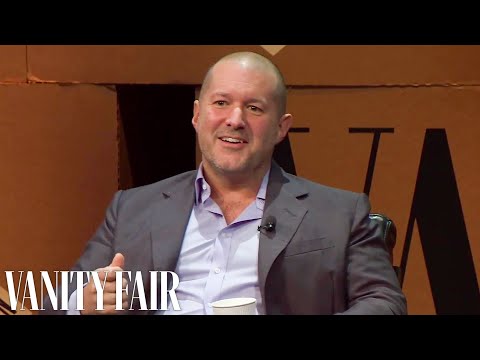
Jony Ive in Conversation with Vanity Fair’s Graydon Carter

Vanity Fair editor Graydon Carter and Apple’s senior vice president of design, Jonathan Ive, sat down for a wide-ranging discussion at the Vanity Fair New Establishment Summit in San Francisco.

Ive spoke candidly about what he learned from late Apple founder and C.E.O. Steve Jobs, how he feels about competitors whose products border on “theft,” and his own development as a designer. He also shared the specifics of his daily routine, and offered an in-depth look at the creative process of Apple’s core design team.

Tim Cook: I’m proud to be gay

Apple’s chief executive publicly confirmed that he is gay in an essay published by Bloomberg Businessweek. The 53-year-old wrote he was inspired by Dr Martin Luther King to set aside his desire for privacy to do “something more important.”

Cook said he hopes to support and inspire others by coming out.

While I have never denied my sexuality, I haven’t publicly acknowledged it either, until now. So let me be clear: I’m proud to be gay, and I consider being gay among the greatest gifts God has given me.

Cook said he would continue to advocate for human rights and equality. “We pave the sunlit path toward justice together, brick by brick. This is my brick.”
Many colleagues already knew about his sexual orientation, he said.
On Twitter co-workers and colleges showed support for Cook.

https://twitter.com/pschiller/status/527806723524792321


[contextly_auto_sidebar id=”EyV1FX3hSFxlyvG0n8E7Dxi2Xxmonfds”]

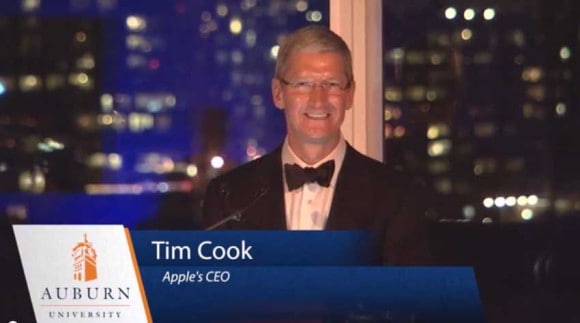
Tim Cook at Auburn University: “Cross-burning was a Symbol of Ignorance”

Apple CEO Tim Cook isn’t known for talking much about himself, but in a speech this week, he talked about some of the early childhood experiences that shape his passions around fighting for human rights and equality.

“Growing up in Alabama in the 1960s, I saw the devastating impacts of discrimination,” Cook said, accepting a lifetime achievement award from Auburn University, his alma mater. “Remarkable people were denied opportunities and treated without basic human dignity, solely because of the color of their skin.”

He talked about seeing a cross-burning at the home of a nearby family.
“This image was permanently imprinted in my brain, and it would change my life forever,” Cook said. “For me, the cross-burning was a symbol of ignorance, of hatred, and a fear of anyone different than the majority. I could never understand it ,and I knew then that America’s and Alabama’s history would always be scarred by the hatred that it represented.”

More at AllThingsD

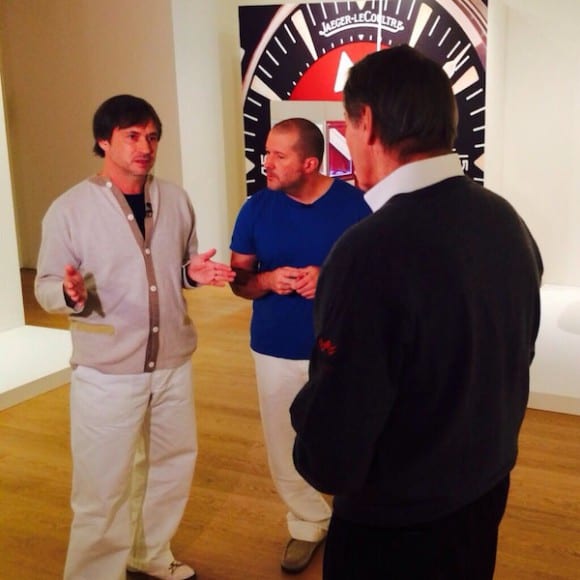
Jony Ive and Marc Newson at Charlie Rose

Marc Newson, Jony Ive, and Charlie Rose (Source: @charlierose)

Jony Ive, Senior Vice President of Design at Apple and industrial designer Marc Newson discuss their (Red) collaboration at Sotheby’s.

Simplicity is refining and being able to define the very essence of what something does, and therefore you understand what it is and you understand what it does….but simplicity for us, it’s not just the absence of clutter, it’s not just stuff that’s not there, it’s this tremendous gravity to trying to find that very simple solution.

Ive and Newson have collaborated numerous times throughout the past few months to select and customize products for Sotheby’s charity auction to benefit Product (RED), including a one-of-a-kind Leica camera, an aluminum desk, solid gold Apple EarPods, and a one-of-a-kind red Mac Pro. Product (RED) has been a longtime Apple partner, with the company raising more than $65 million for the charity since 2006.

Blue Box – Why Steve Jobs and Steve Wozniak hacked the phone network

Before Steve Wozniak and Steve Jobs built Apple in the 1970s, they were phone phreaks.

YouTube-Link

In his famous interview with Bob Cringley for PBS TV series “Thriumpf of the nerds”, Steve Jobs said:
We read about (…) the story Esquire magazine about this guy named “Captain Crunch”, who could supposedly make free telephone calls. You heard about this, I’m sure. And we – again – were captivated: How could anybody do this? And we thought, it must be a hoax. And we started looking through libraries, looking for the secret tones that would allow you to do this. And it turned out we were at Stanford Linear Accelerator Centre one night, and way in the bowels of their technical library way down at the last bookshelf in the corner bottom rack we found an AT&T technical journal that laid out the whole thing. And that’s another moment I’ll never forget – we saw this journal we though – “My God, it’s all real” – (laughs) and so we set out to build a device to make these tones.

And the way it worked was: You know, you make a long-distance call, you used to hear “tüdülüdülü” right in the background. They were tones that sounded like the touch tone you can make on your phone. But they were different frequencies, so you could make them. It turned out, that was the signal from one telephone computer to another – controlling the computers on the network. And AT&T made a fatal flaw when they designed the original telephone network, digital telephone network. They put the signaling from computer to computer in the same band as your voice, which meant, that if you could make those same signals you could put it right in through the handset. And literally the entire AT&T international phone network would think, you were an AT&T computer.

So after three weeks we finally built a box like this that worked. And I remember the first call we made was down to L.A. to one of Woz’s relatives down in Pasadena. We dialed the wrong number, but we woke some guy up in the middle of the night – yelling at him like “Don’t you understand? We made this call for free!”. And this person didn’t appreciate that. But it was miraculous. And we built these boxes to do “blue boxing”, as it was called. An we put a little note in the bottom of them. Our logo was: “He’s got the whole world in his hand”. (laughs) And they worked.

>We built the best blue box in world. It was all digital, no adjustments. And you could go to a pay phone, and you could take a trunk over White Plaines, then take a satellite over Europe and go to Turkey, take a cable back to Atlanta, you could go around the world, around the world five or six times. Because we learned all the codes for how to get on the satellite and stuff. And then you could call a pay phone next door, and you could shout in the phone and after about a minute would come out the other phone. It was miraculous.

And you might ask: “What so interesting about that?” What’s so interesting is that we were young and what we learned was, that we could build something ourselves that could control billions of dollars’ worth of infrastructure in the world. That was what we learned. That it was us two – you know, we didn’t know much – we could build a little thing, that could control a giant thing. And that was incredible lesson. I don’t think there would have ever been an Apple Computer had there not been blue boxing.

Bob Cringely: Woz said, you called the Pope.

Steve Jobs: Yes, we did call Pope. He pretended to be Henry Kissinger. We got the number of the Vatican. And we called the Pope. They started waking people up in the hierarchy, you know. I don’t know, cardinals and this and that. And they actually sent someone to wake up the Pope. When finally we just burst out laughing they realized that we weren’t Henry Kissinger. And so we never got to talk to the Pope. But it was very funny, so.

———————————-

Woz remembers blue boxing:

So we’re sitting in the payphone trying to make a blue box call. And the operator comes back on the line. And we’re all scared and we’d try it again. … And she comes back on the line; we’re all scared so we put in money. And then a cop car pulls up. And Steve was shaking, you know, and he got the blue box back into my pocket. I got it– he got it to me because the cop turned to look in the bushes for drugs or something, you know? So I put the box in my pocket. The cop pats me down and says, “What’s this?” I said, “It’s an electronic music synthesizer.” Wasn’t too musical. Second cop says, “What’s the orange button for?” “It’s for calibration,” says Steve.

— Steve Wozniak,
lecture at Computer History Museum, 2002

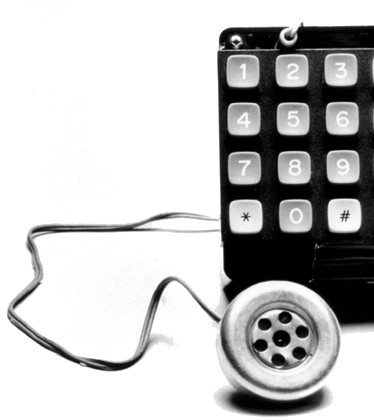
Wozniak and Jobs Blue Box, ca. 1972. The Blue Box allowed electronics hobbyists to make free telephone calls.

The “Blue Box” was a simple electronic gizmo that bypassed telephone company billing computers, allowing anyone to make free telephone calls anywhere in the world.

The “two Steves” had a great deal of fun building and using them for “ethical hacking,” with Wozniak building the kits and Jobs selling them—a pattern which would emerge again and again in the lives of these two innovators. (Wozniak once telephoned the Vatican, pretended to be Henry Kissinger and asked to speak to the Pope—just to see if he could. When someone answered, Woz got scared and hung up.)

These early playful roots are what Wozniak remembers most fondly of Jobs. As columnist Mike Cassidy recalled in a San Jose Mercury News interview, what these two friends most remembered was “not bringing computers to the masses … or the many ‘aha’ moments designing computers. Instead, it’s the time the two tried to unfurl a banner depicting a middle finger salute from the roof of Homestead High School…” or their many Blue Box exploits. Walter Isaacson, Jobs’s official biographer, cites Jobs reflecting on the Blue Box:

If it hadn’t been for the Blue Boxes, there would have been no Apple. I’m 100% sure of that. Woz and I learned how to work together, and we gained the confidence that we could solve technical problems and actually put something into production.

(Isaacson, p. 30)

So far with the story told by Steve Jobs building ‘blue boxes’ about making free phone calls around the world. Now hear it directly from the man who gave Steve Job the idea. Steve Wozniak found a “fiction” article with too much detail to be false. They helped themselves to the library at the Stanford Linear Accelerator and discovered the article was, in fact, real.
But he emphasizes they called around the world to explore not to rip off Ma Bell. All his legit calls were made from home and he had a high phone bill as a result.

(This is an Oct. 4, 1984 speech the Apple co-founder gave to the Denver Apple Pi club at the Colorado School of mines. NOTE: This is assembled from two dubs to fix playback errors. Every word is included, but video quality worsens in the second half.) Kudos to Vince Patton who discovered this video.

——————————–

Source: Computer History Museum

Silicon Valley Historical Association

Tim Cook about his first year as Apple CEO

NBC News “Rock Center with Brian Williams,” December 6, 2012

Nobody remembers the guy who came after Thomas Edison. And nobody seems to recognize Tim Cook as we walk together across the teeming floor of Grand Central Station.

Tim Cook:

I’m a very private person, I like my being anonymous

As we walk: we’re surrounded by examples of what Apple has done to our society — both good and bad.

People now live their lives while listening to the soundtrack of their lives. Communicating with members of their own community while ignoring the actual community around them.

And in this marble monument to another time, where trains lumber to a halt, two stories beneath our feet — we go up the stairs into what we were told the future would look like. The red shirts greet us. And Tim Cook is home now — in the Apple Store — where the successor to Jobs is suddenly treated more like Jagger.

Tim Cook:

It’s pretty spectacular … who else would put a store like this in Grand Central Station?

And who else would have us believe they intend to be the one company that reverses hundreds of years of business history — by becoming the one company that never fades away into irrelevance.

Brian Williams:
You realize if you’re a company that can keep amazing us, consumers, if you’re a company that can stay fresh without an expiration date, you’ll be the first company ever to do that. There is a cycle, a circle of life, a life and death. And you’re trying to buck that trend.

Tim Cook:

Don’t bet against us, Brian. Don’t bet against us.

We started our day with Tim Cook in lower Manhattan, at another of his 250 austere Apple stores where we began the questioning with: what’s different about him.

Brian Williams:
How are you not Steve Jobs?

Tim Cook:

In many ways. One of the things he did for me — that removed a gigantic burden that would have normally existed is he told me, on a couple of occasions — before he passed away, to never question what he would have done. Never ask the question “What Steve would — do,” to just do what’s right.

Doing right has done well for Tim Cook so far. He’s had a good first year on the job – the company’s stock is up about 45% during his tenure, and think about this: he’s already presided over the rollout of 3 iPads, 2 iPhones and 3 Macs.

Brian Williams:
It’s beautiful.

Tim Cook:

Absolutely stunning. Every detail has been focused on.

Brian Williams:
So, you’ve got guys whose job it is to get this mesh right to get this curve right …

Tim Cook:

To get it precisely right.

In fairness, however — this past year, they haven’t gotten everything precisely right.

Starting with Siri … the small woman who lives in your iPhone. The service amazed all of us at first — but then came under criticism for not being … perfect … or as consistently amazing as Steve Jobs wanted it to be.

And then there are the maps … iPhones used to come with Google maps until they set out on their own — but Apple’s version wasn’t quite ready for launch. It lacked some critical street smarts. And in those early days — God help you if you went anywhere near the Brooklyn Bridge or the Hoover Dam. It was a rare and public embarrassment and Cook fired two top executives in charge.

Brian Williams:
How big of a setback was Maps?

Tim Cook:

It didn’t meet our customers’ expectation, and our expectations of ourselves are even higher than our customers’. However, I can tell ya — so we screwed up.

Brian Williams:
And you said goodbye to some executives.

Tim Cook:

Well, we screwed up. And we are putting the weight of the company behind correcting it.

As for the iPhone 5 itself … they have flown off those perfect Apple store shelves. Apple sold 5-million of them in the first weekend alone, breaking all previous sales records. But buyers of the iPhone 5 soon discovered they had to buy something else – none of the old power cords work on the new equipment.

Brian Williams:
Why did we have to buy new cords for this?

Tim Cook:

As it turns out, we had a connector, a 30-pin connector that we used for a decade or more-

Brian Williams:
I’ve got 500 of ‘em at home-

Tim Cook:

You have a few of those –

Brian Williams:
If you need any. Yeah.

Tim Cook:

On iPod. But, Brian, it was one of those things where we couldn’t make this product with that connector — but let me tell you; the product is so worth it.

And that’s the thing about Apple. Sleek isn’t cheap. Those white ear buds announce to the worldyou’ve got a of couple hundred dollars to spend. Your investment will buy you a staggeringly beautiful product that works unlike any other … and in a lot of workplaces, including our own, the Apple products you’ll see are the ones people bring in from home … they’re usually right there on the desk, next to the computers we have to use for work.

Apple prides itself on being equal parts computer-company and religion. Apple fans get whipped up into a stampeding froth with every new product release … customers famously camp outdoors and then emerge triumphant, emotionally spent. Journalists flock to those dramatic product rollouts — as if the CEO is going to reveal stone tablets instead of the kind with scratch-proof glass. And the legendary Apple culture of secrecy is designed to keep it that way.

Brian Williams:
Why are you institutionally so secretive? How is it that you know how many times I’ve listened to Bob Dylan or Kendrick Lamar or “Have Yourself a Merry Little Christmas” and yet we never get to know anything about you guys?

Tim Cook:

We think that holding our product plans secret is very important because people love surprises.

This was one surprise Apple may not have loved. The new Samsung ad campaign — its blistering, bold, damaging. It portrays Apple products and the people who love them … as somehow passé and uncool and even desperate. It’s a blunt instrument disguised as satire, and it’s a frontal attack on a giant that would have been unthinkable not too long ago.

(Samsung ad:)

Woman: Hey what’d you just do?
Man: I just sent him a playlist
Man: By touching phones?
Man: Yep, simple as that
Woman: It’s the Galaxy S3
Man: I’ll see you at the studio later
Woman: When do you think we’re going to be able to do that thing?
Mom: Hey
Son: Hey mom dad
Mom: Thanks for holding our spot
Son: You guys have fun — home by midnight you two
Announce: The next big thing is already here Samsung Galaxy S3
Mom: But honey this is the line for apps, I stand

The unmistakable message right there? Apple products are for your parents. Samsung makes the really cool stuff and they’re much more casual about it.

Brian Williams:
They came along and tried to paint those with white earbuds, Apple users, as losers. They’re trying to paint their product as cool and yours as not cool. Is this thermonuclear war?

Tim Cook:

We love our customers. And we’ll fight to defend them with anyone. Is it thermonuclear war? The reality is, is that we love competition, at Apple. We think it makes us all better. But we want people to invent their own stuff.

He’s talking about the legal fight between Apple and Samsung — they have sued each other in courts around the world over patent infringements. Apple won the last round in the U.S. when a jury ruled Samsung owed them a billion dollars for stealing ideas. Samsung was back in court just today appealing the judgment. Sometimes the business of making pretty things … can get ugly.

Brian Williams:
How tough is your business, how surprised would we civilians be at how rough it gets? Spying, skullduggery?

Tim Cook:

It’s tough. It’s very tough. You have people tryin’ to hack into systems on a constant basis. You have people trying to elicit confidential information — about future product plans. All of these things are things that we constantly fight.

And then there’s Tim Cook’s larger challenge: the man who rhapsodizes about the perfectly rounded edges of his products … vows to always keep Apple cutting edge.

Brian Williams:
It sounded to me that you and I grew up the same American life, kind of grindingly simple and normal American middle class household — when you and I as kids would go to a neighbor’s house and see, under their new TV, Sony Trinitron, that would tell us something instantly. And you’re smiling. And that brand lasted up until — Walkman, Discman. But then, fast-forward to today, it’s less meaningful. How do you not become Sony, with all apologies to Sony?

Tim Cook:

We’re very simple people at Apple. We focus on making the world’s best products and enriching people’s lives. I think some companies — maybe even the one that you mention, maybe they decided that they could do everything. We have to make sure, at Apple, that we stay true to focus, laser focus — we know we can only do great things a few times, only on a few products.

But will the next great thing be Apple’s long-rumored move … into the television business?

Tim Cook:

It’s a market that we have intense interest in, and it’s a market that we see that has been left behind.

Tim Cook has more to say about Apple’s entry into television … in part two of our interview, when we come right back.

Visit NBCNews.com for breaking news, world news, and news about the economy

In August 2011, Tim Cook was made CEO of Apple. Steve Jobs reduced his own role to Chairman of the Board, then less than two months later he was gone … after a long fight with pancreatic cancer.

It was Tim Cook who was chosen to preside over the private memorial service for Apple employees — thousands of people gathered as the face of the founder gazed down upon them from the side of the building.

Tim Cook:

It was — it was the saddest time in my life.

Brian Williams:
Did you know how sick he was?

Tim Cook:

I always thought that he would bounce back. Because he always did. And it wasn’t until extremely close to the end that I reached a — sort of an intellectual point that — that he couldn’t bounce this time.

It’s his company to run now, and after a peaceful transition of power, he was quickly forced into crisis footing because of the situation in China … where so many Apple products are assembled by skilled workers. There’s been trouble, and Cook travelled there after harsh criticism of poor working conditions and low wages dissolved into violence. The situation was later parodied on “SNL” — by cast members who actually make up the heart of Apple’s demographic.

“SNL’S” FRED ARMISEN:

Ohhhhh, no. Talk about Apple Map. It won’t work, right? It take you to wrong place? You want Starbuck, it take you to Dunkin’ Donut? That must be… so hard for you!

China remains a major issue for Apple, and Tim Cook seems to have a ready answer for it.

Brian Williams:
Why can’t you be a made-in-America company?

Tim Cook:

You know, this iPhone, as a matter of fact, the engine in here is made in America. And not only are the engines in here made in America, but engines are made in America and are exported. The glass on this phone is made in Kentucky. And so we’ve been working for years on doing more and more in the United States. Next year, we will do one of our existing Mac lines in the United States.

Brian Williams:
Let’s say our Constitution was a little different and Barack Obama called you in tomorrow and said, “Get everybody outta China, and do whatever you have to do. Make these, make everything you make in the United States.” What would that do to the price of this device?

Tim Cook:

Honestly, it’s not so much about price it’s about the skills, et cetera. Over time, there are skills that are associated with manufacturing that have left the U.S. Not necessarily people, but the education system stopped producing them.

Cook says Apple has already created more than 600,000 jobs here in the US. That includes everything from research and development, to retail to a solar power farm. He also points to the APP industry — another one of those that didn’t exist before Apple came along … all those icons and all those downloads employ a lot of people.

It was such a different world just six years ago when we sat down with Steve Jobs for one of his last television interviews. He showed us around Apple’s flagship store on 5th Avenue in New York, which six years later is still the big glass granddaddy of them all. Back then he was, as usual, all about the future.

{SOT STEVE JOBS Interview}:

We’ve got some really great ideas of the products we’re going to build next year and the year after that we’re working real hard on. So I think that’s- our focal length is always forward.

Brian Williams:
You’re so different. He was all black turtleneck and the glass frames and mystical and mysterious, and — you know, forgive me, you and I could work at a Best Buy. We’re, you know, plain-looking people. You’re a much more conventional-seeming guy. But there’s obviously brain power he saw in you that you brought to bear on this job.

Tim Cook:

I’m not sure a conventional person would’ve come to Apple at that point in time. Almost everyone I know thought I was crazy.

That’s because Apple was on the ropes back in 1998, Steve Jobs had just come back and was trying to steal Cook away from Compaq Computer … a now-faded name that was actually vibrant back then.

Tim Cook:

I just got to Compaq, I’d just gotten to Houston. I agreed to come out and talk — five minutes into my conversation with him, I was willing to throw caution to the wind and come to Apple. And the rest is history.

Tim Cook’s personal history starts in Robertsdale, Alabama — the son of a Gulf Coast shipyard worker and a mom that stayed at home. After working in an aluminum factory as a teenager he went off to Auburn and then to Duke for an MBA. Among what little else we know about him: he’s got a lot of Bob Dylan on his iPod, and Bobby Kennedy was his hero. He still has his accent from the South. These days he finds solitude in the West.

Brian Williams:
For all the folks trying to get to know you and figure you out — where do you go when you need to go someplace?

Tim Cook:

I work out to keep stress away. I’m in the gym by 5a.m. every morning. If I have some free time, I go to a National Park. I love getting in nature and so this – these are the things that calm my mind and allow me to think clearly so that’s what I do.

Brian Williams:
This is kind of your television-coming-out, and I’m glad you did this. Does this mean you have reached a cruising altitude?

Tim Cook:

There’s no – maybe for other CEOs. There’s no cruising altitude at Apple.

Tim Cook is a manager with a vision — who is following in the footsteps of a visionary turned manager. While he has to worry about global issues like the counterfeiters who instantly turn fake copies of every new Apple product: Cook has to keep one eye on the stock price, constantly, and the other on the future and that sure sounds like it means TV.

Brian Williams:
What can Apple do for television watching? What do you know that is gonna change the game, that we don’t know yet?

Tim Cook:

It’s a market that we see, that has been left behind. You know, I used to watch “The Jetsons” as a kid.

Brian Williams:
Absolutely.

Tim Cook:

I love “The Jetsons.”

Brian Williams:
I was right there with Elroy.

Tim Cook:

We’re living “The Jetsons” with this.

{SOT “The Jetsons:” George you’ll never guess what happened}

Brian Williams:
Facetime is “The Jetsons” but television is still television.

Tim Cook:

It’s an area of intense interest. I can’t say more than that. But …

Brian Williams:
I’m not shocked. All right, complete this sentence “Ten years from now, Americans are going to be amazed that they ever ___” What’s the — give us broad generalities. What’s the new thing?

Tim Cook:

(LAUGH)

Brian Williams:
It’s okay to tell me.

Tim Cook:

Love it. I love it.

Brian Williams:
Let this stuff out. Whatever you’re thinking of for the future … it’s all right.

Tim Cook:

Our whole role in life is to give you something you didn’t know you wanted. And then once you get it, you can’t imagine your life without it.

Brian Williams:
Starting with?

Tim Cook:

And you can count on Apple doing that.

Brian Williams:
Oh man, that’s frustrating.