25 Years of Mac Logo

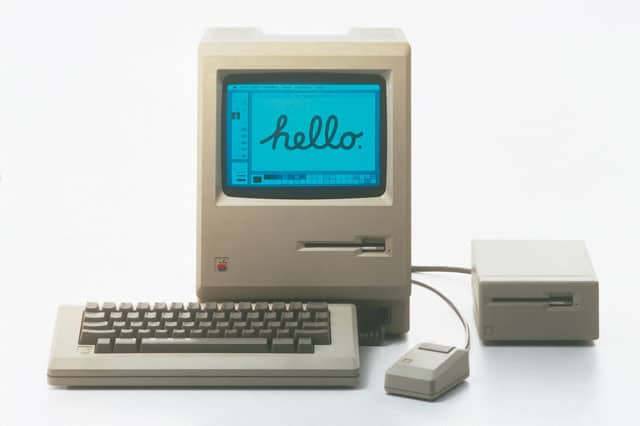
The Apple Macintosh revolutionized the entire computer industry by the year of 1984. Steve Jobs and his ingenious Macintosh team arranged for the computer to be used by the normal “person in the street” – and not only by experts.

Apple Macintosh

The first Apple Macintosh (1984)
[ high res version ]

“Insanely great” - Steve Jobs could hardly put into words his enthusiasm by the launch of the Macintosh. On the legendary annual general meeting of January 24th, 1984, in the Flint Center not far from the Apple Campus in Cupertino, the Apple co-founder initially quoted Bob Dylan’s “The Times They Are A-Changin’” in order to then polemicize against an imminent predominance of the young computer industry by IBM.

The early 1980s. 1981 - Apple II has become the world’s most popular computer, and Apple has grown to a 300 million dollar corporation, becoming the fastest growing company in American business history. With over fifty companies vying for a share, IBM enters the personal computer market in November of 1981, with the IBM PC.

1983. Apple and IBM emerge as the industry’s strongest competitors, with each selling approximately one billion dollars worth of personal computers in 1983. The shakeout is in full swing. The first major personal computer firm goes bankrupt, with others teetering on the brink. Total industry losses for 1983 overshadow even the combined profits of Apple and IBM.

It is now 1984. It appears that IBM wants it all. Apple is perceived to be the only hope to offer IBM a run for its money. Dealers, after initially welcoming IBM with open arms, now fear an IBM dominated and controlled future and are turning back to Apple as the only force who can ensure their future freedom.

IBM wants it all, and is aiming its guns at its last obstacle to industry control, Apple. Will Big Blue dominate the entire computer industry? The entire information age? Was George Orwell right?

The crowd, among them the complete Macintosh developer’s team, shouted back: “Nooooo!”
The introduction of the first Mac on January 24th, 1984; taken from the “Lost 1984 Videos”

There had been only two milestone products so far: the Apple II in 1977 and the IBM PC in 1981, Jobs continued. “Today (…) we are introducing the third industry milestone product, the Macintosh. Many of us have been working on Macintosh for over two years now and it has turned out insanely great.”

Taking a look at the history of the personal computer today, Steve Jobs was on the right track with his historical comparison. However, it would not be IBM that became the great dominator of the computer industry over the years, but rather, the alliance of Microsoft and Intel.

Steve JobsSteve Jobs
Continue reading »

written by Christoph Dernbach \\ tags: , , , , , , , , ,

It is claimed again and again that in the course of the Macintosh’s development, Apple just resorted to the ideas the research laboratory Xerox PARC had hatched before. Fact or Fiction?


Link: sevenload.com
In the movie “Pirates of Silicon Valley“, the issue “Apple and Xerox” is treated slightly ironically.

In the USA, the brand name “Xerox” denotes photocopying just as “Kleenex” stands for tissues or “Scotch tape” for adhesive film. After all, already in 1950, the Xerox Corp. was the world’s first company to actually transfer the “Xerography” invented by the American law student Chester Carlson into a functional product.

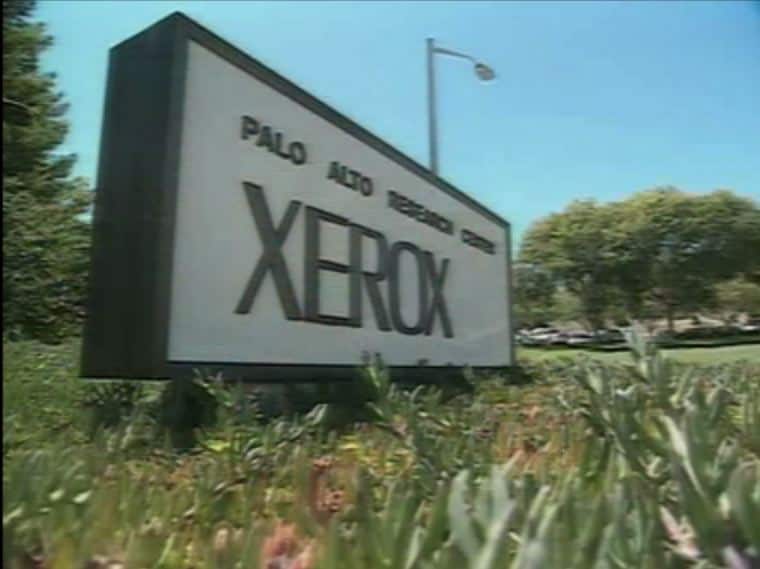
Xerox LogoBy the end of the sixties, the Xerox management sensed the threat of Japanese companies catching up on Xerox’s technological advantage. Moreover, the Xerox head worried that the “paperless office” might emerge with the following computer generations, in which the Xerox would no longer have a place. Against this background, the Xerox Palo Alto Research Center (PARC) in California was founded in 1971.

John Warnock, former researcher in the Xerox PARC and later one of the two founders of Adobe Systems, remembers: “The atmosphere was electric – there was total intellectual freedom. There was no conventional wisdom; almost every idea was up for challenge and got challenged regularly.” Larry Tessler, who later took part in developing the Macintosh and the Newton PDA at Apple, also enjoyed the liberties the PARC provided in the seventies: “The management said go create the new world. We don’t understand it. Here are people who have a lot of ideas and tremendous talent, [are] young, energetic.” The problem, however, was that the company management at the East Coast of the USA did not [care a straw for] the PARC’s research results unless they were directly involved with photocopiers.


Link: sevenload.com

In his TV documentation “Triumph of the Nerds” Robert Cringley is interviewing researchers at the Xerox PARC


Within two years, the researchers at the PARC had designed the Alto, which was something like the first personal computer. The Alto did not feature character-oriented graphics, as did all the other computers of that time, but a bit-oriented version instead. A high quality printer could print exactly what the screen displayed.

Xerox Alto
Xerox Alto

However, this marvelous machine was not freely available on the market. Approximately 1500 units had been produced, 1000 of which Xerox employed in-house; the rest went to universities and public authorities.


Link: sevenload.com

An advertising spot for the Xerox Alto taken from Robert Cringley’s TV documentation “Triumph of the Nerds“.

Jef Raskin, who had been charged initially with the Macintosh project at Apple, kept regular contact to the PARC researchers and tried to convince the Apple management to employ a graphical user interface like the Alto contained in the development of the Lisa.

Raskin claimed he wanted to introduce Jobs to the PARC, but due to his personal dislike of Raskin, Jobs simply did not agree to respond to the offer. According to Raskin, it was not until Bill Atkinson supported him that Jobs set out for the PARC. Whatever way the contact was actually accomplished, this visit meant a turning point to the life of Steve Jobs; the three technologies that the 24-year-old encountered there were each revolutionary on their own: the first graphical user interface for computers; networked Alto computers; and object-oriented programming.


Demo of the Xerox Alto (taken from: Triumph of the Nerds)

Even 17 years after this visit, Jobs can still remember it exactly:

They showed me really three things. But I was so blinded by the first one I didn’t even really see the other two. One of the things they showed me was object oriented programming – they showed me that but I didn’t even see that. The other one they showed me was a networked computer system… they had over a hundred Alto computers all networked using email etc., etc., I didn’t even see that. I was so blinded by the first thing they showed me, which was the graphical user interface. I thought it was the best thing I’d ever seen in my life. Now remember it was very flawed, what we saw was incomplete, they’d done a bunch of things wrong. But we didn’t know that at the time but still thought they had the germ of the idea was there and they’d done it very well and within you know ten minutes it was obvious to me that all computers would work like this some day.

Adele Goldberg
Adele Goldberg

Jobs decided to realign Apple’s strategy and fully rely on the “graphical user interface” (GUI) he had seen at the Xerox PARC. Adele Goldberg, who had been a researcher at the PARC at that time, already suspected that Jobs’ visit would entail extensive consequences: “He came back, and I almost said ‘asked’ but the truth is ‘demanded,’ that his entire programming team get a demo of the Smalltalk System, and the then head of the science center asked me to give the demo because Steve specifically asked for me to give the demo, and I said ‘no way.’ I had a big argument with these Xerox executives, telling them that they were about to give away the kitchen sink, and I said that I would only do it if I were ordered to do it, cause then, of course, it would be their responsibility, and that’s what they did.”


Larry Tessler, Adele Goldberg and Steve Jobs about “Apple and Xerox” (taken from: Triumph of the Nerds)

Apple bought access to the PARC by means of a stock deal that seemed lucrative to the Xerox managers on the East Coast: They might buy 100,000 Apple stocks for one million dollars. Holding this admission ticket in the hand, Steve Jobs, Apple’s president Mike Scott, Bill Atkinson, and a number of members of the developing team marched up. “I think mostly … what we got in that hour and a half was inspiration and just sort of basically a bolstering of our convictions that a more graphical way to do things would make this business computer more accessible.”

Xerox Alto (1973 Prototype Workstation)

Larry Tesler, who then took part in the demo as an employee of the PARC, had been fascinated by the visitors: “After an hour looking at demos, they understood our technology and what it meant, more than any Xerox executive understood after years of showing it to them.”

Kids playing with a prototype of the Xerox Alto

The Macintosh team took up the ideas of the PARC, but it also changed numerous operating modes and added countless new features. Accordingly, the Xerox Alto did not imply, for example, menus flapping down from the upper edge of the screen, but operated with some kind of a pop-up window instead. Moreover, the window did not open automatically by double-clicking on a document, but had to be opened manually. During months of painstaking work, Atkinson had written the QuickDraw routine for the Lisa and the Macintosh, which allowed for overlapping windows to be drawn on the computer screen for the first time.

Screen des Xerox Star
The screen of the Xerox Star

In contrast to the first Mac, the Alto featured no completed desktop metaphor nor ingenious desktop icons such as the trash can, which made it easier to delete files, and not just for computer novices. The historical accomplishments of the Mac team also included the Macintosh Human Interface Guide, which, for instance, when it detected a document in a Macintosh application, determined that it was to be saved using the command “Apple-S.”

As for Xerox, the bitter aftertaste of having missed an historical opportunity remained, particularly due to the fact that parallel to the Apple developers, Bill Gates and his Microsoft crew also went in and out as they pleased. (By the way, they did so without holding an admission ticket comparable to the one Jobs had procured by means of the stock deal.)

“Basically, they were copier heads that just had no clue about a computer or what it could do. And so they just grabbed defeat from the greatest victory in the computer industry. Xerox could have owned the entire computer industry today,” Steve Jobs said in 1996. “Could have been, you know, a company ten times its size. Could have been IBM – could have been the IBM of the nineties. Could have been the Microsoft of the nineties.”
Besides, in the context of the dispute with Apple about the plagiarism accusations around the first Windows versions, Microsoft had pointed out that Apple and Microsoft had both helped themselves generously at XEROX. This episode is described slightly exaggeratedly in the movie “Pirates in the Silicon Valley”:

Christoph Dernbach

****************************************************

Book cover: Revolution in The Valley

Book cover: Revolution in The Valley

James Turner from O’Reilly News interviewed Andy Hertzfeld, one of the original designers of the Macintosh and author of the book, Revolution in the Valley: The Insanely Great Story of How the Mac Was Made, which chronicles the efforts to create the Mac. Andy Hertzfeld currently works at Google as a Software Engineer. In this Interview James Turner asked some questions about Xerox PARC and the development of the Mac:

JT: In your book you allude to Xerox as being, to Bill Gates, the rich uncle that both Apple and Microsoft stole from. What was the relationship like with PARC when you were developing the Mac and how did the Xerox researchers feel about the Mac?

AH: Well, we had no formal relationship with PARC while we were developing the Mac. We got a single demo before the Mac project got off the ground, when the LISA project, that sort of cousin or bigger brother of the Mac, was in development. And so from that one demo we were already pointed in that direction but I would say that Xerox PARC demo galvanized and reinforced our strong opinion that the graphic user-interface was the way to go. And then the influence of PARC was strong in the project, but not through a formal relationship with PARC; more through PARC people getting wind of what we were doing and coming to work at Apple. The very first one was Tom Malloy on the LISA project. He was sort of a disciple of Charles Simonyi–I write about that a little bit in my book. He was one of the original LISA people who came to Apple in 1978. But later, Larry Tessler was a really key figure coming to the LISA team in the summer of 1980 from Xerox PARC and eventually, mostly after the original Mac shipped, there were a dozen or more. Another person I have to mention is Bruce Horn who started working at Xerox PARC when he was 14 years old; he was one of those kids they picked from a Palo Alto High School to teach Smalltalk to and he was one of the four or five key Macintosh developers. And of course he was steeped in all of the PARC values and through Bruce, a lot of them made it into the Macintosh.

JT: Was there any feeling among the Apple engineers that any – guilt is probably too strong a word, but feeling like you know Xerox had these great ideas. I guess Xerox really let them go to waste but–

AH: Oh there was nothing like that; Steve Jobs has a good quote. It’s actually a Picasso quote that he often cites; he cited it at one of our retreats which was sort of good artists copy; great artists steal. And what that means is that when you’re passionate about what you’re doing you’ll take ideas from anywhere and with no guilt. You want to make the best possible thing and that was our mentality.

JT: I have to say I actually worked for Xerox AI Systems in 1986 and it was kind of frustrating because they really had the mentality there that if you couldn’t sell paper and toner for [them] they weren’t interested.

AH: Oh sure. Xerox in a well-documented fashion – they had at least the possibility of having the world at their feet there with the work that Alan Kay and his team did. But yeah; they completely blew it and most of the best PARC people were really frustrated by the Xerox management. There’s no doubt of that; that’s one of the reasons why Steve Jobs is great. You had someone leading the company who could relate to the customers and appreciate things.

written by Christoph Dernbach \\ tags: , , , , , , , , , , , , , , , ,

Steve Jobs

The only problem with Microsoft is they just have no taste, they have absolutely no taste, and what that means is - I don’t mean that in a small way I mean that in a big way. In the sense that they they don’t think of original ideas and they don’t bring much culture into their product ehm and you say why is that important - well you know proportionally spaced fonts come from type setting and beautiful books, that’s where one gets the idea - if it weren’t for the Mac they would never have that in their products and ehm so I guess I am saddened, not by Microsoft’s success - I have no problem with their success, they’ve earned their success for the most part. I have a problem with the fact that they just make really third rate products.

Steve Ballmer

I will admit quite frankly that I think Windows today is probably four years behind, three years behind where it would have been had we not danced with IBM for so long. Because the amount of split energy, split works, split IQ in the company really cost our end customer real innovation in our product line and so whenever I hear these criticisms which I gotta to say sting eh sometimes, I say to myself just you watch, just you watch Windows 95, Windows 9…there’s no lack of focus there hasn’t been here for the last three or four years since we didn’t have this big spot with IBM. Even in the operating systems here now, you’ll start to see clear, clear…and people will recognise clear leadership.

written by Christoph Dernbach \\ tags: , , , , , ,


Link: sevenload.com The most famous Super Bowl ad

1984 is the American television commercial which introduced the Macintosh personal computer for the first time. It is now considered a “watershed event” and a “masterpiece.” It was directed by Ridley Scott, written by Steve Hayden and Lee Clow, and was produced by Chiat/Day. Costume designer Jeanette Farrier designed the costumes for the commercial.

Anya Major performed as the unnamed heroine and David Graham as “Big Brother.” It’s only daytime televised broadcast was on 22 January 1984 during the third quarter of Super Bowl XVIII. Chiat/Day also ran the ad one other time on television, a month earlier at 1:00 A.M on 15 December 1983 on KMVT in Twin Falls, Idaho so that the advertisement could be submitted to award ceremonies for that year. In addition, starting on 17 January 1984 it was screened prior to previews in movie theaters for a few weeks.

1984 used the unnamed heroine to represent the coming of the Macintosh (indicated by her white tank top with a Picasso-style picture of Apple’s Macintosh computer on it) as a means of saving humanity from “conformity” (Big Brother).

These images were an allusion to George Orwell’s noted novel, Nineteen Eighty-Four, which described a dystopian future ruled by a televised “Big Brother.”

Plot

The commercial opens with a dystopic, industrial setting in blue and gray tones, showing a line of individuals (of ambiguous gender) marching in unison. They are moving through a long tunnel monitored by a string of televisions. This is in sharp contrast to the full-color shots of the nameless heroine (Anya Major) who has appeared to rescue them. She looks more like an Olympic track and field athlete than a soldier, as she is carrying a large brass-headed hammer and is wearing an athletic “uniform” (bright orange athletic shorts, running shoes, a white tank top with a Picasso-style picture of Apple’s Macintosh computer, a white sweat band on her left wrist, and a red one on her right).

Big Brother (David Graham) speaking to his audience of drones.

My friends, each of you is a single cell in the great body of the State. And today, that great body has purged itself of parasites. We have triumphed over the unprincipled dissemination of facts. The thugs and wreckers have been cast out. And the poisonous weeds of disinformation have been consigned to the dustbin of history. Let each and every cell rejoice! For today we celebrate the first, glorious anniversary of the Information Purification Directive! We have created, for the first time in all history, a garden of pure ideology. Where each worker may bloom secure from the pests purveying contradictory truths. Our Unification of Thoughts is more powerful a weapon than any fleet or army on earth. We are one people, with one will, one resolve, one cause. Our enemies shall talk themselves to death and we will bury them with their own confusion. We shall prevail!

As she is chased by four security guards (presumably agents of the Thought Police with black riot-police uniform, helmets with visors covering their faces, and armed with large night sticks) the heroine races towards a large screen with the image of a Big Brother-like figure (David Graham) on it. He is celebrating the anniversary of the “Information Purification Directives” (which he summarizes as an end to “contradictory thoughts”) and tells his audience that, “our ‘Unification of Thoughts’ is more powerful a weapon” than anything else he could offer them. The heroine, now close to the screen, hurls the hammer towards it, right at the moment Big Brother announces, “we shall prevail!” In a flurry of light and smoke, the screen is destroyed.

The commercial concludes with text which reads: “On January 24th, Apple Computer will introduce Macintosh. And you’ll see why 1984 won’t be like 1984.”

Production

Development

The commercial was created by the advertising agency Chiat/Day, with copy by Steve Hayden and Lee Clow. Ridley Scott (who had just finished filming Blade Runner the year prior) was hired to direct it, with the “unheard-of production budget of $900,000.”

Steve Jobs and John Sculley were so enthusiastic about the final product that they “…purchased one and a half minutes of ad time for the Super Bowl, annually the most-watched television program in America. In December 1983 they screened the commercial for the Apple Board of Directors. To Job’s and Sculley’s surprise, the entire board hated the commercial.”

Despite the board’s dislike of the film, Steve Jobs continued to support it. Steve Wozniak watched it and offered to pay for the spot personally if the board refused to air it. Chiat/Day finally managed to sell thirty seconds of the original sixty-second ad.

Intended message

Adelia Cellini states in a 2004 article for MacWorld, “The Story Behind Apple’s ‘1984′ TV Commercial“:

Let’s see - an all-powerful entity blathering on about Unification of Thoughts to an army of soulless drones, only to be brought down by a plucky, Apple-esque underdog. So Big Brother, the villain from Apple’s ‘1984′ Mac ad, represented IBM, right? According to the ad’s creators, that’s not exactly the case. The original concept was to show the fight for the control of computer technology as a struggle of the few against the many, says TBWA/Chiat/Day’s Lee Clow. Apple wanted the Mac to symbolize the idea of empowerment, with the ad showcasing the Mac as a tool for combating conformity and asserting originality. What better way to do that than have a striking blonde athlete take a sledghammer to the face of that ultimate symbol of conformity, Big Brother?

However, in his 1983 Apple keynote address, Steve Jobs made the following comment before showcasing a preview of the commercial to a select audience:

It is now 1984. It appears IBM wants it all. Apple is perceived to be the only hope to offer IBM a run for its money. Dealers initially welcoming IBM with open arms now fear an IBM dominated and controlled future. They are increasing and desperately turning back to Apple as the only force that can ensure their future freedom. IBM wants it all and is aiming its guns on its last obstacle to industry control, Apple. Will Big Blue dominate the entire computer industry? The entire information age? Was George Orwell right about 1984?

Reception

Awards

* 2007: Best Super Bowl Spot (in the game’s 40-year history)
* 1999: TV Guide - Number One Greatest Commercial of All Time
* 1995: Advertising Age - Greatest Commercial
* 1984: 31st Cannes Lions International Advertising Festival - Grand Prix

Social impact

Ted Friedman, in his 2005 text, Electric Dreams: Computers in American Culture, notes the impact of the commercial:

Super Bowl viewers were overwhelmed by the startling ad. The ad garnered millions of dollars worth of free publicity, as news programs rebroadcast it that night. It was quickly hailed by many in the advertising industry as a masterwork. Advertising Age named it the 1980s Commercial of the Decade, and it continues to rank high on lists of the most influential commercials of all time [...] 1984 was never broadcast again, adding to its mystique.

1984 became a signature representation of Apple computers. It was scripted as a thematic element in the 1999 docudrama, Pirates of Silicon Valley, which explores the rise of Apple and Microsoft (the film opens and closes with references to the commercial including a re-enactment of the heroine running towards the screen of Big Brother and clips of the original commercial).

The 1984 ad was also prominent in the 20th anniversary celebration of the Macintosh in 2004, as Apple reposted a new version of the ad on its website. In this updated version, an iPod, complete with signature white earbuds, was digitally added to the heroine. Attendees were given a poster showing the heroine with iPod as a commemorative gift.

Further reading

Source:

1984 (television commercial). (2008, July 20). In Wikipedia, The Free Encyclopedia. Retrieved 21:47, August 12, 2008, from http://en.wikipedia.org/w/index.php?title=1984_(television_commercial)&oldid=226800138

This article is licenced under the GNU Free Documentation License

written by Christoph Dernbach \\ tags: , , , , , , , , , , , , , ,