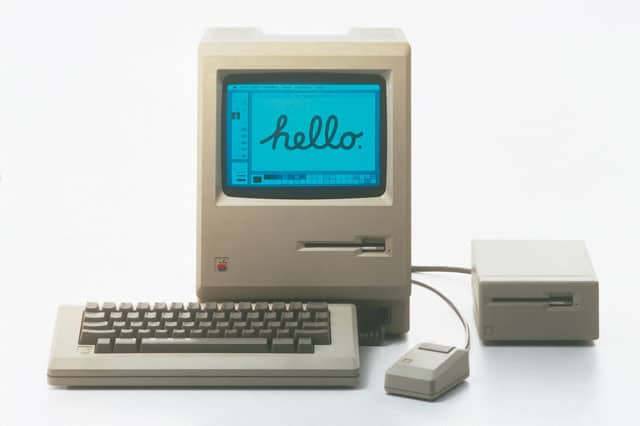
The Apple Macintosh revolutionized the entire computer industry by the year of 1984. Steve Jobs and his ingenious Macintosh team arranged for the computer to be used by the normal “person in the street” – and not only by experts.
The first Apple Macintosh (1984)
[ high res version ]
“Insanely great” - Steve Jobs could hardly put into words his enthusiasm by the launch of the Macintosh. On the legendary annual general meeting of January 24th, 1984, in the Flint Center not far from the Apple Campus in Cupertino, the Apple co-founder initially quoted Bob Dylan’s “The Times They Are A-Changin’” in order to then polemicize against an imminent predominance of the young computer industry by IBM.
The early 1980s. 1981 - Apple II has become the world’s most popular computer, and Apple has grown to a 300 million dollar corporation, becoming the fastest growing company in American business history. With over fifty companies vying for a share, IBM enters the personal computer market in November of 1981, with the IBM PC.
1983. Apple and IBM emerge as the industry’s strongest competitors, with each selling approximately one billion dollars worth of personal computers in 1983. The shakeout is in full swing. The first major personal computer firm goes bankrupt, with others teetering on the brink. Total industry losses for 1983 overshadow even the combined profits of Apple and IBM.
It is now 1984. It appears that IBM wants it all. Apple is perceived to be the only hope to offer IBM a run for its money. Dealers, after initially welcoming IBM with open arms, now fear an IBM dominated and controlled future and are turning back to Apple as the only force who can ensure their future freedom.
IBM wants it all, and is aiming its guns at its last obstacle to industry control, Apple. Will Big Blue dominate the entire computer industry? The entire information age? Was George Orwell right?
The crowd, among them the complete Macintosh developer’s team, shouted back: “Nooooo!”
The introduction of the first Mac on January 24th, 1984; taken from the “Lost 1984 Videos”
There had been only two milestone products so far: the Apple II in 1977 and the IBM PC in 1981, Jobs continued. “Today (…) we are introducing the third industry milestone product, the Macintosh. Many of us have been working on Macintosh for over two years now and it has turned out insanely great.”
Taking a look at the history of the personal computer today, Steve Jobs was on the right track with his historical comparison. However, it would not be IBM that became the great dominator of the computer industry over the years, but rather, the alliance of Microsoft and Intel.
With the initial public offering of Apple Computers in December 1980, Steve Jobs became a multimillionaire – however, he possessed neither enough stock to lead Apple Computers alone nor to determine his own position within Apple. By the beginning of 1981, he actually found himself to be without management responsibility over any specific project. To Jef Raskin’s discomfort, he threw himself into the Macintosh project, which had not been taken really seriously by the Apple board of management at that time.
However, Steve Jobs knew what he wanted. He had seen the graphical user interface of the Xerox Alto at Xerox PARC. Instead of green letters on a dark background, white document windows with black text appeared – just like a sheet of paper. Several different fonts could be selected. The graphics board controlled individual pixels on the screen freely. By means of a mouse, a pointer could be moved on the screen in order to mark texts or issue commands. Files were represented by icons on a virtual desktop.
The Alto was not available on the market. For this experimental computer, the main memory alone would have cost about 7,000 dollars at the time. Jobs wanted a computer even better than the Alto – and also better than Apple’s Lisa. However, the new marvelous machine should cost only a fraction of the Lisa’s price, which was about 12,000 dollars, inclusive of external hard disk.
Pirate flag above the Mac developers’ building “Bandley III”
Within Apple, Jobs gathered a small, conniving team – and he did not care for other projects in the company. Andy Hertzfeld, one of the most important software designers in the Macintosh developers team, remembers:
Steve Jobs kind of came bopping by my cubicle saying OK you’re working on the Mac now. And I said well I have to finish up this Apple 2 stuff I’m doing here. No you don’t that stinks that’s not going to amount to anything you gotta start now. And I said well just give me a few days to finish and he said no and what he did was he pulled the plug on my Apple 2 that I was programming just losing, losing the code I’m working on and start taking my computer and walking away with it and what could I do but follow him out to his car cause he had my machine he plopped it down in the trunk and drove me over to this remote building, took the computer out, walked upstairs, plopped it down on a desk, well you’re working on the Mac now. While Jobs pursued his MacMission he needed a more orthodox chief executive to run the company. A respectable face who could sell to corporate America. He chose Pepsi-Cola executive John Sculley. Sculley refused - leave Pepsi for a 4 year old company that had been set up in a garage! Are you serious?! But it was hard saying no to Steve Jobs.
The Macintosh Pirates
Above the roof of “Bandley III”, a pirate flag with the Apple symbol as eye patch was waving – and on deck of the virtual pirate ship, Steve Jobs was standing as a man who wanted to prove it to them all. Jobs’ first victim was Jef Raskin, who had fought against the application of a mouse and instead preferred a pen or a joystick. After Jobs had relieved his opponent of the responsibility for the software, Raskin gave in exasperatedly and left Apple Computers in March 1982. In retrospect, Raskin can claim that he was the first at Apple to have presented the vision of an inexpensive, easy to handle computer for the masses. Yet in order to keep “his” Macintosh below the price limit of 1,500 dollars, Raskin also wanted to make technical compromises which would have put at risk the Mac’s success. Thus, for instance, he insisted on limiting the main memory to a tiny 64 kilobytes. Jobs accomplished 128 kilobytes – and afterwards, even this space was actually far too tight for the system programmers.
Raskin did not particularly support the innovations the Lisa team had picked up in the Xerox PARC and therefore disapproved of the change to the more capable 68000 processor, which was included in the Lisa as well. It is hardly imaginable what would have become of the Mac if Raskin had asserted his extreme parsimony and his resistance to the mouse. After the internal disputes had been settled, the Mac team now fully concentrated on the in-house competition against the far larger Lisa developing team. Beforehand, Jobs had enticed away from the Lisa team ingenious programmers such as Bill Atkinson and Steve Capps.
Love and Hate
As a project manager, Steve Jobs had been highly controversial not only within Apple. “He’s also obnoxious and this comes from his high standards. He has extremely high standards and he has no patience with people who don’t either share those standards or perform to them,“ Bob Metcalfe remembers. He is the inventor of the networking standard Ethernet, who had worked as a researcher in the neighboring research institute Xerox PARC at that time. “He’s also obnoxious and this comes from his high standards. He has extremely high standards and he has no patience with people who don’t either share those standards or perform to them.” However, Metcalfe still thinks a lot of Jobs as he had made the vision created in the Xerox PARC become reality. “Steve Jobs is on my eternal heroes list, there’s nothing he can ever do to get off it.”
Larry Tessler and Bob Metcalfe about Steve Jobs (quoted from: Triumph of the Nerds)
The respect for Jobs is also shared by Andy Hertzfeld, who had written the Mac’s kernel in the Macintosh ROM, although he was sometimes afflicted with his boss’s tantrums: – quotation – Kenyon set to work again and shortened the booting process by further three seconds.
In the internal competition at Apple over whether the Lisa or the Macintosh would be finished first, Jobs got the short end of the stick. He lost a personal 5,000 dollar bet against the Lisa team leader John Couch when the Apple business computer was launched in January 1983 – at least one year previous to the Macintosh. However, the Lisa computer soon proved to be a huge flop. With a price of 10,000 dollars (exclusive of hard disk), it was far too expensive;the graphical user interface devoured Lisa’s power such that the computer did not work particularly briskly; and it lacked the necessary programs to induce the business world to buy the Lisa in large numbers. Moreover, the newly established distribution team could hardly resort to any experience in handling Corporate America.
The Apple Macintosh had not been a success from the outset. The hardware was not designed particularly generously for the requirements of a graphical user interface. Especially the main memory had been calculated rather tightly. Moreover, there was no hard disk for the Mac at that time. In addition, there was a lack of appropriate software.
The Mac lacked the applications that dragged the Charlie Chaplin figure across the screen box by box in the IBM’s advertising spot for the PC. Therefore, Guy Kawasaki and other “Software Evangelists” of Apple made an effort to convince the developers of other software companies to write programs for the Mac. The Mac’s ROM, which had been calculated far too narrowly at 128 kilobytes, did not make this a simple task. Not until the “Fat Mac” with 512 kilobytes was launched one year after the first Macintosh had this narrow bottleneck been removed.
The problem came to a head when by the beginning of 1985, the Macs that had not found purchasers during the Christmas sales of 1984 were piling up in storage. Apple had to publish the first quarterly loss in the company’s history and release a fifth of the staff. During a marathon meeting on April 10 and 11, 1985, Apple’s CEO John Sculley demanded to have Steve Jobs relieved of his position as an Apple vice president and general manager of the Macintosh department.
Steve Jobs and John Sculley
According to Sculley’s wishes, Steve Jobs was to represent the company externally as a new Apple chairman without influencing the core business. As Jobs got wind of these plans to deprive him of his power, he tried to arrange a coup against Sculley on the Apple board. Sculley told the board: “I’m asking Steve to step down and you can back me on it and then I take responsibility for running the company, or we can do nothing and you’re going to find yourselves a new CEO.” The majority of the board backed the ex-Pepsi man and turned away from Steve Jobs.
On May 31, 1985, Jobs lost his responsibilities and was shuffled off to the chairman position. In September, the Apple co-founder left the company with a few people in order to found NeXT Computer. “I feel like somebody just punched me in the stomach and knocked all my wind out. I’m only 30 years old and I want to have a chance to continue creating things. I know I’ve got at least one more great computer in me. And Apple is not going to give me a chance to do that,” Jobs wrote to Mike Markkula on parting. Ten years later, Steve Jobs also commented on his disempowerment with bitterness in the TV documentary “Nerds in the Valley” (1996): Jobs:
What can I say? I hired the wrong guy. - Question: That was Sculley?
Jobs: Yeah and he destroyed everything I spent ten years working for. Starting with me but that wasn’t the saddest part. I would have gladly left Apple if Apple would have turned out like I wanted it to.
Apple’s Heart and Soul
Andy Hertzfeld, one of the Macintosh’s fathers, later recalled the events:
The conflict came to a head at the April 10th board meeting. The board thought they could convince Steve to transition back to a product visionary role, but instead he went on the attack and lobbied for Sculley’s removal. After long wrenching discussions with both of them, and extending the meeting to the following day, the board decided in favor of John, instructing him to reorganize the Macintosh division, stripping Steve of all authority. Steve would remain the chairman of Apple, but for the time being, no operating role was defined for him. John didn’t want to implement the reorganization immediately, because he still thought that he could reconcile with Steve, and get him to buy into the changes, achieving a smooth transition with his blessing. But after a brief period of depressed cooperation, Steve started attacking John again, behind the scenes in a variety of ways. I won’t go into the details here, but eventually John had to remove Steve from his management role in the Macintosh division involuntarily. Apple announced Steve’s removal, along with the first quarterly loss in their history as well as significant layoffs, on Friday, May 31, 1985, Fridays being the traditional time for companies to announce bad news. It was surely one of the lowest points of Apple history.
Andy Hertzfeld
Hertzfeld mourned for Steve Jobs openly: “Apple never recovered from losing Steve. Steve was the heart and soul and driving force. It would be quite a different place today. They lost their soul.” In contrast, Larry Tessler, who had come to Apple from Xerox, refers to mixed reactions of the Apple staff: “People in the company had very mixed feelings about it. Everyone had been terrorized by Steve Jobs at some point or another and so there was a certain relief that the terrorist had gone but on the other hand I think there was an incredible respect for Steve Jobs by the very same people and we were all very worried - what would happen to this company without the visionary, without the founder without the charisma…”
It is an irony of computer history that, according to industry experts, the Macintosh’s breakthrough on the market was becoming apparent exactly at the time of Jobs’ disempowerment due to the Mac’s poor sales volume. The convincing the “Macintosh Evangelists” were doing gradually began to show results.
Screenshot of PageMaker 1.0 (french version)
New software companies such as Aldus had made an effort to become acquainted with the details of the “Macintosh Toolbox” and written the first desktop publishing programs, such as PageMaker. In combination with the Apple LaserWriter and the page description standard PostScript (designed by Adobe), PageMaker turned the technology of the publishing sector inside out; it did even more when the Mac Plus with 512 kilobytes of ROM entered the market by the beginning of 1986. The Mac Plus even featured cursor keys on its keyboard, which had been resolutely rejected by Steve Jobs for the first Mac, since he intended to force the users to accept the mouse as an input device.
And it is also an irony of computer history that Jobs later saved the struggling Apple Computer company. NeXT’s subsequent 1997 buyout by Apple brought Jobs back to the company he co-founded, and he has served as its CEO since then.
The Knowledge Navigator is a concept described by former Apple Computer CEO John Sculley in his 1987 book, Odyssey. It describes a device that can access a large networked database of hypertext information, and use software agents to assist searching for information.
Apple produced several concept videos showcasing the idea. All of them featured a tablet style computer with numerous advanced capabilities, including an excellent text-to-speech system with no hint of “computerese”, a gesture based interface reminiscent of the multitouch interface used on the iPhone and an equally powerful speech understanding system, allowing the user to converse with the system via an animated “butler” as the software agent.
In one vignette a university professor returns home and turns on his computer, in the form of a tablet the size of a large-format book. The agent is a bow-tie wearing butler who appears on the screen and informs him that he has several calls waiting. He ignores most of these, from his mother, and instead uses the system to compile data for a talk on deforestation in the Amazon rainforest. While he is doing this, the computer informs him that a colleague is calling, and they then exchange data through their machines while holding a video based conversation.
In another such video, a young student uses a smaller handheld version of the system to prompt him while he gives a class presentation on volcanoes, eventually sending a movie of an exploding volcano to the video “blackboard”. In a final installment a user scans in a newspaper by placing it on the screen of the full-sized version, and then has it help him learn to read by listening to him read the scanned results, and prompting when he pauses.
The videos were written and conceived by Hugh Dubberly and Doris Mitsch of Apple Creative Services, and produced by The Kenwood Group in San Francisco. Director: Randy Field. Director of Photography: Bill Zarchy. As a vision statement the films were groundbreaking, as powerful a vision of the future of computing as 2001: A Space Odyssey. It may be useful to note that the video opened with the statement “In the year 2010.” Most viewers missed this indication that the Knowledge Navigator was a visitor from the future and wanted the features now.
The astute bow tie wearing software agent in the video has been the center of quite a few heated discussions in the domain of human-computer interaction. It was criticized as being an unrealistic portrayal of the capacities of any software agent in the foreseeable future, or even in a distant future. Some user interface professionals like Ben Shneiderman of the University of Maryland, College Park have also criticized its use of a human likeness for giving a misleading idea of the nature of any interaction with a computer, present or future.
Compared to recent research in the field of ubiquitous computing and augmented reality interfaces many of the aspects of the Knowledge Navigator seem a bit quaint. For some however this video prototype was and/or still is a source of motivation for their work. They see it as a goal set in a future they might help create one day. To some extent the concept was also used to position the Apple Newton handheld device. Newton was released before the technology was mature however, and proved to be a commercial failure. Eventually, the advent of the Internet and the World Wide Web and several devices marketed by Apple’s competitors would indeed fulfill some of the visions of the Knowledge Navigator.
Macintosh, commonly nicknamed Mac is a brand name which covers several lines of personal computers designed, developed, and marketed by Apple Inc. The Macintosh 128K was released on January 24, 1984; it was the first commercially successful personal computer to feature a mouse and a graphical user interface (GUI) rather than a command line interface. Through the second half of the 1980s, the company built market share only to see it dissipate in the 1990s as the personal computer market shifted towards IBM PC Compatible machines running MS-DOS and Microsoft Windows. Apple consolidated multiple consumer-level desktop models into the 1998 iMac all-in-one, which sold extremely well and saw the Macintosh brand revitalized. Current Mac systems are mainly targeted at the home, education, and creative professional markets. They are: the aforementioned (though upgraded) iMac and the entry-level Mac mini desktop models, the workstation-level Mac Pro tower, the MacBook, MacBook Air and MacBook Pro laptops, and the Xserve server.
Production of the Mac is based on a vertical integration model in that Apple facilitates all aspects of its hardware and creates its own operating system that is pre-installed on all Macs. This is in contrast to most IBM compatible PCs, where multiple vendors create hardware intended to run another company’s software. Apple exclusively produces Mac hardware, choosing internal systems, designs, and prices. Apple does use third party components, however; current Macintosh CPUs use Intel’s x86 architecture. Previous models used the AIM alliance’s PowerPC and early models used Motorola’s 68k. Apple also develops the operating system for Macs, currently Mac OS X 10.5 “Leopard”. The modern Mac, like other personal computers, is capable of running alternative operating systems such as Linux, FreeBSD, and Microsoft Windows, the latter of which is considered to be the Mac’s biggest competitor
Apple Macintosh
The Macintosh project started in the late 1970s with Jef Raskin, an Apple employee, who envisioned an easy-to-use, low-cost computer for the average consumer. In September 1979, Raskin was authorized to start hiring for the project, and he began to look for an engineer who could put together a prototype.
Bright engineers: Andy Hertzfeld, Chris Espinosa, Joanna Hoffman, George Crow, Bill Atkinson, Burrell Smith and Jerry Mannock
Bill Atkinson, a member of Apple’s Lisa team (which was developing a similar but higher-end computer), introduced him to Burrell Smith, a service technician who had been hired earlier that year. Over the years, Raskin assembled a large development team that designed and built the original Macintosh hardware and software; besides Raskin, Atkinson and Smith, the team included Chris Espinosa, Joanna Hoffman, George Crow, Jerry Manock, Susan Kare, Andy Hertzfeld, and Daniel Kottke.
Smith’s first Macintosh board was built to Raskin’s design specifications: it had 64 kilobytes (KB) of RAM, used the Motorola 6809E microprocessor, and was capable of supporting a 256×256 pixel black-and-white bitmap display. Bud Tribble, a Macintosh programmer, was interested in running the Lisa’s graphical programs on the Macintosh, and asked Smith whether he could incorporate the Lisa’s Motorola 68000 microprocessor into the Mac while still keeping the production cost down. By December 1980, Smith had succeeded in designing a board that not only used the 68000, but bumped its speed from 5 to 8 megahertz (MHz); this board also had the capacity to support a 384×256 pixel display. Smith’s design used fewer RAM chips than the Lisa, which made production of the board significantly more cost-efficient. The final Mac design was self-contained and had the complete QuickDraw picture language and interpreter in 64 Kb of ROM - far than most other computers; it had 128 KB of RAM, in the form of sixteen 64 kilobit (Kb) RAM chips soldered to the logicboard. Though there were no memory slots, its RAM was expandable to 512 KB by means of soldering sixteen chip sockets to accept 256 Kb RAM chips in place of the factory-installed chips. The final product’s screen was a 9-inch, 512x342 pixel monochrome display, exceeding the prototypes.
The original 1984 Mac OS desktop featured a radically new graphical user interface. Users communicated with the computer not through abstract lines of code but rather using a metaphorical desktop that included items that the user was already familiar with.
The design caught the attention of Steve Jobs, co-founder of Apple. Realizing that the Macintosh was more marketable than the Lisa, he began to focus his attention on the project. Raskin finally left the Macintosh project in 1981 over a personality conflict with Jobs, and the final Macintosh design is said to be closer to Jobs’ ideas than Raskin’s.
After hearing of the pioneering GUI technology being developed at Xerox PARC, Jobs had negotiated a visit to see the Xerox Alto computer and Smalltalk development tools in exchange for Apple stock options. The Lisa and Macintosh user interfaces were partially influenced by technology seen at Xerox PARC and were combined with the Macintosh group’s own ideas. Jobs also commissioned industrial designer Hartmut Esslinger to work on the Macintosh line, resulting in the “Snow White” design language; although it came too late for the earliest Macs, it was implemented in most other mid- to late-1980s Apple computers.[4] However, Jobs’ leadership at the Macintosh project was short-lived; after an internal power struggle with new CEO John Sculley, Jobs angrily resigned from Apple in 1985, went on to found NeXT, another computer company, and did not return until 1997.
1984: Introduction
This television commercial, which aired during the Super Bowl, launched the original Macintosh.
The Macintosh 128k was announced to the press in October 1983, followed by an 18-page brochure included with various magazines in December. The Macintosh was introduced by the now famous US$1.5 million Ridley Scott television commercial, “1984″. The commercial most notably aired during the third quarter of Super Bowl XVIII on 22 January 1984 and is now considered a “watershed event” and a “masterpiece.” 1984 used an unnamed heroine to represent the coming of the Macintosh (indicated by her white tank top with a Picasso-style picture of Apple’s Macintosh computer on it) as a means of saving humanity from “conformity” (Big Brother). These images were an allusion to George Orwell’s noted novel, Nineteen Eighty-Four, which described a dystopian future ruled by a televised “Big Brother.”
For a special post-election edition of Newsweek in November 1984, Apple spent more than US$2.5 million to buy all 39 of the advertising pages in the issue. Apple also ran a “Test Drive a Macintosh” promotion, in which potential buyers with a credit card could take home a Macintosh for 24 hours and return it to a dealer afterwards. While 200,000 people participated, dealers disliked the promotion, the supply of computers was insufficient for demand, and many were returned in such a bad shape that they could no longer be sold. This marketing campaign caused CEO John Sculley to raise the price from US$1,995 to US$2,495 (adjusting for inflation, about $5,000 in 2007).
Two days after the 1984 ad aired, the Macintosh went on sale. It came bundled with two applications designed to show off its interface: MacWrite and MacPaint. Although the Mac garnered an immediate, enthusiastic following, it was too radical for some, who labeled it a mere “toy.” Because the machine was entirely designed around the GUI, existing text-mode and command-driven applications had to be redesigned and the programming code rewritten; this was a challenging undertaking that many software developers shied away from, and resulted in an initial lack of software for the new system. In April 1984 Microsoft’s MultiPlan migrated over from MS-DOS, followed by Microsoft Word in January 1985. In 1985, Lotus Software introduced Lotus Jazz after the success of Lotus 1-2-3 for the IBM PC, although it was largely a flop. Apple introduced Macintosh Office the same year with the lemmings ad. Infamous for insulting its own potential customers, it was not successful.
Feature stories about the Apple Macintosh on this web site: