Nov 30

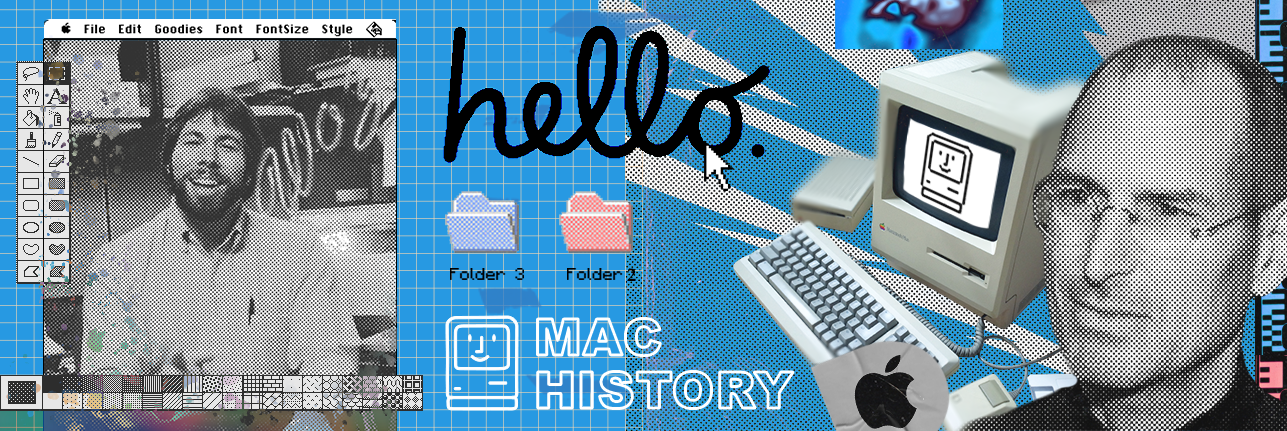
Steve Wozniak remembers building the first Apple Computer at Authors Business Series Luncheon talking about his book “iWoz: How I Invented the Personal Computer and Had Fun Along the Way”:

written by Christoph Dernbach \\ tags: , , , , , ,

Jan 24

25 Years of Mac Logo

The Apple Macintosh revolutionized the entire computer industry by the year of 1984. Steve Jobs and his ingenious Macintosh team arranged for the computer to be used by the normal “person in the street” – and not only by experts.

Apple Macintosh

The first Apple Macintosh (1984)
[ high res version ]

“Insanely great” – Steve Jobs could hardly put into words his enthusiasm by the launch of the Macintosh. On the legendary annual general meeting of January 24th, 1984, in the Flint Center not far from the Apple Campus in Cupertino, the Apple co-founder initially quoted Bob Dylan’s “The Times They Are A-Changin’” in order to then polemicize against an imminent predominance of the young computer industry by IBM.

The early 1980s. 1981 – Apple II has become the world’s most popular computer, and Apple has grown to a 300 million dollar corporation, becoming the fastest growing company in American business history. With over fifty companies vying for a share, IBM enters the personal computer market in November of 1981, with the IBM PC.

1983. Apple and IBM emerge as the industry’s strongest competitors, with each selling approximately one billion dollars worth of personal computers in 1983. The shakeout is in full swing. The first major personal computer firm goes bankrupt, with others teetering on the brink. Total industry losses for 1983 overshadow even the combined profits of Apple and IBM.

It is now 1984. It appears that IBM wants it all. Apple is perceived to be the only hope to offer IBM a run for its money. Dealers, after initially welcoming IBM with open arms, now fear an IBM dominated and controlled future and are turning back to Apple as the only force who can ensure their future freedom.

IBM wants it all, and is aiming its guns at its last obstacle to industry control, Apple. Will Big Blue dominate the entire computer industry? The entire information age? Was George Orwell right?

The crowd, among them the complete Macintosh developer’s team, shouted back: “Nooooo!”


The introduction of the first Mac on January 24th, 1984; taken from the “Lost 1984 Videos”

There had been only two milestone products so far: the Apple II in 1977 and the IBM PC in 1981, Jobs continued. “Today (…) we are introducing the third industry milestone product, the Macintosh. Many of us have been working on Macintosh for over two years now and it has turned out insanely great.”

Taking a look at the history of the personal computer today, Steve Jobs was on the right track with his historical comparison. However, it would not be IBM that became the great dominator of the computer industry over the years, but rather, the alliance of Microsoft and Intel.

Steve Jobs
Steve Jobs
Continue reading »

written by Christoph Dernbach \\ tags: , , , , , , , , ,

Jan 16

Image gallery: The top 10 standout Macs of the past 25 years.

written by Christoph Dernbach \\ tags: , ,

Jan 16

macbanner

Opinion: The top 10 standout Macs of the past 25 years
Launched in January 1984, the first Apple Mac opened the door for a computer revolution that led to the PowerBook, the iMac and even the iPhone. Columnist Michael DeAgonia chooses the 10 Mac models that made the biggest splash.

In the beginning: The making of the Mac
Just how did the first Apple Macintosh computer come to be? The course of events that led to the Mac as we know it was convoluted, the result of luck or coincidence as much as planning. Here’s the story.

The Mac at 25: Successes and regrets, Apple’s had a few
In these heady days when Apple seems to be gaining ground in a number of places and ways, it’s important to remember that everything that followed from the first Mac was not a given. Here’s a look at five successes and five mistakes Apple made during the past 25 years.

Opinion: What will Macs be like in 25 years?
Columnist Seth Weintraub pulls out his crystal ball to predict the future of the Mac — including whether we’ll have Macs at all in 2034.

Timeline: Milestones in the Mac’s history
Take a trip down memory lane as we revisit the Mac’s highs, lows and in-betweens from 1978 to today.

written by Christoph Dernbach \\ tags: ,

Jan 11

YouTube -- Apple Evolution -- Visual History of Apple Products, from the Apple IIe, iMac to the iPhone.

written by Christoph Dernbach \\ tags: ,

Oct 30

Mike Markkula (1977)

Mike Markkula (1977)

It had been a long way until the day of the official introduction of the Macintosh on January 24th, 1984. Five years earlier, in spring 1979, Apple chairman Mike Markkula wondered whether his company should bring a 500 dollar computer to market. Markkula then charged Jef Raskin with the secret “Annie” project.

Raskin had been responsible for Apple’s publications, particularly manuals, and actually was to more intensely oversee the developers writing the applications for the Apple II. “I told him [Markkula] it was a fine project, but I wasn’t terribly interested in a 500 dollar game machine,” Raskin later remembered. “However, there was this thing that I’d been dreaming about – it was [that] it would be designed from a human factors perspective, which at that time was totally incomprehensible.”

In fall 1979, Raskin wrote his article “Computers by the Millions“, in which he drafted his version of a computer for the masses. Markkula insisted on the report to be treated as a confidential internal report. The essay was not published until 1982 in the SIGPC Newsletter, Vol. 5, No. 2.

Raskin had chosen a completely new approach, because until then, the “technically feasible” is what defined a computer’s design. The academic computer scientist, who had kept secret his diploma from the Apple founders at the time of his appointment (as Steve Wozniak and Steve Jobs approached academics extremely distrustfully), wanted to design a computer for the normal person in the street – which of course could not to be unattainable.

The expression of the “Person in the Street” formed by Raskin became a dictum at Apple – abbreviated as PITS. Raskin’s first draft envisioned a closed computer including monitor, keyboard and printer able to work without any external wires – and all that for 500 dollars. In return, the Macintosh should only be equipped with a tiny five inch display, a cheap CPU (6809) and a main memory calculated extremely tight at 64 kilobytes.

Jeff Raskin and Steve Jobs

Steve Jobs and Jef Raskin

At that time, Steve Jobs had not taken particular interest in the Macintosh project – and due to some dim apprehension, Raskin tried everything to exclude the Apple co-founder. Yet in the summer of 1980, a serious conflict between Jobs and Apple’s president Mike Scott was brewing as Scott intended to edge Jobs out of the concrete development of the new Lisa. With his capricious and at times fairly aggressive management style, Jobs had snubbed many developers. In addition, Scott did not think him capable of a major management role and thus planned to assign him the less important role of a company spokesman and promoter in advance of Apple’s initial public offering on December 12th, 1980.

In 1982, Jef Raskin left Apple and founded the company Information Appliance, Inc. in order to realize his original concept of the Macintosh project. The company brought the “SwyftCard” to market, which is a firmware card for the Apple II. The card featured a program package which was also offered on disk as SwyftWare. With the Swyft, Information Appliance later offered a laptop computer, which, however, experienced only moderate commercial success. Raskin licensed the Swyft design to Canon, which constructed the “Canon Cat” on its basis in 1987.

Jef Raskin with a design model of the Canon Cat

Jef Raskin with a design model of the Canon Cat

Despite the broad attention the Canon’s innovative interface attracted, this product did not achieve a breakthrough either. Raskin also blamed Steve Jobs for the failure, since it was Jobs who as the head of NeXT Computer persuaded Canon into giving up the Cat project. However, it was claimed that Cat also fell victim to internal rivalries at Canon.

In his book “The Humane Interface”, Raskin later described his vision of a computer interface constructed for the human being and oriented to human needs – rather than to technology.

On February 26th, 2005, Jef Raskin died at the age of 61 years.

written by Christoph Dernbach \\ tags: , , , , , , ,