
7 – Apple and Microsoft – Help from the archenemy
By the summer of 1997, Apple Computer was not just a company in trouble; it was a corporate casualty in waiting. The “Bleeding in Colors” era was nearly over, and the red ink was flowing much faster than the rainbow-colored logos could mask. When Steve Jobs returned to the company he co-founded, he didn’t just bring a new strategy—he brought a surgical saw and a surprising olive branch extended toward Redmond.
The Boston Massacre: A Giant Screen and a Chorus of Boos
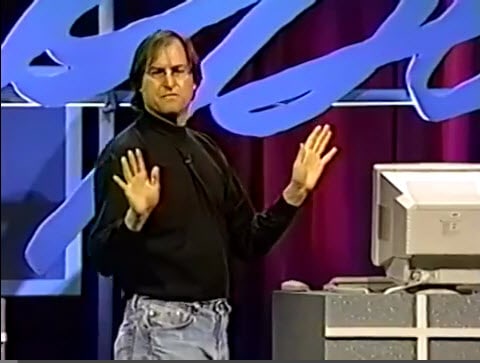
The scene at the 1997 MacWorld Expo in Boston remains one of the most surreal moments in technological history. Steve Jobs, standing on stage in his trademark casual attire, addressed a crowd of Apple faithful who lived and breathed a singular doctrine: Microsoft is the enemy. Then, the unthinkable happened. Bill Gates’ face appeared on a colossal video screen, looming over Jobs like a digital Big Brother. The announcement was a bombshell: Microsoft would invest $150 million in non-voting Apple stock and, more importantly, commit to developing Microsoft Office for the Mac for at least five years.
The reaction was visceral. Boos echoed through the hall, a mixture of betrayal and shock. But Jobs, ever the pragmatist disguised as a visionary, silenced the crowd with a cold dose of reality. “If we want to move forward and see Apple healthy again, we have to let go of a few things here,” he famously stated. “We have to let go of this notion that for Apple to win, Microsoft has to lose.” It was a masterclass in ego-management. Jobs knew that without the industry standard—Office—the Macintosh was a creative island with no bridge to the business world. He wasn’t just taking Gates’ money; he was buying Apple the time it needed to breathe.
The Great Purge: Killing the Clones and the Newton
Once the financial lifeline was secured, Jobs turned his attention inward with a ferocity that stunned the remaining executive suite. He wasn’t interested in consensus; he was interested in survival. He ruthlessly “cleaned up” the management tiers, firing those he deemed “losers” or “rip-off artists” who had allowed the company to drift into a sea of mediocrity.
His first victims were the projects and agreements that he felt diluted the Apple brand. He famously “killed” the Newton, John Sculley’s ambitious handheld PDA, despite its cult following. To Jobs, the Newton—with its clunky stylus and struggling handwriting recognition—was a distraction from the core mission. Next, he tore up the agreements with manufacturers of Macintosh clones. While previous CEOs thought licensing the MacOS would increase market share, Jobs saw only one thing: cheap, ugly hardware cannibalizing Apple’s high-end sales. By killing the clones, he reclaimed total control over the user experience.
90 Days from Death: The “Miraculous” Remnant
The gravity of the situation was even worse than the public realized. Years later, at the 2010 D8 conference, Jobs admitted that upon his return, Apple was roughly 90 days away from total bankruptcy. The coffers were empty, and the product line was a convoluted mess of numbered Performa and Quadra models that even the sales staff couldn’t explain.
Yet, amidst the wreckage, Jobs found a spark of hope. He expected the “good people” to have fled the sinking ship long ago. Instead, he discovered a core group of engineers and designers who stayed not for the stock options—which were underwater—but for the mission. When he asked them why they remained, they gave him a phrase that would become part of Apple lore: “Because I bleed in colors.” They were the true believers in the original six-colored Apple ethos, waiting for a leader who cared about the “insanely great” rather than just the quarterly balance sheet.
The Discovery of Jony Ive: From Frustration to Future
Among those frustrated geniuses was a 30-year-old Briton named Jony Ive. Having joined Apple in 1992, Ive had spent years being ignored by a succession of CEOs—Sculley, Spindler, and Amelio—who viewed design as an afterthought, a “veneer” to be slapped onto a beige box at the end of production. Ive was so disillusioned by the company’s focus on profit maximization that he reportedly had his resignation letter in his pocket when Jobs visited the design studio.
The meeting changed history. Jobs didn’t see design as a department; he saw it as the soul of the product. When Jobs announced that the goal was no longer “just to make money, but to make great products,” Ive realized he had finally found his kindred spirit. Jobs recognized Ive’s undiscovered brilliance, and together they began a partnership that would eventually produce the iMac, the iPod, and the iPhone.
By stabilizing the ship with Microsoft’s capital and refocusing the culture on design excellence, Jobs didn’t just save Apple—he set the stage for the most remarkable corporate turnaround in history. The “archenemy” had provided the ladder, but it was Jobs and his “miraculous” team who climbed it to reach the stars.
he Antitrust Insurance: Why Gates Needed Apple to Live
While the Apple community viewed the $150 million investment as an act of mercy, Bill Gates was playing a much larger game of chess. In 1997, Microsoft was the undisputed titan of the tech world, but it was also a company under heavy fire. The U.S. Department of Justice was circling Redmond with a massive antitrust investigation, accusing Microsoft of maintaining an illegal monopoly in the PC operating system market.
For Gates, the death of Apple would have been a PR and legal disaster. If his only viable competitor vanished, the calls to break Microsoft into smaller pieces would have become deafening. By propping up Apple, Gates bought himself “antitrust insurance.” He could point to a healthy, revitalized rival in Cupertino as proof that the market was still competitive. Furthermore, the deal included a crucial provision: Apple agreed to make Internet Explorer the default browser on the Mac, effectively giving Microsoft a decisive edge in the “Browser Wars” against Netscape. It was a win-win; Jobs got his capital, and Gates got a shield against the regulators and a foothold in the emerging web market.
Read the next page: The old/new Apple design: Less is more