The Legend of Steve Jobs – His Life and Career – 9
The iPhone – Secret project “Purple 2”
Even more serious consequences for Apple and the industry came with the next major project, which was developed under the code name “Purple 2”. Shortly after the presentation of the first iPod, the Apple leadership dealt with the question of whether Apple should launch a (mobile) phone. In a secret operation, a development group was founded, which remained largely unknown within the company. As part of secret work on a predecessor of the iPad, the engineers in Cupertino had built up a considerable knowledge of touch-screen technology that could be transferred to a smaller screen.
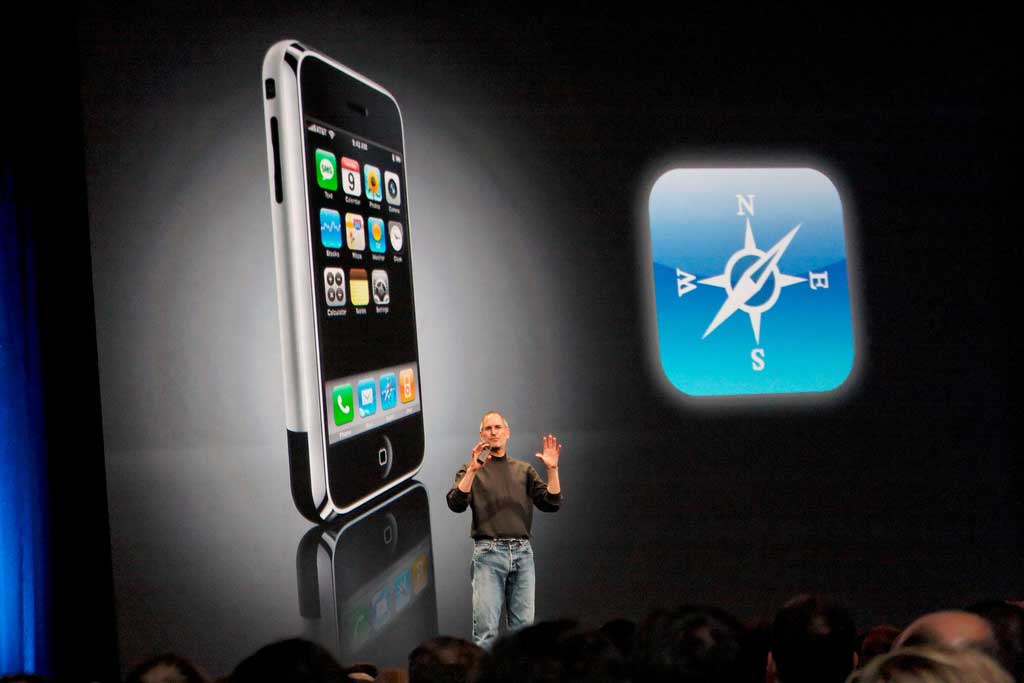
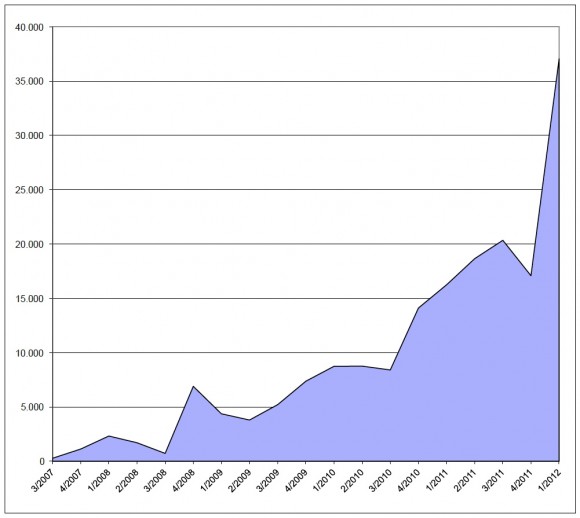
Moreover, a microprocessor ARM11 chip, which could provide sufficient power for complex smart phone applications, finally came on the market. As of 2005, the Apple smartphone designed by Jony Ive gradually materialized. At the MacWorld Expo in January 2007, Steve Jobs boasted, “Today, we’re introducing three revolutionary products of this class. The first one is a widescreen iPod with touch controls. The second is a revolutionary mobile phone. And the third is a breakthrough Internet communications device.” Jobs repeated this list many times until it began to dawn on even the last visitor at the Moscone Center what he meant: “These are not three separate devices – this is one device… and we are calling it iPhone!” The old archrivals from Microsoft attempted to ridicule Apple’s advance. “It’s the most expensive mobile phone in the world,” barked Microsoft CEO Steve Ballmer in a TV interview. “The business customer will reject it because it has no keyboard.” Ballmer was very much mistaken. By the end of the first fiscal quarter 2012 (end of December 2011), Apple had sold 183 million iPhones.
Only Google could keep up with the iPhone, thanks to its Google Android mobile operating system. Until his death Steve Jobs was convinced that the success of Android was only possible because of a betrayal of the long-standing Google boss Eric Schmidt. Between 2006 and 2009, Schmidt was on the Apple Board, where he had seen the development of the iPad and iPhone. His obligations to Apple did not prevent him from pushing Google to develop a competing system. Only when his conflict of interest became very obvious, Schmidt resigned from the Apple board. In January 2010, when the Taiwanese company HTC introduced a new Android-powered smartphone, which dominated many of iPhone’s features, Jobs became furious. “Our lawsuit is saying, “Google, you fucking ripped off the iPhone, wholesale ripped us off. Grand theft. I will spend my last dying breath if I need to, and I will spend every penny of Apple’s $40 billion in the bank, to right this wrong,” said Jobs to book author Isaacson. “I’m going to destroy Android, because it’s a stolen product. I’m willing to go to thermonuclear war on this. They are scared to death, because they know they are guilty.” Apple and many Android OEMs like Samsung and HTC have been fighting for months in court. Despite victories in some points, Apple was not able to stop the winning run of Android. Jobs could take comfort in the fact that two-thirds of the profits of the entire smartphone industry are noted in the books of Apple, and other manufacturers excluding Samsung, are financially getting nowhere.
Steve Jobs had put the first stages of his personal suffering already behind him when he presented the first iPhone in January 2007. In October 2003 he was diagnosed with cancer, which for months he initially wanted to combat without methods of conventional medicine. Finally end of July 2004, he underwent an operation to have a tumor removed from his pancreas. While in the summer of 2007, at the sales launch of the first iPhone, Jobs again seemed quite well, one year later he appeared at the developer conference WWDC 2008, looking decidedly thinner. In early 2009 he retired from public life and underwent a liver transplant.
He returned to the stage two more times, to present both the first and second iPad. It must have been a big victory for Jobs that under his leadership Apple brought a digital tablet to the market, which at the same time established a new device category. His old adversary Bill Gates had presented tablet PCs on shows such as CES over the past ten years, but the devices were too complicated to use, too expensive and flawed, so nobody bought them. At his last public appearance, Steve Jobs fought for a building permit before Cupertino City council for the futuristic new Apple Campus 2, which was designed by British architect Norman Foster.