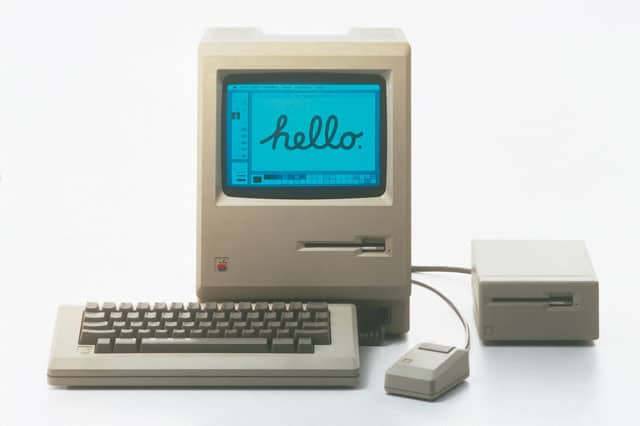
It is claimed again and again that in the course of the Macintosh’s development, Apple just resorted to the ideas the research laboratory Xerox PARC had hatched before. Fact or Fiction?
In the USA, the brand name “Xerox” denotes photocopying just as “Kleenex” stands for tissues or “Scotch tape” for adhesive film. After all, already in 1950, the Xerox Corp. was the world’s first company to actually transfer the “Xerography” invented by the American law student Chester Carlson into a functional product.
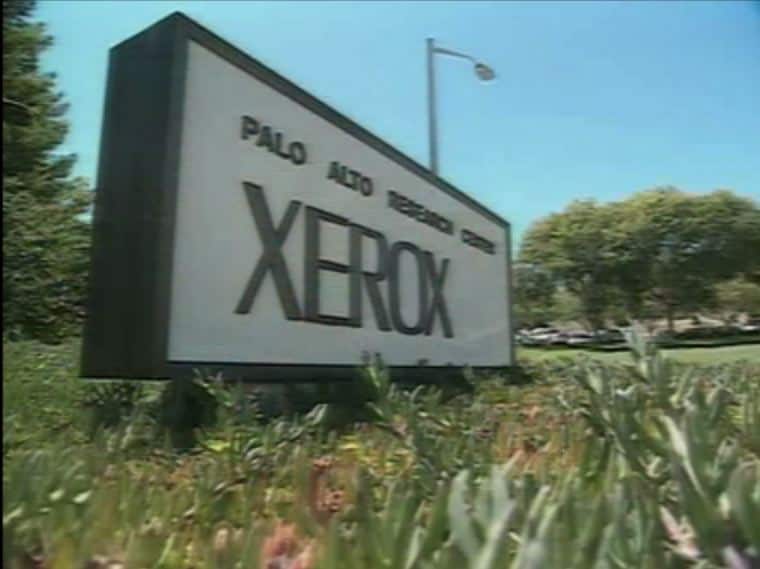
By the end of the sixties, the Xerox management sensed the threat of Japanese companies catching up on Xerox’s technological advantage. Moreover, the Xerox head worried that the “paperless office” might emerge with the following computer generations, in which the Xerox would no longer have a place. Against this background, the Xerox Palo Alto Research Center (PARC) in California was founded in 1971.
John Warnock, former researcher in the Xerox PARC and later one of the two founders of Adobe Systems, remembers: “The atmosphere was electric – there was total intellectual freedom. There was no conventional wisdom; almost every idea was up for challenge and got challenged regularly.” Larry Tessler, who later took part in developing the Macintosh and the Newton PDA at Apple, also enjoyed the liberties the PARC provided in the seventies: “The management said go create the new world. We don’t understand it. Here are people who have a lot of ideas and tremendous talent, [are] young, energetic.” The problem, however, was that the company management at the East Coast of the USA did not [care a straw for] the PARC’s research results unless they were directly involved with photocopiers.
In his TV documentation “Triumph of the Nerds” Robert Cringley is interviewing researchers at the Xerox PARC
Within two years, the researchers at the PARC had designed the Alto, which was something like the first personal computer. The Alto did not feature character-oriented graphics, as did all the other computers of that time, but a bit-oriented version instead. A high quality printer could print exactly what the screen displayed.
Xerox Alto
However, this marvelous machine was not freely available on the market. Approximately 1500 units had been produced, 1000 of which Xerox employed in-house; the rest went to universities and public authorities.
An advertising spot for the Xerox Alto taken from Robert Cringley’s TV documentation “Triumph of the Nerds“.
Jef Raskin, who had been charged initially with the Macintosh project at Apple, kept regular contact to the PARC researchers and tried to convince the Apple management to employ a graphical user interface like the Alto contained in the development of the Lisa.
Raskin claimed he wanted to introduce Jobs to the PARC, but due to his personal dislike of Raskin, Jobs simply did not agree to respond to the offer. According to Raskin, it was not until Bill Atkinson supported him that Jobs set out for the PARC. Whatever way the contact was actually accomplished, this visit meant a turning point to the life of Steve Jobs; the three technologies that the 24-year-old encountered there were each revolutionary on their own: the first graphical user interface for computers; networked Alto computers; and object-oriented programming.
Even 17 years after this visit, Jobs can still remember it exactly:
They showed me really three things. But I was so blinded by the first one I didn’t even really see the other two. One of the things they showed me was object oriented programming – they showed me that but I didn’t even see that. The other one they showed me was a networked computer system… they had over a hundred Alto computers all networked using email etc., etc., I didn’t even see that. I was so blinded by the first thing they showed me, which was the graphical user interface. I thought it was the best thing I’d ever seen in my life. Now remember it was very flawed, what we saw was incomplete, they’d done a bunch of things wrong. But we didn’t know that at the time but still thought they had the germ of the idea was there and they’d done it very well and within you know ten minutes it was obvious to me that all computers would work like this some day.
Adele Goldberg
Jobs decided to realign Apple’s strategy and fully rely on the “graphical user interface” (GUI) he had seen at the Xerox PARC. Adele Goldberg, who had been a researcher at the PARC at that time, already suspected that Jobs’ visit would entail extensive consequences: “He came back, and I almost said ‘asked’ but the truth is ‘demanded,’ that his entire programming team get a demo of the Smalltalk System, and the then head of the science center asked me to give the demo because Steve specifically asked for me to give the demo, and I said ‘no way.’ I had a big argument with these Xerox executives, telling them that they were about to give away the kitchen sink, and I said that I would only do it if I were ordered to do it, cause then, of course, it would be their responsibility, and that’s what they did.”
Larry Tessler, Adele Goldberg and Steve Jobs about “Apple and Xerox” (taken from: Triumph of the Nerds)
Apple bought access to the PARC by means of a stock deal that seemed lucrative to the Xerox managers on the East Coast: They might buy 100,000 Apple stocks for one million dollars. Holding this admission ticket in the hand, Steve Jobs, Apple’s president Mike Scott, Bill Atkinson, and a number of members of the developing team marched up. “I think mostly … what we got in that hour and a half was inspiration and just sort of basically a bolstering of our convictions that a more graphical way to do things would make this business computer more accessible.”
Larry Tesler, who then took part in the demo as an employee of the PARC, had been fascinated by the visitors: “After an hour looking at demos, they understood our technology and what it meant, more than any Xerox executive understood after years of showing it to them.”
The Macintosh team took up the ideas of the PARC, but it also changed numerous operating modes and added countless new features. Accordingly, the Xerox Alto did not imply, for example, menus flapping down from the upper edge of the screen, but operated with some kind of a pop-up window instead. Moreover, the window did not open automatically by double-clicking on a document, but had to be opened manually. During months of painstaking work, Atkinson had written the QuickDraw routine for the Lisa and the Macintosh, which allowed for overlapping windows to be drawn on the computer screen for the first time.
The screen of the Xerox Star
In contrast to the first Mac, the Alto featured no completed desktop metaphor nor ingenious desktop icons such as the trash can, which made it easier to delete files, and not just for computer novices. The historical accomplishments of the Mac team also included the Macintosh Human Interface Guide, which, for instance, when it detected a document in a Macintosh application, determined that it was to be saved using the command “Apple-S.”
As for Xerox, the bitter aftertaste of having missed an historical opportunity remained, particularly due to the fact that parallel to the Apple developers, Bill Gates and his Microsoft crew also went in and out as they pleased. (By the way, they did so without holding an admission ticket comparable to the one Jobs had procured by means of the stock deal.)
“Basically, they were copier heads that just had no clue about a computer or what it could do. And so they just grabbed defeat from the greatest victory in the computer industry. Xerox could have owned the entire computer industry today,” Steve Jobs said in 1996. “Could have been, you know, a company ten times its size. Could have been IBM – could have been the IBM of the nineties. Could have been the Microsoft of the nineties.”
Besides, in the context of the dispute with Apple about the plagiarism accusations around the first Windows versions, Microsoft had pointed out that Apple and Microsoft had both helped themselves generously at XEROX. This episode is described slightly exaggeratedly in the movie “Pirates in the Silicon Valley”:
James Turner from O’Reilly News interviewed Andy Hertzfeld, one of the original designers of the Macintosh and author of the book, Revolution in the Valley: The Insanely Great Story of How the Mac Was Made, which chronicles the efforts to create the Mac. Andy Hertzfeld currently works at Google as a Software Engineer. In this Interview James Turner asked some questions about Xerox PARC and the development of the Mac:
JT: In your book you allude to Xerox as being, to Bill Gates, the rich uncle that both Apple and Microsoft stole from. What was the relationship like with PARC when you were developing the Mac and how did the Xerox researchers feel about the Mac?
AH: Well, we had no formal relationship with PARC while we were developing the Mac. We got a single demo before the Mac project got off the ground, when the LISA project, that sort of cousin or bigger brother of the Mac, was in development. And so from that one demo we were already pointed in that direction but I would say that Xerox PARC demo galvanized and reinforced our strong opinion that the graphic user-interface was the way to go. And then the influence of PARC was strong in the project, but not through a formal relationship with PARC; more through PARC people getting wind of what we were doing and coming to work at Apple. The very first one was Tom Malloy on the LISA project. He was sort of a disciple of Charles Simonyi–I write about that a little bit in my book. He was one of the original LISA people who came to Apple in 1978. But later, Larry Tessler was a really key figure coming to the LISA team in the summer of 1980 from Xerox PARC and eventually, mostly after the original Mac shipped, there were a dozen or more. Another person I have to mention is Bruce Horn who started working at Xerox PARC when he was 14 years old; he was one of those kids they picked from a Palo Alto High School to teach Smalltalk to and he was one of the four or five key Macintosh developers. And of course he was steeped in all of the PARC values and through Bruce, a lot of them made it into the Macintosh.
JT: Was there any feeling among the Apple engineers that any – guilt is probably too strong a word, but feeling like you know Xerox had these great ideas. I guess Xerox really let them go to waste but–
AH: Oh there was nothing like that; Steve Jobs has a good quote. It’s actually a Picasso quote that he often cites; he cited it at one of our retreats which was sort of good artists copy; great artists steal. And what that means is that when you’re passionate about what you’re doing you’ll take ideas from anywhere and with no guilt. You want to make the best possible thing and that was our mentality.
JT: I have to say I actually worked for Xerox AI Systems in 1986 and it was kind of frustrating because they really had the mentality there that if you couldn’t sell paper and toner for [them] they weren’t interested.
AH: Oh sure. Xerox in a well-documented fashion – they had at least the possibility of having the world at their feet there with the work that Alan Kay and his team did. But yeah; they completely blew it and most of the best PARC people were really frustrated by the Xerox management. There’s no doubt of that; that’s one of the reasons why Steve Jobs is great. You had someone leading the company who could relate to the customers and appreciate things.
With the initial public offering of Apple Computers in December 1980, Steve Jobs became a multimillionaire – however, he possessed neither enough stock to lead Apple Computers alone nor to determine his own position within Apple. By the beginning of 1981, he actually found himself to be without management responsibility over any specific project. To Jef Raskin’s discomfort, he threw himself into the Macintosh project, which had not been taken really seriously by the Apple board of management at that time.
However, Steve Jobs knew what he wanted. He had seen the graphical user interface of the Xerox Alto at Xerox PARC. Instead of green letters on a dark background, white document windows with black text appeared – just like a sheet of paper. Several different fonts could be selected. The graphics board controlled individual pixels on the screen freely. By means of a mouse, a pointer could be moved on the screen in order to mark texts or issue commands. Files were represented by icons on a virtual desktop.
The Alto was not available on the market. For this experimental computer, the main memory alone would have cost about 7,000 dollars at the time. Jobs wanted a computer even better than the Alto – and also better than Apple’s Lisa. However, the new marvelous machine should cost only a fraction of the Lisa’s price, which was about 12,000 dollars, inclusive of external hard disk.
Pirate flag above the Mac developers’ building “Bandley III”
Within Apple, Jobs gathered a small, conniving team – and he did not care for other projects in the company. Andy Hertzfeld, one of the most important software designers in the Macintosh developers team, remembers:
Steve Jobs kind of came bopping by my cubicle saying OK you’re working on the Mac now. And I said well I have to finish up this Apple 2 stuff I’m doing here. No you don’t that stinks that’s not going to amount to anything you gotta start now. And I said well just give me a few days to finish and he said no and what he did was he pulled the plug on my Apple 2 that I was programming just losing, losing the code I’m working on and start taking my computer and walking away with it and what could I do but follow him out to his car cause he had my machine he plopped it down in the trunk and drove me over to this remote building, took the computer out, walked upstairs, plopped it down on a desk, well you’re working on the Mac now. While Jobs pursued his MacMission he needed a more orthodox chief executive to run the company. A respectable face who could sell to corporate America. He chose Pepsi-Cola executive John Sculley. Sculley refused – leave Pepsi for a 4 year old company that had been set up in a garage! Are you serious?! But it was hard saying no to Steve Jobs.
The Macintosh Pirates
Above the roof of “Bandley III”, a pirate flag with the Apple symbol as eye patch was waving – and on deck of the virtual pirate ship, Steve Jobs was standing as a man who wanted to prove it to them all. Jobs’ first victim was Jef Raskin, who had fought against the application of a mouse and instead preferred a pen or a joystick. After Jobs had relieved his opponent of the responsibility for the software, Raskin gave in exasperatedly and left Apple Computers in March 1982. In retrospect, Raskin can claim that he was the first at Apple to have presented the vision of an inexpensive, easy to handle computer for the masses. Yet in order to keep “his” Macintosh below the price limit of 1,500 dollars, Raskin also wanted to make technical compromises which would have put at risk the Mac’s success. Thus, for instance, he insisted on limiting the main memory to a tiny 64 kilobytes. Jobs accomplished 128 kilobytes – and afterwards, even this space was actually far too tight for the system programmers.
Raskin did not particularly support the innovations the Lisa team had picked up in the Xerox PARC and therefore disapproved of the change to the more capable 68000 processor, which was included in the Lisa as well. It is hardly imaginable what would have become of the Mac if Raskin had asserted his extreme parsimony and his resistance to the mouse. After the internal disputes had been settled, the Mac team now fully concentrated on the in-house competition against the far larger Lisa developing team. Beforehand, Jobs had enticed away from the Lisa team ingenious programmers such as Bill Atkinson and Steve Capps.
Love and Hate
As a project manager, Steve Jobs had been highly controversial not only within Apple. “He’s also obnoxious and this comes from his high standards. He has extremely high standards and he has no patience with people who don’t either share those standards or perform to them,“ Bob Metcalfe remembers. He is the inventor of the networking standard Ethernet, who had worked as a researcher in the neighboring research institute Xerox PARC at that time. “He’s also obnoxious and this comes from his high standards. He has extremely high standards and he has no patience with people who don’t either share those standards or perform to them.” However, Metcalfe still thinks a lot of Jobs as he had made the vision created in the Xerox PARC become reality. “Steve Jobs is on my eternal heroes list, there’s nothing he can ever do to get off it.”
Larry Tessler and Bob Metcalfe about Steve Jobs (quoted from: Triumph of the Nerds)
The respect for Jobs is also shared by Andy Hertzfeld, who had written the Mac’s kernel in the Macintosh ROM, although he was sometimes afflicted with his boss’s tantrums: – quotation – Kenyon set to work again and shortened the booting process by further three seconds.
In the internal competition at Apple over whether the Lisa or the Macintosh would be finished first, Jobs got the short end of the stick. He lost a personal 5,000 dollar bet against the Lisa team leader John Couch when the Apple business computer was launched in January 1983 – at least one year previous to the Macintosh. However, the Lisa computer soon proved to be a huge flop. With a price of 10,000 dollars (exclusive of hard disk), it was far too expensive;the graphical user interface devoured Lisa’s power such that the computer did not work particularly briskly; and it lacked the necessary programs to induce the business world to buy the Lisa in large numbers. Moreover, the newly established distribution team could hardly resort to any experience in handling Corporate America.
The Apple Macintosh had not been a success from the outset. The hardware was not designed particularly generously for the requirements of a graphical user interface. Especially the main memory had been calculated rather tightly. Moreover, there was no hard disk for the Mac at that time. In addition, there was a lack of appropriate software.
The Mac lacked the applications that dragged the Charlie Chaplin figure across the screen box by box in the IBM’s advertising spot for the PC. Therefore, Guy Kawasaki and other “Software Evangelists” of Apple made an effort to convince the developers of other software companies to write programs for the Mac. The Mac’s ROM, which had been calculated far too narrowly at 128 kilobytes, did not make this a simple task. Not until the “Fat Mac” with 512 kilobytes was launched one year after the first Macintosh had this narrow bottleneck been removed.
The problem came to a head when by the beginning of 1985, the Macs that had not found purchasers during the Christmas sales of 1984 were piling up in storage. Apple had to publish the first quarterly loss in the company’s history and release a fifth of the staff. During a marathon meeting on April 10 and 11, 1985, Apple’s CEO John Sculley demanded to have Steve Jobs relieved of his position as an Apple vice president and general manager of the Macintosh department.
Steve Jobs and John Sculley
According to Sculley’s wishes, Steve Jobs was to represent the company externally as a new Apple chairman without influencing the core business. As Jobs got wind of these plans to deprive him of his power, he tried to arrange a coup against Sculley on the Apple board. Sculley told the board: “I’m asking Steve to step down and you can back me on it and then I take responsibility for running the company, or we can do nothing and you’re going to find yourselves a new CEO.” The majority of the board backed the ex-Pepsi man and turned away from Steve Jobs.
On May 31, 1985, Jobs lost his responsibilities and was shuffled off to the chairman position. In September, the Apple co-founder left the company with a few people in order to found NeXT Computer. “I feel like somebody just punched me in the stomach and knocked all my wind out. I’m only 30 years old and I want to have a chance to continue creating things. I know I’ve got at least one more great computer in me. And Apple is not going to give me a chance to do that,” Jobs wrote to Mike Markkula on parting. Ten years later, Steve Jobs also commented on his disempowerment with bitterness in the TV documentary “Nerds in the Valley” (1996): Jobs:
What can I say? I hired the wrong guy. – Question: That was Sculley?
Jobs: Yeah and he destroyed everything I spent ten years working for. Starting with me but that wasn’t the saddest part. I would have gladly left Apple if Apple would have turned out like I wanted it to.
Apple’s Heart and Soul
Andy Hertzfeld, one of the Macintosh’s fathers, later recalled the events:
The conflict came to a head at the April 10th board meeting. The board thought they could convince Steve to transition back to a product visionary role, but instead he went on the attack and lobbied for Sculley’s removal. After long wrenching discussions with both of them, and extending the meeting to the following day, the board decided in favor of John, instructing him to reorganize the Macintosh division, stripping Steve of all authority. Steve would remain the chairman of Apple, but for the time being, no operating role was defined for him. John didn’t want to implement the reorganization immediately, because he still thought that he could reconcile with Steve, and get him to buy into the changes, achieving a smooth transition with his blessing. But after a brief period of depressed cooperation, Steve started attacking John again, behind the scenes in a variety of ways. I won’t go into the details here, but eventually John had to remove Steve from his management role in the Macintosh division involuntarily. Apple announced Steve’s removal, along with the first quarterly loss in their history as well as significant layoffs, on Friday, May 31, 1985, Fridays being the traditional time for companies to announce bad news. It was surely one of the lowest points of Apple history.
Andy Hertzfeld
Hertzfeld mourned for Steve Jobs openly: “Apple never recovered from losing Steve. Steve was the heart and soul and driving force. It would be quite a different place today. They lost their soul.” In contrast, Larry Tessler, who had come to Apple from Xerox, refers to mixed reactions of the Apple staff: “People in the company had very mixed feelings about it. Everyone had been terrorized by Steve Jobs at some point or another and so there was a certain relief that the terrorist had gone but on the other hand I think there was an incredible respect for Steve Jobs by the very same people and we were all very worried – what would happen to this company without the visionary, without the founder without the charisma…”
It is an irony of computer history that, according to industry experts, the Macintosh’s breakthrough on the market was becoming apparent exactly at the time of Jobs’ disempowerment due to the Mac’s poor sales volume. The convincing the “Macintosh Evangelists” were doing gradually began to show results.
Screenshot of PageMaker 1.0 (french version)
New software companies such as Aldus had made an effort to become acquainted with the details of the “Macintosh Toolbox” and written the first desktop publishing programs, such as PageMaker. In combination with the Apple LaserWriter and the page description standard PostScript (designed by Adobe), PageMaker turned the technology of the publishing sector inside out; it did even more when the Mac Plus with 512 kilobytes of ROM entered the market by the beginning of 1986. The Mac Plus even featured cursor keys on its keyboard, which had been resolutely rejected by Steve Jobs for the first Mac, since he intended to force the users to accept the mouse as an input device.
And it is also an irony of computer history that Jobs later saved the struggling Apple Computer company. NeXT’s subsequent 1997 buyout by Apple brought Jobs back to the company he co-founded, and he has served as its CEO since then.
By means of the Macintosh, the Apple management planned to prevent the absolute predominance of IBM. Thereby, they all had underestimated Bill Gates and Microsoft.
Apple boss John Sculley’s marketing strategy for the launch of the Macintosh was obvious. The former Pepsi manager, who had been brought to Apple by Steve Jobs, intended to arrange a duel between IBM and Apple, black vs. white, with Apple playing the role of the underdog. Sculley wrote in his book Odyssey:
So we needed a campaign that would focus on a two-horse race to leverage off of Apple’s underdog status. Dozens of other computer companies were coming out with products and I was afraid we were going to get lost in the crowd. If we could create a two-horse race between us and IBM, we might be able to convince people that there are really only two computer companies competing in the marketplace. In any large consumer industry, few people remember the third- or fourth-largest competitor.
In the fight against competitors such as Atari, Commodore, Sinclair and Amstrad, the Apple strategy paid off well. But Sculley, as well as Steve Jobs, had completely underestimated that Microsoft, being an ally from the outset, would, with the aid of Apple, develop into a dominant power of the PC industry and even dwarf IBM.
Bill Gates and Paul Allen had founded Microsoft as a small software company in Albuquerque (New Mexico) in 1975 and developed the programming language BASIC for the legendary computer MITS Altair in collaboration with other co-workers. Due to fortunate circumstances, Microsoft landed the order from IBM to deliver not only BASIC, but also the operating system for the first IBM PC in 1980. In the negotiation phase, the then leading operating system manufacturer Digital Research (CP/M) did not want to engage in page-filling adhesion contracts from IBM – and thus lost this gigantic deal.
Advertisement
Though Microsoft did not have any operating system at that time, this did not prevent Bill Gates and his companion Steve Ballmer from playing for high stakes while facing IBM. From their neighboring software shack Seattle Computers (in the mean time, Microsoft had moved to the northwest of the USA) they bought all rights for QDOS (Quick and Dirty Operating System) for no less than 50,000 dollars in July 1981 and renamed it as MS-DOS. Gates had been clever enough at that time not to have all rights to the system negotiated away by the IBM crew and was therefore able to win clone companies such as Compaq as customers later.
Microsoft then provided their BASIC for the Apple II as well. Therefore, Steve Jobs and Bill Gates constantly ran into each other at that time. “Even before we finished our work on the IBM PC, Steve Jobs came and talked about what he wanted to do, what he thought he could do, sort of a Lisa but cheaper. We said boy, we’d love to help out”, Gates remembers. “The Lisa had all its own applications, but of course they required a lot of memory, ah, and we thought we could do better, and so Steve signed a deal with us to actually provide bundled applications for the first Mac, and so we were big believers in the Mac and what Steve was doing there.”
Bill Gates praising the Apple Macintosh by its launch in January 1984
Apple urgently needed software for the Mac, as there did not yet exist any program for the new system except for their in-house products MacWrite and MacPaint. Gates promised to have the programs Chart and File written for the Mac in addition to the spreadsheet program Excel. Steve Jobs appreciated the risk Microsoft took, but was not content with the first results though. “Most people don’t remember, but until the Mac, Microsoft was not in the applications business… it was dominated by Lotus. And Microsoft took a big gamble to write for the Mac.”
Apple still could have coped well with having given Microsoft’s new application business a leg up. However, Bill Gates had tasted blood in the Macintosh project. Jeff Raikes, who was responsible for the Office business at Microsoft until early 2008, reviews: “And so we got started in early 1982 on our Macintosh software effort and I think at that point in time, you know, it really clicked with Bill that, you know, graphic user interface was going to be the way, the way of the future. But while Bill was having his own GUI revelation, Jobs believed that Apple’s true enemy was IBM.”
Quote of the movie: “Pirates of Silicon Valley” – Microsoft steals from Apple
However, it was not until November 1985 that Microsoft introduced the first version 1.01 of Windows, which was two years after Gates had announced Windows in his first Comdex keynote at the Fall 1983 Comdex in Las Vegas. The system was based on DOS and was incredibly slow, but it reminded one of the Macintosh GUI in some features. In order to prevent Apple from taking legal action, Gates put the screws on Apple boss Sculley. His message was: As soon as Apple sends out the lawyers, Microsoft will immediately stop the development of Word and Excel for the Mac. Since Apple was depending on the Microsoft applications, Sculley licensed some of the Mac technologies to Microsoft.
As Microsoft went public with the next large version leap of Windows 2.03 at the beginning of 1988, Sculley tried to pull the ripcord and sued Microsoft and Hewlett-Packard for copyright infringement on March 17, 1988. John Sculley had been in a difficult situation, particularly as he had engaged in vague formulations in the contract with Microsoft in 1985, which gave great leeway to Gates and his lot. Moreover, he knew that his chances to win an action against Microsoft had been, purely from a legal viewpoint, not particularly good: “The look and feel, which is how it looks, the experience of using it, was not patentable, but it was copyrightable, but there was no precedent law. This was going to be a precedent setting case.”
Parody of an advertising spot for Windows featuring Steve Ballmer
Bill Gates recalls also reluctant this time.: “But it was a period of five years where, Microsoft er, our whole strategy would have been ruined because Windows was very important to us. (…) We assumed that the lawyers, the judges would all come to the right conclusion which eventually they did.” Sculley: “And Apple lost. But in that period of about six years that this case was going on it may have lulled us into a bit of complacency thinking that we were going to be insulated, you know, from the Windows attack.”
The introduction of Windows 3.1 in 1992 brought Microsoft the breakthrough in the “GUI war.” The system lacked the elegance and usability of the Macintosh system 7.0, but Windows appeared good enough to most PC users. With the help of Windows 95, which had been introduced with gigantic effort on August 24, 1995, Microsoft caught up closer to the Mac and in some aspects even appeared more progressive than the Mac OS, which had become dated in the meantime.
Steve Jobs, who, as the head of NeXT, had observed the advance of Windows from a distance, did not have any kind words for Bill Gates at the launch of Windows 95:
The only problem with Microsoft is they just have no taste, they have absolutely no taste, and what that means is – I don’t mean that in a small way, I mean that in a big way. In the sense that they don’t think of original ideas and they don’t bring much culture into their product, and you say why is that important – well you know proportionally spaced fonts come from type setting and beautiful books, that’s where one gets the idea – if it weren’t for the Mac, they would never have that in their products and so I guess I am saddened, not by Microsoft’s success – I have no problem with their success, they’ve earned their success for the most part. I have a problem with the fact that they just make really third rate products.
It is claimed that Jobs has apologized to Bill Gates for this remark later.
Steve Jobs about Microsoft (1995)
The relationship between Apple and Microsoft – and thus also the relationship between Steve Jobs and Bill Gates – did not get back to normal before the summer of 1997, when Steve Jobs had returned to Apple and engaged in the support of Microsoft in order to make the troubled company profitable again.
Bill Gates on the video screen at the MacWorld Expo 1997 in Boston
Many faithful Apple fans still remember with horror the moment when Steve Jobs announced the former archrival very pragmatically as the knight in shining armor at the MacWorld Expo 1997 in Boston with Bill Gates appearing on an oversized video screen just like “Big Brother.” Introducing Gates, Jobs said: “”We have to let go of the notion that in order to for Apple to win, Microsoft has to lose. Relationships that are destructive don’t help anybody. The era of setting this up as a competition between Apple and Microsoft is over.”
Microsoft invested 150 million dollars in 150,000 Apple stocks and, according to certain rumors, paid further 100 million dollars for copyright infringement during the past few years. At the same time, Gates obliged himself to continue the development of the Internet Explorer and Microsoft Office for the Mac for the following five years. Gates drew hisses from the audience of Apple faithful. The crowd also groaned when Steve Jobs said Apple would make Microsoft’s Internet Explorer the default browser for viewing the World Wide Web on Macintosh computers. That development was a blow to Netscape Communications Corp., which made a more popular competing browser and lost later on in the famous “browser war” against Microsoft.
Apple CEO Steve Jobs introduced the first iPod seven years ago on 23 October 2001. He announced it as a Mac-compatible product with a 5 GB hard drive that put “1,000 songs in your pocket.” The software bundled with the first generation iPod was Macintosh-only, so Windows users had to use third-party software like ephPod or XPlay to manage their music.
It is quite funny to read the Cnet article by Ina Fried about this event and all the reactions of the experts:
IDC analyst Bryan Ma said Apple may take some heat for entering the consumer electronics market, which typically has lower profit margins than Apple gets from its computers. But, he added, the iPod could serve an important function: convincing people to buy a Mac instead of a PC.
“It’s another incentive for them that can convince people to buy a Mac,” Ma said.
The iPod does cost considerably more than the nearest competitor with a portable hard drive--the $249 6GB Nomad Jukebox from Creative Labs. But Ma said the iPod has significant advantages in terms of its size, battery life and anti-skip protection.
“They’ve totally polished…the product,” Ma said of Apple. “If I were an engineer at Creative Labs, I’d be scrambling.”
Technology Business Research analyst Tim Deal dinged the $399 price as “a little high.” But he noted that the iPod’s FireWire connectivity allows for faster song downloading than USB. The iPod also sports “a significant battery life and a fast recharge speed,” he said.
Deal also praised that fact that the iPod fits into Apple’s digital hub strategy. “However, I question the company’s ability to sell into a tight consumer market right now at the iPod’s current price.”
The iPod is another stab at Sony’s success in the consumer market, Deal noted.
“Clearly Apple is following Sony’s lead by integrating consumer electronics devices into its marketing strategy, but Apple lacks the richness of Sony’s product offering. And introducing new consumer products right now is risky, especially if they cannot be priced attractively,” Deal said.
Stephen Baker, an analyst at NPD Intelect, said that the iPod will likely stand out for its large storage capacity but predicted that the device may have trouble digging out a niche in the market.
The most expensive MP3 players that use flash memory sell for around $249 right now, with the average player selling for less. Many are also adding features for playing mini-CDs. Sonicblue’s Rio 600, for instance, sells for $199. It comes with 64MB of flash memory for storage. Apple’s new device has far more storage--enough for 50 hours of music--but it costs twice as much.
The iPod has “good features, but this is a pretty competitive category,” Baker said. “The question is whether people want that robust of a feature set with that high of a price.”
Ultimately it comes down to taste. It comes down to trying to expose yourself to the best things that humans have done and then try to bring those things in to what you’re doing. I mean Picasso had a saying he said good artists copy great artists steal. And we have always been shameless about stealing great ideas ehm and I think part of what made the Macintosh great was that the people working on it were musicians and poets and artists and zoologists and historians who also happened to be the best computer scientists in the world.
The fact is that the world is divided between users of the Macintosh computer and users of MS-DOS compatible computers. I am firmly of the opinion that the Macintosh is Catholic and that DOS is Protestant. Indeed, the Macintosh is counter-reformist and has been influenced by the ratio studiorum of the Jesuits. It is cheerful, friendly, conciliatory; it tells the faithful how they must proceed step by step to reach -- if not the kingdom of Heaven -- the moment in which their document is printed. It is catechistic: The essence of revelation is dealt with via simple formulae and sumptuous icons. Everyone has a right to salvation.
The nature of the personal computer is simply not fully understood by companies like Apple (or anyone else for that matter). Apple makes the arrogant assumption of thinking that it knows what you want and need. It, unfortunately, leaves the “why” out of the equation — as in “why would I want this?” The Macintosh uses an experimental pointing device called a ‘mouse’. There is no evidence that people want to use these things. I dont want one of these new fangled devices.