How the Founders of Apple Got Rich

| January 30, 2011 | 0 Comments
Steve Wozniak and Steve Jobs

Steve Wozniak and Steve Jobs

The two Apple founders both came from humble backgrounds and were not endowed with commercial success. In order to afford the first pieces of the Apple I in 1976, Steve Jobs and Steve Wozniak almost literally sold the shirts off their backs. Jobs invested the proceeds from the sale of his VW bus ($1,500 dollars). “Woz” parted with his beloved programmable calculator Hewlett-Packard 65 and deposited 250 dollars in the company’s treasury.
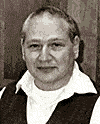
Ronald Wayne (Photo courtesy of Owen Linzmayer)

Ronald Wayne (Photo courtesy of Owen Linzmayer)

Ronald Gerald Wayne, the “third founder” of Apple Computer, was with the company for only a short time. He illustrated the first Apple logo and wrote the Apple I manual. While at Apple, he also wrote their partnership agreement. Wayne worked with Jobs at Atari before co-founding Apple Computer on April 1, 1976. He was given a 10% stake in Apple, but relinquished his stock for 800 dollars only two weeks later because legally, all members of a partnership are personally responsible for any debts incurred by any of the other partners.

After Apple’s IPO, Wayne’s stake could have been worth as much as US$ 1.5 billion. He claimed that he didn’t regret selling the stock as he had made “the best decision available at that time.” According to CNET, as of 1997 Wayne was working as an engineer for a defense contractor in Salinas, California.

See also: Two days in the desert with Apple’s lost founder, Ron Wayne @ engadget.com
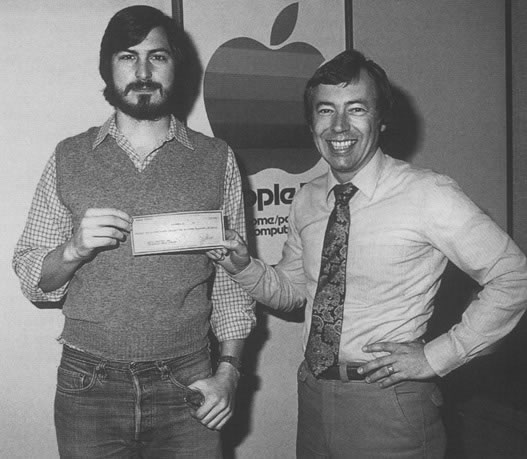
Steve Jobs and Mike Markkula

Steve Jobs and Mike Markkula

The foundations for the commercial success were laid in 1977 by venture capitalist Arthur Rock as well as by the ex-Intel manager Mike Markkula, who invested 92,000 dollars in Apple and secured a bank loan of 250,000 dollars. Markkula was lured out of retirement by Steve Jobs, who was referred to him by Regis McKenna and venture capitalist Don Valentine.

Valentine—who after meeting the young, unkempt Jobs asked McKenna, “Why did you send me this renegade from the human race?”—was not interested in funding Apple, but mentioned Jobs’ new company to Markkula. Jobs visited him and convinced Markkula of the market for the Apple II and personal computers in general. Later Valentine asked Markkula if he could also invest in Apple.
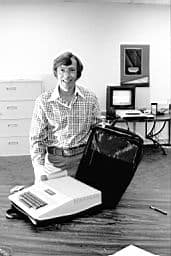
Mike Markkula at the Apple offices April 1, 1977

Mike Markkula at the Apple offices April 1, 1977

In 1977, Markkula brought his business expertise along with US$250,000 ($80,000 as an equity investment in the company and $170,000 as a loan) and became employee number 3. The investment would pay off for Markkula. Before Apple went public in 1980, he owned a third of the company.

Markkula also brought in Apple’s first CEO, Michael Scott, then took the job himself from 1981 to 1983. Markkula served as chairman from 1985 until 1997, when a new board was formed after Jobs returned to the company. Wozniak, who virtually single-handedly created the first two Apple computers, credits Markkula for the success of Apple more than himself. “Steve and I get a lot of credit, but Mike Markkula was probably more responsible for our early success, and you never hear about him,” told Wozniak the Failure Magazine in July 2000.


Excerpt of the TV documentary “Triumph of the Nerds” (PBS)

With the initial public offering on December 12, 1980, Jobs and Wozniak became multimillionaires, as Apple Computer was now valued at 1.8 billion dollars. Jobs possessed 7.5 million stocks (217 million dollars); “Woz” was assigned four million stocks (116 million dollars). Markkula’s share of seven million stocks was worth 203 million.

“I was worth about over a million dollars when I was twenty-three and over ten million dollars when I was twenty-four, and over a hundred million dollars when I was twenty-five,” Jobs said in an interview with Robert Cringley (”Triumph of the Nerds“) in 1996. “And it wasn’t that important because I never did it for the money.”

In the famous Playboy interview (February 1985) Jobs made also clear that money is not a primary motivation for him:

PLAYBOY: We survived 1984, and computers did not take over the world, though some people might find that hard to believe. If there’s any one individual who can be either blamed or praised for the proliferation of computers, you, the 29-year-old father of the computer revolution, are the prime contender. It has also made you wealthy beyond dreams—your stock was worth almost a half billion dollars at one point, wasn’t it?

JOBS: I actually lost $250,000,000 in one year when the stock went down. [Laughs]

PLAYBOY: You can laugh about it?

JOBS: I’m not going to let it ruin my life. Isn’t it kind of funny? You know, my main reaction to this money thing is that it’s humorous, all the attention to it, because it’s hardly the most insightful or valuable thing that’s happened to me in the past ten years. But it makes me feel old, sometimes, when I speak at a campus and I find that what students are most in awe of is the fact that I’m a millionaire.
When I went to school, it was right after the Sixties and before this general wave of practical purposefulness had set in. Now students aren’t even thinking in idealistic terms, or at least nowhere near as much. They certainly are not letting any of the philosophical issues of the day take up too much of their time as they study their business majors. The idealistic wind of the Sixties was still at our backs, though, and most of the people I know who are my age have that ingrained in them forever.

In the Forbes List of the World’s Billionaires (2011) Steve Jobs is ranked at number 110 overall and number 34 in United States with a net worth $8.3 Billion. However, Apple’s controversial stock options of 2001 have contributed to the Apple CEO’s wealth only on a small scale.

Pixar Logo (1986)

Pixar Logo (1986)

In the first instance, Steve Jobs has became a billionaire due to the fact that he had sold all of his stocks – except for one – after his dismissal from Apple in 1985 and invested five million dollars in the computer graphics division of George Lucas, which became Pixar later.

Within the following years, Jobs invested further millions in Pixar since the cartoon expert had to face a long dry spell. Jobs’ stubbornness paid off for him: with the initial public offering of Pixar in 1995, Jobs became a billionaire. As Pixar had been acquired by Disney, Jobs received a 6.7 percent share of Disney for his 49 percent share of Pixar. The Disney stocks alone made up about 4.7 billion dollars of Steve Jobs’ fortune in 2010.


Steve Jobs returning to Apple Computer (MacWorld Expo 1997 in Boston)

In 1996, Apple announced that it would buy Steve Jobs’ other company, NeXT, for US$429 million. The deal was finalized in late 1996, bringing Jobs back to the company he founded. He soon became Apple’s interim CEO after the directors lost confidence in and ousted then-CEO Gil Amelio in a boardroom coup.

Jobs was widely known for taking the $1 salary, a practice that had been in place since he rejoined the company in 1997. His salary was occasionally enhanced by valuable gifts such as a 90 million dollar Gulfstream jet. In March 2003, he was awarded 10 million restricted shares of Apple stock. The annual report of Apple 2007 noted that Jobs holds 5.5 million shares of Apple stock through a series of restricted stock awards over the years that have vested. But it also pointed out that he hadn’t sold a single share of Apple stock in the 10 years since he rejoined the company. His total compensation for 2010 was again the lone dollar, according to a Securities and Exchange Commission filing. He hadn’t sold any of his shares since 1997, according to the 2010 filing. He held no unvested equity awards.

Steve Jobs died on October 5th, 2011. His widow, Laurene Powell, will manage a $4.6 billion trust containing the 138 million shares of the Walt Disney Co. that Jobs acquired when he sold Pixar in 2006. The trust was Disney’s largest shareholder (January 2012) with a 7.7 percent stake in the media conglomerate. Jobs originally acquired the shares in 2006 when he sold Pixar to the company for $7.4 billion. At the time, Jobs owned more than half of Pixar’s stock.

iWoz Cover

iWoz Cover

Steve Wozniak had been less lucky when it comes to money. In order to finance a house and a car to the amount of two million dollars, Woz gave away many founder’s shares even before the initial public offering, which were worth much more by the IPO. 80 Apple employees who had left empty-handed in the company’s options program benefited from this so-called “WozPlan”.

When Wozniak abandoned his work at Apple in April 1981, he still possessed four percent of the Apple stocks, which were worth 70 million dollars at that time. A series of misinvestments and two divorces made Wozniak’s fortune diminish rapidly. However, he still should be a millionaire. By his own account, Woz is still drawing a small paycheck from Apple today and is still listed as “employee”.

Wheel of Zeus, Wozniak’ latest enterprise, in which he intended to develop and distribute a GPS positioning system for dogs, does not seem to be crowned by success either. By now, the company’s former web address www.woz.com redirects visitors to Wozniak’s private homepage www.woz.org. (Edited in June 2008).

Woz was more fortunate with his book iWoz, which has probably sold reasonably well and provided for several public appearances. Woz was a regular guest of Steve Jobs’ keynotes at the MacWorld Expo.


Authors@Google: Steve Wozniak

Updated January 2012
See also: The Legend of Steve Jobs – His Life and Career » Mac History.

Tags: Steve Jobs, Steve Wozniak, fortune, money, stock options, net worth, salary, Mike Markkula, Ronald Gerald Wayne, founders, IPO,

Tags:

Category: Apple People

About the Author ()

Leave a Reply